Transcript
What is it about strategy now that keeps producing these massive global revenue machines while other genres, especially when I'm looking at this action RPG simulation, are really suffering at the same time? It's a bunch of things, I think, compounding on each other. They have these really interesting and live ops and game events, the alliances, the the competitive events. These really create the durable engagement and retention. Monetization tightly coupled to the time and social competition. You really want to be able to to pay to win your wars, to not let your alliance down. That produces some pretty high LTV, which lets them fund really aggressive acquisition, makes the winners global. They're able to go to all sorts of different markets. And these these aren't things that we see in other genres a lot of the time. I guess the closest cousin that that comes to mind are some of the Chinese MMOs like Perfect World where guilds kind of near alliance obligation. There's cross-server PvP and some other scheduled conflicts that create these
epic moments. And relative power between players is an important motivation as well in in this genre as well. Of course, mobile MMOs never really jumped to the West. The MMO players here really prefer you know, PC console games like WoW and and Final Fantasy, it seems like. But I would I would say the lesson here is that what makes these 4X games work is not necessarily a 4X only special. That these lessons of reusable economic and social systems based on real player motivations are I I think they're working here in strategy first, but I think they're also applicable beyond strategy, for sure. I actually had a webinar today with AppsFlyer and we're talking about this. One of the panelists was suggesting that we kind of have this loop because the amount of money put in into advertising in North America creates this loop where the in-app ad revenue also increases in North America. And so, by feeding this loop, we're essentially feeding the machine that is self-fulfilling and thus there would be opportunities if you look outside that key North American market for growth and
and so forth. But like one North American market is is first of all that tier one West market is very familiar for most of the game developers is culturally it's kind of hard to make a game for a specific audience that is more of a niche. Like if you're making a game for Middle East, you better be from Middle East to make a game for Middle East.
[laughter]
Like it's um and the same thing goes for for the key Asian market, same goes for the European less because European and and and US audience has pretty much the same taste, but you know, Oceania isn't and so forth. So what I'm kind of like leading towards is when you make this this graph, are you saying that there are certain types of opportunities in certain regions where certain types of genres are doing particularly well and that could be interesting for a western developer or publisher? Yeah, I so I looked into this a little bit a little bit more and honestly at the high level, it's really just strategy puzzle and shooting that I'm seeing. Going to some little bit deeper,
there there's some interesting stories. So one is a interactive story actually in the US which is Love and Deep Space.
Yeah, made in China. that that's come out. Another interesting China game for sure. It's really interesting. It's the number one interactive story game by a mile, like 19X more revenue than the number two interactive story game worldwide, but that's not just worldwide. And if look at the US only, it drove five times more revenue than the number two interactive story game and that's typical like Asian well high production value 3D anime art style, but it's still you know, hitting in in landing in in America for sure. But what's really interesting about this game is the way it monetizes. It has these handsome anime men with whom player develops relationships through cinematic story chapters, has other gameplay like real-time combat missions, but the story content often the form of basically dates are attached to powerful items that are locked behind gacha events.
So that's kind of how this this game is is working and I found it really really interesting to follow since its release. Other stories, Battle Royale in the US, basically Free Fire has been doing really well here. Interestingly, it had some huge growth in the US over 2025.
It's now the number one mobile shooter in the US in revenue. They had a lot of major spikes alongside collabs. They collabed with Naruto is a really big one. And they had a release of a really rare cosmetic that did really well in terms of driving spikes. But the general revenue trend throughout the year was positive despite declining downloads and active users. So it's not something I haven't looked into a ton, but it it does seem like a really interesting story. One more thing, I guess. Survival in China, there's there's this game called Tomb Busters. It looks like Repo on mobile to a degree. It's a kind of a com- order comedy co-op extraction game, one to four players. A lot of the same social factors it feels like as Repo driving its success. So yeah, maybe maybe we'll see some of these social experiences jumping to mobile in the next year. With There are some other, you know, social games, of course, in in the West that are working, like Roblox chief among them. I mean, you mentioned it. So now I want to talk about China. So I actually uh
[laughter]
I covered this in in some charts in my previous presentation. I actually pulled it here. Look at this. Look at this slide. Look So
[laughter]
Oh, no. So yeah, my my presentations are
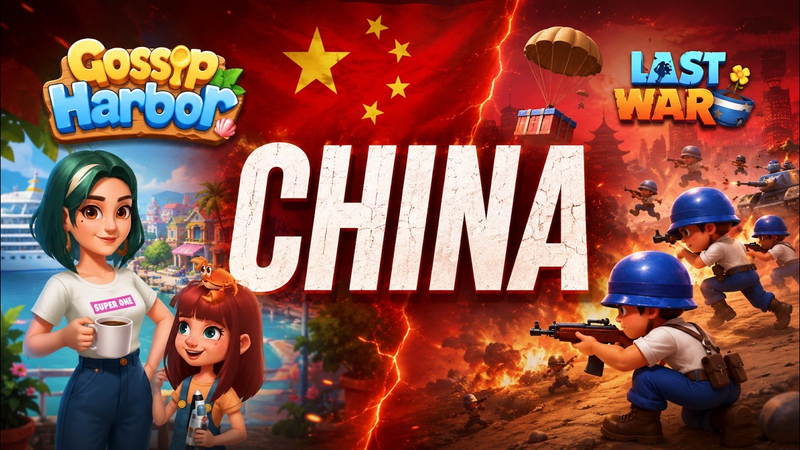
fun. But basically, what I'm when I was looking at it and and just really going through like the top 20 publishers, there's already what 11 or no, there's eight of them are coming in from China. And what's really interesting is that that there's doesn't seem to be any stop for this. And I used an example of Merge Two where the Finnish company Metacore with their Merge Mansion, they had the uh mystery puzzle game, and then came the Israeli Travel Town and kind of beat them and grew the market by by basically twice. And then the Chinese started coming in. Gossip Harbor that just beat Candy Crush. Insane growth to already. And then they released another game that was already doing better than than the previous number one. And now even Century Games, which is, you know, behind the King Shot and White Survival. They are also doing tremendously well in casual games. So, where I have a kind of tried to look at the the entire publishing and I worked for one, by the way, it'd be the best company I worked for. But anyway, it's still great workplaces. But when when
you think about why they're so good, they have these big team size, like really really big team size. They have the 996 culture of extreme, like they're skillful at hard work, which is you're not born with it, you just have to learn how to how to work hard. They're very pragmatic in terms of how they develop, so there's not that sort of a oh, we didn't invent it here and thus we can't use this mechanic. It's like no, this mechanic work, this works, this style works, we're just going to use it. Monetization, as you mentioned multiple time, it's at the core of the development and they don't have this sort of a almost like a stigma with monetization, we can't do this, we we can only do cosmetics, we can't do this, we can't do like no, you can do anything because monetization is the is the lifeblood of your game. This allows you to acquire users and stay on top. And then the approach of development factories where when they like a certain genre, they would just go with five teams against it and hope, you know, not hope, but basically put in the bets and the shots on goal, making sure that one of them lands, maybe even two, like we're seeing with
Century Games. And and final one is the structural advantage that they have. They do have a bigger target market. Like when you account for China, that's 700 players. I mean, they do play around with how do you calculate their population, but but assuming assuming the calculations are somewhat correct, that's 700 million players that we can't access to. So, I'm kind of going through these these elements, what does your data show and tell about how these Chinese publishers cracks the Western market so efficiently? Because it's not only about, you know, having more people. Yeah, of course. Thank you for this breakdown, this is actually really interesting for me to see. Working at at Sensor Tower, I get a lot of access to the data and so we know a lot of the what, but the why and the how is something that we we don't get a lot of visibility into. But yeah, looking at what's making Century Games so successful. By the way, if we're looking at more recent data like January, February, I think they're now our number two mobile publisher globally.
Yeah. Uh they're moving up. Which is which is pretty pretty insane. Cuz number one's Tencent. No one's ever Well, you know. Yeah, Tencent's just going to acquire them. But even when I was doing my presentation, that was last November. Yes. They were already twice the size of Supercell. And Supercell's Clash Royale hadn't even, you know, started declining rapidly at that point. Yeah. I mean, Supercell's also Tencent though, right?
Who are we kidding? Chinese company.
[laughter]
One other, uh I guess, element that I that I that I didn't see in the immediately in the the the six bullets that you called out there uh is just the UA strategy, I guess. So, looking at their downloads for for Whiteout Survival, Sensor Tower estimates 68% of their US downloads come from paid display, 15% come from paid search. So, they're absolutely scaling through UA. They have this whole strategy their ASO as well, which we mentioned later. But it's definitely scaling through UA and going through all these different creatives and having this huge like creative factories and finding these concepts that maybe Western companies are a little bit shy of.
Yes. They're willing to lean into that,
for sure. Programmatic. Yes. Also, just talking about the monetization, yeah. I think I mentioned this a bit before, but players really motivated to monetize with alliance pressure peaking with these huge monthly inter-server PvP events creating huge LTV. It's it's a flywheel, you know. They they have this huge deep LTV that they're getting with their live ops. Really executing on the UA side as well. Art style, obviously universally readable and appealing, kind of reminiscent of Supercell in some ways. And yeah, like you said, they they didn't just double down on Whiteout Survival. I think FunPlus' Last War Survival, they they're kind of really all in on Last War, but Century Games, they launched King Shot, which is the top game by 2025 revenue growth, expanded into casual with Match Merge 2, Tasty Travels. And yeah, now they're now they're number two overall. So, you really really interesting story to watch with with Century Games for the past couple of years. And there's a lot of competition between these Chinese public let's just just take strategy as an example. Like you can see even the competition. Now, we talk about Century
Games. What 3 years ago we would be talking about was it Rise of Civilizations or what was that? Lilith, right? Rise of Kingdoms. Yeah, yeah. Like new comes in, the previous goes down. It's it's really really interesting. And Yeah. I I don't know. Like how do you succeed against these companies? Cuz like yes, they they are really great at strategy, but now they are crushing casual with merge two games. When are they going to be owning match three? Like what? By summer? We'll see. I don't know. That's a that's a pretty high mountain to climb. It's a tough question. I feel like a lot of things you brought up in in in your slide are kind of tough to match from a Western perspective cuz a lot of this is is on the the execution side. You know, creative iteration volume, live ops cadence. These publishers are really good at finding concepts that convert whether it's in in strategy or or in match and scaling them across different markets. All these games are not just big in
Asia, they're able to penetrate America and Europe and these tier one Western markets. They're able to keep pressure on long enough to compound. They're able to use a lot of these UA and a lot of these tactics, you know, the 996 and so forth that maybe Western publishers aren't or or can't do. Beating them, it's it's it's a tough question cuz you can't really do a lot of the same things that they're doing. Why? I mean I would when you when you break it down like yes, they they Yeah. they will beat you on cost of talent. So, that allows them probably to scale bigger. But at the time like European titles not that expensive and Chinese titles is actually not that cheap. So, you probably can find a happy medium where you can scale. They will beat you on content volume just because of the amount of work they can do and the team size. They will beat you on iteration speed. Like we see them They they don't they don't do these like, you know, let's let's ship an update, take a break, think about what it comes next. It's like, no. Even even
with what I remember like working at FunPlus and working on strategy games, the way the teams were structured was very different that I had used to. So, it wasn't like one game team. Really? It was multiple games, but the live ops and marketing was its own team. So, they would do live ops because the engines are same. So, they would do live ops across the portfolio from from that central team. I believe Zone adopted that type of a tactic cuz they were being looking at the the way the Chinese are working. So, it wasn't even that like you had the creative lead and they do the things inside the game and they're kind of siloed and they're supported by marketing. It's like, no, there's the publishing team and they are running these things across portfolio and and that allowed the learnings to go really fast and also moving the events from from one to another and trying at a bigger audience because you have multiple different games that are essentially same products. And and again, like the Yeah, and the final part is like technological advantage. I know everybody keeps talking about AI, how
it's giving this, how it's giving that. Chinese are using AI a lot. And they have proprietary models inside these companies. Like whatever you're thinking, they already doing it and they're doing it cheaper. So, how do you compete against that? What's coming to mind I guess is like the latest big really Western hit was like Monopoly Go which brought this coin leader thing to the market, had a bunch of different new things attached to it using the the IP and finding a loop that really allowed them to to monetize really well in in in the coin leader genre.
[music] [music]
Auto-generated captions from YouTube — names and numbers may be misheard.




















Comments