ReportInvestGame
From Volatility to Stability: Q3 2024 Gaming Deals Report
202424 pages~17 min full read
Key insights
7 slides
Where money goes
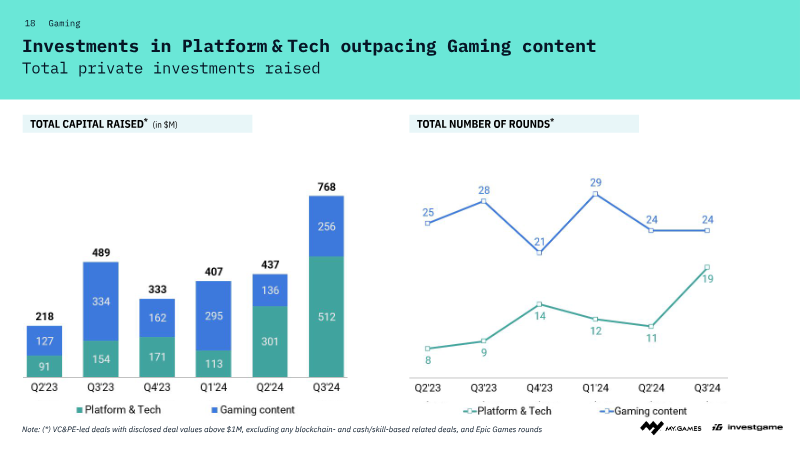
Capital increasingly flows toward platform and technology sectors.
Investor focus is shifting away from traditional gaming content. Capital increasingly flows toward infrastructure, payment systems, and development tools.
Studio funding
Early-stage venture capital remains consistent while late-stage faces headwinds.
Within the gaming segment, early-stage venture capital remains consistent. Late-stage fundraising continues to face significant headwinds.
Page 10 of the reportQ1'20381
Q2'2042
Q3'201,710
Q4'20381
Q1'21730
Q2'211,323
Q3'211,234
Q4'21937
Corporate partners
Corporate venture capital frequently co-invests with traditional venture firms.
Corporate venture capital has emerged as a vital component of the ecosystem. It frequently co-invests with traditional venture firms to support studios and tech providers.
Page 14 of the reportQ1'20211
Q2'2012
Q3'20330
Q4'20163
Q1'21261
Q2'211,185
Q3'21720
Q4'2167
Public listings
The quarter saw the first initial public offering in two years.
Public markets remain under pressure, but the quarter saw the first initial public offering in two years.
Page 7 of the reportQ1'200.3
Q2'204.6
Q3'204.7
Q4'205.4
Q1'218.7
Q2'218.5
Q3'214.2
Q4'213.1
Revenue divergence
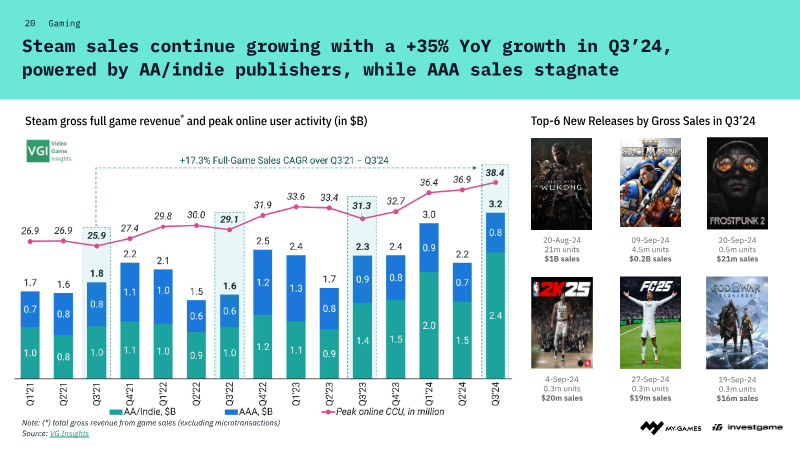
AA and indie publishers drove 35% year-over-year gross revenue growth.
Steam sales data reflects a divergence in performance. AA and indie publishers drove a 35% year-over-year growth in gross revenue, while AAA titles have experienced stagnation.
Geographic hubs
North America and Western Europe remain the primary investment hubs.
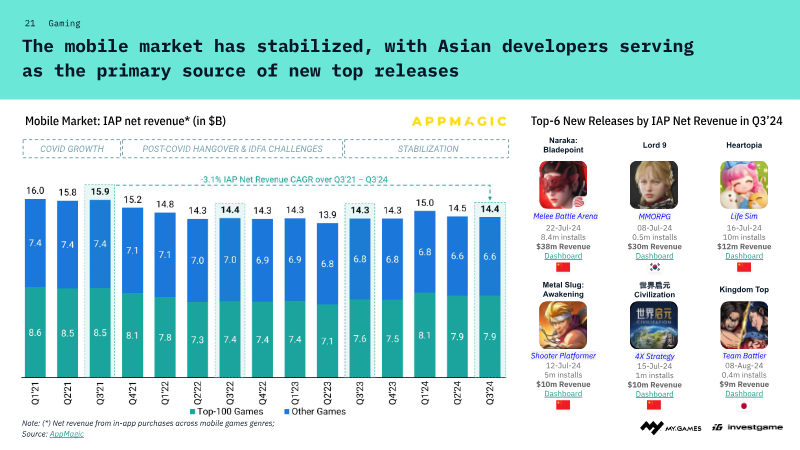
North America and Western Europe remain the primary hubs for investment activity. The mobile market continues to rely heavily on Asian developers for new top-performing releases.
Resilience
The broader ecosystem is finding stability through diversified investment.
While the gaming sector faces ongoing challenges in late-stage funding, the broader ecosystem is finding stability. This comes through diversified investment in gaming-adjacent technologies and a resilient indie development scene.
1 / 7
Ask AI about this report