1 free read left. Create a free account for unlimited reading + AI research.
Create free accountWhitepaper DiGRA
1 free read left. Create a free account for unlimited reading + AI research.
Create free accountWhitepaperDiGRA
The study compared Lineage and EverQuest, two massively multiplayer online role-playing games with physically similar design and technology.
This study compares how two physically similar massively multiplayer online role-playing games, Lineage and EverQuest, acquire markedly different meanings depending on how their players perceive them. Lineage players tended to regard the game world as an extension of everyday social life, using it to express identity, form relationships, and conduct economic activity, while EverQuest players viewed it primarily as a fantasy product to be consumed for experiences such as exploration and goal achievement. The authors argue that the value of digital content is thus shaped by its consumers rather than solely by its designers.
The research draws on surveys of roughly 4,786 Lineage players, predominantly male and averaging about 20.6 years of age, and approximately 4,000 EverQuest players, averaging about 25.6 years old, with EverQuest data partly drawn from a prior study by Yee. The analysis examines reported motivations, satisfying activities, character creation priorities, cross-gender character ownership, and attitudes toward in-game romance and friendship. Lineage respondents placed greater emphasis on character names and social interaction, while EverQuest respondents prioritized character ability and leveling.
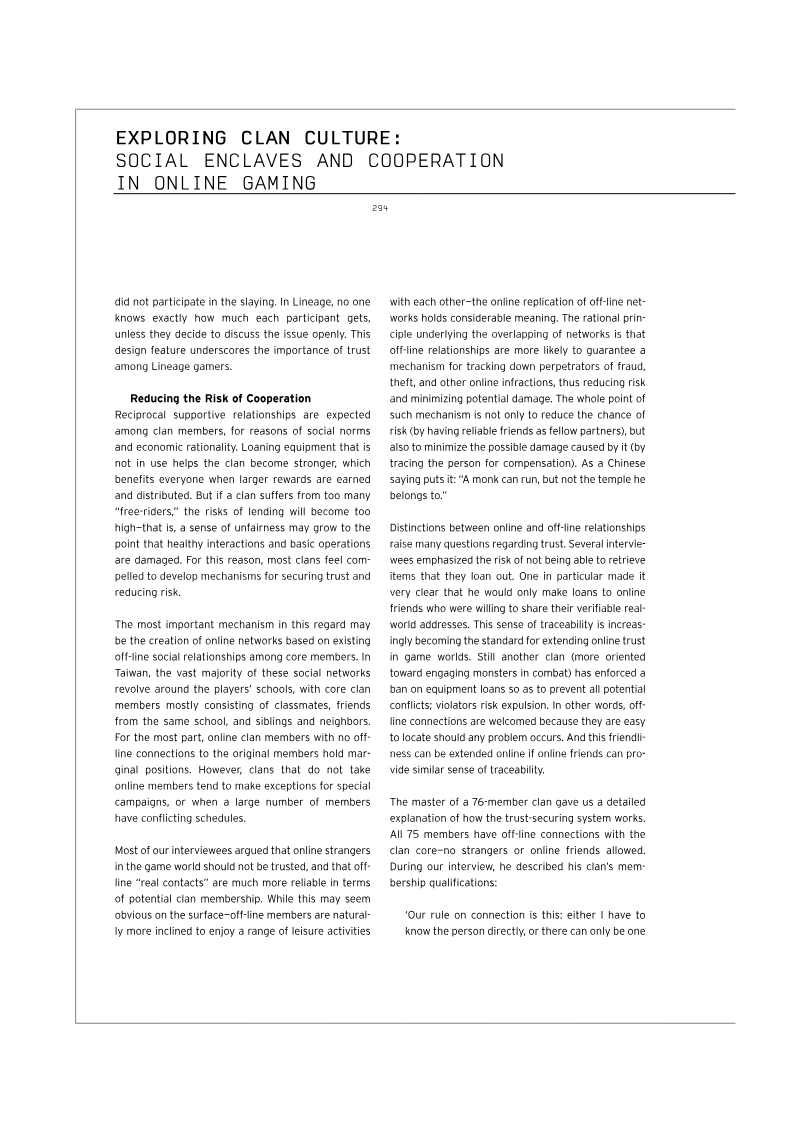
Behavioral differences were also pronounced. Roughly 57% of Lineage players belonged to clan-style blood pledges oriented toward castle sieges and hunting, compared with about 82% of EverQuest players in guilds, though EverQuest players showed higher participation in guild events. Lineage respondents were far more likely to consider in-game romantic relationships comparable to real ones, and 43% reported trading items for real money, with 96% believing they owned those items despite company prohibitions. The authors conclude that identical design and technical features can yield fundamentally different virtual worlds through divergent player understanding and consumption patterns.
Each row is a game or company this document names, each column a document, oldest first. A mark means that document names it. Select a row to see those documents.
DiGRA · 2018
DiGRA · 2018
DiGRA · 2018
DiGRA · 2018
DiGRA · 2018
DiGRA · 2018
DiGRA · 2018
DiGRA · 2018
DiGRA · 2018
DiGRA · 2018
DiGRA · 2018
DiGRA · 2018
DiGRA · 2005