1 free read left. Create a free account for unlimited reading + AI research.
Create free accountWhitepaper International Journal of Serious Games
1 free read left. Create a free account for unlimited reading + AI research.
Create free accountWhitepaperInternational Journal of Serious Games
Digital Game-Based Learning (DGBL) currently faces a significant crisis of empirical validation, characterized by a pervasive lack of methodological rigor that undermines its perceived educational value. While the field spans diverse applications—including mathematics, language acquisition, health behavior, and cognitive development—the existing body of research fails to provide conclusive evidence of effectiveness. This failure stems primarily from inconsistent study designs, inadequate control groups, and the frequent omission of critical variables such as participant assignment methods and specific gameplay composition. Without a standardized framework for evaluation, the industry struggles to justify the financial and pedagogical investments required for widespread implementation.
A systematic review of 25 representative studies reveals that small sample sizes and the presence of confounding variables, such as instructor influence and the integration of supplementary materials, frequently obscure the actual impact of the games themselves. These methodological shortcomings prevent researchers from isolating the specific benefits of digital interventions, rendering the findings largely non-generalizable. Furthermore, the absence of pre-testing and the use of non-validated measurement tools create a fragmented landscape where results cannot be reliably compared or replicated across different educational contexts.
To advance the field, researchers must transition toward a more disciplined approach that prioritizes standardized evaluation frameworks and robust statistical techniques. Establishing clear, replicable research practices is essential to move beyond anecdotal success stories and toward a data-driven understanding of how digital games influence learning outcomes. By adopting rigorous learning analytics and consistent reporting standards, the industry can improve the validity of its claims and provide stakeholders with the empirical evidence necessary to support the long-term integration of game-based tools in formal and informal education.
International Journal of Serious Games · 2023
International Journal of Serious Games · 2022

International Journal of Serious Games · 2020

International Journal of Serious Games · 2020

International Journal of Serious Games · 2020
International Journal of Serious Games · 2020
International Journal of Serious Games · 2020
International Journal of Serious Games · 2020

International Journal of Serious Games · 2020



International Journal of Serious Games · 2020

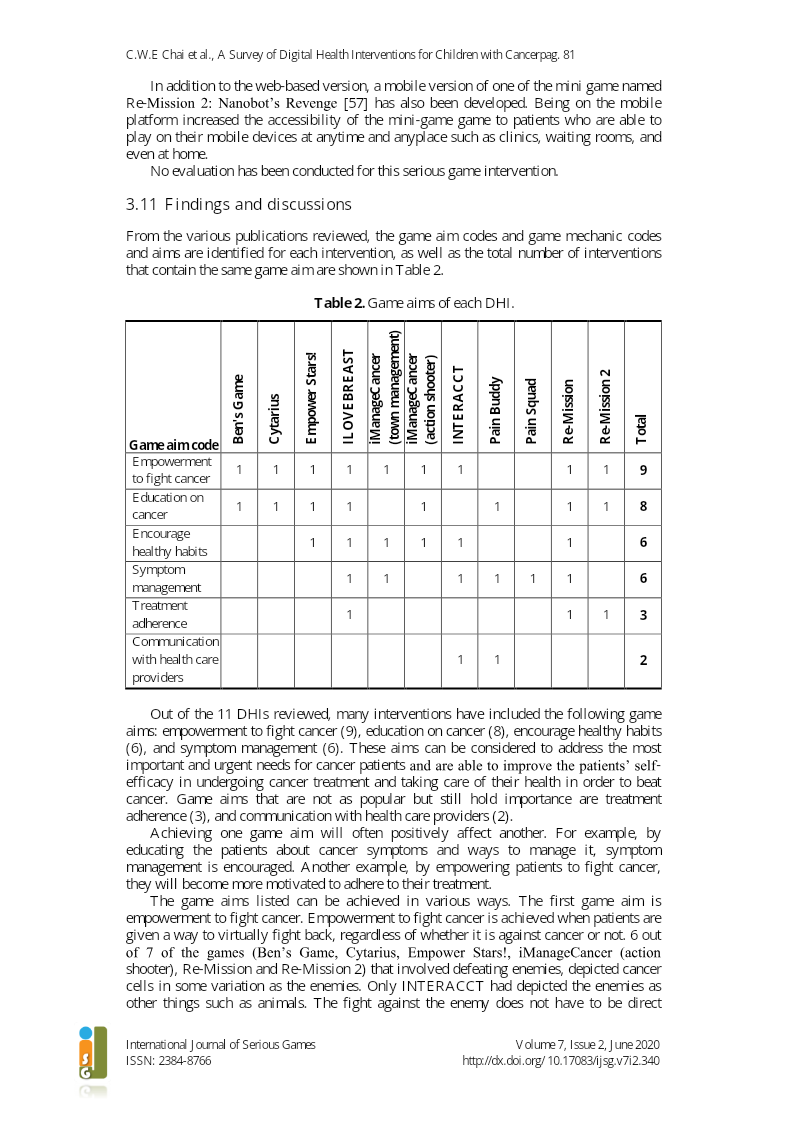

International Journal of Serious Games · 2020
Air Force Institute of Technology · 2020
Institute for Educational Technology · 2019