1 free read left. Create a free account for unlimited reading + AI research.
Create free account
Superstar Session: Uncover Opportunities & Expand Your Portfolio by Understanding Gamer Preferences
Key insights
6 takeaways- 01Core games, specifically strategy and RPG titles, generated nearly 50% of global consumer spending during the first half of 2020.
- 02Regional market preferences are distinct, with U.S. consumer spending heavily driven by casino games, while Asian markets lead in action RPG revenue.
- 03While hyper-casual games lead in total download volume, core games command the majority of total time spent by players.
- 04Battle royale titles maintain significant engagement depth despite accounting for only a small fraction of total mobile game downloads.
- 05Social features such as chat and multiplayer functionality are primary drivers of success and growth for casual titles, as demonstrated by the performance of Among Us.
- 06Developers can reduce portfolio risk by using cross-app affinity analysis to identify shared user bases and validate the viability of hybrid monetization models.
Ask AI about this video
Transcript
and we're gonna dive straight in straight into that second talk uh which will be given by two people from at annie uh i would like to welcome to our virtual stage uh june you and lexi siddow i hope i pronounced those names right so please come in and they're gonna talk about undercover market opportunities and expand your gaming portfolio by understanding gamer preferences it's a long title but definitely interesting topic welcome hello hello mateen hi whenever you're ready feel free to start is my screen live yes i can see it okay great great okay so good morning everyone welcome to pocket gamer connects and welcome to the
anthony session understanding understanding gamer preferences i'm jinder from apani and today i'm here with my colleague lexi we are really excited to present some of the latest and most unique game industry insights from athany to uncover granular market opportunities and top performing game features today we'll also show you highlights from game iq which is a product we launched back in september and this is a product that was designed specifically for games companies and so before we start here is a quick disclaimer about our data and presentation okay so we will start with a simple introduction of ourselves and our company my name is jinder i'm the general manager of gaming and apani i've been at apani for over seven years today based out of our singapore office which is one of our 12 global offices and throughout my career i've worked with lots of game companies globally across market data analytics demand and monetization and also today with me we have lexi
hi everyone i'm lexi sedo i am a senior market insights manager at appiani and i actually just hit my five years at the company um i think last week great great great to hear and here's a quick introduction about apani company we are the mobile performance standard through our mobile data and insights platform we help create winning mobile experiences for those aspiring to achieve excellence and here are some of the global companies that trust in our data products and teams so moving on to today's presentation we will cover three main parts first i will do a short introduction of our game iq product and lexi will go on to present some of the most unique and granular game insights and finally we will present some customer use cases of game iq okay let's get started so game iq is a game changer for the mobile games industry it provides a detailed taxonomy that allows us to break down every market publisher and app to analyze areas of opportunity
and reasons of reasons for success so apparently game iq consists of two major parts taxonomy and tags so here's a quick overview of taxonomy basically we've taken this a few steps beyond the existing taxonomies on the app stores by classifying games into granular and up-to-date sub-genres for instance on the app stores today extinct exonomy you would have the puzzle genre but here we've broken it down into further sub-genres like bubble cardboard hidden object match three matches plus build physics based and so on next what about what happens inside of game inside the game we've grouped it into five main types of tags and here we show examples of three types of tags here monetization art style and gameplay so under monetization you would have examples of tags like does this game contain advertising or battle pass vip subscription starter packs and so on so when we put all these together this is how it would look like
at with an app so let's look at this app that is marvel strike force by scopely under the existing taxonomy this will be categorized under the role playing category and with game iq this is firstly a core game then it is a rpg game then it is a specific turn based game with all these 18 tags across art style gameplay features monetization and even tagging it with the marvel ip so this sums up our game iq offering at the app level and you will get a lot more amazing insights at the publisher level country level sub-genre level and so on so with that i'll hand it over to lexi to take you through the insights okay thank you agenda i'm i am okay all right okay um so i'll take you guys through now a bit of the insights that we have from our game iq product um so there's a lot of great stuff that we've been able
to derive from here so this is just a little bit of a taste of what's available um so what we could see in the first half of 2020 is um so kind of to look at this chart there's a lot going on but basically the pink is core games the casino games are that darker purple and then the middle purple is casual games but we can break that down into all of these different genres and sub genres um so what's really interesting is that of all consumers found in the app stores um strategy and rpg specifically uh drove nearly half of all global consumer spends so we've highlighted rpg um as well as strategy the other thing that we can see as well is we can start to take some of those sub genres so that's that kind of third layer of depth uh we can look at sort of how they've grown globally um and look at that kind of growth factor of that of the spend um from h1 2019 to h21 2020. and what's really interesting is that we see all the different um sort of higher
levels represented so there's the pink again is core the darker blue is casino and then the purple is um casual but we can see which specific sub-genre within core was you know seeing some of the most growth or contributing some of the largest growth um and so that shows you kind of a deeper level that you would not get just by looking at say core as a whole what's also interesting is that we see that um simulation and then going further into sandbox um also had a strong growth here and what we want to call out is that you know this would include games such as roblox which in the app stores is categorized as adventure but we've taken it multiple steps further to kind of give you that more granular insights here so this is another great view um i really love this one so we're looking at two things here this is sort of a quadrant view um to help you sort of visualize a bit more of the emerging trends in the space so on the y-axis we've got average time per user so that's that depth of
engagement and then on the x-axis we have active users and we're looking at the growth factor here so there's a couple things to call out the first is that we see um within the casual genre puzzle sub-genre and then um excuse me casual tuning puzzle genre and then cardboard um sub genre we see that they've seen phenomenal growth in active users to really reached um a large audience and seen growth coming from the kind of average performer quadrant as a sub-genre overall into the challenger space we see a similar trend for sandbox sub-genre which falls under the casual overall umbrella uh we again move from average performers a sub-genre into the challenger's space and then one of the big um sort of large trends we've seen this year is just the growth of battle royale especially as people have been kind of hunkered down at home and looking for things to connect as well as entertain up to stay connected with your friends so we see here that as a sub genre
battle royale within core overall um kind of broke out saw a greater depth of engagement as well as breadth of engagement um and broke out of that kind of niche player into an attention leaders space all right um this is another there's a lot going on here but basically this is a really cool view i really love looking at some of the differences among uh regions as well as countries what's really interesting is that we start to see so this is um this is looking at kind of the one of our main tags that we have so there's a theme and setting tag that we're able to look at with game iq um and what's really interesting is that in the first half of the year um across all the markets analyzed here we see that fantasy games actually overall was one of the main themes or settings of games that people um were downloading from new games which makes a lot of sense since a lot of us might have been stuck at home uh during a lot of coveted lockdowns and looking for that escape what's really interesting is that you see um among all of these different markets um the differences in what type of
fantasy games people are playing so it's not enough just to say okay there's you know we're all playing these different types of fantasy games there's a very big difference on what those games are from brawl stars in some markets to pokemon go or coinmaster they're very different types of games and we also start to see those trends like different uh themes and settings emerge under different markets right casino gambling is big in the us we've got sports and soccer showing up in brazil and we see that kind of play out over many different markets here so there's those differences at play we also can look at the kind of buckets of games uh both kind of multiple things happening here we're looking at it by how those games uh played out in say a certain time period like h1 by downloads um by time spent and by consumer spend and then we're also able to see how those differences are in a market level so downloads is the first chart here where it's mostly casual games dominating the most downloaded games for that time period um
across most markets we start to see in time spent that core games start to really over index a bit more than they are for downloads and we also see especially in in apac markets that core represents a greater portion of overall time spent and for consumer spend it's a much different story right we still see casual showing up but core is the bulk of most markets um for driving consumer spend and really is the alliance share in markets like japan south korea and indonesia and i'd also like to call out on this slide if we looked at the us um casino represents 22 of overall spend yet only about uh four percent of downloads in the in the first half of the year so those are some key insights to know for those specific markets this is another uh really amazing thing we were able to do we're able to slice and dice by our tag so as jimmy mentioned before we have monetization method um tagged for all of these different games and we're able to look at that
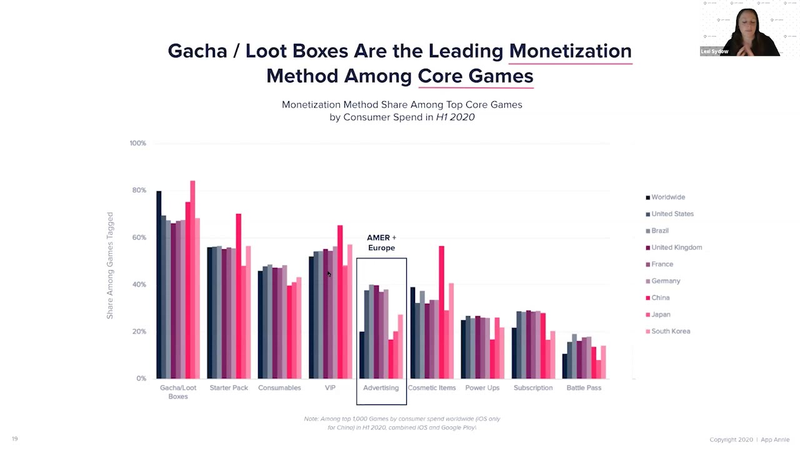
within the realm of core so if we want to get very specific looking at modest monetization methods among core games there are a couple of things i'll call out in this view the first is that among core games actually um gotcha loot boxes are the most prevalent monetization uh method used across nearly every market here um what we're also able to see is that we do see advertising is is something that um we're starting to see this um sort of the um hybrid model emerge here um and we'll touch base on that a little bit later but obviously you would expect that not to be the bulk for most core games then we can look at this and how how the spread how each country sort of looks so one thing i'll call out um that's noteworthy is just when we look at china um we're able to see you know that they over index and use uh certain monetization methods more in core games and other markets so things like starter packs or vip or cosmetic items um they definitely over index relative to the rest of the markets we're looking at here and the global sort of average which is
that dark blue bar here and then the last thing i'll leave you with that's also very interesting to look at is is just that in-app advertising space right so these are the hybrid models it's it's using ads as well as um you know other mechanics because these are the top charts by um the top core games by consumer spend so these are both in-app purchases and then also we're seeing that in america and europe um that there's a lot more of an inclination to incorporate in-app ads alongside traditional in-app purchases within core games that's not necessarily the case in the in china japan or south korea as you can see in this chart but it is a trend to keep note of um and one that we have seen growing in this space all right and then this is a quick view i'm looking we're able to see there's some great maps that can visualize some of some of the sub-genres and genres within game iq so what we're able to see is that for hyper-casual apps um excuse me hyper-casual games we're
able to see that the us is number one market for downloads yet only commanding about a 15 share of total downloads in h1 um also number one for consumer spend but equating to about 40 of overall consumer spend and then we can see um this is of the most downloaded games were able to see where those games were published so for most markets um the most downloaded games came from french publishers in h1 and we can look at that view for a slightly different genre or sub-genre like city battle games where really we're able to see a slightly different spread as well as looking at the publisher hq of those games and the bulk of them actually do come from china for most markets that we see what's interesting is there is a little bit of homegrown apps taking a bit more of the space for the us as you can see in the purple bar here so i'll leave you with just a few key findings and hand it back to agenda so basically one of the key things we
saw on h1 was that there were over 5 billion downloads of hyper casual games globally we also saw that over half of time spent in top games was in core games which is a testament to how mobile is a very competitive gaming platform at this point in time as well as the increased um sort of casual gamer that's starting to dabble in a bit more of the core genres of games we also saw that for casino games consumers spend grew 40 percent year over year in h1 and we saw that 20 of the total time spent um in the top mobile games by mao um was in battle royale games despite those games only representing three percent of downloads um so battle royale really punching above their way for engagement and then we also saw that eighty percent of total consumer spend um in action rpg games came from apac markets um so definitely driving the lion's share of of engagement and spend there
and i'll pass that back to jenna thank you so let's go on to use cases so firstly let's take a look at some in-game elements that result in the success of the game so in the third quarter of this year there was a huge growth unicorn amongst casual games it shot up from the the left bottom over here all the way to the top right over here and to emerge as the top download the game globally for both downloads and revenues i'm sorry for both downloads and active users so who amongst us knows this game yes and it is among us okay so a key contributor to the success of this game came from the social features so firstly we see that this game has got chat and multiplayer tags amongst all the gameplay features and to note these chat and multiplayer are not common
occurrences in casual games but of course they are very common in in the core games and the importance of social here is also supported by this summary of the top keywords from all the favorable app reviews in the us so you can see that the friends theme does come up a lot especially from people who enjoy the game and give it a high rating next let's take a look at how these social features impact what happens inside the game here is a quadrant chart that's generated by the app insight generator and on the left you see this list of all the gameplay features that we have and we map all these out on this chart of usage thickness which is measuring open rate against the average active place so you can see that games containing social features like friend invites mmo chat and social assists appear on the top right quadrant these features are part of the success equations of games that have high usage thickeners and as lexi mentioned just now high
usage usually also leads to high revenues either via ad monetization or in-app purchases so the same chart but we look at this same quotient chart but with this time revenues against active users so you can see that features like chat multiplayer friend invites and leaderboard are also part of this success equation for apps that have high usage and high monetization and additionally what we've also noticed about among us is that it has very high affinity with gen z the the gen z user demographic we've observed that users of among us also have a high cross-up affinity with apps of other gen z-heavy apps like discord google classroom twitch and line webtoon so all these numbers you see on screen they're basically talking about for instance the first app discord is a slightly over three it means that users of among us are three times more likely to also use uh compared to the general population to also use this chord
so finally here's a view of other top performing casual titles with social features on the left we see a chart of top casual games with social features ranked by downloads and on the right it's ranked by consumer spend so aside from impacting downloads and consumer spend i also think it's contributed to the longevity of titles and i uh longevity of titles and ips like subway surface which has actually been around since 2012 and also other titles like magic magic tiles talking tom roblox and more okay so moving on to the second use case which sub-genres to expand to so this use case came up in an interesting webinar with outfits 7 a few weeks ago they were looking to expand to other soft genres following their massive hits in the tamagotchi sub-genre so let's take a look at this chart which they did internally so they were looking at the cross app affinity and the
cross app usage of my talking tom versus all the other sub-genres of games all the games in the world so all these dots on the chart great dots on the charts here it represents games that the users also play so an app that appears at the top right here would have high affinity and high cross app usage with my my talking tom so they had a hypothesis that talking com users would have high affinity with match 3 gamers but when they loaded the game iq data they observed this so firstly the red dots represent match 3 which are at the bottom left of the chart which means that there is low cross affinity and low cross usage instead arcade runner games and of course their own tamagotchi games scored high on this cross usage chart and affinity chart so they were able hence to decide on runner games against match 3 games another example which they called it the crazy ideas example was that ipad data was also used to validate
crazy ideas at alphabet 7. so in this case their crazy idea was to marry this coinmaster game which is a which is a hybrid casino game with high distribution with covered fashion which is a casual game that has high monetization so they looked into the affinity data between these two sub-genres and it turns out that the in terms of the cross usage is only just five percent between these two sub-genres which ranks it as 39th out of a possible 104 sub genres in terms of the affinity this ranks at 2.4 x which is ranked at 8 58 out of 104 sub-genres so they killed this idea they killed this crazy idea and we won't see this mining fashion tom hybrid game anytime soon okay so with that we've come to the end of our sharing today and this is a quick summary of what we presented firstly the latest market opportunities by the granular sub-genres we've also broken down some in-game
elements of the recently successful casual games and finally we explored some opportunities for expansion not just by market size but also by looking into what your users also play so thank you for everyone's attention today here's a couple of links where you can get more information about our products and our industry reports so thank you and we move on to the question answer session yes yes indeed first of all thank you so much for yet again a very insightful talk um i always love using using annie uh for for insights um and uh yeah we do have a couple of good questions came into qa and we do have a few minutes left for them so let me start at the top uh joe is wondering how realistic of a threat to annie's business model is apple and google's offering of more fine-grained app classifications and insights i think it's a little bit different i think apple and google they provide they're more of a b2c model and i think
for consumers just understand the current taxonomy is good enough for consumers and what we provide is more for the b2b space for for people to analyze the market sizing and so on so i think it's different need yeah all right um and then someone who kind of has a question about the use of your tool uh by experience what is the learning curve for developers to get used to the more detailed classification um to be honest we already work with a lot of developers globally i mean like playtaker rovio igg ea and so on um so i think the i think for a lot of the sophisticated developers they had already been developing their own taxonomy even before we did you know so so this there was always they already saw a need to go into more granular subcategories and i think as for the the other developers who have not kind of looked into this
with app annie i think i hope that this presentation is a kind of an easy step up into introducing you know um i mean it's like everyone's talking about hyper casual these days and for aspiring developers developer they might think they might think you know okay i should do hyper casual because everyone's talking about it and now it's only all the french developers doing it i should do something for asia or something you know but hyper casual is so big if i'm trying to monetize buy a video ads or i'm trying to monetize buy iep or some i'm trying to monetize via starter packs or so on uh which type of type of casual should i make i think that's um i think that's the kind of entry level use case that we can solve and with that it's easy to to get to more advanced levels all right definitely i'll add to that and just say that the data is it creates this type of classification i found it's very um fun as well as you kind of saw with some of the examples like like what gender was saying with outfit seven is they they came with a crazy idea and they were just like let's see
let's see if this would surprise us at work and i think that that's what um is actually quite fun about this type of rich classification data is you can start testing really interesting um granular and detailed hypotheses and you can start playing it out um with our data so that you're you know as a developer you're not spending your resources and money developing something that you you know haven't sort of tested within the realms of of data that could show you an indication um so i do think it's i don't feel like there's that big of a learning curve i think it's more it's exciting and it's actually quite easy to get your hands into it because it's so um there's so much so many possibilities definitely still sounded like a great game concept to me by the way all right um next question is can we get um about the regulations in different uh parts of the world uh with gacha and loot boxes having some legal issues in some regions what geos took best advantage of this monetization
model i think with gacha has actually been around for quite a number of years and is still around now and um it's adopted in a lot of core games and it's quite global in terms of the the uh penetration and how consumers are able to understand it i think in some big markets so having said that it's global but i think some big markets like china they're starting to come up with some legislation around it like in china i think they the the guideline is that you must state what is the what are the odds of getting something and what will you get so it's less of a you know blind gamble you know so you know what you may get or may not get and what the odds are so that's uh i think how some countries have gone about it and in terms of i think i think what's uh what's been uh what i've what has come up on my radar a bit more in in some countries like china india it's a bit more of the which could you know have which is kind of like what you say uh here jio's taking advantage of this is in the area of real money gaming or cashback games
that's why we've been hearing a lot more and we think there might be some regulation and guideline coming up soon to regulate this as well let's see yeah and i think our last question for today is also kind of a little bit hooking into the the question of regional uh data um is did you see any changes on the data with issues uh in india you know relating to the pubg being blocked yes of course i mean uh our data is sourced from from i mean from developers and our panels globally so if people stop using the apps because the apps cannot connect to the servers because of local legislation or blocks then we would register no data for those so we register no downloads if they're pulled off the stores and we register no usage data and revenues if um the access is blocked of course but of course there are still users who you know find their ways to get get around these products sometimes in
some areas exactly all right um i think we are also uh out of time for uh for this session so i'd like to say a huge thanks to both of you for sharing all these insights you
Summary
This session explores how granular market data and refined game taxonomies enable developers to identify growth opportunities and optimize portfolio expansion. By moving beyond broad app store categories, the analysis emphasizes the importance of classifying games by specific sub-genres and in-game features—such as monetization methods, art styles, and social mechanics—to understand the drivers of player engagement and revenue.
Key findings from the first half of 2020 highlight that core games, particularly strategy and RPG titles, account for nearly half of global consumer spending. While hyper-casual games dominate in terms of download volume, core games command the majority of time spent, with battle royale titles demonstrating significant engagement depth despite representing a small percentage of total downloads. Regional analysis reveals distinct market preferences; for instance, casino games represent a significant portion of U.S. consumer spend, while Asian markets lead in action RPG spending. Furthermore, the data indicates that social features, such as chat and multiplayer functionality, are critical success factors for casual titles, as evidenced by the rapid growth of games like Among Us.
The methodology relies on a proprietary taxonomy that tags games across multiple dimensions, allowing for cross-app affinity analysis. This approach helps developers validate strategic hypotheses, such as identifying which sub-genres share user bases or determining the viability of hybrid monetization models. By analyzing cross-app usage patterns, developers can make data-driven decisions regarding portfolio expansion, effectively filtering out high-risk concepts that lack alignment with existing player behaviors. Ultimately, the analysis suggests that success in the mobile gaming landscape requires a nuanced understanding of how specific in-game elements correlate with user retention and monetization across diverse global markets.















Comments