1 free read left. Create a free account for unlimited reading + AI research.
Create free account
Success Bi Design: How we Embraced What we Knew (in a Field we Didn’t) to Achieve Success
Key insights
6 takeaways- 01Founders can overcome a lack of technical expertise by retaining intellectual property while outsourcing development to specialized partners, such as the Finnish firm Kaos Games.
- 02The four-pillar startup framework—hipster (design), hacker (coding), hustler (sales), and hound (research)—provides a structured approach for non-technical founders to manage game development.
- 03Initial attempts to bridge technical gaps through local outsourcing and equity-based partnerships were unsuccessful, highlighting the importance of vetting technical partners carefully.
- 04Lean operational strategies, including using platforms like 99designs for visual assets and A/B testing on social media, allow for rapid validation of design choices.
- 05Market research should be segmented by demographic, specifically targeting 18-25-year-old Android users, 18-30-year-old Apple users, and high-spending users over 40.
- 06As of 2019, Dark Horse Digital successfully launched a Minimum Viable Product (MVP) on the Google Play Store that achieved distribution across 96 countries.
Ask AI about this video
Transcript
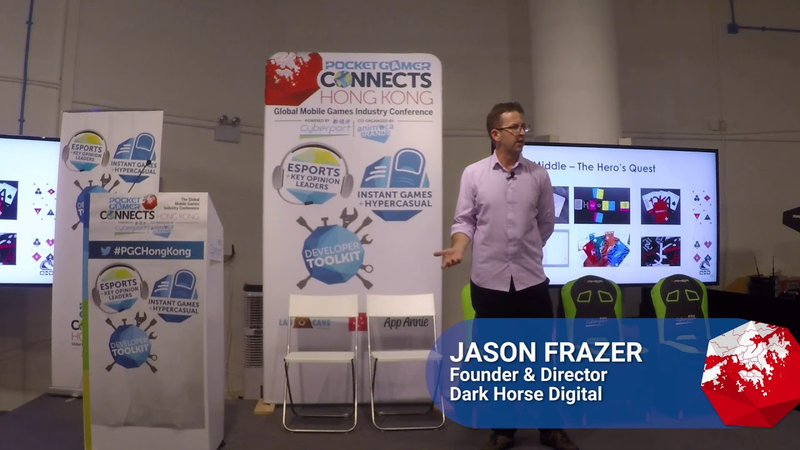
[Music] hi everyone my name is Jason Frasor and I'm here to take you through our presentation today on how we embrace what we knew in a field that we didn't to achieve success so this is the audience interaction part which seems to be an issue today can I just very quickly get a show of hands for those of you who are here if you've built a game built and released a game just raise your hands if you haven't built and released a game okay you can work in the games industry thank you thank you audience participation guy thank you and if you don't work in the games industry we're off the floor thank you and then I've got one more question before we go I want you to have a think about what your
ultimate goal is for working in the games industry and this will come back to later on when we were halfway through the presentation did you ever think about what it is you want to achieve by working in the industry right so this is the agenda for my talk for the next about 12 minutes so I'm going to take you through the process that leads myself and my company to get to Pocket Gamer connects in Hong Kong and why any of this is important to you guys who are intendant's today alright so in the beginning there was me there wasn't really just me but my name is Jason Frasor I am the founder of darkest digital we are a two-person startup two-person business startup and we make games specifically only one game at this stage a card game called bamboozled and bamboo foo is based on a card game that my friends and I used to play all the way back in 1996 we first started playing so way back when I was still
going university yes they had university then and it was an excuse for my mates and I to get together at the end of a long working week it was either end of the university week or a working week and it was basically like I mentioned it was basically an excuse for us just to be together and we would have these regular meetings pretty much every Friday like constantly for at least three or four years and it was about about 2000 2001 where I thought to myself if this is an opportunity for us to get together and stay connected and be with someone then perhaps it's an opportunity to other people to do as well so I pitched the idea to my friends and I said to them perhaps we could build a business around this game and like I mentioned it was a I gave them the option to for us to get together and build a business around it my friends Gail she could see the opportunity or the potential and the idea so we went ahead and started a business so at that stage this was the
early foundations for our company darkhorse digital so why are we here so I'd like to think that everybody here at puffy game mechanics Hong Kong is here for one of two reasons we either want to relieve make and release a successful game or we either want to build a grow successful business in the gaming industry and so with that in mind I think that there are some benefits in seeing how other people end up getting to or achieving this particular goal in a number of different ways and how we can apply those learnings into what we do so when we decided to make a business we sat down and we went well how close are we to what we consider a traditional game development team so what I'm just showing on the screen now is I'm making some very broad brushstroke generalizations around what we considered a traditional game development team was and then we sat down and worked out what our skills were
today ah there we go so you can probably see when you make a comparison against what we thought was a traditional game development team and who we were we actually couldn't be anything further from what we considered a traditional game development team was we were actually much much closer to what what what was considered a business startup so we we made the decision very early on that rather than try and be a traditional game and development team that we would try and be a business startup and build a game as our product I probably should have mentioned that I've got a presentation at the end of my presentation today I've got a link a URL to the presentation so if you want to take any notes or anything I've got the URL at the end of the into the talk so when when we made the decision to effectively adopt a traditional startup approach there's a methodology in the business startup world that says in order for you to be a successful business startup you need to have four key skill sets the first one is the
hipster so the hipster is the design social media guy person you've got the hacker so the hacker is the coder or the developer who makes your product you've got your hustler and the hustler is the leads the sales person and then you've got a hound and a hound is the researcher so we were pretty confident we could cover three of these four skills but there was one skill that we were very confident that we absolutely couldn't cover could you guess you know me too well paddy yeah there was no way in the world that we could make up the hacker part so we obviously had a deficiency so then we obviously we we needed to go ahead and try and find a hacker so where did we start we started with our friends and family we went back to them to see if there was anybody who had either the skills that we needed or we're willing to come on the journey to build a business with us and when we couldn't find that we went ahead and we tried outsourcing so again this really
dates me way back in 2010 particularly in Australia app development was in its infancy and it was quite expensive so we approached a local game development company there and outsourcing process was was like I mentioned very expensive and we didn't know a lot about the industry so we made the decision that that wasn't going to be an approach that we could take so then we went an exam a lot at let me start again there we went and went back to our colleagues to see if there's anybody that we were either working with who had the skills that we needed to move ahead we found some colleagues that I was working with who had the ability to make the game and we're interested so we went ahead and created a company and we basically came up with the company and we Kate went away out we went about having an equities split based on the skills and the experiences that we brought to the company and we did this for about 18 months and we got to a point where where everybody in the company was kind of moving in a
different direction so we sat down and we decided that it was going to be best to have a company buy up so when we had the company buyout it was essentially back to both myself and Gail so we had to get once again take restock of where we're at and this was about two more years further down the track so once again we decided the we decided to try the outsourcing attempt so we knew a little bit more about the industry we had fairly comprehensive documentation because that was something that uh that I was doing in my other job so we approached two more Australian companies the second company went broke they went bankrupt and the third company they just weren't prepared to listen to what it was that we had to say so that wasn't going to work for us long term so once again in our development process in our journey to releasing a game we were back to taking stock so the first thing that we did was we sat down and we worked out what it was that we wanted to do and where it was that we wanted to go and
once we made that decision I've animated my slide wrong okay all right there we go that's what should have happened once we decided that we either wanted to be acquired as a company or we wanted to have our products available for licensing and then from that decision we worked out the the approach is to get there we knew we had to make an MVP we knew that we had to release on other platforms we knew we had to move into multiplayer we want to move into eSports and that would eventually get us to our goal now what about this time we also figured that it was important for us to embrace three fairly key ideas or key items sorry first one was to embrace what it was that we did no the second one was to learn what it was that we didn't know and the third one was to effectively outsource the rest all right so we knew design both my business partner Gail and I were from a design background we had quite strong design ideas we also knew
that our card game we had to have a contemporary design we needed to standout business startups generally don't have a lot of money so we needed to get noticed and the easiest way for us to get noticed was to have a design that was clean crisp and something that people would want to download we also knew that the card players were people who were typically fairly safe and what it was that we wanted to play so if we had a design that was something that they wouldn't embraced and we were kind of halfway to getting to where we wanted to go we focused on three key elements the first one was the playing cards as I mentioned we wanted to make sure that the playing cards again look we're familiar to our to our audience but again looked fairly new and updated the second one was the icon or the logo and this was something that that our players or our customers I guess where it was something that they were going to experience us for the first time when they go to a google play or an app store so it needed to sell our message it needed to be clear around the game and
make it I guess enticing around so that they wanted to download and play it and the third one was the game we needed to make sure that the game was again was a very clear design that people would want to play it and that it was something that they could move through very easily we didn't want to give them an excuse to leave because you know they've obviously made the effort to want to download our game so we wanted to keep them playing for as long as as long as we could we also thought it was important to leverage things as well so like IP as a start up it was important for us to own all our IP and leverage our IP so things like if we if we owned our playing cards we could do things like print physical playing cards and right a revenue source from that well you needed to make sure that our logo was something that we could use on merchandising like t-shirts and and other things like we need like if we wanted to for example in a crazy world leverage our characters for animation for example later on we needed to make sure that we owned them all our IP around that we also leveraged other
existing resources like contest websites so there are two websites called 99 designs and freelancer com that we leveraged as well and you could put up your a job on the websites and you would get hundreds and hundreds of iterations of the work that you were after for a very very small fraction of the cost so at the same time we had an idea around the design that we wanted and we had people who were presenting their designs and we could do things like do a/b testing as well as we were getting designs up we could post the designs on social media and ask people to to choose and vote for things that they liked and they didn't like so they were there was some resources that we could use very easily and didn't cost very very much at all so the card designs so here are some examples of some of the hundreds and hundreds of card designs that we actually went ahead and went looking at and they provided a basis of what it was that we were looking for and the design that we've we're currently working with is the one that's in the top in the story in the bottom right hand corner so
hopefully still has that sort of traditional look and feel but fresh enough to make people think that was something that they'd be interested in doing well logo again like I mentioned we had hundreds and hundreds of different versions of the logo and then here are some examples and you can kind of see the path of where it was that we started I did a sketch on a post-it note on a desk at work which is the one that you see in the top left hand corner and the one that we've got at the moment that's currently in the Google Play and when we go to app store next month the logo that we use it was in the bottom right hand corner that's our current logo it might change once we do a bit more testing but hopefully it's it's sort of fresh and sells our game quite clearly and then some of the examples of the the table layouts that we ended up going with so one in the top left hand corner came from on 99designs the the bottom one in the middle top middle one came from the companies that we work with the ones in the bottom middle were designs that I
did and then they at the current company another company that we're using are the ones in the top right hand corner and then the ones that we've got currently in the in our game in the Google Play Store are those in the bottom right hand corner there's been a little bit of a progression working our way through so then we needed to learn about things that we didn't know and we didn't know much about our customers or our players so we started with the card players and what we found with card players were that they would play for significant periods of time that were the audience that were most likely to download an in-app purchase and they like to evergreen content so evergreen content is just a game that they play over and over and over again so for us this was promising so we went ahead and researched the rest of our target players so for us it was important to target both the 18 to 25 year old Android users because there was such a large audience they were low spenders but they would play for a significantly
long period of time and if they liked something that they would tell their friends which was obviously important to us as well because we wanted to get the word out the same with the 18 to 30 year old Apple users they were very similar to the 18 to 25 year old Android users they would play for a shorter period of time but that would spend more money and they too would tell their friends if they liked the game that they were playing as well again getting the word out getting us to be known virally I guess and the third market that will target that we're moving towards are the over 40 year olds who play on laptops or desktops and we found that these guys would play for significantly long periods of time they would play between tasks when they were doing jobs at home and they also had quite a high spend and it was an opportunity for us to end up moving into multiplayer eSports at a later stage so all of these things that we were learning about our customers were getting us to where it was that we wanted to go and then finally we were we
had to still out surest so we were still looking for a hacker at this stage we still hadn't found one and so we did things like apply for government grants in Australia we spoke was speaking to investors and we upped our networking capabilities we were going to more and more events and that poker game it connects in San Francisco in 2017 I met Patti and Patti introduced me to chemists games who are based in Finland and they liked what we were doing now we're looking for games to fill out their suite of products they they like the fact that we had comprehensive documentation so we had quite a comprehensive game design document and a number of other things and they were very easy to work with so for us that was a benefit for us because we're easier to work with as well so it was it was a it was a fit so after all this time we had found our hack up now so why is any of this important to you
well we are living proof that you don't even need to be working in the games industry to be a success we're we found that it was important to know your end goal and then if you if you just work out ways to get to your end goal you might consider adopting a startup mentality saying very very lean and then considering if you even have the four skill business startup steps if you don't what is it that you can outsource can you do a skill swap if you can just do the development side of things perhaps you can find somebody else in a similar situation like us here who didn't have the skills and could do potentially things for you get leverage and come up with a win-win situation and perhaps though that the most one of the most important things that's probably not done enough is to celebrate and reflect on the winds it doesn't matter how small they are because if you if you're either working in your own startup if you're ever worked in any of those you know that it's very very difficult and one of the few things that keep you going is celebrating the little
milestones that you have and and this was very important to us so how close are we to getting to our end goal is so last April we released an MVP on the google play store called BAM we've done two updates month we'll release an iOS version we own over our own IP which is obviously important to us as well again like I mentioned so we can leverage the IP BAM has been downloaded in 96 countries so far so that was that's quite a key winner for us we haven't had the growth that we would want which I don't which is I don't think anybody has the growth that they ever want but the advantages for us is we've got we've created quite a stable base which allows us to continue having discussions with publishers and investors who will help us keep moving forward and then just to finish with I've just got a couple of motivational quotes which apply to where we were and what we've gotten to so in 2001 if I'd have known it was going to take 16 years to release a game I might
not have started and back then technology was different and it seemed impossible and it you know it's not impossible as Nelson Mandela said until it's done so these are my details as I mentioned you've got the URL to a copy of the presentation please feel free to reach out to me if you'd like to at any stage and I wish all the best ask any questions no good excellent the answer is 42 42 I just see your report titled by the BI design what do you mean by bi dissident success VI design
what do you mean bi all by design said the boy is 2 there are two of us in our team and the design is obviously we came from a design background so we focused on what it was that we knew and in the field that we didn't know we didn't know anything about the games industry and we were still able to release a game yeah there's only two of us so there's two of us plus Kaos games we do the development side of things technically we're three so maybe we should have said success Freud does it just doesn't have the same thing any other questions [Music] thank you thank you thanks guys all the best [Music]
Summary
The presentation outlines the strategic journey of Dark Horse Digital, a two-person startup that successfully navigated the game development industry despite lacking a traditional technical background. The core thesis posits that founders can achieve success by leveraging their existing professional strengths, identifying critical knowledge gaps, and strategically outsourcing technical requirements. By adopting a lean startup methodology, the company transitioned from a conceptual card game based on a social tradition to a globally distributed digital product.
The development process relied on a four-pillar startup framework: the hipster (design), the hacker (coding), the hustler (sales), and the hound (research). While the founders possessed strong design capabilities, they lacked internal development expertise. Initial attempts to bridge this gap through local outsourcing and equity-based partnerships proved difficult, leading to significant delays and organizational restructuring. Eventually, the company secured a partnership with a Finnish developer, Kaos Games, which provided the necessary technical execution while allowing the founders to retain ownership of their intellectual property.
Key operational strategies included the use of crowdsourcing platforms like 99designs and Freelancer to iterate on visual assets, and the application of A/B testing via social media to validate design choices. Market research focused on three distinct segments: 18-25-year-old Android users, 18-30-year-old Apple users, and a high-spending demographic of users over 40. This research informed the game’s design, which prioritized clean, contemporary aesthetics to ensure broad appeal.
As of the 2019 reporting period, the company had released a Minimum Viable Product (MVP) on the Google Play Store, achieving downloads in 96 countries. The founders emphasize that maintaining a lean operation, protecting intellectual property, and celebrating incremental milestones are essential for long-term viability in the competitive gaming landscape.















Comments