Computer Space
Game
4 documents in the library are about Computer Space, from writers such as DiGRA and Homo Ludens. Each has a summary and key insights with the page they come from.
Connections
Each row is a game or company named alongside Computer Space, each column a document, oldest first. A mark means that document names it. Select a row to see those documents.
Documents about Computer Space
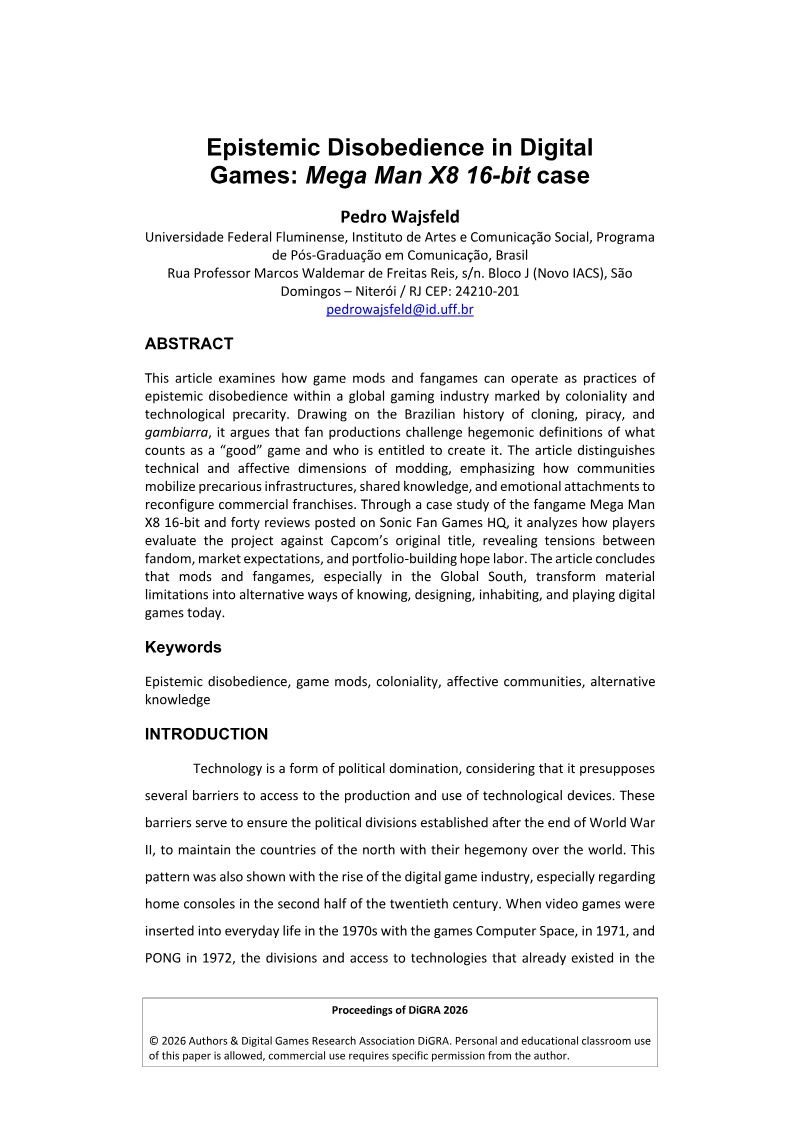
Epistemic Disobedience in Digital Games: Mega Man X8 16-bit Case
The analysis explores how fan-made digital games and modifications, particularly within the Global South, embody "epistemic disobedience" against the hegemonic structures of the global gaming industry.
- The paper frames fan modifications and fangames, such as a 16-bit demake of Mega Man X8, as "epistemic disobedience": creative resistance to the industry's narrow definition of the "ideal gamer" and its profit-driven standards of value.
- Drawing on Walter Mignolo's decolonial theory and Brazil's history of market reserve policies, console cloning, piracy, and gambiarra (creative improvisation under scarce resources), the author treats fan works as both technical and affective achievements.
- The reception analysis examines roughly 40 player reviews of the Mega Man X8 fangame hosted on Sonic Fan Games HQ, which averaged 4.33 stars, with players praising its fluid gameplay and expressing nostalgia.
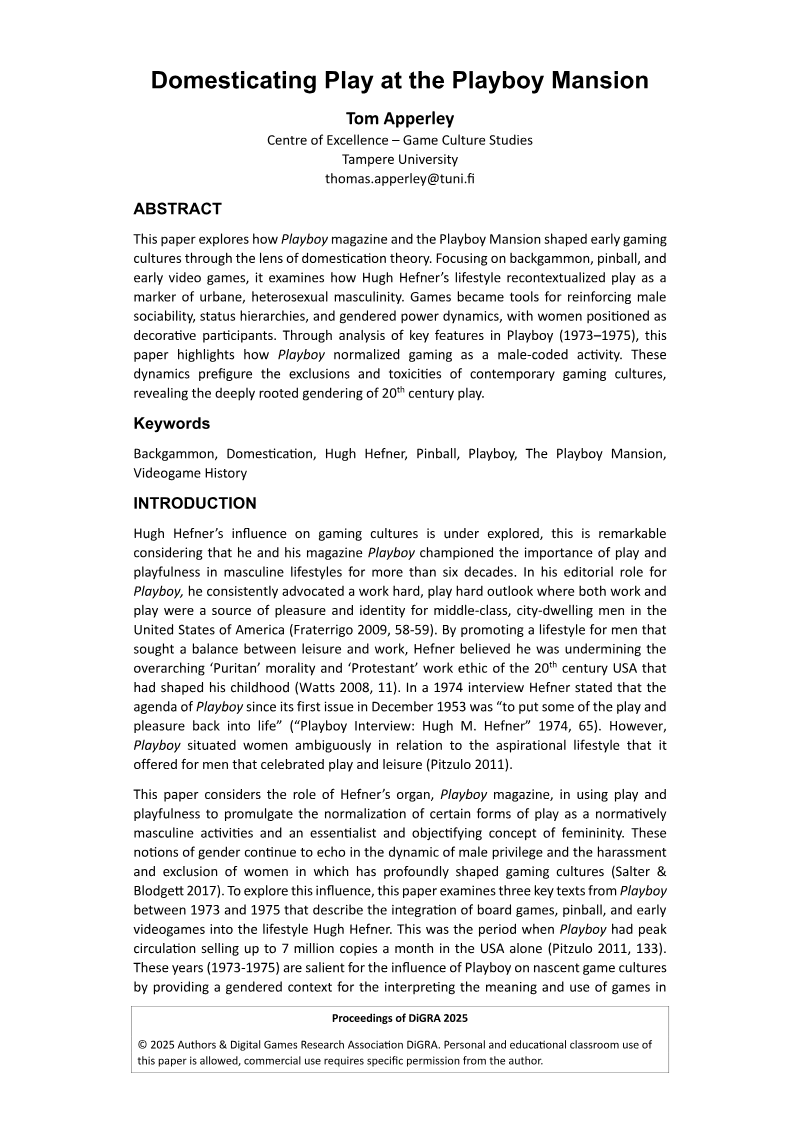
Domesticating Play at the Playboy Mansion
The document analyzes how Playboy magazine and Hugh Hefner's persona, particularly through the lens of the Playboy Mansion, significantly shaped early gaming cultures by framing play as an attribute of urbane, heterosexual masculinity.
- Tom Apperley's paper argues that Hugh Hefner's "work hard, play hard" lifestyle at the Playboy Mansion framed games like backgammon, pinball, and early arcade cabinets as markers of heterosexual, urban masculinity during roughly 1973 to 1975.
- The study finds that play at the Mansion was structured by asymmetrical gender roles: competitive games were coded as masculine, while women's participation was framed as sociable, decorative, and "natural," with nudity making women visually present rather than active participants.
- The paper situates this gendering of play within Playboy's peak circulation of up to seven million copies monthly and the emergence of home gaming with the 1972 Magnavox Odyssey.
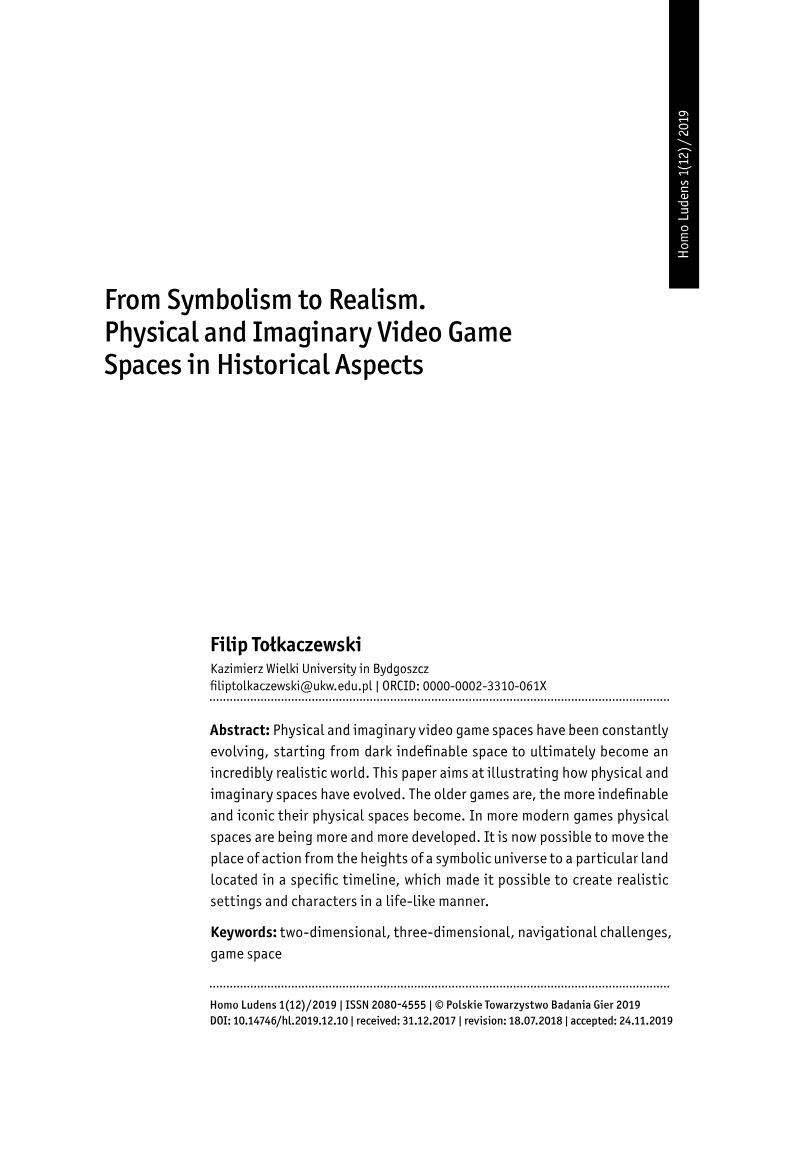
From Symbolism to Realism: Physical and Imaginary Video Game Spaces in Historical Aspects
Filip Tołkaczewski argues that video game space has evolved from symbolic, minimally defined environments into highly realistic, elaborately constructed worlds, and that this shift is turning games toward a new medium resembling interactive film.
- The study argues that video game spaces evolved from abstract, symbolic settings in early titles like Spacewar!, Space Invaders, and Asteroids toward increasingly realistic, continuous, and detailed worlds, a shift tied to technological advancement.
- The analysis frames early game spaces as simplified 'allegories of space' in the sense described by Espen Aarseth, relying heavily on player imagination to fill in what the graphics did not show.
- Key milestones in the trajectory include the flip-screen technique in Adventure and Gravitar, the side-scrolling and off-screen virtual space introduced by Defender (1980/1981), the 2D era of Super Mario Bros. (1985) and Contra (1988), the pseudo-3D of Wolfenstein and Doom, and the true 3D turn of Super Mario 64 on the Nintendo 64.
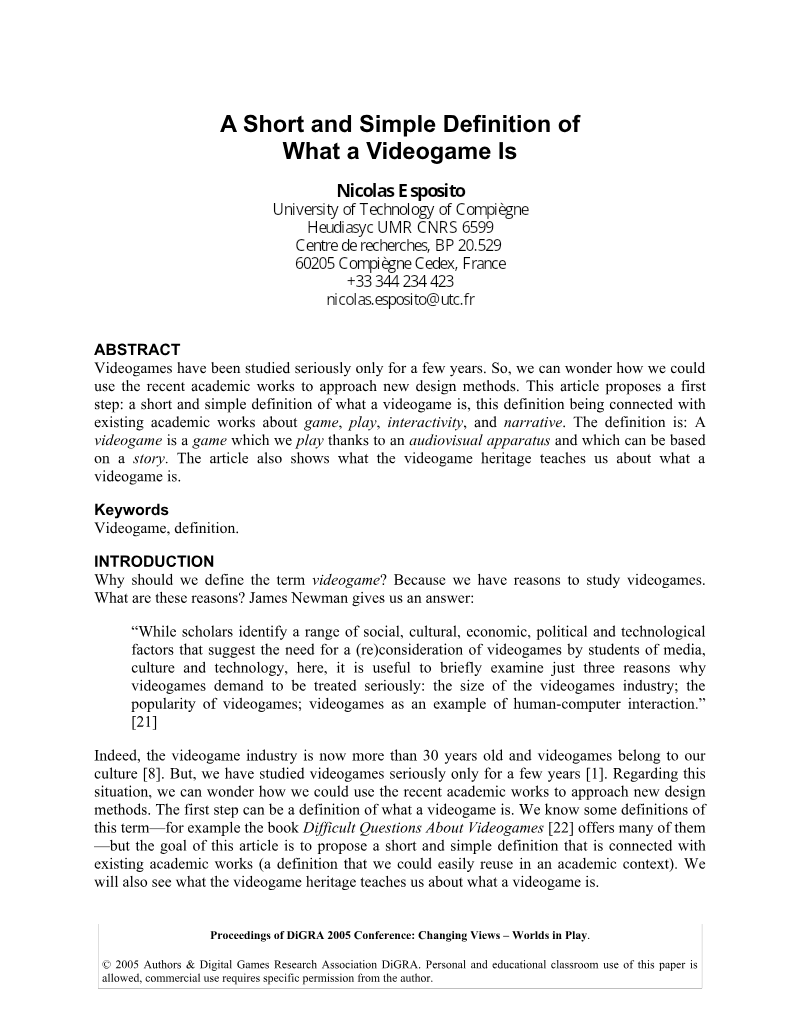
A Short and Simple Definition of What a Videogame Is
Nicolas Esposito's 2005 DiGRA conference paper proposes a compact, academically grounded definition of the videogame as a stepping stone toward new design methods.
- The paper proposes a short, reusable academic definition of the videogame as a game played through an audiovisual apparatus that can be based on a story, intended as a foundation for future videogame design methods.
- The author argues that serious videogame studies only began in recent years, even though the videogame industry was already more than thirty years old at the time of writing (2005).
- The definition is grounded in established game theory, drawing on Caillois, Huizinga, Zimmerman, Crawford, Kramer, and Juul's account of automation and rule enforcement.