Loading the document
1 free read left. Create a free account for unlimited reading + AI research.
Create free account
Session: Know Your Number: The D2C Maths Nobody Shows You - Adam Cavanagh, Tebex.
Key insights
Distilling the key insights…
Ask AI about this video
Transcript
[music] [music] on to our next session. So, this is the last talk in this part. There will be more straight after and it's still more D2C stuff, but technically the track changes to a different name. But, um we've got our next speaker. So, this one is know your number, the D2C maths nobody shows you. Welcome our speaker on stage.
Come on. Come on, I'm joking. We up? Perfect. Okay, folks. So, um
D2C the maths nobody shows you. Again, there's nothing sort of fictitious, clandestine, anything done underhanded in payments. It's the way the payment industry works, but I think it's super important that we understand how payments work and how it can actually used as more of a lever. Is this working? Yes. Okay, so Firstly, a little bit about me. I, for one, it's quite important, an avid gamer. Uh first started with the Game Boy back in the day, bit Tetris. Come on. Then N64, Zelda got like my heart. I'll say you today more prominently uh Ark Raiders, uh a Nordic born studio, has definitely taken a lot of my time. I've been working for the best part of um two decades now, nearly. Wow, crazy to actually say it, nearly two decades and around a decade in payments infrastructure, APIs, things of that nature. I'm incredibly passionate about connectivity and access. It's something that kind of drives my thesis the places
where I want to work and who I want to service. So, I've been very blessed to do that. And in life, it's very robotic, but I have a wonderful 5-year-old son. Uh my wife, we just moved to Madrid last year. We were in London for a decade together, but we went for a sunnier climate. And if you can't tell, if you're not from the UK, I'm not from London either. I'm from the north, so a place near Manchester. So, we decided to move to Spain and and have a life out there. So, I just want to frame the session a little bit because as I could just said, um the way payments work, it is very It's incredibly complex. Even when you're working payments, it's complex. There's new legislation, new fees that seems to seemingly come up from different providers, things of that nature. But, this this moment that we're in right now for the um for the gaming industry, it's it's been really tough, I think. And the reason we're giving this talk is because I believe something that we've launched at Gamescom called transparent pricing, which we'll get to later, can be a massive benefit for studios and
games and for the people who work in them. Um we've had studios close down. We've had game funding pulled. Ultimately, I think for a mismanagement more than anything. I think there's been people in in this industry who maybe don't belong, managers that have come from outside of the world not understanding games and experience and things that we look for. And the tough one has been mass layoffs. And I think this has affected, if not you directly in the room, someone connected to you. And it's been an incredible painful and tough period. And I know this is uber negative and it's not, but it's why this motion and this pricing dynamic has came out and why we we've decided to share it. But, we're on track for circa the second worst year in amount of layoffs we've had in the last 5 years, which is incredibly tough. And like I said, I'm sure it's affected you guys and it makes me passionate about what we're trying to achieve today with this new model. So, what does that going to It's a trick It's a trickle-down effect on the economy on our studios. Like, game trajectory has never been more important or under more more pressure. Like, it's
get 300,000 Steam list wish list, convert 7%of them. If that doesn't happen, what we doing? Budgets have a microscope on them. So, if you're reporting upwards to your board or your fund and investors and things like that, they're really like getting into the detail and expecting a more rapid rate of return. And the thing that's the saddest, I'm blessed to speak to studios every day of my life in this role and whether it's an indie, a double A, a triple A, a lot of companies that we speak to and a lot of games that are trying to survive versus thrive. And for me, that's just incredibly painful, especially with the the types of games we're releasing and the type of innovative games we have under an amount and an an ordinate amount of pressure to succeed quicker than maybe previously was because, ultimately, of mismanagement. So, the good news, it's not all bad. The industry is absolutely thriving. We've got 3.6 billion gamers up from 3.4 last year. Now, doesn't sound too much, but it's fairly fairly incremental given the size. 50%of those gamers actually pay for a
subscription showing the commitment. The worldwide gamers, we actually have 80% of the internet who play video games, which to me was just a wild statistic. So, we've still got 20 20%more to go, but the fact we've got 80%of the internet using games just shows how connected we are. A 5%year-on-year growth in emerging markets and again, emerging markets, there's more connectivity, there's more access to games, and it's a big big focus for the industry moving forward and it can certainly help elevate and move the needle for your studio and your game if managed correctly. And then mobile, part of the reason we're here, 74%of of mobile studios have a D2C store or manage their own web store today. That that number to me is absolutely astounding and 5 years ago, it was circa 19%. So, I think Darius spoke really well previously about um not every studio or not every game needs or deserves a web store. I think in mobile, it's quite crucial to survive and not thrive. Well, thrive not survive, sorry.
17 billion spent by a D2C, 15%in in-app purchases, absolutely astronomical numbers. And then again, one of the top studios had 4%of their revenue from their DTC channel, just incredible. So, the audience is there, it's not all negative. The thing that's really tough for me is that the industry's been struggling, but we've got more gamers than ever spending more than ever. So, there's a there's a misbalance there and a and a misinterpretation. So, why we're here? We're here to lift the veil on the murky world of hidden payments and hidden fees. And I say this again to be really clear, Tebex has always priced traditionally like we do uh in any industry, it's not just gaming. Our competitors, we all price the same. There's nothing shady, nothing clandestine, surreptitious in how people approach payments, but it's just that the unknowns that rules as um the studios and game makers, that's where you're going to see what we're going to speak about now can be a little bit awkward in forecasting and budgeting to make your game ultimately thrive. So, we all always need numbers. They
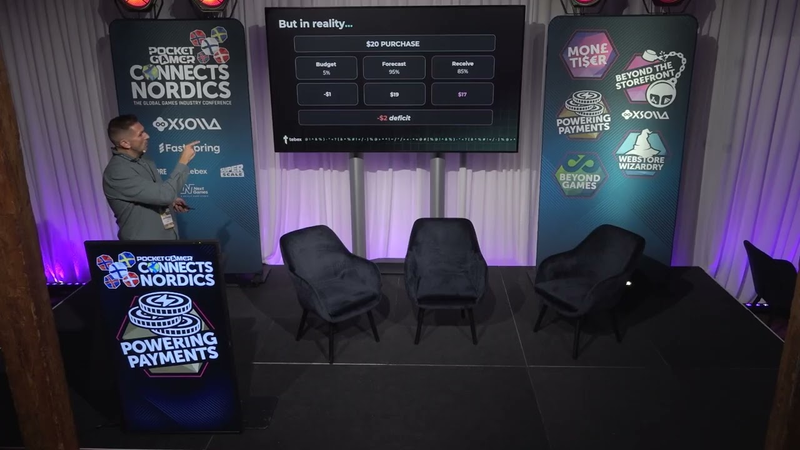
seem to move quite often. This is relatively EU focused, but I won't go through them all. If you're going to accept payments and use a store, be it one of the big monopolistic ones or a web store, these are kind of the breakdowns of what you get. Traditionally, what we seem to say in the the merchant of record space, if you're having your own direct DTC store via someone like ourselves, there's usually a headline line rate of 5%, and then you're going to take the 95%of revenue off the back of that. But, this is where it gets really interesting, what matters. So, that is the headline rate. Yes, we'll give you 5%, and then you'll be good to go and you'll take your revenue. In reality, I've I've made the math really simple for us in this graph, but it usually typically becomes double that or sometimes triple that depending on method, fee, where it is, and we'll get into that a little bit, but you can imagine as this example, $20 purchase is made, you're budgeting to lose a dollar of that or as cost of sales, you're expecting to get 19 bucks back in your pocket. But, when you actually get it, 17 bucks at the end of the month or the end of
the day or whenever you actually decide to pull your money, which means you've got a $2 deficit just seemingly gone, unknown. And why? Now, you say Adam, two I can live with that. I can certainly survive and thrive with a $2 deficit." But, when you extrapolate that into a million dollars of sales, it starts to get quite serious. So, you're budgeting to lose 50k of that million dollars in sales. You're forecasting to get into your bank account, into your studio, into your investment, into your games 950k back. When you actually get your money at the end, when you withdraw it, you get you see it's 850, you've got a massive deficit that you wasn't accounting for, or circa 100k, which is massive for any form of budgeting, forecasting, speaking to investors, and things of that nature. Now, I'm being somewhat crass in the 15%and the 5%and how that is, but it's just to stipulate the importance of how this can impact your game, your studio, your funding incredibly, incredibly inefficiently. But, why? You ask, why? We're asking why? I guess, yeah. Why?
So, I have them here, we have them at Standout Side. At Gamescom this year, we launched something called the the field guide to hidden fees. And again, to be very clear, it's not hidden, it's not clandestine, it's not done in in a bad way, in a malicious way. It's just the way the payment industry works. We give you a headline rate for what we'll do, and then there's all these fees beneath it. And these are these these beautiful creatures that take all of that revenue that you're expecting, that deficit, it's because of these things. So, chargeback fee. I don't know if you're aware, but when a chargeback is is claimed against your game, your your company, there's an automatic 15 to 20 dollars fee that's just given to you. Whether you're right, whether you're wrong, whether it's true, you lose that. So, if you're doing a 20 dollars sale, you're almost in the red or flat immediately. Not covered massively. Conversion fees is it's the biggest pain that everyone knows about. If you want to convert money, settle in different currency, all the good thing that affects those, it comes with quite a hefty fee. Variable payment processing, and I think again, Barry spoke about it. We're we're such a a global world now, and
processing a payment in Japan versus the UK versus Pix in Brazil or UPI in India, they all carry different fees and network charges, which you, as a CFO, as a game builder, whoever you are, will never really understand the depth and complexity of it, even though you're going to get a big uh a list in your T's and C's in your contract, no one really gets into the nitty-gritty of it. Payout, repatriation, getting your money back out, creator codes, abandoned basket, all these little things that take those little tiny percentages out of the revenue you was expecting that you wasn't necessarily forecasting for. So, the math you need to know, again, a real-world example with the veil pulled and some real numbers. So, Qualtate, come and work with us, you get 5%, brilliant. And this is a customer we've been working with for the last 3 months, who was working with one of our competitors, and then we started to run some numbers with them and work it through. So, headline rate, 5%. And when you actually begin to break it down, you see the payment method variants, the uh getting your money out, chargeback
fees, all these little things became a blended rate and an effective rate of circa 11.6%. Now, if anyone's quick at math, the real numbers on that board is 11.38, but we even couldn't account with an invoice for that 0.22%from the invoice from one of our competitors, cuz sometimes the complexity in payment, while it's not surreptitious or shady, I really want to stress that, we used to price the same, it's just so hard to get a variable stuck cost. So, we believe we could launch something that would help studios really begin to plan, forecast, and manage. So, if we take that real real uh example which you just said, the studios then circa a million uh per month in sales, their 5% effective rate, they were expecting to lose 50K of that number. So, in their head, they were going to get a massive 950K again, but their true cost, their true effective rate was 11.6%, meaning they had a massive deficit of more than double of more than double what they were expecting. Again, coming back to that budgeting and forecasting
and being able to invest in the right areas, speak to your speak to your suppliers, speak to your investors, and like put the money that makes a game thrive, not survive. We've we believe that launching and working with a partner such as Tebex having a blended effective rate enables you to really forecast what you're expecting in every sale. So that doesn't matter if you're selling your game in Japan, Mexico, India, UK, Finland, you know exactly what you're going to pay or exactly what you're going to get per transaction. And with the 7%effective rate here, the studio will save up 50k off per month. That's over half a million dollars per year. So you can start to see where that money forecasting it, forecasting with your CFO, forecasting it into the budget, it might let you hire another head, invest in UA. We all know how hard it is to actually get attention from our players today. It's so competitive. If you can actually forecast effectively, you can hire a great person. You can invest in the game. You can invest in innovation, new gaming mechanics, anything like that to help you thrive versus surviving and keep going.
So predictability is a massive competitive advantage in in my eyes, in our eyes. Um that's it. That's in any facet of business. I think it's more than obvious now that D2C is a necessary pillar. Be it web, be it mobile, be it desktop. It's just it's it's a must-have. It's no longer as convincing you to have a shop. It's kind of known that it's needed. The thing we push and urge is really treat payments as as its own pillar in itself. Pull those levers, work with a partner who will understand and work with you so you can forecast. So it's a key pillar. If you take anything away, think control, predictability. Work with all all of our competitors, great companies, great products. Work with them to try and understand this number. So it will enable you to forecast and ultimately thrive versus keeping your game to survive. Welcome any questions. Thank you for your time.
[music] [music]
Summary
The talk, given by Tebex Head of Sales Adam Cavanagh at Pocket Gamer Connects Summit Shanghai 2026, argues that studios selling direct-to-consumer (D2C) need to understand their true effective payment rate. The core thesis is that headline merchant-of-record rates, typically around 5%, substantially understate the real cost of accepting payments, which hidden fees can double or triple. He frames the message against a difficult industry backdrop of studio closures, funding pullbacks, and mass layoffs, which he says are near the second-worst year in five years.
Cavanagh offers market context: about 3.6 billion gamers, up from 3.4 billion, with roughly half paying for subscriptions, 80% of internet users playing games, and 5% year-on-year growth in emerging markets. He says 74% of mobile studios now run a D2C or web store, up from about 19% five years earlier, and cites one top studio deriving 4% of revenue from its DTC channel.
His central example is a customer with a headline rate of 5% whose blended effective rate reached roughly 11.4 to 11.6% once chargebacks, currency conversion, variable payment-method costs, payouts, and other fees were included. On a $1 million monthly sales base, that gap turns a expected $50,000 cost into more than double that. He argues that a blended, transparent rate of about 7% would let studios save around $50,000 per month and forecast each transaction reliably. He concludes that predictability and treating payments as a core pillar are essential for studios to thrive rather than merely survive.









Comments