Key insights
9 slides
The contraction
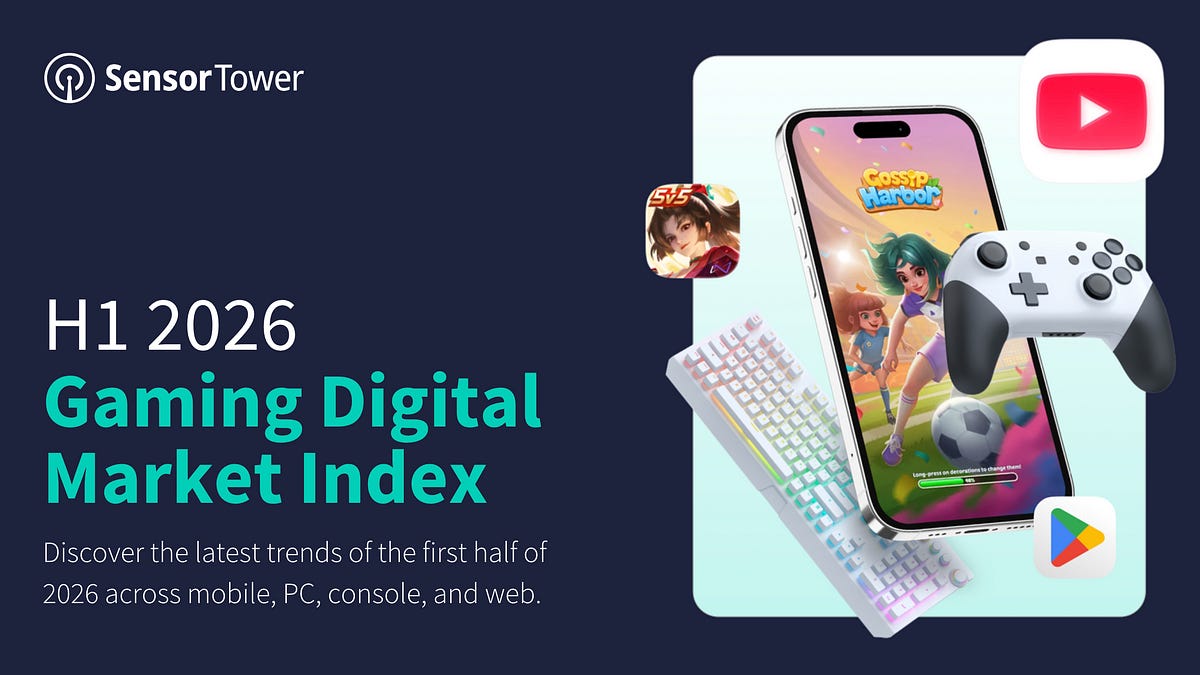
Mobile gaming revenue fell 2% to $40 billion in H1 2026.
Total downloads declined 11.9% during the same period. The industry experienced contraction and strategic realignment.
Platform stagnation
Steam revenue declined 5% amid record-high competition.
PC and console sectors faced stagnation. Competition across all platforms intensified pressure on developers to secure player attention.
Steam decline. Steam revenue declined 5% in H1 2026.
Puzzle growth
Puzzle emerged as a primary growth driver in mobile gaming.
The Match Merge 2 puzzle sub-genre nearly doubled its revenue to $1.91 billion.
$1.91 billion
Match Merge 2 puzzle sub-genre revenue in H1 2026
- Gossip Harbor growth
- 135%
Survival surge
New survival titles surged while established titles declined.
Kingshot grew 461% to $700 million and Last Z: Survival Shooter grew 328% to $359 million. Established titles saw a combined $370 million revenue decline.
Strategy dominance
Strategy remains the highest-earning mobile genre by IAP revenue.
Strategy earned $9.27 billion despite having 1 billion installs.
$9.27 billion
Strategy genre IAP revenue in H1 2026
- Strategy installs
- 1 billion
- Puzzle installs
- 5.07 billion
Ad consolidation
AppLovin and AdMob control nearly 65% of mobile game ad revenue.
The ecosystem is defined by aggressive ad monetization and high-volume creative strategies. In-game advertising accounts for 70.3% of revenue in India.
Structural transition
The industry is transitioning toward direct-to-consumer channels.
This shift complicates traditional performance tracking and obscures standard store-based metrics. The market is moving away from reliance on legacy storefronts.
D2C shift. The industry is undergoing a fundamental structural transition toward direct-to-consumer channels.
Regional disparities
Tencent retains top mobile publisher position as Century Games narrows gap.
Notable growth occurred in Asia, with high average revenue per user in Gulf countries. Browser games remained largely flat during the period.
Market leadership. Tencent retains its top position among mobile publishers.
Steam dominance
Action games dominated the Steam market in H1 2026.
Action games accounted for 107 million copies sold and $2.005 billion in revenue. This represented approximately 40% of the total market.
1 / 9
Ask AI about this report