Updated Jun 1, 2026 by AppLovin
Financial · May 7, 2026
Published by AppLovin
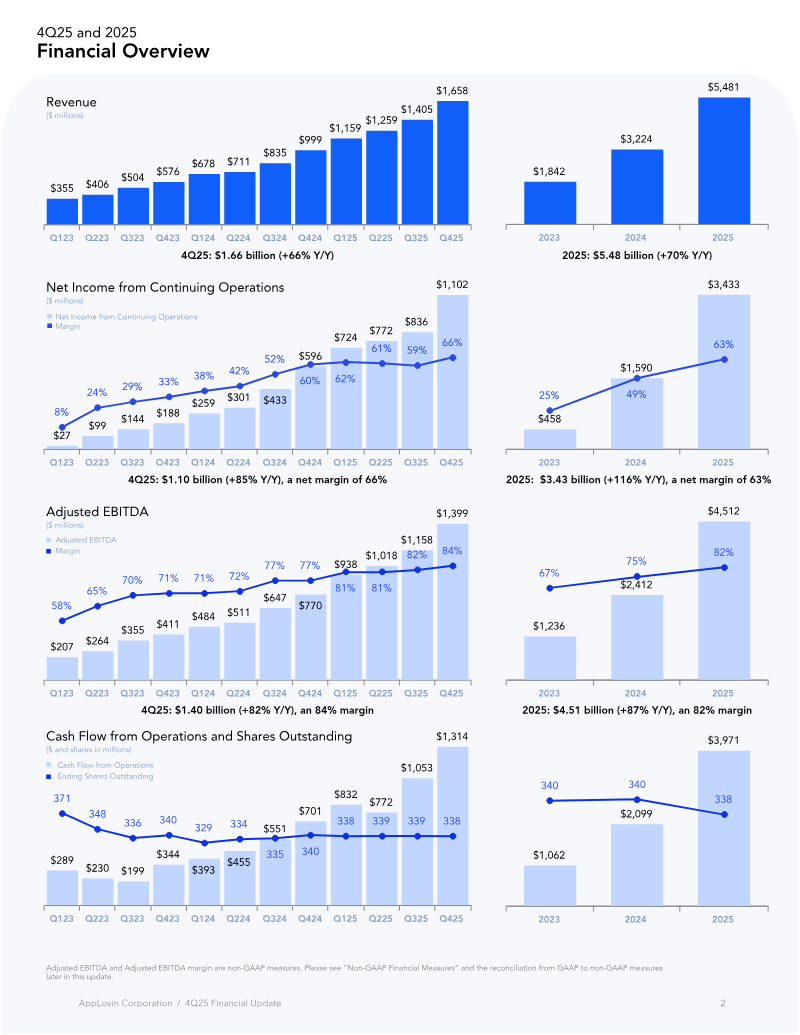
($ millions) $1,658 $1,842 Revenue $1,259 $1,405 <u>$1,842</u> ($ millions) $835 $999 $1,159 <u>$1,259</u> <u>$1,405</u> <u>$1,658</u> $406 $504 $576 $678 $711 <u>$835</u> $999 <u>$1,159</u> $406 <u>$504</u> <u>$576</u> <u>$678</u> $711 Q223 Q323 Q423 Q124 Q224 Q324 Q424 Q125 Q225 Q325 Q425 Q126 Q223...
> **[Chart page]** This page contains visual data — view in PDF for the best experience. Financial Overview ( millions) 1,658 $1,842 Revenue 1,259 1,405 $1,842 ( millions) 835 999 1,159 1,259 1,405 $1,658 406 504 576 678 711 835 999 1,159 406 504 576 678 $711 Q223 Q323 Q423 Q124 Q224 Q324 Q424 Q125 Q225 Q325 Q425 Q126 Q223 Q323 Q423 Q124 Q224 Q324 Q424 Q125 Q225 Q325 Q425 Q126 Net Income from Continuing Operations 1Q26: 1.84 billion (+59% Y/Y) 1,206 Net Income from Continuing Operations 1,102 1,206 ( millions) 1,102 Net Income from Continuing Operations 62% $836 66% 65% Margin 52% 60% 62% 772 836 66% 65% 38% 42% 52% 60% 724 772 33% 38% 42% 433 724 61% 59% 24% 29% 33% 433 596 61% 59% 24% 144 188 259 301 $596 $99 Q223 Q323 Q423 Q124 Q224 Q324 Q424 Q125 Q225 Q325 Q425 Q126 1Q26: $1.21 billion (+67% Y/Y), a net margin of 65% Adjusted EBITDA $1,557 ( millions) 1,399 Adjusted EBITDA Margin 70% 71% 71% 72% 77% 77% 81% 81% $1,158 85% 65% O 770 938 $1,018 82% 84% 411 484 511 647 264 355 411 484 264 355 Q223 Q323 Q423 Q124 Q224 Q324 Q424 Q125 Q225 Q325 Q425 Q126 Q223 Q323 Q423 Q124 1Q26: $1.56 billion (+66% Y/Y), an 85% margin Q225 Q325 Q425 Q126 Cash Flow from 1Q26: $1.56 billion (+66% Y/Y), an 85% margin ( and shares in millions) Operations and Shares Outstanding 1,314 $1,291 Cash Flow from Operations 1,314 1,291 Ending Shares Outstanding $1,053 Cash Flow from Operations Ending Shares Outstanding 701 832 772 1,053 348 336 340 329 334 335 $701 338 339 339 338 336 348 336 344 329 334 551 340 338 339 339 338 336 230 199 • 393 455 $551 34O 6 C 230 199 344 393 $455 Q223 Q323 Q423 Q124 Q224 Q324 Q424 Q125 Q225 Q325 Q425 Q126
utstanding $1,053 Cash Flow from Operations Ending Shares Outstanding 701 832 772 1,053 348 336 340 329 334 335 $701 338 339 339 338 336 348 336 344 329 334 551 340 338 339 339 338 336 230 199 • 393 455 $551 34O 6 C 230 199 344 393 $455 Q223 Q323 Q423 Q124 Q224 Q324 Q424 Q125 Q225 Q325 Q425 Q126 Adjusted EBITDA and Adjusted EBITDA margin are non-GAAP measures. Please see “Non-GAAP Financial Measures” and the reconciliation from GAAP to non-GAAP measures later in this update. Q323 Q423 Q124 Q224 Q324 Q424 Q125 Q225 Q325 Q425 Q126
Non-GAAP Financial Measures To supplement our financial information presented in accordance with generally accepted accounting principles in the United States (“GAAP”), this financial update includes certain financial measures that are not prepared in accordance with GAAP, including Adjusted EBITDA and Adjusted EBITDA margin. A reconciliation of each such non-GAAP financial measure to the most directly comparable GAAP measure can be found below. We define Adjusted EBITDA for a particular period as net income, adjusted for loss (income) from discontinued operations, net of income taxes, interest expense, other (income) expense, net (excluding certain recurring items), provision for (benefit from) income taxes, amortization, depreciation and writeoffs and as further adjusted for non-operating foreign exchange (gain) loss, stock-based compensation, transaction-related expense, restructuring costs (benefits), as well as certain other items that we believe are not reflective of our core operating performance. We define Adjusted EBITDA margin as Adjusted EBITDA divided by revenue for the same period. We believe that the presentation of these non-GAAP financial measures provides useful information to investors regarding our results of operations and operating performance, as they are similar to measures reported by our public competitors and are regularly used by securities analysts, institutional investors, and other interested parties in analyzing operating performance and prospects. Adjusted EBITDA and Adjusted EBITDA margin are key measures we use to assess our financial performance and are also used for internal planning and forecasting purposes.
ed by securities analysts, institutional investors, and other interested parties in analyzing operating performance and prospects. Adjusted EBITDA and Adjusted EBITDA margin are key measures we use to assess our financial performance and are also used for internal planning and forecasting purposes. We believe Adjusted EBITDA and Adjusted EBITDA margin are helpful to investors, analysts, and other interested parties because they can assist in providing a more consistent and comparable overview of our operations across our historical financial periods. We use Adjusted EBITDA and Adjusted EBITDA margin in conjunction with GAAP measures as part of our overall assessment of our performance, including the preparation of our annual operating budget and quarterly forecasts, to evaluate the effectiveness of our business strategies, and to communicate with our board of directors concerning our financial performance. These measures have certain limitations in that they do not include the impact of certain expenses that are reflected in our consolidated statement of operations that are necessary to run our business. Our definitions may differ from the definitions used by other companies and therefore comparability may be limited. In addition, other companies may not publish these or similar metrics. Thus, our non-GAAP financial measures should be considered in addition to, not as substitutes for, or in isolation from, measures prepared in accordance with GAAP.
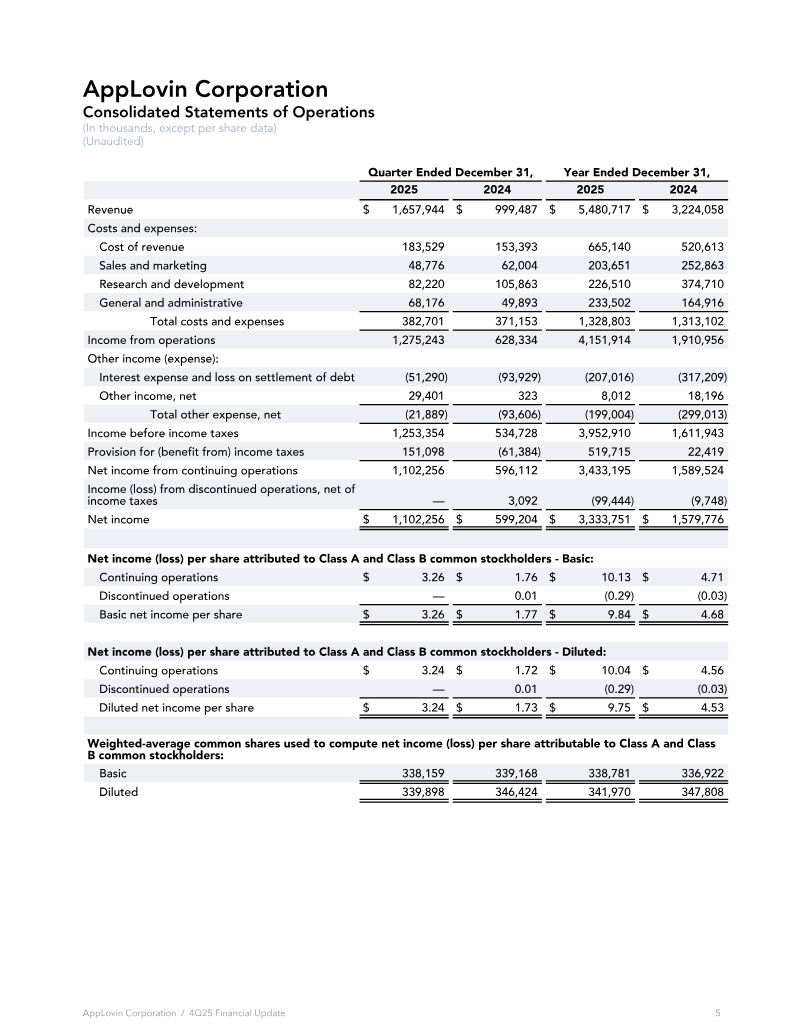
AppLovin Corporation Consolidated Balance Sheets (In thousands, except per share data) (Unaudited) March 31, December 31, 2026 2025 Assets Current assets: Cash and cash equivalents 2,758,671 2,487,096 Accounts receivable, net 1,958,023 1,819,366 Prepaid expenses and other current assets 130,881 124,330 Total current assets 4,847,575 4,430,792 Property and equipment, net 114,820 122,445 Goodwill 1,523,050 1,539,986 Intangible assets, net 368,996 396,714 Equity method investments 288,669 287,666 Other non-current assets 564,595 482,007 Total assets 7,707,705 7,259,610 Liabilities and Stockholders’ Equity Current liabilities: Accounts payable 697,524 746,977 Accrued and other current liabilities 796,858 586,811 Total current liabilities 1,494,382 1,333,788 Long-term debt 3,514,022 3,512,987 Other non-current liabilities 335,818 278,164 Total liabilities 5,344,222 5,124,939 Stockholders’ equity: Preferred Stock, $0.00003 par value—100,000 shares authorized, no shares issued and outstanding as of March 31, 2026 and December 31, 2025 — — Class A, Class B, and Class C Common Stock, $0.00003 par value—1,850,000 (Class A 1,500,000, Class B 200,000, Class C 150,000) shares authorized, 336,294 (Class A 306,087, Class B 30,208, Class C nil) and 338,313 (Class A 307,955, Class B 30,358, Class C nil) shares issued and outstanding as of March 31, 2026 and December 31, 2025, respectively 11 11 Additional paid-in capital 504,342 446,550 Accumulated other comprehensive loss (67,767)
ed, 336,294 (Class A 306,087, Class B 30,208, Class C nil) and 338,313 (Class A 307,955, Class B 30,358, Class C nil) shares issued and outstanding as of March 31, 2026 and December 31, 2025, respectively 11 11 Additional paid-in capital 504,342 446,550 Accumulated other comprehensive loss (67,767) (46,987) Retained earnings 1,926,897 1,735,097 Total stockholders’ equity 2,363,483 2,134,671 Total liabilities and stockholders’ equity 7,707,705 7,259,610
The 2026 State of Gaming analysis demonstrates a shifting landscape in which mobile gaming remains the largest driver of downloads—approximately 50 billion in 2025—but its growth rate is slowing. Revenue, however, continues to climb as monetization models mature and lifetime value deepens, especially within hybrid‑casual titles that now generate the most incremental income. In contrast, PC and console platforms experience record revenue growth, with Steam’s premium segment up 32 % and blockbuster releases such as Battlefield 6 capturing significant market share from incumbents. Shooter downloads on these platforms have plateaued, suggesting new titles are primarily cannibalizing existing audiences rather than expanding the category. Genre‑specific dynamics reveal that strategy games are the only mobile genre to grow in downloads, driven by 4X titles from Eastern developers. Action and shooter games dominate PC/console gains, while hyper‑casual remains the largest download engine but shows a notable lift in time spent, particularly in Tier 2 markets. Casual titles face declining day‑7 retention, indicating a stickiness challenge that could erode long‑term player value. Live‑ops and acquisition strategies have evolved toward retention‑focused events, multi‑tier season passes, and expedition‑style rewards. These mechanisms now represent the most reliable revenue drivers across competitive genres such as RPG, action, and simulation. Advertising spend remains concentrated on social channels—YouTube, Facebook/Instagram—and high‑attention formats like video, playable, and rewarded ads. Battlefield 6’s pre‑launch spend surpassed Call of Duty titles, leveraging Facebook, Reddit, and desktop display, while its post‑launch strategy pivoted to YouTube with cinematic, celebrity‑hook creatives. Geographically, the U.S. market shows a skew toward lifestyle and puzzle categories despite lower IAP shares, whereas casino titles exhibit higher spend‑to‑revenue efficiency. Overall, the industry is moving from acquisition toward deeper monetization per user, with indie shooters and simulation titles gaining traction amid intense competition in the shooter segment.
The interim filing presents the fourth‑quarter 2025 financial results for a midcore‑casual gaming group, emphasizing a record‑setting revenue run and the successful execution of a transformation agenda that includes the integration of the Plarium acquisition and the rollout of a new district structure in early 2026. Revenue reached SEK 3,123 million, reflecting 108 % organic growth year‑on‑year and a 25 % increase on a constant‑currency basis, while adjusted EBITDA rose to SEK 717 million, delivering a 23 % margin that matches the full‑year figure. Unlevered free cash flow amounted to SEK 878 million, with a cash‑conversion rate of 66 % and a leverage ratio of five times EBITDA, underscoring robust liquidity and disciplined capital management. User‑acquisition spending accelerated, representing 38 % of quarterly revenue—up from 37 % in the prior quarter—and grew 76 % on a reported basis, driven by heightened investment in original studios, new casual titles, and the racing franchise. The direct‑to‑consumer channel expanded by 600 basis points to 32 % of total revenue, reflecting a strategic shift toward higher‑margin in‑app purchases. Across the fiscal year, the company posted a 9 % organic revenue increase, with word‑games, racing, and RAID franchises delivering the strongest quarter‑end performance. Operating cash flow for the quarter stood at SEK 840 million, while adjusted net income was SEK 1,390 million, translating to an adjusted EPS of SEK 11.33. The financial outcomes exceed guidance and position the firm to meet its medium‑term outlook, with a pre‑IPO study for PlaySimple concluded and the midcore transformation progressing as planned.
2023 - 2025 (Key Insights and Data) QUONADIS â—Ź Users in Gaming on different platforms CANDISS â—Ź The Attention Economy: Gaming vs. Other Leisure Spending oy ss GANG Ae IED â—Ź Mobile Gaming Marketability â—Ź Downloads and Revenue Concentration in Mobile Gaming â—Ź Mobile Gaming vs Non-Gaming â—Ź Mobile Gaming Growth (Android vs.
A well‑designed in‑game offer system is presented as the most potent driver of lifetime value and average revenue per paying user. By integrating a limited set of synergistic offer types—login bonuses, triggered prompts, endless streams, “1 + X” bundles, battle‑passes, stamp‑cards, and curated bundles—and optimizing their frequency, timing, pricing, segmentation, and economic balance, developers can achieve conversion rates as high as ninety‑six percent on login offers and lift repeat‑purchase value by roughly twenty percent through endless offers. Conversion is shown to be a function of repeated exposure rather than a single impression; players typically require about seven viewings before taking action. The most effective moments to surface offers are at login, during “out‑of‑currency” events, after level failures, or in high‑momentum gameplay phases. A dynamic, tiered pricing ladder that escalates after each purchase and regresses after periods of inactivity—exemplified by a seven‑tier structure ranging from under one dollar to ninety‑nine dollars—enables precise alignment with player spend propensity while avoiding both under‑monetization of high‑potential users and alienation of low‑spenders. Segmentation must extend beyond basic recency and frequency metrics to incorporate geographic tier, acquisition source quality, and player progression. Lower‑tier regions demand adjusted price ladders and reduced offer frequency, whereas high‑quality acquisition channels justify more complex bundles. Early‑game players respond best to inexpensive, simple offers, while mid‑ and late‑game users can be presented with higher‑value packages. Anchoring the entire shop around a stable, low‑priced entry pack establishes a reference point that shapes perceived value across all offers. Collectively, these principles apply to mobile and casual games operating globally, reflecting current industry practices and data from recent case studies. Implementing the outlined framework promises measurable improvements in monetization efficiency, player satisfaction, and overall revenue performance.