1 free read left. Create a free account for unlimited reading + AI research.
Create free accountWhitepaper DiGRA
1 free read left. Create a free account for unlimited reading + AI research.
Create free accountWhitepaperDiGRA
The paper describes esports research as growing quickly while still being nascent and dominated by discipline-specific agendas.
Growth. Esports publications rose roughly 1.5 times per year and citations roughly 1.9 times per year over the past decade.
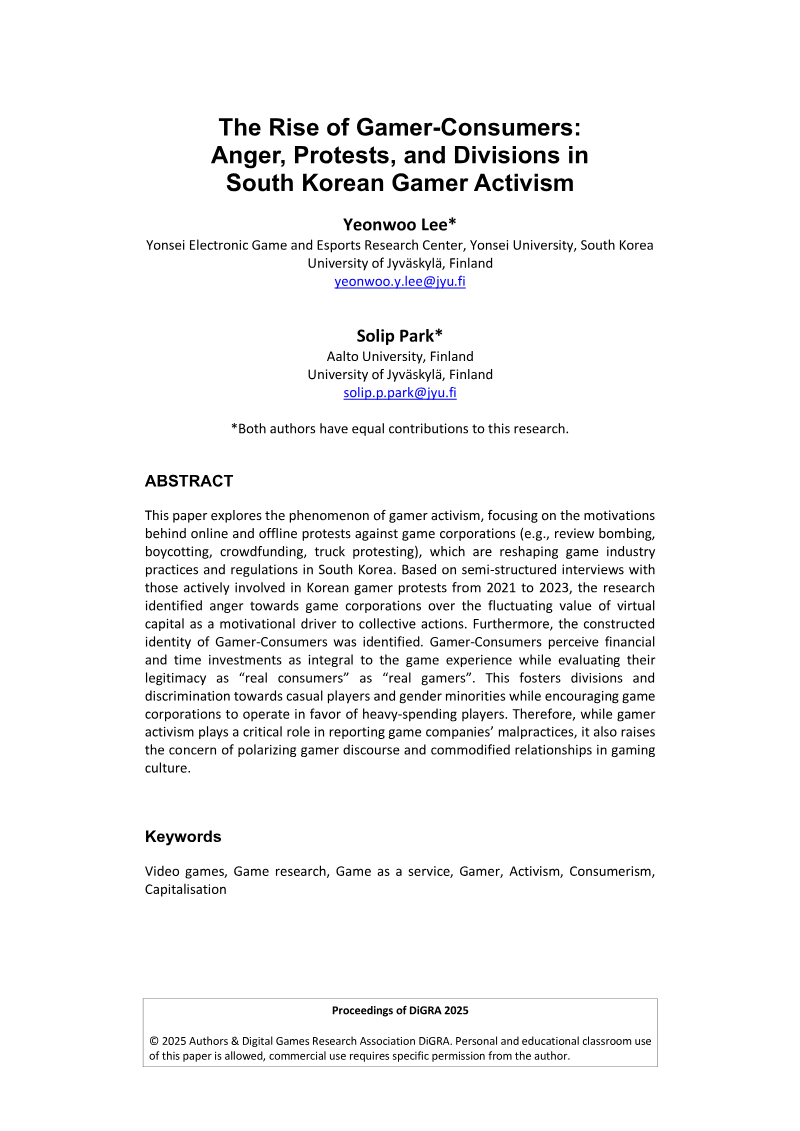
This study is a meta-scientific scoping review of South Korean esports research, designed to compare the topics represented in regional academic literature against the priorities stakeholders say they want studied. The authors argue that esports scholarship, though growing rapidly, is still nascent and dominated by discipline-specific agendas, and that its strong cultural and regional variation has been insufficiently examined, particularly for South Korea, a country that was influential in shaping modern competitive gaming yet whose academic discourse has largely stayed within national and linguistic boundaries.
The research is structured as a two-part process. The first component is a systematic review of publications by South Korea-based researchers, drawn from the Korean Citation Index using esports-related keywords in both English and Korean. From an initial pool of 755 articles, 86 had been selected at the time of writing, with plans to extend coverage to publications through 2021. The second component is a planned stakeholder survey targeting players, coaches, researchers, sponsors, audiences, and fans, aimed at mapping their research preferences. The authors intend to compare the two outputs to identify discrepancies between what has been studied and what stakeholders value, and to propose directions for future work.
The paper situates its contribution within a broader context in which esports output has grown substantially, with an average annual increase of roughly 1.5 times for publications and 1.9 times for citations over the past decade, based on Web of Science data. The authors also note that prior reviews have relied largely on English-language studies, so the regional review is expected to reveal tendencies that differ from existing global analyses. The methodology and results are intended to be publicly available so that other researchers can replicate or extend the work in other regional contexts.

DiGRA · 2026

DiGRA · 2026



DiGRA · 2026



DiGRA · 2026



DiGRA · 2026



DiGRA · 2026



DiGRA · 2026



DiGRA · 2026

DiGRA · 2026



DiGRA · 2026



DiGRA · 2026

DiGRA · 2026
DiGRA · 2005