Updated Jun 1, 2026 by Remedy Entertainment
Financial · May 4, 2026
Published by Remedy Entertainment
May 5, 2026 Remedy Entertainment Plc Remedy Entertainment Plc | Stock exchange release | May 5, 2026, at 09:00 a.m. Remedy Entertainment Plc | Business Review January–March 2026 Remedy is focusing on its core strengths, CONTROL Resonant on track and marketing activity ramping up Profitable quarter, increased game sales and royalties The Business Review is unaudited. Figures in parentheses refer to the comparison period in the previous year, unless otherwise stated.
Remedy Entertainment Plc | Stock exchange release | May 5, 2026, at 09:00 a.m. EEST Remedy Entertainment Plc | Business Review January–March 2026 Remedy is focusing on its core strengths, CONTROL Resonant on track and marketing activity ramping up Profitable quarter, increased game sales and royalties The Business Review is unaudited. Figures in parentheses refer to the comparison period in the previous year, unless otherwise stated. Highlights from January–March 2026 • Revenue decreased by -1.9% to EUR 13.1 (13.4) million. • EBITDA was EUR 2.9 (2.6) million. • Operating profit (EBIT) was EUR 1.0 (1.3) million, and the operating profit margin was 7.8% (9.7%) of revenue. • Cash flow from operations was EUR 8.3 (-6.6) million. • In February 2026, Jean-Charles Gaudechon was appointed as the CEO of Remedy as of March 1, 2026. REMEDY ENTERTAINMENT PLC. LUOMANPORTTI 3, 02200 ESPOO, FINLAND 2 (20)
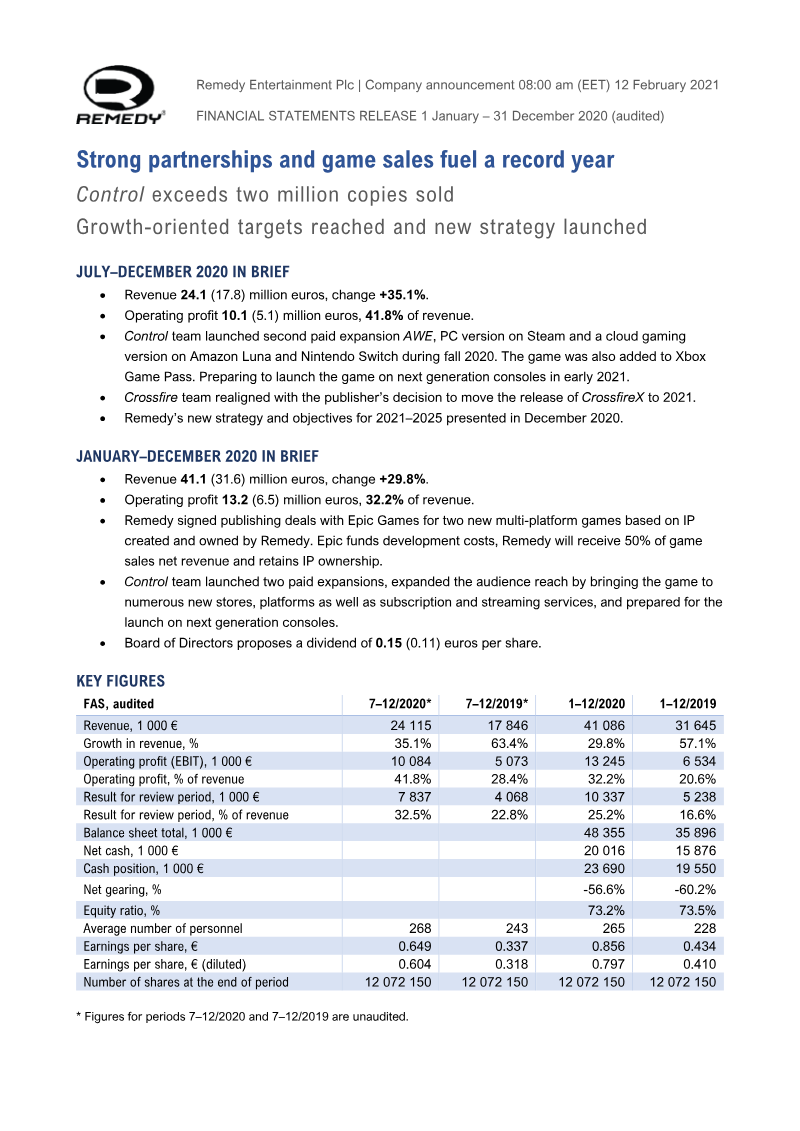
> **[Chart page]** This page contains visual data — view in PDF for the best experience. Key Figures MEUR, IFRS, Group, unaudited 1–3/2026 1–3/2025 1–12/2025 Revenue 13.1 13.4 59.5 Growth in revenue, % -1.9% 24.1% 17.5% EBITDA 2.9 2.6 11.3 EBITDA, % of revenue 22.3% 19.3% 19.1% Operating profit (EBIT) 1.0 1.3 -14.9 Operating profit, % of revenue 7.8% 9.7% -25.0% Result for review period 0.5 0.6 -13.0 Result for review period, % of revenue 3.6% 4.4% -21.9% Balance sheet total 86.1 97.4 87.5 Cash flow from operations 8.3 -6.6 4.5 Net cash 15.9 12.3 11.1 Cash and liquid investments 34.0 28.0 29.4 Net gearing, % -27.7% -17.6% -19.7% Equity ratio, % 68.6% 73.9% 67.4% Capital expenditures 3.3 3.8 14.3 Average number of personnel during review period (FTE) 374 363 371 Headcount at the end of period 391 373 387 Earnings per share, € 0.04 0.04 -0.96 Earnings per share, € (diluted) 0.04 0.04 -0.96 Number of shares at the end of period 13,640,451* 13,585,151 13,640,451* *Includes 50,000 treasury shares. REMEDY ENTERTAINMENT PLC. LUOMANPORTTI 3, 02200 ESPOO, FINLAND 3 (20)
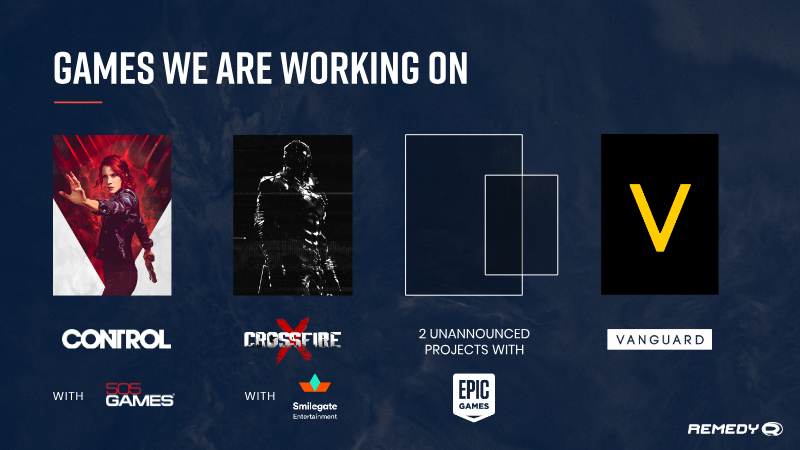
Comments by CEO Jean-Charles Gaudechon Remedy had a profitable first quarter of 2026, ahead of marketing ramp up and related spend to support the launch of CONTROL Resonant. Revenue was EUR 13.1 (13.4) million, with a decrease of -1.9% from the comparison period. Revenue from game sales and royalties increased, driven by royalties from Alan Wake 2, revenue from FBC: Firebreak and the sales of Control which improved from the comparison period. Development fees decreased but made over half of the total revenue in Q1. Development fees were received from Max Payne 1&2 remake and CONTROL Resonant. EBITDA improved to EUR 2.9 (2.6) million and operating profit (EBIT) was EUR 1.0 (1.3) million. More of what makes us Remedy After assuming the role of CEO in March and getting to know the company and our teams, my belief in Remedy's vision and future only continues to be reinforced. The gaming industry and market have always been dynamic, now more volatile than ever. As the industry searches for its footing, Remedy will double down on what makes the studio unique: our creative identity, memorable IPs, and commitment to delivering exceptional quality and originality. We are more focused than ever on moving forward with franchise expansion, selfpublishing, and commercial discipline to improve our business performance. The studio is in good shape to deliver on these pillars. CONTROL Resonant In the first quarter, we took numerous steps in the ambitious global marketing campaign we have planned for CONTROL Resonant.
anchise expansion, selfpublishing, and commercial discipline to improve our business performance. The studio is in good shape to deliver on these pillars. CONTROL Resonant In the first quarter, we took numerous steps in the ambitious global marketing campaign we have planned for CONTROL Resonant. In February, a new gameplay trailer made its debut during PlayStation’s highly viewed State of Play. In March, NVIDIA, Remedy’s longtime partner, released a new CONTROL Resonant trailer. We expanded beyond the trailers by showcasing exclusive content of CONTROL Resonant with the global press and content creators, with positive overall sentiment. The first episode of the CONTROL Resonant developer diary was also released for our community, continuing to build awareness ahead of the launch. While our core markets remain a priority, we also want more players around the world to experience Remedy's games. Remedy launched well-received social media marketing in China to engage with the local community. We are working with local partners on addressing the Chinese and other Asian markets. After the reporting period, in May, Remedy also made an exclusive appearance at Gamescom Latam in São Paulo, Brazil, with key members of the team on the ground to connect with fans. We remain committed to our goal of making the game a ‘must-have day-one purchase’ for the fans of Control and for gamers worldwide. A lot of interest was captured in connection with our December 2025 announcement, and we expect the momentum to intensify leading up to the launch. Leading indicators are on track for us to reach this
making the game a ‘must-have day-one purchase’ for the fans of Control and for gamers worldwide. A lot of interest was captured in connection with our December 2025 announcement, and we expect the momentum to intensify leading up to the launch. Leading indicators are on track for us to reach this REMEDY ENTERTAINMENT PLC. LUOMANPORTTI 3, 02200 ESPOO, FINLAND 4 (20)
goal. I play the game regularly; the gameplay and overall feel are coming together, and I am confident we have a strong product at hand. Games in the market Overall, our portfolio performed steadily in Q1, the year-on-year uplift driven by stronger publishing work on Control, royalties from Alan Wake 2 and revenue accruals from FBC: Firebreak, which was launched in the second quarter of 2025. Control retained solid sales momentum during Q1 and sold better than in the comparison period, driven by promotions and added visibility from CONTROL Resonant. At attractive price points, Control provides an easy entry-point for new players to get involved in the CONTROL universe ahead of the sequel and expands our addressable audiences. Control has sold over 6 million lifetime copies. Alan Wake 2 continued to earn royalties in the first quarter. Alan Wake 2 and Alan Wake Remastered became available in Amazon’s Luna service, generating a platformdeal royalty. Other games of the Alan Wake franchise continued normal backcatalogue sales. FBC: Firebreak received its last Major Update ‘Open House’ in March, and the game moved to maintenance mode. Friend’s Pass feature was introduced to serve our community and to support the game’s player base. FBC: Firebreak will remain live and playable. Upkeeping the infrastructure will not incur significant costs for Remedy. FBC: Firebreak remains available on both PlayStation Plus and Xbox Game Pass and is available for purchase on the PC and console platforms it was released on.
The interim analysis evaluates Nitro Games’ financial and operational performance for the first quarter of 2025, focusing on revenue trends, profitability, capital structure, workforce dynamics and geographic exposure. Total revenue fell 9 % year‑over‑year to €2.43 billion, driven primarily by a sharp contraction in the Games segment, which dropped from €263 million to €75 million, while the Service segment remained relatively stable. EBITDA declined to €416 million, a 30 % decrease, and EBIT fell to €87 million, down 45 %; net profit reached €58 million, a 46 % reduction. Cash balances contracted to €1.09 billion and net debt stayed around €3.1 billion, yet the equity ratio improved markedly to 37 % from 22 % a year earlier, indicating a stronger balance‑sheet position despite weaker earnings. Workforce metrics show an average headcount of 49.7 employees, an 8 % increase over the prior year, with 49 employees at quarter‑end. The share‑holding structure as of 31 March 2025 reflects a modest share capital of €80 k. A notable operational setback was the cancellation of a Netflix‑commissioned project, which contributed to the steep decline in the Games segment. Geographically, revenue concentration shifted heavily toward North America, accounting for €2.34 billion of total sales, while the European Union market contributed a comparatively small share. The combined financial and operational indicators suggest that, although Nitro Games faces significant top‑line pressure and reduced profitability, its capital structure
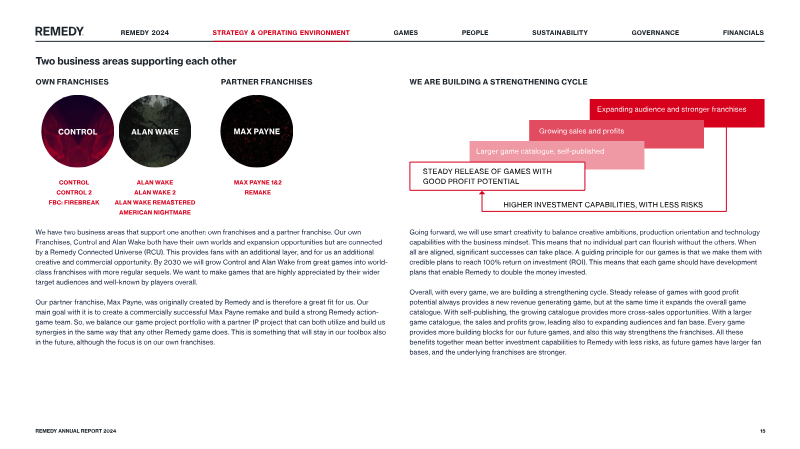
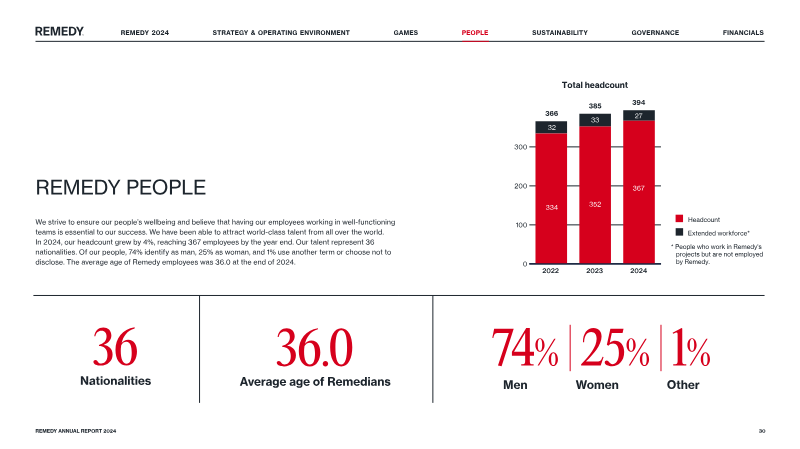
Remedy Entertainment achieved a significant financial turnaround in 2024, with revenue growing 49.3% to €50.7 million and EBITDA improving to €2.5 million. This recovery was driven largely by the commercial success of Alan Wake 2, which surpassed 2 million units sold and fully recouped its development and marketing costs. The company is currently executing a major strategic shift toward a self-publishing model for its owned intellectual properties, a move bolstered by reacquiring the full rights to the Control franchise and securing strategic financing through a partnership with Annapurna and a convertible loan from Tencent. The long-term strategy for 2025–2030 aims to double 2024 revenue by 2027 while achieving a 30% EBITDA margin. To reach these targets, the studio is focusing on a disciplined production pipeline managed through a six-stage gate process. Key upcoming projects include the multiplayer spin-off FBC: Firebreak, budgeted at €30 million, and Control 2, budgeted at €50 million. Both titles are scheduled to enter full production by early 2025. Additionally, the Max Payne 1&2 remake, fully funded by Rockstar Games, moved into full production at the end of 2024. Operating primarily from Finland with a global reach, the studio grew its headcount to 367 employees to support its portfolio of four major projects. Beyond game development, the partnership with Annapurna is designed to expand the Alan Wake and Control franchises into film and television, evolving these IPs into world-class brands. This expansion occurs within a global games market projected to reach $213.3 billion by 2027, positioning the studio to maximize royalty potential and commercial alignment through its new self-publishing capabilities and steady release cadence.
The new five‑year strategy and action plan sets out a comprehensive roadmap for the UK video‑games and interactive‑entertainment sector, positioning it as the world’s leading hub for new intellectual property and innovation by 2030. Its core thesis is that sustained growth, enhanced global perception, and a resilient, diverse talent pipeline will secure the industry’s long‑term economic and cultural impact. The plan outlines four strategic priorities—transforming public and media perceptions, building a pro‑games policy agenda, cultivating a highly skilled and inclusive workforce, and strengthening businesses through targeted support. Key initiatives include three flagship campaigns: energising industry to turn innovative stories into globally successful IPs, empowering talent by nurturing creators and entrepreneurs, and elevating games to showcase British‑made titles as forces for good. The 2024‑25 action schedule launches a coordinated PR strategy, high‑impact partnerships with cultural and digital brands, and an evidence‑led lobbying effort aimed at more competitive tax reliefs, increased investment, and the introduction of a Digital Creativity GCSE. A new research and evidence base will underpin policy advocacy, while a sector‑wide skills network and the refreshed #RaiseTheGame programme will drive diversity, equity, and inclusion across the talent pipeline. The plan also commits to environmental responsibility through participation in the Playing for the Planet Alliance and internal sustainability measures. Supporting stronger businesses will involve a refreshed membership strategy, expansion of the Ukie Worldwide platform for trade and investment, and the continuation of the Video Games Growth Programme. By inviting industry stakeholders to engage through surveys, working groups, mentorship, and board participation, the strategy seeks broad collaboration to deliver its ambitious objectives across the UK’s mobile, console, core and casual game segments throughout the 2024‑2030 horizon.
Games Workshop achieved record-breaking financial results for the 2019/20 fiscal year, demonstrating significant resilience despite the operational disruptions caused by the COVID-19 pandemic. Annual revenue rose 5.1% to £269.7 million, while profit before tax reached £89.4 million. This performance marks the fourth consecutive year of record growth, driven primarily by a robust trade segment—which now accounts for 52% of total revenue—and a substantial increase in royalty income from licensing agreements in the video game and media sectors. The company’s strategic focus remained on the global expansion of its Warhammer intellectual property and the modernization of its industrial infrastructure. Significant capital investments totaling £18 million were directed toward production and logistics expansions in Nottingham and North America, alongside the implementation of a new ERP system. While physical retail sales declined by 11% due to pandemic-related store closures, digital engagement and online sales saw marked growth. The company also successfully navigated the transition to IFRS 16 accounting standards, which brought £32.1 million in lease liabilities onto the balance sheet. Geographically, North America remains the company's largest market, contributing £104.8 million to total revenue. Despite the economic uncertainties of the pandemic and Brexit, the Group maintained a strong liquidity position, ending the period with £52.9 million in cash and no utilized borrowing facilities. This financial stability allowed the board to maintain its commitment to shareholders through dividends of 145 pence per share and to support its workforce by providing full pay during shutdowns and distributing profit-share bonuses to all staff. The report concludes with a focus on long-term sustainability, ethical sourcing, and continued IP exploitation to ensure future viability.