Updated Jun 10, 2026 by Remedy Entertainment
Financial
Published by Remedy Entertainment
Remedy Entertainment reported a robust first‑half performance for 2025, with revenue climbing 43.4 % to €30.3 million. The surge was largely driven by sales and royalties from its flagship titles Control and Alan Wake 2, alongside the launch of its inaugural self‑published game, FBC: Firebreak. EBITDA improved markedly to €6.8 million from a loss of €3.6 million in the prior year, and operating profit turned positive at €0.8 million; however, cash flow from operations remained negative (€–3.5 million) due to the timing of development‑fee receipts and investment outflows. The balance sheet at June 30, 2025 shows total assets of €97.5 million and liabilities of €27.9 million, yielding an equity ratio of 72.8 % and a net gearing of –14.4 %. Cash and equivalents stood at €10.0 million, while other current assets were €17.5 million. Equity increased to €69.6 million, supported by a €1.0 million net rise in share‑based and cash equity transactions during the period. The workforce expanded to 385 employees, a 6.6 % year‑over‑year increase, and the company’s market capitalization reached €202 million at year‑end. Operating cash outflows of €3.48 million and net investment outflows of €6.66 million were largely attributable to capitalised development costs of €6.10 million. Revenue for the half‑year rose to €16.9 million from €13.4 million in H1 2024, with development fees comprising the majority of sales. Overall, Remedy’s shift toward self‑publishing has begun to pay off, as more than half of its revenue now derives from game sales and royalties rather than external development fees.
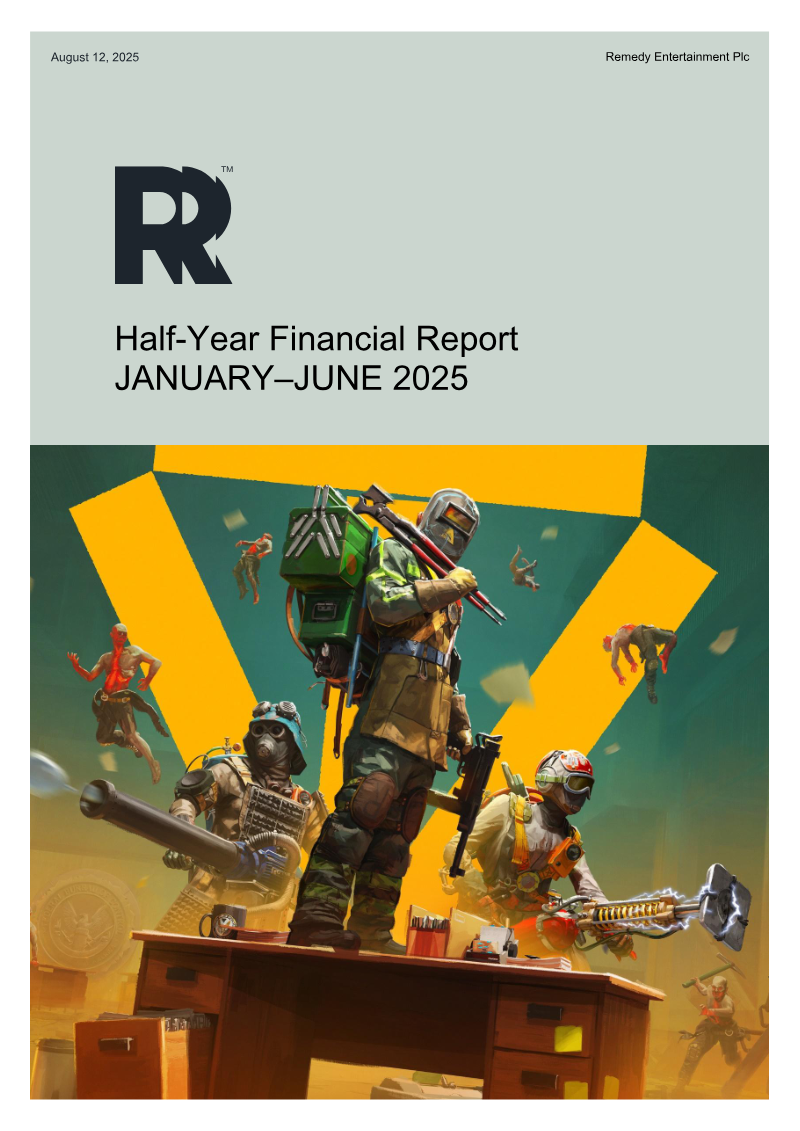
Remedy Entertainment Plc | Stock exchange release | August 12, 2025, at 09:00 a.m. EEST Remedy Entertainment Plc | Half-Year Financial Report January–June 2025 Remedy’s first self-published game FBC: Firebreak released Continued growth with a rising share of game revenue The Half-Year Financial Report is unaudited. Figures in parentheses refer to the comparison period in the previous year, unless otherwise stated. Highlights from April–June 2025 • Revenue increased by 63.5% to EUR 16.9 (10.3) million. • EBITDA was EUR 4.2 (-2.4) million. • Operating profit (EBIT) was EUR -0.5 (-3.2) million, and the operating profit margin was -2.7% (-31.0%) of revenue. • Cash flow from operations was EUR 3.1 (0.9) million. • In June 2025, Remedy launched FBC: Firebreak worldwide, a three-player co-op FPS and the company's first self-published game. • In May 2025, Remedy purchased 80% of key personnel’s 2019 stock options (103,199 rights on May 8) and the sellers used remaining options to subscribe 25,800 shares.
> **[Chart page]** This page contains visual data — view in PDF for the best experience. Highlights from January–June 2025 • Revenue increased by 43.4% to EUR 30.3 (21.1) million. • EBITDA was EUR 6.8 (-3.6) million. • Operating profit (EBIT) was EUR 0.8 (-5.3) million, and the operating profit margin was 2.8% (-25.0%) of revenue. • Cash flow from operations was EUR -3.5 (4.2) million. • During the first quarter of 2025 Remedy made the final instalment in acquiring full rights to the Control franchise from 505 Games. Key Figures MEUR, IFRS, Group, 4–6/2025 4–6/2024 1–6/2025 1–6/2024 1–12/2024 unaudited Revenue 16.9 10.3 30.3 21.1 50.7 Growth in revenue, % 63.5% 16.2% 43.4% 33.7% 49.3% EBITDA 4.2 -2.4 6.8 -3.6 2.5 EBITDA, % of revenue 24.9% -23.0% 22.4% -16.8% 5.0% Operating profit (EBIT) -0.5 -3.2 0.8 -5.3 -4.3 Operating profit, % of revenue -2.7% -31.0% 2.8% -25.0% -8.4% Result for review period -0.6 -2.2 0.0 -4.2 -3.6 Result for review period, % of -3.4% -21.4% 0.1% -19.9% -7.1% revenue Balance sheet total 97.5 90.3 97.5 90.3 99.3 Cash flow from operations 3.1 0.9 -3.5 4.2 11.0 Net cash 10.0 19.0 10.0 19.0 25.3 Cash and liquid investments 27.6 23.1 27.6 23.1 41.1 Net gearing, % -14.4% -29.1% -14.4% -29.1% -36.9% Equity ratio, % 72.8% 73.5% 72.8% 73.5% 70.9% Capital expenditures 5.5 3.4 9.2 23.0* 26.6* Average number of personnel 370 350 366 348 351 during review period (FTE) Headcount at the end of period 385 361 385 361 367 Earnings per share, € -0.04 -0.16 0.00 -0.31
% -14.4% -29.1% -14.4% -29.1% -36.9% Equity ratio, % 72.8% 73.5% 72.8% 73.5% 70.9% Capital expenditures 5.5 3.4 9.2 23.0* 26.6* Average number of personnel 370 350 366 348 351 during review period (FTE) Headcount at the end of period 385 361 385 361 367 Earnings per share, € -0.04 -0.16 0.00 -0.31 -0.27 Earnings per share, € (diluted) -0.04 -0.16 0.00 -0.31 -0,27 Number of shares at the end of 13,640,451 13,552,651 13,640,451 13,552,651 13,574,151 period *Contains 16.9 million invested in publishing rights of Control franchise REMEDY ENTERTAINMENT PLC. LUOMANPORTTI 3, 02200 ESPOO, FINLAND 2 (20)
Comments by CEO Tero Virtala In the second quarter of 2025, Remedy’s revenue increased by 63.5% from the comparison period and was EUR 16.9 (10.3) million. Game sales and royalties increased while development fees decreased. Game sales increase was driven by the sales of FBC: Firebreak, including an initial accrual from subscription service agreements with Sony and Microsoft. Alan Wake 2 and Control continued to sell steadily and accrue royalties. Development fees were from Control 2 and Max Payne 1 & 2 remake. EBITDA was EUR 4.2 million, improving by EUR 6.6 million from the comparison period. Operating profit was EUR -0.5 million, improving by EUR 2.7 million from the comparison period. Release of Remedy’s first self-published game FBC: Firebreak Remedy’s first multiplayer game FBC: Firebreak launched on the 17th of June. The launch succeeded technically, reaching over 1 million players in its first 10 days. Majority of the players were Xbox Series X|S and PlayStation 5 users. On Steam, which was planned as the primary consumer sales channel on PC, the launch underperformed. The game’s initial onboarding experience and mission structure resulted in high early player drop-offs and an influx of negative reviews. As players spent more time in the game and we released updates improving the game, sentiment in reviews turned more positive.
on PC, the launch underperformed. The game’s initial onboarding experience and mission structure resulted in high early player drop-offs and an influx of negative reviews. As players spent more time in the game and we released updates improving the game, sentiment in reviews turned more positive. Commercially, we were unsatisfied with the launch-phase consumer sales of FBC: Firebreak. Thus far, FBC: Firebreak’s commercial performance has largely been driven by the Xbox and PlayStation subscription service agreements. A considerable portion of the revenues from these agreements will still be recognized throughout the contract period. FBC: Firebreak was designed as a game that evolves over time. Despite the rocky launch, we believe we have a solid game to build on. Players who spent over an hour with the game reviewed the game mostly positive – showing us that the core experience of the game is entertaining. We have already rolled out patches and communicated on how the game will continue to develop. Looking ahead, a larger “Major Update” late September will be the next key step for FBC: Firebreak. This will be supported by targeted marketing activities, which we expect to drive interest in the title. We are committed to continuing to work on FBC: Firebreak, engaging with the community, and expanding the game. Games in development Control 2 development is on track towards meeting its next milestones. The focus is now on the gameplay, environments, and missions. Work continues on developing the game into a strong commercial offering.
n FBC: Firebreak, engaging with the community, and expanding the game. Games in development Control 2 development is on track towards meeting its next milestones. The focus is now on the gameplay, environments, and missions. Work continues on developing the game into a strong commercial offering. The Max Payne 1 & 2 remake project continues its progress and remains in full production. In the second quarter, the team built on steady momentum from earlier in the year. Collaboration with Rockstar Games remains close and productive, ensuring alignment as the project advances toward its next major phase. REMEDY ENTERTAINMENT PLC. LUOMANPORTTI 3, 02200 ESPOO, FINLAND 3 (20)
PCF Group S.A., operating under the People Can Fly brand, has entered into a significant development and publishing agreement with Microsoft Corporation to produce a new AAA video game currently titled Project Maverick. This partnership, formalized on June 13, 2023, establishes a work-for-hire framework where the studio develops the title using intellectual property owned by Microsoft. The agreement aligns with the studio’s updated corporate strategy to pursue high-value collaborative opportunities with major industry publishers alongside its own internal projects. The financial scope of the project is substantial, with Microsoft providing a total production budget ranging between $30 million and $50 million. Funding is structured around a milestone-based payment system, where the publisher provides capital as the studio completes specific stages of development outlined in a detailed product appendix. This arrangement ensures that the entirety of the production costs is covered by the publisher, mitigating financial risk for the developer while securing a high-budget project for its production pipeline. The scope of this agreement covers the full development cycle of the game, though specific release windows or geographic target markets are not disclosed. The terms of the contract are described as standard for the industry, containing no unusual conditions or deviations from typical AAA publishing agreements. By securing this contract, People Can Fly reinforces its position as a leading global developer capable of handling large-scale, high-budget productions for major platform holders, leveraging its technical expertise within a secure financial framework provided by one of the industry's largest entities.
The board of PCF Group S.A., headquartered in Warsaw, announces the suspension of development activities on the Gemini project effective 1 June 2025. The decision follows the expiration of the existing content‑rider agreement linked to the production‑publishing contract with Square Enix Limited, under which the group performed work‑for‑hire across Europe. Because Square Enix has not presented a new execution agreement covering subsequent production milestones and has failed to communicate its intention to continue or terminate the project, the company faces significant uncertainty regarding the publisher’s commitment. Legal justification for the suspension derives from Article 17(1) of the MAR Regulation, which permits the board to halt operations when contractual conditions become untenable. The lack of a renewed agreement and the absence of any definitive response from the publisher render further collaboration doubtful, according to the board’s current assessment. No additional contractual arrangements have been secured to replace the expired agreement, and no alternative funding or partnership has been identified for the Gemini project. The board commits to issuing separate updates as new information becomes available, ensuring that stakeholders receive timely public disclosures about the evolving situation. This communication underscores the company’s adherence to regulatory requirements and its proactive management of contractual risk in the European video‑game development sector.
The primary purpose is to announce that PCF Group S.A., headquartered in Warsaw, entered into a Prototype Development Agreement with Sony Interactive Entertainment LLC, based in San Mateo, California, on 13 March 2025. The agreement establishes a work‑for‑hire relationship in which PCF Group will develop a prototype for a new video‑game project codenamed “Project Delta,” using intellectual‑property rights owned by Sony. Compensation will be provided by Sony according to a predefined milestone schedule attached to the contract, with each development phase linked to specific deliverables and payment terms. Key contractual elements mirror standard production agreements for similar projects, indicating no substantive deviations from industry norms. The milestone‑based structure ensures that progress is measured and remunerated in stages, aligning financial risk and reward between the developer and the publisher. The partnership reflects PCF Group’s strategic direction, updated on 31 January 2023, which prioritises selective collaborations with reputable partners under work‑for‑hire models when attractive opportunities arise. Geographically, the arrangement links a Polish development firm with a U.S. publisher, illustrating cross‑border cooperation within the global video‑game sector. The scope is limited to prototype development for a single, unnamed title, without disclosure of budgetary figures or timelines beyond the milestone framework. The agreement underscores PCF Group’s commitment to leveraging its technical capabilities in alignment with its broader corporate strategy.
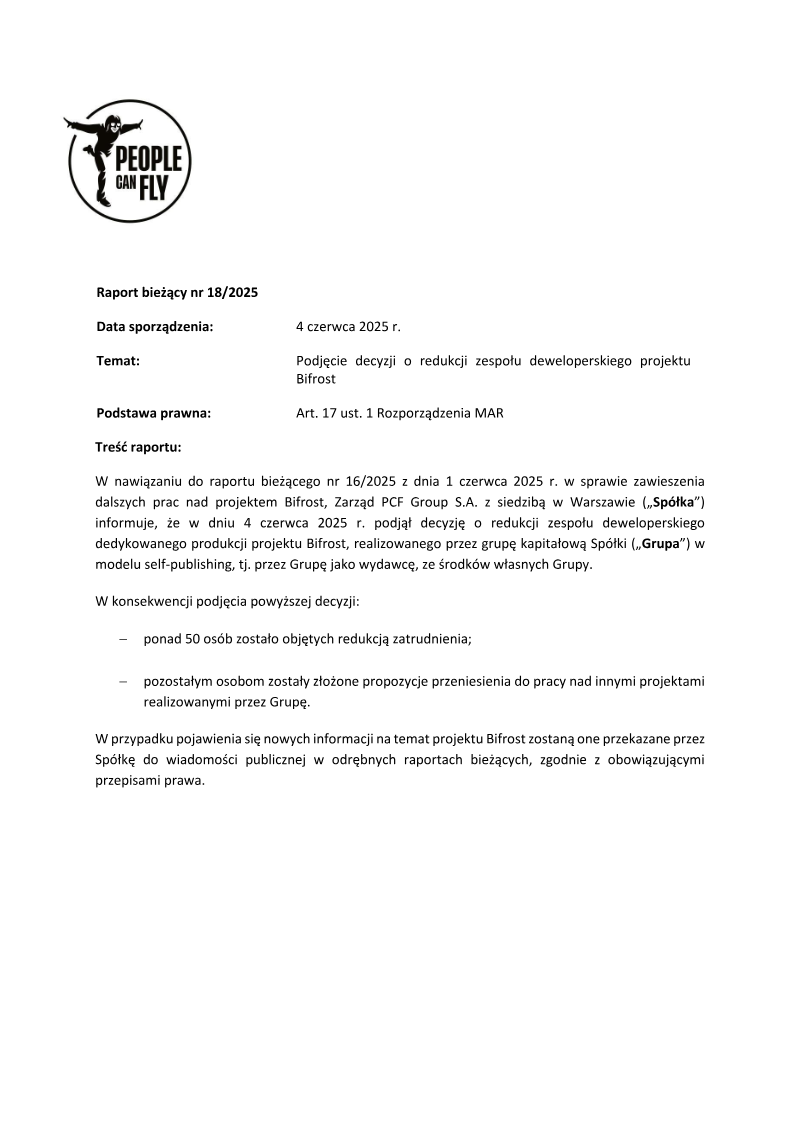
The decision to downsize the development team for the Bifrost project was formally adopted on 4 June 2025 by the board of PCF Group S.A., headquartered in Warsaw, invoking the authority granted under Article 17, paragraph 1 of the MAR Regulation. The primary objective of the decision is to align the project’s staffing levels with the company’s strategic shift toward self‑publishing, financed entirely from the Group’s own resources. Implementation of the decision will affect more than fifty employees, who are subject to termination of employment. Remaining staff members have been offered relocation to other ongoing projects within the Group, reflecting an effort to retain talent while consolidating development activities. The action follows an earlier suspension of work on Bifrost reported on 1 June 2025, indicating a continued reassessment of the project’s viability. The scope of the announcement is limited to PCF Group’s internal operations, covering its Warsaw‑based corporate entity and its self‑publishing development model. No external market or geographic data are presented, and the report does not rely on survey methodology; instead, it is based on internal governance procedures and legal compliance requirements. Future updates concerning Bifrost will be communicated through separate current reports in accordance with applicable legal provisions.