1 free read left. Create a free account for unlimited reading + AI research.
Create free accountArticle Game Production Alchemist
1 free read left. Create a free account for unlimited reading + AI research.
Create free accountArticleGame Production Alchemist
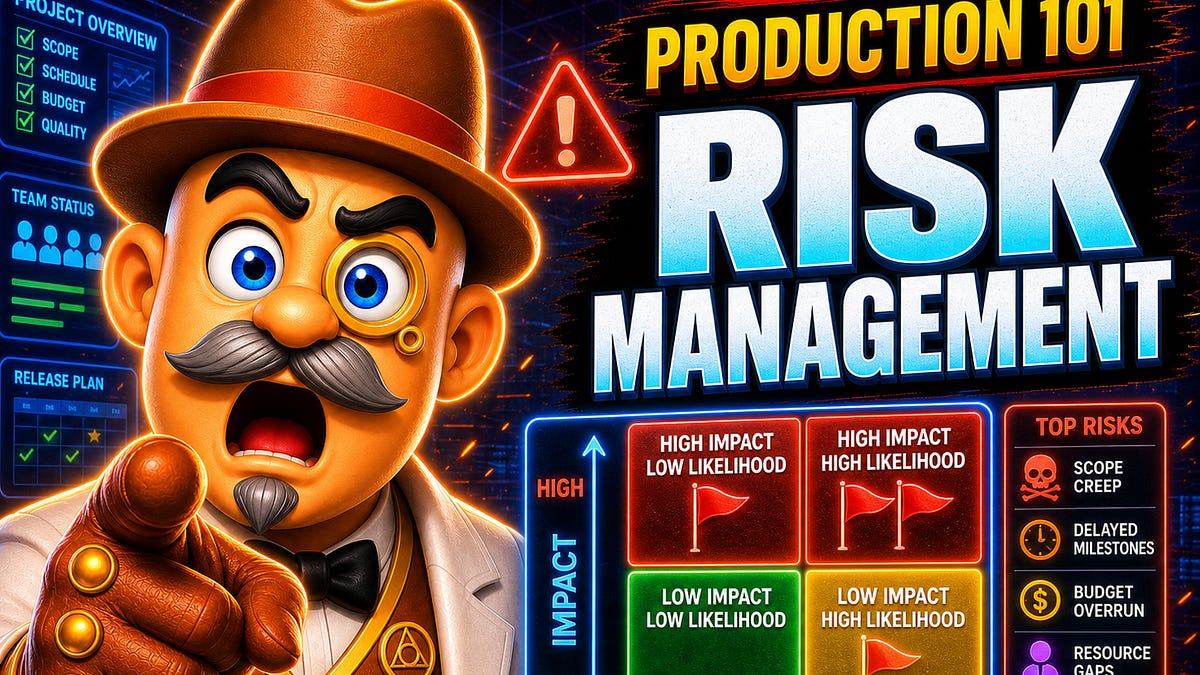
Risks are potential future events that require contingency planning. Issues are current problems that demand immediate resolution and ownership.
Effective risk management in game production requires moving beyond passive status reporting to active, anticipatory planning. The core thesis is that a risk register serves only as a historical record unless it is integrated into a dynamic management layer where risks are clearly defined, assigned to owners, and reviewed regularly. A fundamental distinction must be maintained between risks, which are potential future events requiring contingency, and issues, which are current problems requiring immediate resolution.
To be effective, risk identification must be a collective, team-wide effort rather than a solitary administrative task. Risks should be articulated using an "if-then" format to clarify the cause, event, and impact, allowing for more precise scoring and prioritization. While probability and impact matrices serve as useful thinking aids, they should be supplemented by the intuition of experienced producers. Once identified, risks should be managed through five distinct strategies: mitigation, avoidance, acceptance, monitoring with prepared contingencies, and transfer.
The methodology emphasizes that process alone cannot solve cultural deficiencies. Successful studios foster an environment where surfacing bad news is valued rather than penalized. Without this cultural foundation, risk registers become stagnant documents that fail to prevent crises. Ultimately, the producer’s role is to act as an early warning system, ensuring that risks are surfaced and escalated to the appropriate level of authority—whether that involves budget or strategic decision-making—long before they materialize into project-threatening issues.
Game Production Alchemist · 2026
Game Production Alchemist · 2026
Game Production Alchemist · 2026
Game Production Alchemist · 2026
Game Production Alchemist · 2026
Game Production Alchemist · 2026

Game Production Alchemist · 2026

Game Production Alchemist · 2026

Game Production Alchemist · 2026

Game Production Alchemist · 2026

Game Production Alchemist · 2026

Game Production Alchemist · 2026

Thomas Brush · 2026








Comments