1 free read left. Create a free account for unlimited reading + AI research.
Create free accountArticle Game Production Alchemist
1 free read left. Create a free account for unlimited reading + AI research.
Create free accountArticleGame Production Alchemist
A case study showed team throughput plummeting from 26 to 11 items per week. Over half of the active tasks became significant outliers during this period.
It's like a car slowly going off course without the driver noticing until it's far from the intended path.
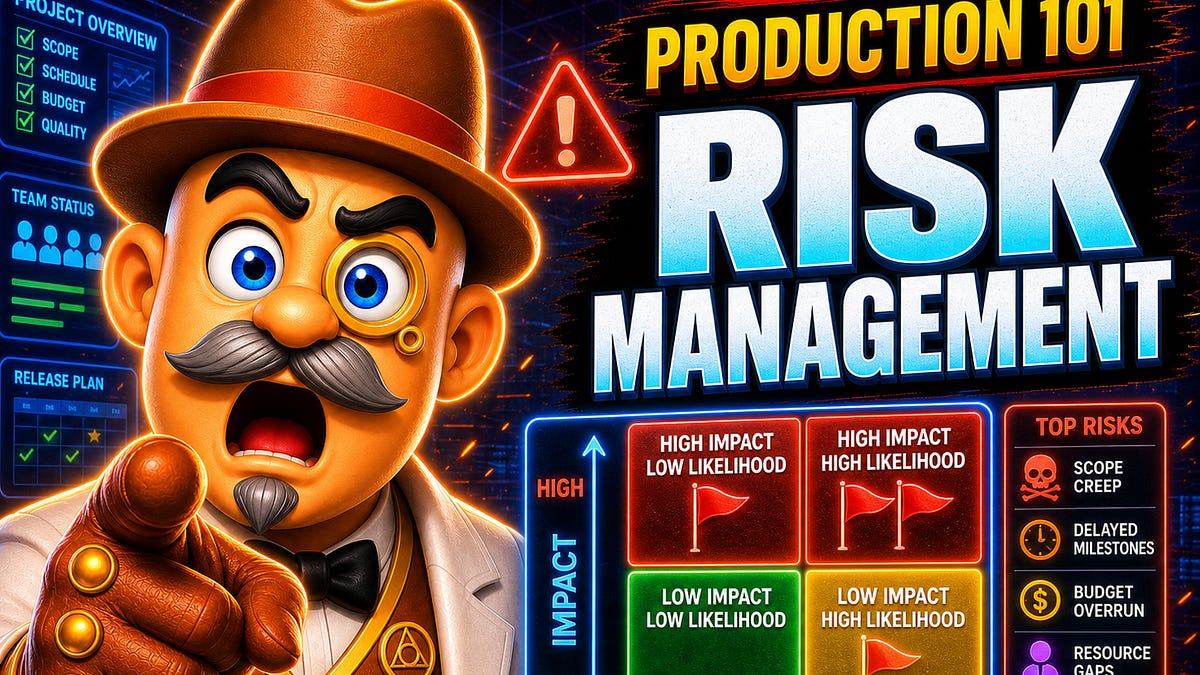
The primary objective of this analysis is to demonstrate how AI agents can be utilized in game production to identify and mitigate operational "drift"—the gradual accumulation of unseen project problems—before they escalate into critical delays. By automating the monitoring of production data, teams can shift from reactive crisis management to proactive, data-driven decision-making. The core thesis posits that while AI agents are highly effective at surfacing anomalies and maintaining data integrity, human producers must retain final decision-making authority, as the agents serve to clarify signals rather than perform complex mathematical judgments.
Key findings highlight the severe impact of unmonitored project drift, illustrated by a case study where a team’s throughput plummeted from 26 to 11 items per week, while over half of the active tasks became significant outliers. To combat this, seven specific AI-driven use cases are proposed: tracker configuration audits, standardized reporting definitions, automated risk tagging, blocked-work sweeps, scope-creep monitoring, ageing alerts for stagnant tasks, and Monte Carlo forecasting. These tools ensure that project status reports are grounded in evidence rather than subjective assessments.
The scope of this analysis is focused on professional game production environments, drawing from insights presented at the 2026 International Game Developers Conference (IGDC). The methodology relies on comparative snapshot analysis, where AI agents perform high-frequency audits of project management software to detect inconsistencies in workflows and delivery rates. By implementing these automated oversight mechanisms, production teams can achieve greater predictability and ensure that project health metrics remain accurate and actionable throughout the development lifecycle.
Game Production Alchemist · 2026
Game Production Alchemist · 2026

Game Production Alchemist · 2026
Game Production Alchemist · 2026

Game Production Alchemist · 2026
Game Production Alchemist · 2026

Game Production Alchemist · 2026

Game Production Alchemist · 2026

Game Production Alchemist · 2026

Game Production Alchemist · 2026

Game Production Alchemist · 2026

Game Production Alchemist · 2026
Naavik · 2025