1 free read left. Create a free account for unlimited reading + AI research.
Create free account🧙 Solo Dev Journey #2: Am I Making ANY Money?
Key insights
6 takeaways- 01Aggressive paid UA scaling creates a compounding effect by boosting organic install volume alongside paid acquisition.
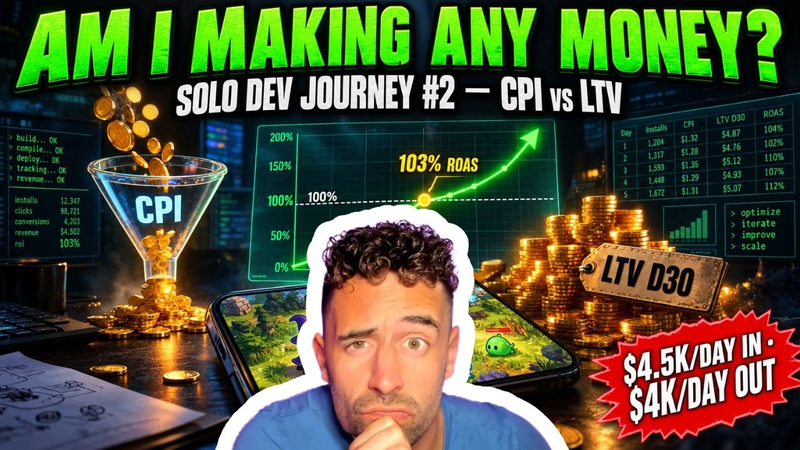
- 02The developer achieved a 103% return on ad spend (ROAS) over a 30-day period by scaling daily UA expenditure from $200 to $2,500.
- 03Profitability in mobile UA is driven by the relationship between CPI and LTV over a defined payback window rather than immediate day-zero returns.
- 04Data aggregation and attribution should be managed through platforms like Singular, with custom dashboards required to filter out fraudulent activity such as sideloaded APKs and fake in-app purchases.
- 05LTV must be tracked across specific intervals—D7, D30, and D90—to determine the point at which retention curves stabilize and justify continued spending.
- 06Successful UA strategy requires a diversified channel mix—including AppLovin, Unity Ads, Google, and Mintegral—because each channel, geography, and creative asset produces a unique LTV curve.
Ask AI about this video
Transcript
So, in that case, obviously, I want to spend more, because if you spend more, you will get more money back. So, I started spending and going from 200 per day until 1K within pretty much a week. And then, you see some of these days are already kind of almost in profit. The whole month is 103%. In my opinion, is very decent.
[music] [music] [music] [music] [music]
[music] [music]
Okay, real talk before we start. This episode is brought to you by Potensic. And if you're a mobile game publisher tired of leaving money on the table, then listen up. Potensic is a premium ad network built by people who have actually been on both sides of this industry, game publishers, agencies, successful exits. So, they get it. Here's the thing. Potensic has direct deals with Amazon, Apple, Coca-Cola, Vodafone. It's not programmatic. It's direct. Those budgets land in your game at premium CPMs, no middleman tax. And they handle everything with their in-house team in terms of the creatives. Plus, they've partnered with playable maker, Vungle. So, they will take brands' YouTube videos or static images and actually
turn them into playable ads or even video. Proper interactive format built for gaming inventory. Brands getting a gaming native creative. Publishers are getting a higher CPMs. Everyone wins. Head to potentials.com to get started or check their creative portfolio in the link in the show notes. Thank you very much Potentials for sponsoring this episode. Hello, guys. This is Mate Loncaric and I think this is going to be another version of the solo dev journey. So, it's number two. I'm doing this because the first one had an amazing success and it was an amazing success. You got you sent really nice and warm feedback. So, I have decided to do it more often. Then, if you want you know more about my game dev arm and let's call it the dev journey, let me know what you want to
know and I'm going to be very much glad to answer all your questions. Anyway, enough of this this Today, I'm going to talk about mainly about CPI versus LTV equation and the question about oh, am I making any money? Because even though I love games and I love kind of spending time playing them obviously and also making different games on on my game account with my game developer team because obviously I'm not making all of these games by myself. I want to get at least a little bit of sleep. I'm still working as a UA consultant. We have Playable Maker with Andre and Tibor and I have a UA well, not UA team. I'm the team, but I have the motion designers for creative work and also a few programmers already for the actual dev work.
So, let's talk about actual money making cuz even my developers and my friend always asking, "Is this making money?" And when I'm telling them, "I'm spending 4K a day, make make Well, I'm spending 4 and 1/2 K per day and making 4K per day and I am happy about that." They're asking, "Oh, well, but that doesn't make any sense. It's still, you know, it's still not enough." So, how does the whole CPI versus LTV equation work? I already kind of spoke about this in the past and also written an article about it. Now, I'm going to just show you all the numbers from a singular account and walk you through different things that, you know, as a developer and pretty much UA person need to talk about. So, I I'm showing you the numbers from August 2026 until
pretty much now. Well, November, this still didn't happen yet. Anyway, so we have this journey and I started started kind of working on this since April, so I'm not showing you the whole picture, but I don't think that's relevant that much, but anyway. So, going from spending 2.7 K per day to let's say five or four or five K per day or four to 4.5. And here is the So, this is the red daily spent and here's the daily revenue. What you need to think about is very important, which is you are your cost per install is, let's say, $2. And your LTV and lifetime value, let's say, is 2.5, but the time frame is very important. So, it's lifetime value on day 7, day 30, day 90, day 365 or day 730. It's always in time. So, it's not day
zero because your players are playing the game, they have certain retention, day one retention, day three, day seven, day X retention, and then you look at the lifetime value. And lifetime value there is the time element. It's not always on day one, which makes no sense. The day one our lifetime value is only premium games where you buy the game, you pay, and that's it. Here, your players play in time, and they decide to pay in different time frames or in their life in their player journey. Let's say on day one, it's also on day 30, day 60, day 90, and their LTV increase over time. Until there's pretty much nobody going in the game or they churn. That's why if I'm spending 2K per day or 2.5 K per day, I want to see this money back in 30 days. So, that's my payback period, which is 30 days. Cuz I know after 30 days,
it's maybe 1 or 2% of the players still playing this game, which I'm not talking about Robot Robot Wreckage, for example. I mean, the real number is maybe 3 or 4%, but it doesn't matter. Let's say the day 60 retention is 0.5%. So, I am have to be absolutely sure I get all the money that I spent in 60 days. If I don't, then I can say I'm losing money. So, for example, if I scroll here and I have this table, so let's say I spent on September 15th, $1.7,000. Then, you know, on the day one I got back already 800. Then, on day two 1,000, on day three 1,050, and that's how it increases. And then, after 30 days, I already have
100 1%. On this day, I already got 122 day 20%. On some of these other days, I didn't even get to this level of spend, right? Because for whatever reasons, I was spending unprofitably, I was testing different channels, I was doing whatever. You don't have the context, so it doesn't matter. But this is this is the number, or it's it's going to actually take a little bit longer to to get that money back. So, I'm I can tell you in these couple of months, already spent 250k and got back 170. Which is, again, I'm still lacking $70,000, but eventually it's will come it's going to come. Because if, let's say, I'm going to show you last month for One Man Army, because I launched an interesting game that is kind of
growing nice, let's put it that way. And it's when I'm recording this, it's October 20. It's pretty much 20 days until the last day of September. So, I would like to see the money back at least on some days in 100 or 120%. So, now I'm it's while it's loading, this is the CPI versus LTV. You need to be sure that whatever you're spending, you're getting the money back in certain period of time. And that's I that's what I always care about. And it doesn't really need to be in first couple of days. It's impossible. I mean, hyper-casual games, they usually were trying to get the money back in 7 days because front-loaded with ads, shitty day 7 to day 30 to day retention because pretty much nobody was playing those games anymore. And different games have very different retention profiles.
But anyway, so let's see if I have Okay, so I do have actually some data in here. So I launched the game, which is 1 major 6th of or 7th of September. And step-by-step, I was, you know, increasing. I was talking about this in the last podcast. I launched AppLovin and Facebook. And first couple of days, you know, it's always very shaky and whatnot. So first days, nobody cares. But then it's actually started to work. So I already have 120% ROAS. In some of the days, 200% ROAS because I started spending and then obviously if I see a good numbers, I'm working in UA 12 years. So when I'm seeing numbers like day 1 ROAS, 60%. That's very cool because that's very high. I'm usually not seeing these types of numbers. 80%, 75%. So this in my book is very
good. So in that case, obviously I want to spend more because if you spend more, you will get more money back. So I started spending and going from 200 per day until 1K within pretty much a week. And then, you see, some of these days are already kind of almost in profit. The whole month is 1 103%. ROAS, which again, in my opinion, is very decent for 40K spend. Obviously, it's not for 100,000 spend, but you know, we will get there eventually, step by step. I'm not in a rush. I don't think the game is ready for that type of scale, but it will eventually get there. We need more features, spend depth, and whatnot. I think that one major army is maybe 20 30 30% feature ready. So, again, mark my words, we will get there. Already getting interesting emails from different publishers. Anyway, so we went
for well, I went from spending 200 per day to 1.5 to 2,500 600, and then it was kind of going around this 200 2,500 per day. And getting the money back in less than 30 days. Which is very important. So, CPA versus LTV, that is very important. Also, the thing is each of the channels have very different LTV curves and very different audience. So, when I'm looking at the the the channel mix, as I said, I started with AppLovin and Facebook, then organic started to wake up, which is kind of a function of the UA anyway, because here the game was on the on the store, but no nothing was happening until a week afterwards, and then it starts to kind of work. Then I I added also Unity Ads, which is very surprising, because
honestly, as I mentioned on the different podcasts, I wasn't really very big fan of uh Unity Ads. Not at all. But uh you know, I don't know like what kind of happened, but suddenly I felt like this is a good place uh to start with or like continue with, and then eventually I I added also uh Google Ads. And pretty much Facebook started well, AppLovin started really bad. That's what I mentioned in the previous episode. But then it's all kind of shifted and changed. Right now or back in the like end of September AppLovin was working really well and it's still one of the best channels. And Facebook and another one and pretty much everything was in line with what what I expected. Also this is still all just Android. Also when you're looking at the the CPI versus LTV equation
usually iOS and Android are very different and very different, you know, because CPI on iOS tends to be higher but also higher quality. CPI and Android tends to be lower, also slightly lower quality. And then there's the the question about different types of organics here and there and whatnot. So it's a complex question. But we can always answer all the questions. In my opinion in in my case all of these organic installs and revenues are pretty much very much tied to the actual UA and how much money I spend because I see as soon as I spend more organics go up as well. If I spend less organic goes go down. You need to kind of factor this into the into the whole equation. So pretty much this is end of end of September and right now when I'm
looking at the the October spend we had it around 2.8 to 4.something. But still very very much spending on these channels. I added Mintegral into the mix. Thanks to the the good friends from Mintegral and started very slow but now it's actually picking up quite nicely. And then, you know, I never thought I will going to I will going to have this problem, but I started seeing like weird spikes. Here, Facebook. Here, organics. I was like, I'm looking at the campaigns. Suddenly, I see like 90 purchases from Germany. But as you know, as the UA manager, and let's call it the game owner, and the whole owner of the whole like game department is like, oh. I'm looking at the purchases on Google Play console every day.
And order management, I'm looking at what's happening. And I was looking at it as like, huh, I don't see like so many German like pay- payments from Germany like suddenly. I don't really see There's also like Vietnamese here in this organics. Huh, I don't see Vietnamese currency in the Google Play console. What's happening? So pretty much, I the game got a little bit popular, so I actually started seeing cheaters and people that side loaded uh SDKs and APKs Well, not SDKs, APKs. And I was getting all these fake uh inner purchase in here. I was like, huh. That's not good. Also, I don't really want to send these fake uh inner purchase to any of the channels because that's going to up the learnings and algorithms, and I don't really want to see cheaters. But obviously, it wasn't my fault I didn't add license key.
And in here, pretty much in singular, uh no, yeah, I'm not going to show you the license key, but pretty much here, I can stops getting fake like not real purchases pretty much and then everything else is excluded. Anyway, so then I was like, "Okay, interesting. I really want to see the actual kind of the the performance." So, then I [snorts] I built this interesting dashboard on my end. Well, not my end, on the on the the cloud side. And then added pretty much screenshots from all the all all the channels, the the MCP from Singulars. I got all the all the installs from it and the and revenues from Singular. At the same time, the screenshots and like all the data as CSV exports from Google Play Console and App Store Console as well.
And removed all the all the fake in-app purchases. And built pretty much this dashboard so I can actually watch like what's working, what's not working, which countries are working, what what is the the spend versus in-app revenues. Well, not even all of them. All the revenues. Android versus iOS. And like how the cohorts actually, you know, evolve over time because that is very very important because again, as I said, I want to see the cohorts evolve over time and then still kind of measure over time so I get the money back because you know, even though I like games, still need, you know, to pay the bills. So, I built all of these. I mean, it's pretty much the same thing as I see I have in Singular, but as soon as I kind of fixed the fake in-app revenue um showing and like sending, then I don't really need this. But it's a good exercise because then
from here, I actually go to all the different channels and then have different chats. For example, with Unity setup and and pretty much every every day I'm pulling the numbers, getting all the information from from all the channels, and making decisions on a on a daily basis. And what does that mean is that I'm getting creative data, I'm getting channel level data because this Unity, but I have uplab in mintegral, pretty much everything. And then because I mean, I'm obviously I'm going to Singular and looking at all of these. But here, I'm actually asking a question, get me this, get me that, so I can make a decisions because I also have a like UA senior skill in Cloud, which is pretty much me. So, I'm talking to myself and and getting the all the data from MCP, which would take me years and
eternity to to get it. So, for you as a, you know, as the the game developer, what you need to understand is how much money you pay for the install, what channel is it, how the LTV evolves over time, which is here. And then, because again, if you have if you are paying $2 CPI, you need to get 2.5 at least, if not more in certain amount of time. This is very important for you to understand like how this evolution looks like and where the curve plateaus because then, if it plateaus in around 30 days, like that's that's it. That's where you need to have the money back, no kind of questions. And then, you kind of reverse engineer like how much money you can spend to actually get this number, and then you go from there. You add different channels because different channels, different LTV curves. And then, that's pretty much it. Also, look at the geo level and the
creative level because not even channels have different LTV curves, but also creatives. That's why, you know, we have the creative discussion about fake ads. How does that work? We can talk about it later. And then also different geo- geos. My main geos are US now, but second one is Korea on Android and then Germany on iOS is actually Japan and then Germany. So, you know, different things. And then you need to tailor the UA activities to these different channels, creatives, and geos. So, I guess that's it, guys. So, if you have any questions, and I mean any, I use the old all the data here pretty much. So, I don't care. I'm here for you. And if you need more information, and you need to know like what this means and how you should think about scaling your game, growing the UA, what you should do, let me know in the comment section. And then that's going to be the third
episode of this solo dev journey. And thank you very much for listening. See you next time. Or see you in the comment section. Thank you very much. Yes. Bye-bye.
Summary
This analysis examines the financial mechanics of mobile game user acquisition (UA) through the lens of a solo developer managing the title One Mage Army. The core thesis posits that profitability in mobile gaming is not determined by immediate day-zero returns, but by the relationship between cost per install (CPI) and lifetime value (LTV) over a defined payback window. By analyzing cohort performance over 30 to 60 days, developers can justify spending levels that appear unprofitable on a daily basis but yield positive returns as retention curves stabilize.
Key findings emphasize that LTV is a time-dependent metric that must be tracked across specific intervals—D7, D30, D90, and beyond—to accurately assess the viability of a game. For One Mage Army, the developer achieved a 103% return on ad spend (ROAS) over a one-month period by scaling daily spend from $200 to $2,500. The analysis highlights that organic installs often correlate with paid UA volume, suggesting that aggressive scaling can create a compounding effect on total user acquisition.
Methodologically, the developer utilizes Singular for data aggregation and attribution, supplemented by custom dashboards to filter out fraudulent activity, such as sideloaded APKs and faked in-app purchases from specific regions. The strategy involves a diversified channel mix—including AppLovin, Unity Ads, Google, and Mintegral—noting that each channel, geography, and creative asset possesses a unique LTV curve. The developer concludes that successful scaling requires tailoring UA activities to these specific variables, ensuring that the payback period aligns with the point at which the retention curve flattens, thereby maintaining financial sustainability while the game remains in early development.










Comments