VideoDeconstructor of Fun
Match Masters' Influencer Marketing Playbook: 8 Years of Always-On Growth
1 Jun 202647 min video
We start the promotion with hey, you want a chance to win two tickets to the World Cup final.
I'll play that. Where's that?
Exactly. It's get their attention. So, what you need to do?
[music]
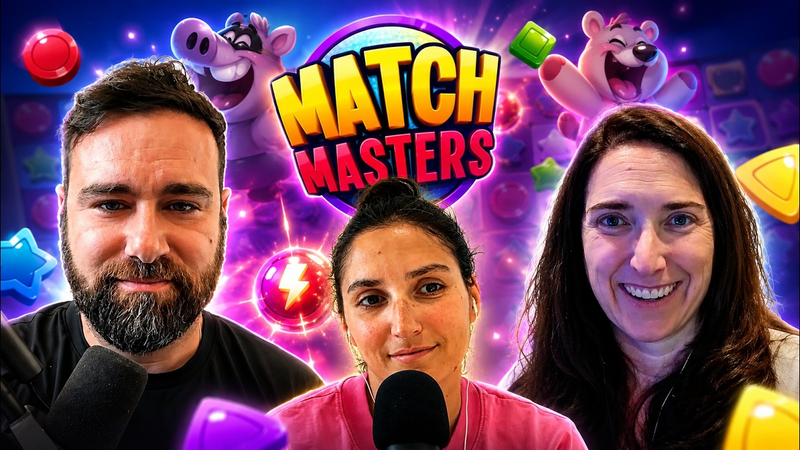
Hello everyone. Welcome to Deconstructor Fun interview series. I'm Jen Donahoe and on today's episode, we are going to tackle influencer marketing again. We did a podcast last year. So, what I wanted to do was actually go deeper into influencer marketing because this is a channel that has moved from a nice to have to a core pillar of mobile game growth. The best studios treat it as a brand moment. The rare place where you can get a little bit of attribution of the performance marketing and a little bit of lift of brand awareness all in the same campaign. So, this episode is about going into the details. We're going to talk about how you run them, measure them. This isn't 101 anymore. We're going a lot deeper. So, I'd like to welcome Marion Well, Marion
Balanof. So, Marion joined me on a podcast last year and she's an influencer marketing consultant who works with mobile game studios like Wooga and Supercell on so many great in influencer marketing campaigns. We actually had a chance to work together with a client, too. So, that was like super fun. So, I wanted to bring her back, but I also wanted to bring someone new. So, Aviv is joining us. He is the influencer marketing leader at Candivore and they are the studio behind Match Masters. If you haven't played, it's an PVP match three game. So, you all have been running influencer marketing as a core channel for the last eight years. I know you've been there two years, right Aviv? Is that what you said? But, I mean just amazing to talk to somebody who has had a team that really believed in this as a channel for such a long time. All right. Attention app and game developers. The difference between scaling and failing comes down to one thing, intelligence. Sensor Tower delivers the ultimate competitive edge that separates market
leaders from the forgotten. Their platform doesn't just show you what's happening across global app stores, it reveals why it's happening and what to do about it. Need to crack new markets, track competitor UA performance in real time, reverse engineer the monetization strategies powering today's billion-dollar games. Sensor Tower transforms impregnable market noise into actionable signals. The platform goes beyond raw data offering intuitive tools and expert analysis that convert insights into revenue-generating decisions. That's why thousands of studios from scrappy Indies to global powerhouses rely on Sensor Tower to outmaneuver the competition. Stop flying blind, start your free trial today at sensortower.com. That's sensortower.com.
Guessing where your users come from? That's so 2010. AppsFlyer is like having a cheat code for mobile marketing. Pinpoint attribution, real-time
insights, and analytics that actually make sense. Stop flying blind and start flying smart. AppsFlyer, because your data is your best co-op partner.
[clears throat]
So, welcome. And we are going to jump right in. So, our first question, Marian, I'm going to direct this at you since we're going to talk a little bit of strategy first. Influencer marketing feels almost as important as traditional marketing and traditional user acquisition, especially as you think about all of the challenges that we're facing in getting attention. So, I like to call this brandformance. I think one of our friends, Sara, used to say this and and taught me this term and now I use it everywhere, which is the combination of the intersection of brand marketing, which is awareness marketing, a little bit harder to track, with performance marketing, which we all think is absolutely attributable to every single person and penny, you know, we all know that the the real answer is somewhere in between that. And I think influencer marketing does a great job of
literally sitting in between those two things if you were to put them on a spectrum. So, let's start with you Mary Ann. What role should influencer marketing play in today's growth stack? And how do you see this as a key strategy as we look at game growth, as we look at how do you bring more players into the game?
Peyton, uh yeah, thank you very much for having me again. So, as you said, I think it really is about how do you see influencer marketing, right? So, it sits at the intersection of both performance and brand. So, you do get attributed installs, but it's not the full picture, right? So, many of it comes organically and it's really important that you take that into consideration when you look at the performance because otherwise, you have no chance of reaching profitability. The biggest problem that I see is that a lot of us used to treat it as an experiment, right? So, it's like let's try it once, we have some budget left, and then it doesn't yield the results that you want, and then basically they cut it. But the the the winning strategies are the ones that make it work are the ones that have been having
it as a permanent pillar and not as just a seasonal add-on. This is a great graph here where we see a company that was investing in influencer marketing for a very long time. This is a game that is 10 years old, right? So, the decline in install is just what the life cycle of that game was. And so, during the time when we had influencer marketing investment, you could see that uh the installs were declining at around 2.56% per month, right? Over the last 2 years. But then, once they cut the influencer marketing spend, the decline actually increased, and so the decline actually was 2.7 faster just because there was no influencer marketing. The correlation between influencer marketing that sits in a way at the top of the funnel, It does do branding, it does create trust with the audience, and that does help, you know, with installs and with a lot of things in in the growth stack. So, the thing is that it should not be competing with paid UA. It just makes it more efficient.
Yeah, I get that a lot, which is are these channels in a sense competing with each other? Um I I think sometimes you have to think about them separately in order to kind of prove their benefit, but what I try to tell people is that marketing campaigns have to stack. All All boats rise.
Exactly, yeah. Like influencer marketing really feels the whole the whole growth system. It will, you know, generate UA creatives because you have content creators creating content. It will lift App Store rankings. It will stabilize the AUs because you have ongoing content where influencers are talking about it. And obviously, as we were just saying, it reduces CPI. So, I understand the need to identify the impact of each channels individually, but at the same time, if you look at it holistically, it is much more powerful.
That's a good segue to Aviv. Let me get you in on the conversation. So, Candy Crush has really stood out because you built influencer marketing for Match Masters from day one. Super impressive that even 8 years ago, you know, the
team really thought about that being such a dedicated piece of it. So, I think you have a three-person team, too, and you use a blitz model where every creator goes live on the same day, and you do a split test markets where you evaluate all these on potential and established countries that run on a monthly cadence. So, first, what has been the influence and the impact of this strategy on the channel? So, let's talk about that first, and then you're Walk us through it like how you think about this. When we talked offline in our pre-meeting, I was super impressed with the way that you all think about the strategy to the planning to the execution. It feels different. So, so walk us through that.
Uh so, first, Jen, thanks for having me. Super exciting to be here. So, yes, exactly as you mentioned, in Candy Crush we run influencer campaigns since day one of the marketing, which is 8 years ago. It's incremental part of the marketing budget, and we saw the influencer marketing not a niche, we saw
it as a growth engine for all the marketing activity. We are performance-driven company, and influencer is not brand awareness for us, it's another performance tool for getting very high-value audience, and track them, and analyze the results, and improve. We can see the result, we track them on our internal analytics tools. There is a lot of impacts for influencer campaigns. First, like we can identify high retention in influencer campaigns compared to any other media source, especially for user acquisition. The users that came to our the theater is really intent. They are warm, they have more time to hear about the game, and not like just seeing an ad and click it. Again, as Marion said, we see organic lift, also, which contribute to all the dow, everything. And it is also the productivity and the store ranking.
Regarding the process, exactly as you mentioned, we have like a method of always-on campaigns in few countries that works really good for us, and we try every time to promote the app with different creators and different verticals, and we have always test new markets for penetrate them. It leads me to other topic that is very interesting about agencies. We are usually working with agencies, especially for non-English speaking markets. There is very high impact and power for local agency. They know their market better than all their creators and in some cases they have like much better rates for the creators. It's you want to work with them. And also they reduce all the bureaucracy. As you mentioned, we are three people in the team and we have a lot of tasks on the table.
Yeah.
So working with an agency provide good relationship with them is something that is critical for the success of the campaign. I can mention some agencies that we are work with.
I'm sure they would appreciate you giving them a shout-out if you don't mind.
Yeah, sure. So Cherry Pick Talent from UK. OMG for me as well, actually.
Oh, nice.
We have like a weekly meeting with them, strategy meeting. We decide together based on our data and their recommendation and their knowledge, especially with other mobile gaming apps about new creators, new verticals that we want to try. Vertical if if someone is not familiar is like the type of content of the creators. Could be like DIY or fashion or travel or gossip. We always try to test new verticals.
Oh, that I love that that process. I want to go back on something you said because I really need people to understand this and you were willing to share a number with me. Talk a little
bit more about organic uplift and what numbers you have seen kind of be successful. I can talk about the ranges I've seen, but what have you seen on like general organic uplift when you run IM campaigns?
Yeah. So here we can see the contribution of organic lift of influencer campaign. In this graph the red line is influencer and we see the installs over the date. The blue one is the organic and the yellow is is paid. So we can see the direct impact when we see the spike on the influencers install. Immediately, it affect their organic installs, okay? What we see here is for in the campaign that we made in Israel. And again, it's make sense. Sometimes it's like something that catch you and you go to the store or just share it to friend or anything else. And we can see that there is a correlation between the influence activity and the paid. But, the
contribution for the organic uplift, it's much higher. And like the delta here is all the incremental list that relate directly to influencer. So, like this is why we see the spike in 2 days and then the decrease.
Awesome. And you generally see about a 30% organic uplift when you're running these tests. Is that about how it works?
Usually, yes. When we do like a blitz or mini blitz to one country, it affects positively on the App Stores. When like Google Play or Apple see like an increase on the installs in specific country, it automatic like you will arise in the leaderboard of the top charts of the country, okay? So, it's like a cycle. It's like positive effect that affect one of each other.
Something important to mention, I think is about this organic uplift cuz it will vary from one game to another, from one audience to another, from one country to another.
Yeah.
If Aviv is around 30%, it's also because a lot of the campaigns that they run at Much Masters are with giveaways. And so, those in that sense, they are forcing the audience to click the link to be part of the campaign. So, a lot of the traffic is already going to be attributed directly because they're clicking the link. For other campaigns where you don't necessarily run those giveaways or like where you have a gift link or something like that, you might have a far higher share of organic traffic up to sometimes 100% of the attributed traffic.
Oh, understood. That makes it a lot of sense. Actually, attribution is a topic I really wanted to get into because it is, you know, my life every day. I'm sure yours as well. It's everyone asking you how did it do?
Very much.
So, let's get into that. So, it's a it's a key reason why actually many I mean, you and I both Marian as we talked to clients, they're like, "I don't really want to do these campaigns because this UA stuff I tend to know what how it does." It also runs on a very short click window in many cases 24 hours.
Influencer content needs a a longer window. Although, Aviv, you're showing us that in some cases in some countries it can actually move the needle very quickly, but in general it needs a little bit longer. You need to have discovery. You need to have you know, time for that download. So, Marian, can you walk us through how do you approach modeling the direct attribution piece to help showcase the value of influencer marketing? I know we've talked a little bit now about organic. So, let's talk about like the performance side of the brand performance of influencer marketing.
Yeah, so I think it's something we touched upon briefly with Aviv example. The key information there was that it was Instagram stories. So, we know Instagram stories are only live for 24 hours. So, that's why in that specific case it was interesting to look at the the performance only on such a short window. But, when you look at other pieces of content that live for so much longer than 24 hours, you know, they get views 7 days after, 30 days after, years after sometimes. And so, if we look into the attribution it's basically broken
for influencers because as you said like in in traditional user acquisition, you look at it on a 24-hour window. But, we know that those videos are being watched long after that. So, what I recommend is at least a 7-day minimum click window. And then on top of that a layer of a proxy model for the uplift because if you do not look at that, there's no chance for you to reach profitability. So, look at what happens to organic installs volume in a market like before, during, and after the campaign. And this graph is really really important because it shows you from a data set from one of the clients that I was running campaigns for, you see the amount of views that you have at day 7 and day 30, and what you see is that at day 365 you already have 50% more installs than what you have were accounting for at day 30, and in that case it was only 2 years. So, imagine if you've been running that for so long, it is really important that you look at the performance outside of that day 7, day 30 window because yes, on paper your CPI at day 30 is going to be far more expensive than what you see on on Meta
or Google, but if you look at day 365 or 2 years or even lifetime, it's going to be far lower than what you were accounting for. And this still generates a lot of traffic and a lot of exposure for your game or your app. If you think about it, you still have those tracking links in those posts that people can still click on, so you still get attributed installs, but then you have to look into that long tail. It is going to be harder for you to estimate, but it is really important to at least consider all those additional attributed installs beyond the campaign window because when you stop investing in influencer marketing, your campaign don't stop, they keep on living, you know, almost forever.
The other thing I do when I when I make a style guide. So, a lot of times people will yell at me and they're like, you want to spend $200,000 to make a style guide? And in one case, when I was working on Teamfight Tactics, we spent money on to create a style guide, and 6, 7, 8 years later, they're still using those same style guide, the same logos, the same lockup, the same character art.
And and so, in a sense that investment amortizes over time, it becomes almost evergreen. And so, I think this is the same kind of idea is where you invest in this, it can still work for you over time.
100%.
Awesome.
I have I have a great example for that on one of our campaign in the UK, the initial results wasn't good at all in one of the creators. And when we check it like after 3 months, 4 months, we saw a spike in our wine in in a purchases. And I've checked so we we we caught a whale. So I I dig into that to see when this whale was and why took so much time to convert him. And what I revealed that that this whale installed the app around 40 15 days since the publish date. So it's a long tail that leaps all the the results. So I'm I'm absolutely agree with Marion especially for YouTube. Yeah, it's something that that can happen.
I love that. I love that influencer marketing allows you to go fishing for whales, too. It's not just UA, it's not other things. I think that's awesome. Actually, Aviva, I wanted to ask you a little bit about, you know, some of the attribution concerns and tracking links in the 7-day window. You talked a little bit earlier about and Marion mentioned that you have this giveaway mechanic. So it ties in-game rewards directly to those links, which I think is absolutely brilliant, right? Like let's incentivize everybody to click on that link so that we all know where people come from. So could you walk us through, you know, the user journey? Like what does a viewer see from a creator? And then how do they go into the game? How do they unlock that during a product marketing event? And, you know, I think this is really a system that proves the value of influencer marketing.
Yeah. So first, I must say that the lack of attribution is one of my pain point and for my colleagues, too, especially for the influencers marketing field. So we found a method in Candy Bowl to like jump over this obstacle and solve it. So
we are [clears throat] running a giveaway campaign. It means that we run an in-app event. It's like a competition for all the users. This competition is like could take like few days, typically between 1 week to 2 weeks. And one or maybe in some cases more of the users can win a tangible prize with high value. It's something that in most of the time we give the influencer like a budget and the influencer decide what the giveaway will be because they know the audience, they know what they like. The only one that can play and participate in this giveaway is the users that click the link. So, if they install the app organically, they will not enter to the giveaway. They don't have a chance to win the prize, okay? And the influencers really emphasize it during the promotion, okay?
You have to click this link to get this, right?
Exactly. It's not like click here and download the app. Is if you not click, you don't have a chance to win this awesome prize that I showed you. And we're usually in that case we use like a hook. We start the promotion with "Hey, you want a chance to win two tickets to the World Cup final?"
I'll [laughter] play that. Where's that?
Exactly. It's catch your attention. So, what you need to do? So, now it lead me to the slides we see here. We built like a full funnel, which is kind of product marketing funnel that is dedicated for the creators.
Product people, please listen. Cuz if we had that in in other games, you would make a killing and Match Masters is doing it so brilliantly.
Yeah, this is again, I just I want people to understand. I I preach this all the time. It is one team, one dream. Product, marketing, influencer, everyone has to work together. And when you do, you can really unlock magic for
everybody. Okay, sorry. Aviv, we have just given you the floor. Go for it.
So, um here in that case I can show you an example of one influencer that is an Israeli influencer called Kevin Robin. This is like the part of the first time user experience when they enter the app. So, at the first time the user get a welcome pop-up with an art that is a dedicated for the influencer audience, okay? We can see here like a character who wear like a kind of bandana and he get like an exclusive gift from the creator. After that, the user is getting to the leaderboard. The leaderboard is part of like the stars. The method here is to earn stars. Each win you earn a few stars and the more stars do you have, you climb high in the leaderboard and then you can win the grand prize. Again, here as well is only for the users that click the link and came from Kevin promotion. And Kevin is also here here in the top of the
leaderboard. You can see it here. It takes like a few days and after the winner and the loser as well, they also get a dedicated pop-up with the same dedicated art. And after that, the stars which takes like as I mentioned, 10-40 days. After that, in some cases we proceed with another kind of product marketing tools. We can run sales with the same art of the creator. We can run calendar or day task or something like is more additional events in the game and we can trigger it only for the users that install by using the link of the creator. Um beside that, we are using it in kind of retargeting method. We checked it and in some cases, especially in cases that we work with the influencer like more than one time for a long-term collaboration, existing users can also join the race
and we see very positive impact in our purchases during the race period of existing users as well. So, imagine someone that installed the app, play, and then churned. And after a few months, he can see the promotion in the influencer that he or she likes promoting another giveaway with cool prizes. So, it makes the the user return to the app, play. So, it's again, it's kind of retargeting a method that we use. And it's some secret secrets that I can't share. But I invite everyone to download Match Masters and you will probably reveal it at that coming months.
Oh, nice. Something secret. So, super cool. So, when you use this actually also for retargeting, those players come in and they not only re-engage, but they re-spend.
They start spending and they spend at a higher level, too, right? Is that So, that's kind of the other benefit that you're seeing?
Exactly. In some cases, we see like churn. Some of them were depositors, and now it's it's easy to monetize them because they used to to make a purchase in the app. So, the side effect of the that is like the inner purchase during the the storage period is like in average six times higher than what we see on the data of new users that we reach from the creator. So, again, it could be kind of retargeting. It could be like existing users that some of their friend share with them or just existing users that also followed the creator. It's mainly happen in kind of blitz campaign that we mentioned. We are like running It could be like 20 creators at the same day, and they run the same race, the same competition. Okay? So, it's not separate by creators. It's a bit complex, but our
agency know how to deal with it. So, they promoted the same day at the same time. And then we can see like a blast.
So, Marion, I'm super fascinated by this because you and I we've always talked about gifting, right? Like, "Hey, you click on the link, you download the game, you get a gift, you get $5 value, whatever that is." And that's kind of a no-brainer and obvious. The innovation here is that you were leveraging the influencer to bring someone into a longer engagement event. And the event has not only an in-game reward, but like you're saying, an out-of-game reward, too. Like, Aviv, did I get that right?
Yeah.
Okay. Awesome. Like, Marion, like, is this the innovation? Like, I haven't heard of this before. Like, I'm dumb. This is This sounds awesome.
yeah, it is really great because it plays on, you know, people's, you know, some some out strength in the sense that you have a lot of giveaways that are just like random and luck-based where you like click and maybe you have a chance to be selected. In their case,
it's skill-based because you play the game, the more you play, the better you are, and the the more stars you earn, and the more you're at the top of that leaderboard. And so, people feel like they hold the power to actually decide of their destiny type of thing. So, that's a massive difference. The problem is the rules for giveaways and contests like that uh vary from one country to another. So, if if you're doing that, please, you know, loop in your legal team cuz you will need to be very specific, especially in terms of wordings.
I must say something here. There is some specific country that not allowed to run giveaway with tangible prizes. And we need to find like a very creative approaches to to overlap it. So, it's really good point Marion. Like, I highly recommend to check with the uh lawyers and their the legal restrictions.
Yeah, and and then in terms of like prizes, obviously, you need to have the
incentive for people to download the game, which can be an in-game item, whatever, where you translate the value of that into a currency that they understand, especially if they've never played the game before. But what Aver is doing and what he was talking about before is like all those giveaways where you have the influencer having all the items that they want to give away, which can be related to them. I don't know if it's a cooking influencer, maybe you have a robot, maybe you have something else, like a rice cooker, whatever that is. They have tons of items and it's like, "Wow, there's a lot of things to win. I might have a chance." And on top of that, but I'm the one playing the game, so the more hours I put in, the more chances I have to win one of those items. And so it makes it really, really tangible because you see those items, you see that it's related to the influencer. The influencer has chosen the item themselves because they know it that's going to appeal to the audience. And that makes it
just more personal than, "Okay, let let's win a $100 Amazon voucher or something like that."
Mhm. That makes sense.
Kick-ass live ops need kick-ass tools. That's where Heroic Labs comes in. They just released a massive update to their Satori live ops platform. And having done my research, I can say with confidence that it's second [music] to none. In a single product, you get everything you need, including event capture, player segmentation, feature flags, remote configuration, AB testing, experimentation, live events calendar, messaging, retention graphing, analytics, and so much more. If you're serious about running live services in a game, get serious about the tools you use. Connect with Heroic Labs and make some serious cheese with your live ops. Unless you've been living under a rock, you know this is Webstore Rumspringa. 70% of top apps are using a Webstore, and the best ones, they're doing it with AppCharge. Do you want a $20,000 in-app purchase? Yeah, AppCharge does that. How about using web-based Apple Pay checkout? Yeah, AppCharge does that. Do you want to pretend that subscriptions are still a viable
monetization strategy for games? Yeah, AppCharge even lets you do that. Look, these guys are backed by Supercell, Moon Active, and Playtika. They get what high average revenue per paying customer means, and they're already doing over half a billion dollars in trans actions a year. So, are you going to be the first to do a $20,000 IAP? Don't accept the microtransactions, embrace macrotransactions. Learn more at appcharge.com.
Let's be honest, you're tired of chasing installs across the same crowded networks. We all are. That's why Vibez built a new playbook. They're the fastest-growing gamified rewards platform, and they are helping studios scale smarter, not just bigger. Their AI-powered targeting means you will finally hit the audience you want, and with their new ROAS optimization engine, performance doesn't just grow, it actually levels up. So, if you're looking for a growth with a fresh angle, check out Vibez. It's built different, it's designed for growth, and it's
powered by good vibes. So, head over to v y b s.co, and get yourself some good vibes.
Um let's talk a little bit. You want to dig into regional testing, Avive? I think we we talked we showed the chart earlier that showed the uplift for the test that you ran in Israel. Is there anything that you want to go into a little bit more about how you've utilized country- or regional-based testing to really prove out your campaigns?
First, again, as I mentioned, we have like two branches. We have the whole Wiz Zone campaign, and we have market penetration of test of the old market. So, usually analyze um the results of in slow of user acquisition campaign in specific country. In some cases, we can identify positive trends in terms of high retention, low CPI, I ROI. And then something that we can think about running an influencers campaign there.
So again, we check a lot of things about the country in terms of what are the the popular apps, what is the um advertising cell phone and mobile devices and and so on. And then usually we like doing kind of audit to the agencies. We are reaching through agencies, kind of interviewing them. It's like multi conversation, but we want to see if they to check if they worked with previous mobile games, case studies. And then we start in the general progression of recruiting progress and stuff. In some cases, this country provide like good results and then we try again. If it's provide good results at the second time, so like we're moving it to like the always on campaign. Israel wasn't like one of our major markets at all. We tried Israel. We tried campaigns in YouTube and Instagram. YouTube campaign provide very low CPI,
but very low ROI as well. Instagram campaign is the opposite with high CPI and I ROI as well. So the second campaign we tried on Instagram. Usually, YouTube is our main channel. And in Israel, again we tried again Instagram and we saw that it's really works. We received very high retention and we see very good in the purchases amount. And then we we like again, move it to always on model. And something that's interesting about us is we have struggled at the beginning to reach the A-list influencers in Israel because they didn't knew about that. They didn't want to work with like apps. Maybe they thought it's like suspicious or gambling or I don't know why. It's not It's not so common to publish apps in Israel. So they don't want to work with us. They refuse. And after
like the third or the fourth campaign, they saw the buzz around that and they saw that we hire like new creators and then they reached us. Hey, [laughter] I want to collaborate with you. Hey, I want to work with you. Yeah, yeah. So yeah, that's like the kind of positive aspect about it.
Awesome. So I So you've got always on and then you've you're you're using countries to try to unlock new areas. You also not only are you doing a country, you're doing channels within it. So you have YouTube, you have Instagram. Anything with TikTok or is it mainly YouTube, Instagram that you're seeing your most successful channels?
Yeah, TikTok I didn't find a way to crack it. One of the highest struggles and maybe I would like to hear your thoughts about it as well is that they don't have like a good placement for adding link. The link in bio is not working. It's not like part of the funnel and they don't have the option to add sticker link like Instagram and I
think it's going to be in YouTube shorts as well. So the only option to promote with TikTok is with a spark ads which means that you pay double. You pay for the influencer and you pay for the media. It's not worth it. So yeah, we we we are not promoting so much in TikTok.
Interesting. All right, maybe that's some feedback for our friends at TikTok. If they could only put the link into that, they would probably become a killer channel for you. I'd have to imagine.
Yeah, but the thing is that then people would spend less in ads and that's not what they want, right? So
Yeah.
So the idea with TikTok is like you work with very, very small creators like almost UGC because you don't pay for the content much and then you put the paid media behind it. Um but then as Avi said you work with big TikTok creators and you're not going to be able to attribute any of the traffic coming from there. And then on top of that you have to put media spend behind it to then be able to have a tracking link then it just doesn't make sense. That's why we don't
really work with TikTok.
Ah, interesting. Interesting.
performance campaigns.
But uh the spark ad component, I have friends at other companies that maybe not as much for influencer but spark ads have been, you know, really, really successful. Like you said, you're not double paying in the sense.
It's a good method for UGC. Okay, feel like [clears throat] you you you work with the UGC not something that someone that is famous. So you feel like someone real talking with you and like something is is is a good fit for for the TikTok platform.
Something more for the UA team. So does does your UA team do UGC and that that's kind of how you divide and oh, okay. Got it. You guys are both nodding yes on that one.
I think so for for for people that understand really the the full context I think Avi and I are seeing influencer marketing as you pay people to create content that goes live on their own channels that reaches their own audience organically. But then you have a GC where you pay someone to create content but then you're going to put media
behind it so you know the audience that content is going to reach.
Yeah. And that has been immensely successful for a number of my friends. In fact, in so many ways where that as a content creation, you know, everyone talks about how difficult it is to make UA content. It's actually what I think is probably what can make or break many of these game companies. The Chinese game companies for Forex games have completely just dominated. The fact that they can churn out thousands and thousands of ads, including UGC, is really helping them to win and dominate. And so, the divide here is that this is more working directly with creators who are creating their own organic content.
I have a quick slide on that because I was presenting that and talking about UGC and everything here, you can see those are UGC ads, right? But they take all the codes from influencer marketing directly. And so, what they combine all together is gameplay, emotion, and social proof. And so, that's why you
really see all those UGC ads performing really well, but at the same time it all comes from influencer marketing. So, if you can work around both together, then you have a winning strategy, basically.
Oh, that makes sense. Um Marion, do you want to talk a little bit about you know, we've talked, in a sense, testing in the region. So, what do you test and how do you think about it? Because creator and market testing can actually create some of these surprises. So, for Match Masters, true crime, so verticals, going back to what are the channels that work? True crime creators with a female audience age 30 to 55 delivered consistently. Tech reviewers flopped, des- despite looking like a natural fit. I actually was like, of course they're going to flop. This is not your audience. Small and medium markets read cleaner than the US. So, Marion, can you explain a little bit about how to test verticals, kind of the equivalent of what we in gaming say is a subgenre on on YouTube? So, talk more about that.
Yeah, of course. I mean, I think it it
all comes down to looking at those verticals. And why are we talking about verticals is because if you look at influencers individually, even if on paper they're exactly the same, two of them, so you have one performer, top performer, you find a lookalike, it might not perform the same at all. Because there's so many things that can differ from one campaign to another, right? And so, that's why it's really important for you to take a step back and analyze the performance on a vertical level, right? So, true crime, family, gaming. But then again, in gaming, this is very broad between someone that plays The Sims to someone that plays Diablo. Clearly, those are not the same people, right? So, you need to really classify the type of influencers that you're working with and the type of content that they produce. And when you go around, you know, launching your influencer campaigns and then testing it in maybe another geos, it all comes down to testing those verticals, having enough influencers in each of those verticals in order to gather enough data to back up your decisions. So, for me, usually it's at least 10 videos within a vertical and at least half a million views combined
because otherwise, you might have some outliers and that's going to bias your results, right? So, looking into that performance and then understanding which of those verticals are showing potential versus the ones that are not. Basically, looking into the components of the error. So, CPM, how much you're paying the influencers, conversion rates, how many views, how many installs of the game per views, and then the LTV and the retention, so the quality of the users that you're acquiring. And it's really, really important to have this sort of global picture of all the influencers that you've worked with within all of the verticals so you can accumulate that data and say for sure, "Okay, well, this vertical seems to be performing. Um this one not because we've tested 10 family channels. Um we had a million views and we see that the CPM is really high, conversion rate is quite poor, and also the LTV and the retention of those users is really poor, right? So, there's nothing you can do." Versus maybe a vertical where you see, "Okay, that the CPM is on average, the LTV is really good, conversion rate is really low, right?" So, then you see, "Okay,
you don't have three alarm bells, you only have one, conversion rate." So, how do I improve that conversion rate? And that goes down to the techniques that um Much Masters using. So, having gift links, having giveaways, so incentivize those users to go and download your game and play your game.
Awesome. Makes sense. So, Aviv, just, you know, it was a perfect segue to you and how you're thinking about your vertical testing approach. What do you think it teaches you about gaming marketers and how to pick creators and countries and what are you testing next?
Yeah, so, um, first we have kind of a structured method. We can see it here. First, one of the, uh, key points in marketing, but especially in influencer marketing, you need to know your audience, okay? Gender, age, countries, which social media channels in the relevant country that you want to promote, okay? You need to to know it, which audience you want to target. I really contribute like using surveys in the app or even out of the app to get as
much data as you can and then understand what is your core audience. After that, we have our our core audience, we need to know their interests, okay? What they like to do in the free time. In most of the time, that's a tip, their interests are not familiar with, um, your product or with your app. For example, if your app is, uh, poker, it means that your, uh, audience probably like poker, but they probably like other things. Based on the interests, um, you need to find the verticals, okay? As as we mentioned, the verticals are like the the categories that the creators uh, provide content based on on this category. So, to be aligned with uh, with the interest. And after that, again, you need to find the best creators or the most relevant creators based on the vertical. And again, I'm totally agree with everyone. In some, uh, cases, you need to test like in bulk of size or
more, and it's different from country to country, okay? For example, um, truck and vertical works very good in, uh, US, Canada, UK, but in Eastern Europe, we didn't provide good results with didn't do a current creators. So, it's not something mandatory and you need to try it again and again and find that the vertical. And also, you need to find always new verticals to test. And based on that, you can find like like look-alike creators based on these interests. For example, I can give like example. Now, we are finding like in some DIY home structure creator that provide very good results. So, now we want to scale it. And again, as as you mentioned, I personally doubt that tech reviews could be a blast because they have like reliable and their audience believe and they have like a consistent views, but it's it wasn't a disaster. Okay. It didn't didn't didn't didn't provide good results at all. Um, but we learn from that, you know.
It's you don't have guaranteed success, but you can't work like in a method of spray and pray.
I love that. And I love that you've been given the freedom to do this type of testing. You know, Marion, one of the challenges we ran into in the past is, you know, you run your first campaign and then the client is like, "No, all right, we're done. Influencer marketing doesn't work." Yeah. So, what do you What do you say to that
[laughter]
The thing is that what I try to do is even before we launched the first campaign, I'm like, "This will take time and this will take budget and efforts to make it work." So, if you just want to test one campaign, let's just not do it because it's not going to work. It's not It's not going to drive the result that you want. We will get learnings and that's what you're paying for for the first few campaigns and that's what's most important, but you cannot expect it to work. So, I think it's really about framing it and just like setting the right expectations. So, if there's one key learning from that conversation, I think it is that you need to invest to get those learnings. Learnings is as valuable as, you know, getting your ROI
because if you get to that learning phase, when you optimize your campaigns next and then they become profitable. Then, not only do you have unlocked a user acquisition channel, but on top of that, you'll see how influencer marketing impacts everything else in your growth stack, as we were mentioning before, you know, app store rankings. It helps with your other user acquisition channel by lowering your CPI. It can help you um get more creatives out of the content made for influencers. It's really all as in like a holistic view of everything that it impacts, not only as a as a performance channel.
Yeah, I I like to also say, "Hey, with user acquisition, you don't turn it on and it just works right away, right?" Like, don't doesn't your UA team tell you that we have to test multiple creatives? I mean, back in the day for me, we would only keep 10% if or less of creatives, and after a week or 2 weeks, you're throwing all of that work out. You're literally it's done. It's gone.
Yeah, I guess it's also like looking at the initial results. If you only look at the attributed traffic, and if you only look at the performance window within I don't know, 7 30 days, the performance looks absolutely crazy, and you're like, "I'm going to kill this channel right away because I'm throwing money out of the window." But, it is so biased because the attributed installs are only just a small portion of what you're actually getting, and the performance long lives outside of those 30 days. So, you're really essentially comparing, you know, traditional UA with influencer marketing, but really not on equal grounds because those are two completely different channels.
Awesome. Well, Aviva, Maryam, this was amazing. Thank you for sharing so much data. Aviva, that's why I was like, "Oh, somebody who wants to share data, you know." So, thank you again, Match Masters, Candy Vor, and Maryam. This with this has been awesome. I'll see you guys next time.
Thank you so much, Jen. Have a great day.
Thank you very much.
You did it. You made it to the end of the [music] episode. As a fan of the show, it would help us out if you'd subscribe and leave us a review on the podcast service of your choice. Those stars and likes, while a small action on your [music] part, mean a lot to us and help to grow the show. More importantly, are you a member of the Deconstructor of [music] Fun Slack Group? If you have 5 years or more of games industry experience, go [music] to deconstructoroffun.com/slack and apply to join. Join the games industry's best professional community filled with peers always willing to lend a hand, or subscribe to our newsletter [music] to get all the latest insights from the Deconstructor of Fun content creators. Thanks for listening.
Auto-generated captions from YouTube — names and numbers may be misheard.
Sustainable growth in the mobile gaming industry requires transitioning influencer marketing from an experimental tactic into a permanent, always-on pillar of the acquisition strategy. Abandoning these programs prematurely can accelerate install declines by nearly threefold, whereas a consistent presence fosters a positive feedback loop. By deploying a blitz approach—where multiple creators publish content simultaneously—studios can trigger significant organic uplift, improve App Store rankings, and enhance the overall efficiency of paid user acquisition. This strategy effectively positions influencer marketing as a brandformance tool, attracting higher-intent users who demonstrate superior retention compared to those acquired through traditional paid media channels.
Accurate performance measurement necessitates moving beyond standard 24-hour or 30-day attribution windows. Because influencer content often drives engagement and installs months or even years after publication, teams must adopt long-tail attribution models and proxy metrics to capture the true value of these campaigns. Integrating these efforts with in-game, skill-based giveaway events further optimizes results by providing clear tracking mechanisms, re-engaging churned players, and boosting monetization through personalized, creator-led incentives. This holistic approach transforms influencer content into a sustainable library of assets that supports long-term growth.
Success relies on a data-driven methodology that prioritizes rigorous testing across specific regions and content verticals rather than relying on broad, unoptimized tactics. By analyzing metrics such as CPM, conversion rates, and lifetime value across a statistically significant sample of content, marketers can identify high-performing segments and refine their investments. While initial campaigns should be viewed primarily as an investment in learning, this structured, long-term commitment ultimately lowers effective acquisition costs and provides a stable foundation for scaling mobile games in competitive global markets.

Deconstructor of Fun · 2026

Deconstructor of Fun · 2026

Deconstructor of Fun · 2026

Deconstructor of Fun · 2026

Deconstructor of Fun · 2026

Deconstructor of Fun · 2026

Deconstructor of Fun · 2026

Deconstructor of Fun · 2026

Deconstructor of Fun · 2026

Deconstructor of Fun · 2026

Deconstructor of Fun · 2026

Deconstructor of Fun · 2026
Deconstructor of Fun · 2026

Naavik · 2026

Deconstructor of Fun · 2026

Deconstructor of Fun · 2026

Almedia · 2026
InvestGame · 2026

Deconstructor of Fun · 2026

Deconstructor of Fun · 2026

Deconstructor of Fun · 2026

Deconstructor of Fun · 2025

Deconstructor of Fun · 2025

Deconstructor of Fun · 2025
Comments