1 free read left. Create a free account for unlimited reading + AI research.
Create free accountWhitepaper ETC Press
1 free read left. Create a free account for unlimited reading + AI research.
Create free accountWhitepaperETC Press
Its contributions cover educational, social, emotional and civic outcomes of games and play. Many are early-stage proposals rather than validated studies.
The 2018 Meaningful Play Proceedings is a collection of research papers, extended abstracts, and case studies examining how games and play can produce educational, social, emotional, and civic outcomes. Its contributions range from early-stage design proposals to empirical studies, and many papers are explicitly exploratory, framing their findings as preliminary tendencies or design illustrations rather than validated conclusions. A recurring theme is the tension between the goals of designers, educators, and therapists and the way players actually engage with games, whether in virtual reality public service experiences, cognitive-load-informed playtesting, or sickle cell anemia educational games that improved health awareness but rarely delivered their intended STEM content.
Across its sections, the volume covers a wide range of platforms and settings, including commercial titles such as Doki Doki Literature Club, Final Fantasy XI, Overwatch, and Firewatch, as well as board games, browser-based educational tools, augmented and mixed reality, and location-based games in public parks. Participants include undergraduates, middle and high school students, kindergarten-age children, speech-language pathology clinicians, Indigenous community members, and Mechanical Turk workers, with the bulk of samples drawn from North American contexts, particularly the United States. Several studies are notably limited by small or homogeneous samples, a point the authors often acknowledge themselves.
Substantive quantitative findings appear in a number of studies. Incremental games were linked to recovery from work fatigue when played during work, though they supported only certain recovery dimensions. Linear point-scoring outperformed exponential scoring for response quality in crowd contributions, and Mechanical Turk survey respondents defined their characters primarily through personality rather than demographics. Other contributions, notably the EOTA peer-feedback method, the Maquette Framework for educational alternate reality games, and the Rosenstrasse historical role-playing game, are presented mainly through classroom experience, design frameworks, or qualitative observation, leaving formal validation to future work.
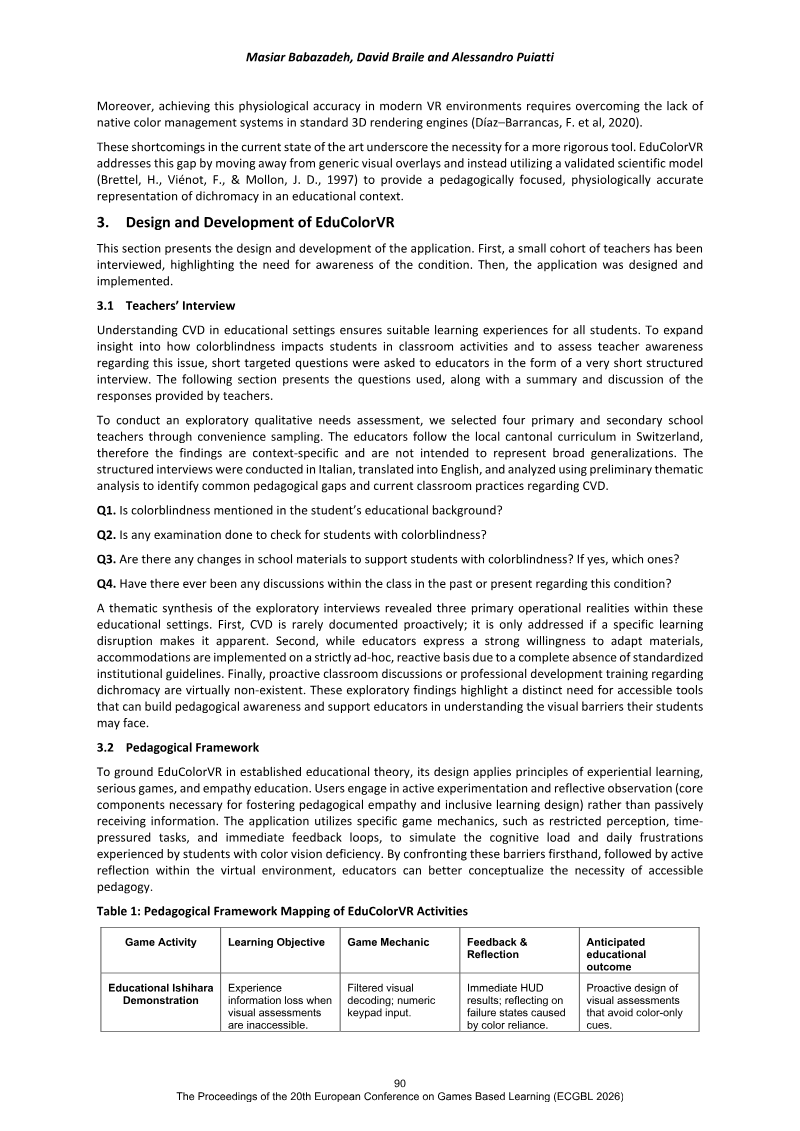
Each row is a game or company this document names, each column a document, oldest first. A mark means that document names it. Select a row to see those documents.
European Conference on Games Based Learning (ECGBL) · 2026
European Conference on Games Based Learning (ECGBL) · 2026
ETC Press · 2022
European Conference on Games Based Learning (ECGBL) · 2026