Firewatch
5 documents in the library are about Firewatch, from writers such as Game Developers Conference and Thomas Brush, the newest from 2026. Each has a summary and key insights with the page they come from.

Firewatch is a single-player first-person video game where you, as a man named Henry, explore the Wyoming wilderness after taking a summer job as a fire lookout. What is supposed to be a peaceful respite from your complicated life takes a turn when you start to question some of the things that are happening to you. Your only human connection is over a handheld radio, which you’ll use to speak with your supervisor Delilah about the things both of you are experiencing.
- Released
- Feb 9, 2016
- Developer
- Campo Santo
- Publisher
- Panic
- Genres
- Adventure, Indie
- Platforms
- PlayStation 4, Linux, PC (Microsoft Windows), Mac, Xbox One, Nintendo Switch
- Links
- Wikipedia
Game data from IGDB.com
Documents about Firewatch

Want To Make 3D Games? It's Easier Than You Think!
This presentation outlines a streamlined, cost-effective workflow for achieving a stylized, Firewatch-inspired aesthetic in 3D game development using Unity.
- Achieve a stylized, Firewatch-inspired aesthetic by removing specular information from materials and applying image-editing filters like oil paint and smart blurs to textures.
- Maintain consistent environmental scale by using a primitive cube—specifically half the height of the character controller—as a universal reference point for all assets.
- Streamline iteration by converting all external assets into editable formats like PSD and Blender files, eliminating the need for repetitive re-exporting.
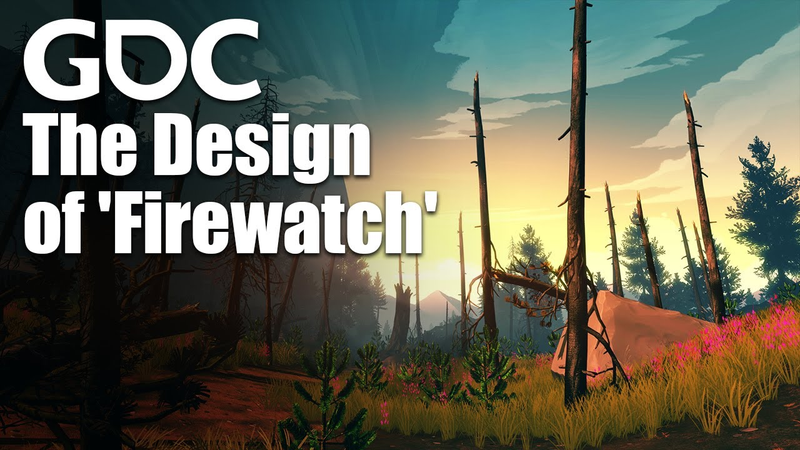
Interactive Story Without Challenge Mechanics: The Design of Firewatch
The design of Firewatch centers on the prioritization of narrative integrity over traditional challenge-based mechanics.
- Design narrative-driven games as a series of 'interesting outcomes' rather than 'interesting choices,' shifting the focus from risk-reward analysis to the organic, often invisible, results of player behavior.
- Implement a centralized 'fact-checking' system to track game state variables, preventing logic conflicts where redundant or contradictory story facts cause bugs in complex, branching narratives.
- Use 'reactivity' to support a wide spectrum of player possibilities, ensuring that even if a player ignores specific quest instructions or sequence-breaks, the game world acknowledges their actions through altered dialogue and narrative consequences.
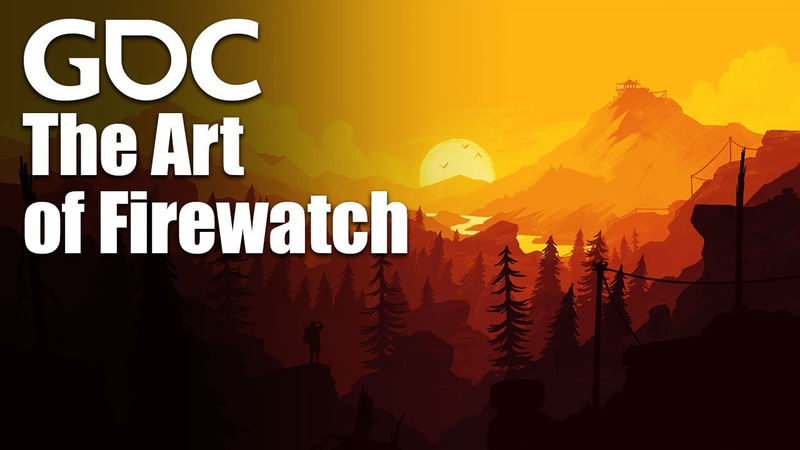
The Art of Firewatch
The development of the narrative exploration game Firewatch required a strategic approach to translating a bold, 2D graphic art style into an immersive 3D environment.
- Campo Santo utilized a small, distributed team of ten to develop Firewatch, proving that resource constraints can be leveraged as an empowering design strategy.
- To maintain a stylized 3D aesthetic, the team implemented a procedural sky system and custom 'stylistic fog' using RGB texture strips to manage atmospheric depth and mood-driven color shifts.
- The team prioritized production efficiency by using a limited set of modular rock and tree assets, reserving high-detail artistic bandwidth exclusively for unique, narrative-critical props.
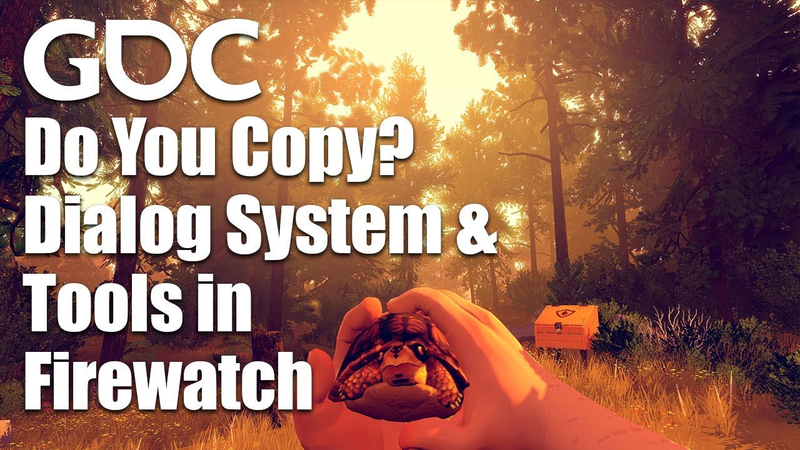
Do You Copy? Dialog System and Tools in Firewatch
The development of Firewatch centered on creating a highly responsive, non-linear narrative experience through a lightweight, event-driven dialogue architecture.
- The Firewatch dialog system utilized a lean, event-driven architecture where game state was interrogated via boolean tests on floating-point values rather than complex string parsing.
- Dialogue choices were generated on-demand at runtime rather than being pre-compiled, allowing the system to dynamically match responses based on specific player history, such as naming a pet.
- To manage non-linear, branching narrative complexity, the team built a custom tool called Magpie that provided full-text search, free-form tagging, and a unified ID system to track dialogue lines from development through to final recording.
The 2017 Game Developers Choice Awards
The 2017 Game Developers Choice Awards served as a comprehensive celebration of the industry’s evolution, balancing commercial blockbusters with innovative independent titles.
- Overwatch was named Game of the Year at the 2017 Game Developers Choice Awards, reflecting its significant cultural impact during that period.
- The 2017 awards ceremony formally recognized the industry's expansion into new platforms by establishing a dedicated virtual reality category, with Job Simulator winning the inaugural award.
- Pokémon Go was highlighted for its role in driving mobile innovation, underscoring the industry's shift toward diverse and accessible gameplay experiences.