1 free read left. Create a free account for unlimited reading + AI research.
Create free accountWhitepaper DiGRA
1 free read left. Create a free account for unlimited reading + AI research.
Create free accountWhitepaperDiGRA
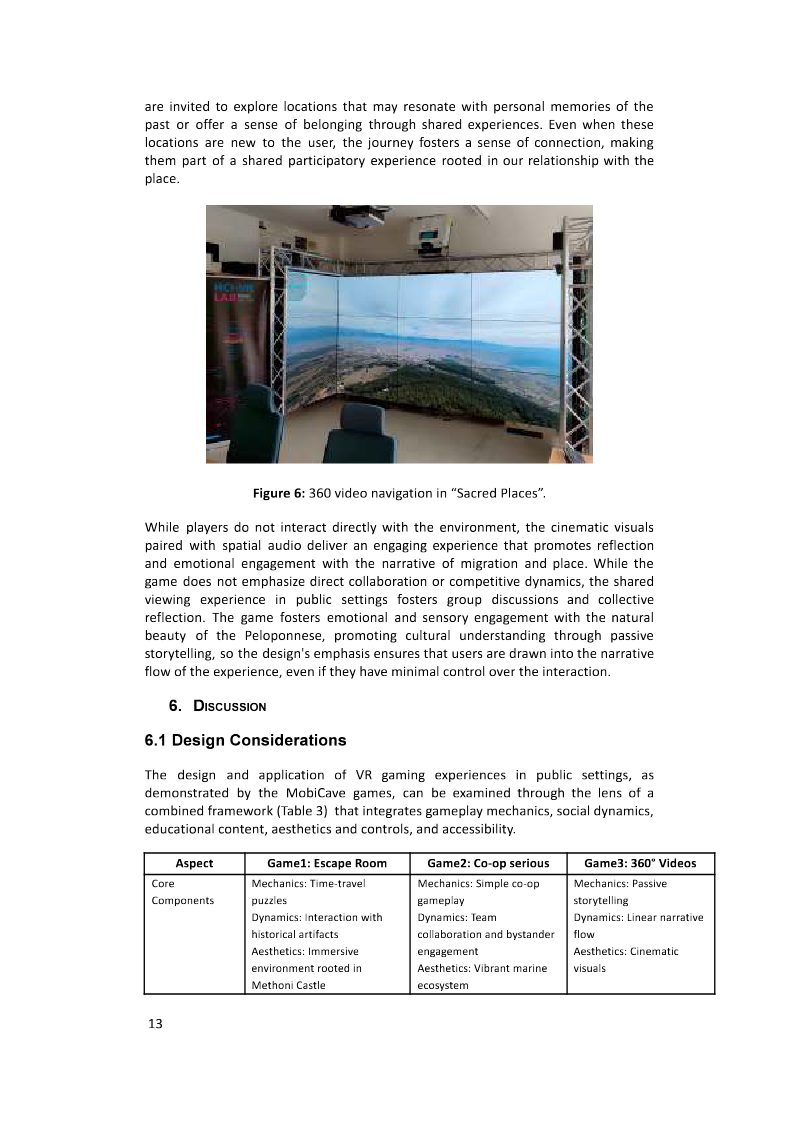
The game follows a third-generation immigrant visiting his family's birthplace in Arcadia. The landscape serves as a kaleidoscope of family history for the protagonist.
"Sacred Places" is a design-oriented paper presenting a 360° narrative VR game that explores the memory and identity of Greek-Australian immigrants through landmarks, oral testimony, and ethnographic material. The project is built for hybrid use across a room-sized CAVE and mobile head-mounted displays, and its central aim is to test how spatial storytelling can activate cultural memory and a sense of place. Its story follows a third-generation immigrant visiting his family's birthplace in Arcadia, with the landscape functioning as a kaleidoscope of family history for the protagonist and as a source of familiarity for players with shared immigrant backgrounds.
The paper frames its design within theories of memory, drawing on Pierre Nora's concept of lieux de mémoire and Jan Assmann's mnemohistory, and it connects these ideas to literary and game precedents such as Woolf's To the Lighthouse and What Remains of Edith Finch. The design combines ethnographic research and testimonies, non-linear first-person narration, high-resolution 360° video captured from multiple viewpoints, textual narrative overlays, interactive objects, and full-body motion tracking for the CAVE setup. The authors position the work as addressing a gap in VR heritage research, which has seldom examined hybrid CAVE/HMD frameworks for activating memory in non-expert users.
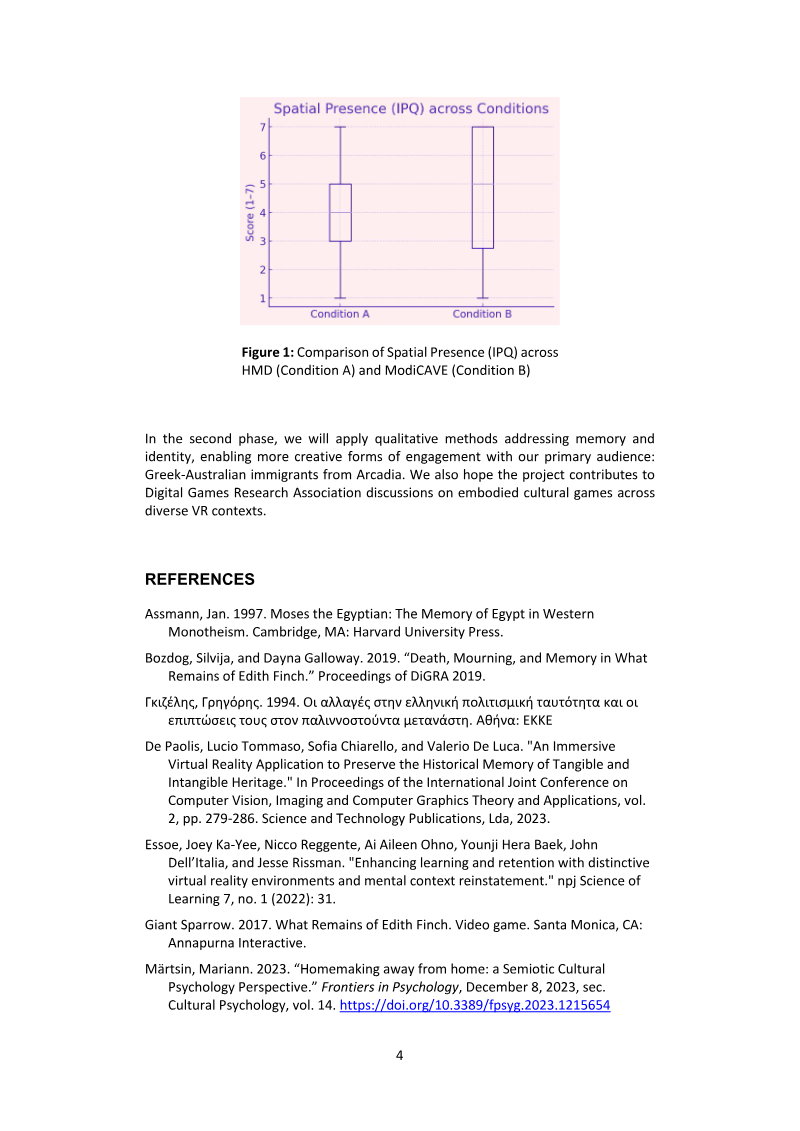
A preliminary user study compared the two platforms using the Self-Assessment Manikin, an IPQ presence questionnaire, a reduced AttrakDiff form, and open-ended responses. Participants generally reported increased spatial presence and emotional arousal with repeated trials, and they rated the CAVE as more immersive than the mobile HMD, particularly citing its spatial audio as sharpening narrative focus. The sample size is not specified in the excerpt, and the authors note that a qualitative second phase with the target community is planned.
Each row is a game or company this document names, each column a document, oldest first. A mark means that document names it. Select a row to see those documents.

DiGRA · 2026

DiGRA · 2026



DiGRA · 2026



DiGRA · 2026



DiGRA · 2026



DiGRA · 2026



DiGRA · 2026



DiGRA · 2026

DiGRA · 2026



DiGRA · 2026



DiGRA · 2026

DiGRA · 2026
DiGRA · 2026