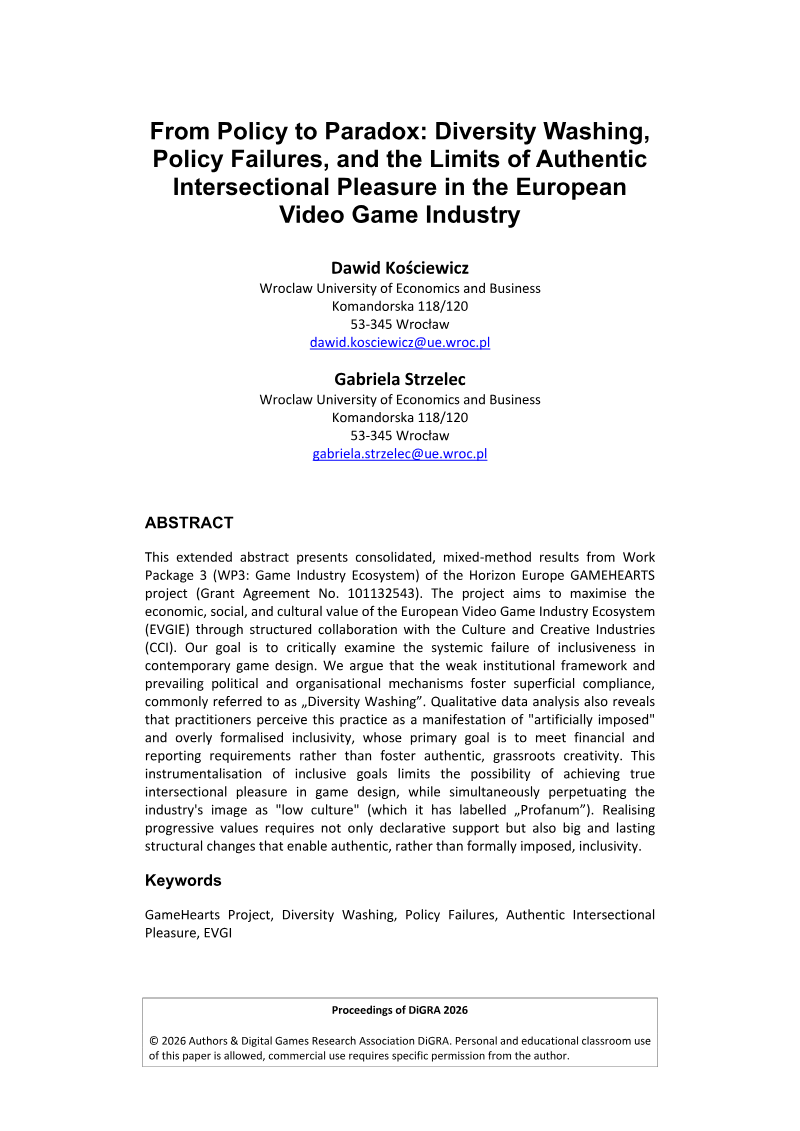
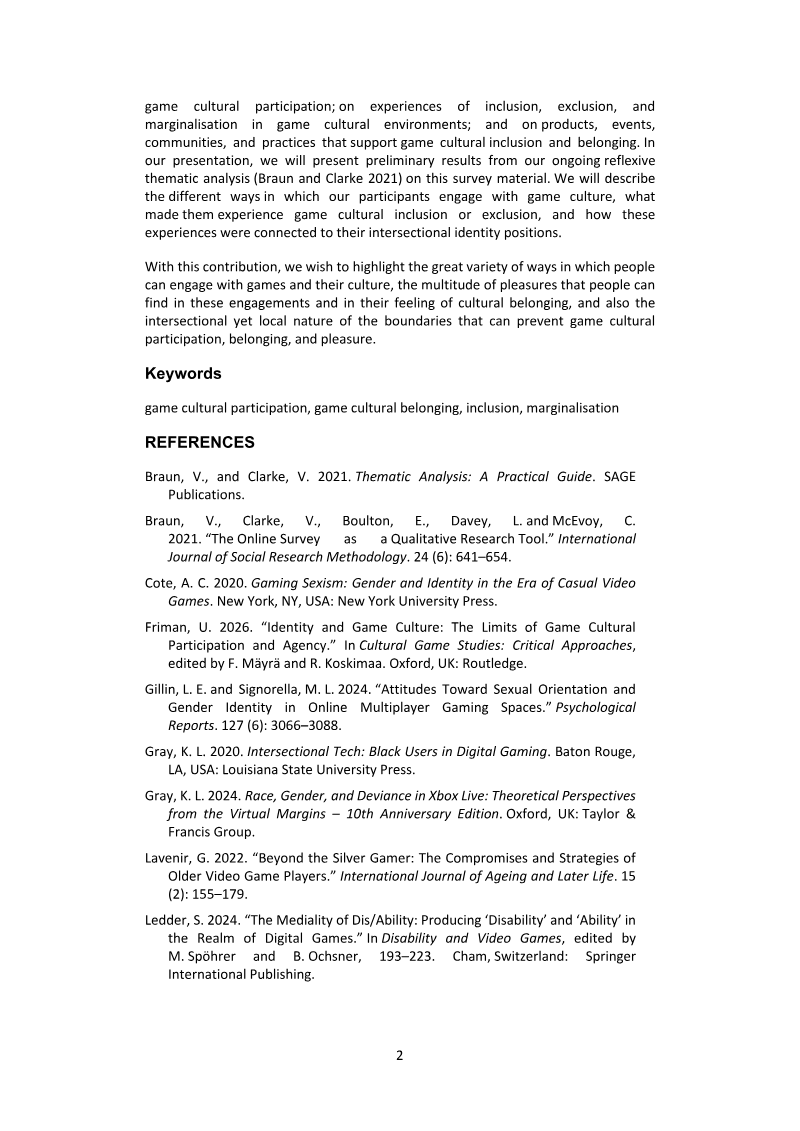
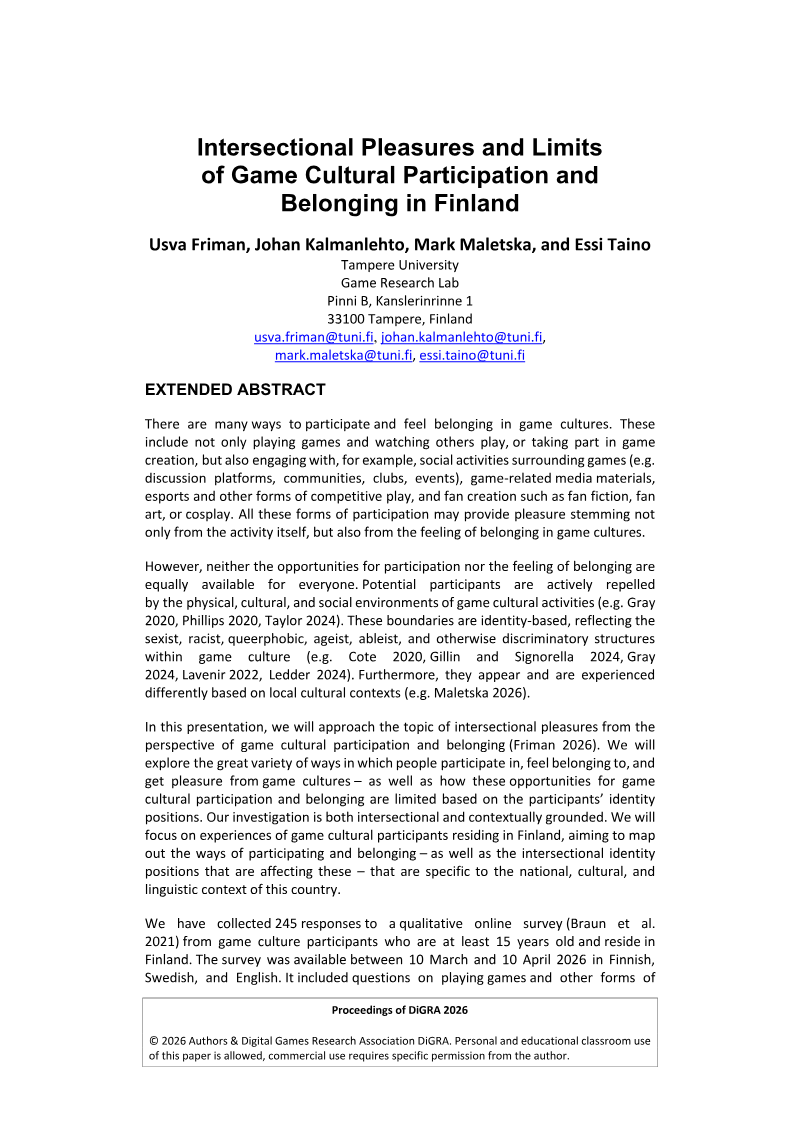
1 free read left. Create a free account for unlimited reading + AI research.
Create free accountWhitepaper DiGRA
1 free read left. Create a free account for unlimited reading + AI research.
Create free accountWhitepaperDiGRA
The paper argues that white, Western, largely male scholars are treated as the default authorities on play. Non-white and non-Western perspectives are devalued or marginalized.
Under-theorized. The European dimensions of this bias are argued to remain under-theorized.
Playgrounds of Whiteness argues that European game studies is structured by epistemic whiteness, a set of norms that treat white, Western, and largely male scholars as the default authorities on play while devaluing or marginalizing non-white and non-Western perspectives. Drawing on critical race theory, postcolonial thought, and autoethnographic reflection, the paper uses the "playground" as an analogy for disciplinary spaces designed around white assumptions. Its central claim is that the Eurocentric bias in game studies has been under-theorized in its specifically European dimensions, and that naming this bias is a necessary first step toward epistemic justice. The work is framed as a politically engaged inquiry into dominant trends rather than a charge that all European game scholarship is uniformly biased.
The analysis focuses on the foundational texts of the field. Building on Tara Fickle's critique, the paper examines how Huizinga's and Caillois's core concepts of play, culture, and civilization carry Orientalist and Eurocentric assumptions. Caillois's taxonomy, for instance, is shown to echo Linnaean racial classification, and his account of Chinese play relies on a British colonial-era dictionary. The paper further contends that divisions such as the magic circle and the ludology/narratology debate reproduce a eurowhite standard of "ideal" knowledge and "ideal" game objects, marginalizing Indigenous and Global South scholars and games. Play itself is treated as a power relationship capable of excluding and subjugating racialized players.
The paper concludes that European whiteness and games epistemology mutually reinforce one another, producing a form of epistemic violence that privileges some knowledges and knowers while sidelining others. In response, it calls for citational representation and collaborative redesign of knowledge-production practices, rather than superficial inclusion or critical play alone. It also offers relational models, such as Gotlandic mythology, as alternatives to extractive, Eurowhite frameworks for understanding human-nature and play relationships.

DiGRA · 2026

DiGRA · 2026



DiGRA · 2026



DiGRA · 2026



DiGRA · 2026



DiGRA · 2026



DiGRA · 2026



DiGRA · 2026

DiGRA · 2026



DiGRA · 2026



DiGRA · 2026

DiGRA · 2026
GAMEHEARTS · 2025