1 free read left. Create a free account for unlimited reading + AI research.
Create free accountWhitepaper DiGRA
1 free read left. Create a free account for unlimited reading + AI research.
Create free accountWhitepaperDiGRA
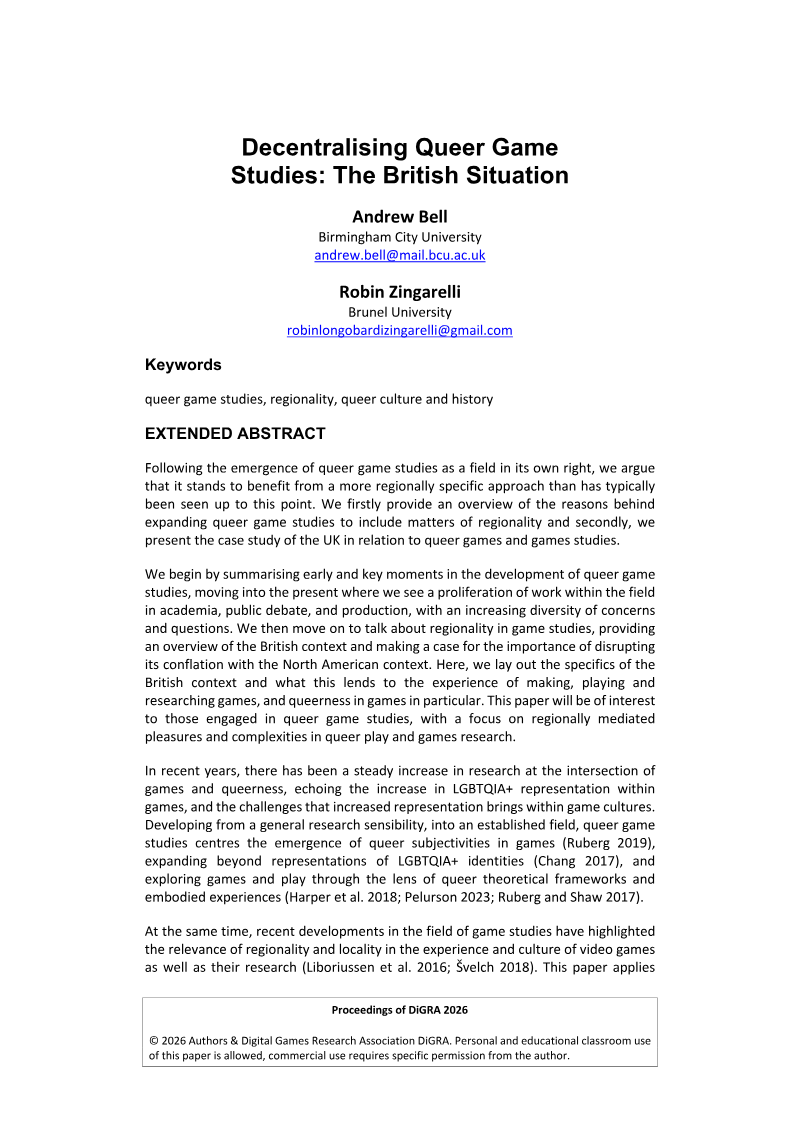
The authors contend that Britain has its own distinct queer character. They argue this is too often wrongly merged with North American experience.
This paper argues that queer game studies would benefit from a regionally specific approach rather than its typical framing within North American urban contexts, and it uses the British situation as a case study. The authors position the field's development from early foundational work through to today's proliferation of research spanning academia, public debate, and game production, noting a growing diversity of concerns. They contend that regional theory in game studies has matured, and that the British context has its own distinct character that is too often conflated with North American experience.
To ground this argument, the paper examines two historical and political moments that have shaped queer life in Britain. The first is the Section 28 legislation of 1988 to 2003, which restricted local authorities from promoting homosexuality, and whose intellectual, cultural, and generational legacy is traced through existing scholarship. The second is contemporary British attitudes toward queer and gender-diverse identities, including the strategies of the anti-gender movement that seek to limit queer social participation and public articulation. Together these moments are presented as conditioning the environment in which British queer players, designers, and researchers operate.
The authors adopt a reflexive method, situating themselves as queer scholars based in the UK and interrogating their own experiences of queer play and research within this legislative and cultural landscape. Rather than offering quantitative survey data or a systematic sample, the paper relies on historical context, theoretical frameworks of regionality, and personal positionality to articulate what regional specificity contributes to the field.
The paper's central conclusion is that regional specificity offers both broader representation beyond dominant North American-centred approaches and practical value in responding to local political challenges. While focused on Britain, the authors advocate for a wider move to highlight regional particularities in queer game studies globally, presenting this as both a scholarly and strategic priority amid rapidly changing debates around queer identities.

DiGRA · 2026

DiGRA · 2026



DiGRA · 2026



DiGRA · 2026



DiGRA · 2026



DiGRA · 2026



DiGRA · 2026



DiGRA · 2026

DiGRA · 2026



DiGRA · 2026



DiGRA · 2026

DiGRA · 2026
DiGRA · 2002