1 free read left. Create a free account for unlimited reading + AI research.
Create free account
Knowing Ze Dschermans PG Connects Digital #2
Key insights
6 takeaways- 01As of 2020, Germany had 34 million players with an average age of 37.5 years and a nearly even gender split of 52% male and 48% female.
- 02The German video game market is a top-five global territory generating approximately $6 billion in annual revenue.
- 03Companies with militaristic branding, such as Wargaming, have faced operational challenges in Germany, including difficulties securing office space and resistance from marketing partners.
- 04Historical socio-political headwinds, including strict regulations on violent content and Nazi imagery, have long hindered the industry's growth and institutional support.
- 05The German government has recently begun shifting its stance by implementing formal game development funding programs and relaxing restrictions on historical symbols in interactive media.
- 06Success in the German market requires a long-term strategic approach that accounts for navigating bureaucratic hurdles and managing public perception regarding war-themed content.
Ask AI about this video
Transcript
we've got uh tom uh from wargaming uh who is going to uh come and talk to us so uh tom i think you're online is that right yes here we go um so tom will join us surely uh knowing the daisumus i have no idea how to pronounce that i do apologize uh i cannot wait to see what it's about though so tom over to you sir thank you so much uh so hello everybody um my name is tom putski and i'm with wargaming since more than nine years in the games industry since 25 plus years and uh to be frankly honest um this is something very interesting for me at the moment i love to talk on stages
uh directly interacting with the audience and running around and walking around and and right now i have the situation sitting here in my home office in berlin so by the way best greetings from berlin everybody and have a nice talk about knowing the germans and in deep talk about a complicated topic to put it like this uh in within 20 minutes so uh let's get started uh it's always time for a challenge so what to expect today first of all some information about germany as one of the top five global video game markets short of course why is germany so different an overview history wise and today problems we are facing in germany and why some examples and as i don't want to leave you out with
all this negativity stuff there is a slide where it's getting a little bit better and hopefully i still have some time with q a okay the first minute of my talk is done and i made it in one minute which is pretty good because actually uh on talks in normal lifetime i need at least 10 to 15 minutes to introduce myself well this went good so german games market just short overview as you can see we have top five countries china united states japan korea south korea and then germany we're talking about a games market of approximately six billion dollars revenue a year and here are some demographics from this market approximately 40 34 million germans are playing video
games the total number of our population is a little bit more than 82 million the average age of player is rising as you can see here on the right side from 2016 35 years average 2019 36.4 and 20 20 37.5 years the gender is 48 of the gamers are women 52 percent of the gamers are male so nearly half of the player base is female this is helpful for the whole games market it's from experience not very helpful regarding war gaming and its products we are doing stuff with tanks and ships and warplanes this is not very helpful regarding female audience last slide with numbers promised market
growth in a german games market from 2018 2019 plus six percent and here on the right side you have a slight idea subscription fees online services games in sales retail and digital it's more than one billion euro in-game purchases growing big time 2.254 million a billion euro and last but not least gaming hardware with way more than 2.3 billion euro okay and promised these are this is the last slide with numbers and now let's get a little bit deeper into the german behavior regarding video games so we have the situation or maybe you all have heard it a little bit already
germany is different regarding video games meaning uh first of all age rating uh we have huge problems with violence we don't have any problem with sexual explicit content in video games definitely not but with violence we had this just as an example oil instead of blood for command and conquer because the little soldiers were all considered as robots we had shooter ads from first person shooter developers and they put a label on it banned in germany we had more than one decade the killer games debate here in germany regarding first-person shooters and of course we had huge huge problems with any kinds of nazi symbols like ss runes swastikas and lightweights germany is different because of something else as well long time germany was a pc driven market meaning pc games
the problem for the german game development for example was that the pc market was so big and so convenient that the first generation of developers missed consoles completely and didn't catch up so far and are still struggling to catch up especially in development for consoles uh germany is different for another reason typical german genres gaming genres uh simulations of all kinds name anything we have a simulation for it especially economic driven simulations started with animated extra sheets and likewise and of course the typical building up strategy titles like settlers or i know series or these are typical german games why and last but not least
games in germany were long time not considered as culture at all culture is something we in germany i'm talking about the public opinion and the opinion leaders are thinking of beethoven brahms and so on and so on and now let's get a little bit into this and i give you a short history lesson why in my personal opinion these things are a little bit different in germany and of course oh i've forgotten about the quote this is the only quote i want to bother you with also a promise but i found this very very appealing a quote from the german weekly political magazine deed site and it is no other product after 1945 has contributed as much to renewing the image of the germans as the automobile german cars not german
tanks roll on the roads of the roads of the world today which i think is better because tanks don't belong on the roads they belong on the screen car manufacturers are paying careful attention to avoid avoiding all militaristic connotations all possible associations with the nazi era and imagine that the car manufacturer porsche built the tiger tank a german suv must feel like a tank but it must not like look like one okay and now we go on a little bit germany is different it started my short history starts 1945 uh with the downfall end of world war ii in europe 8th and 9th of may 1945. uh left picture shows uh soviet soldiers hit um raising the soviet union flag on
german reichstag and the other picture shows the old town of dresden so this is how the younger german history started down on the ground next starting again the so called tromaphrone we even have a german word for this literally translated with rubble women started cleaning up the mess and building up the country after 1945. we even have some monuments for these ladies in a couple of german cities especially monuments for the tribal fraud why it was women well the men were prisoner of war or dead at this time then the next big step was the airlift of berlin in 1948 until 1949
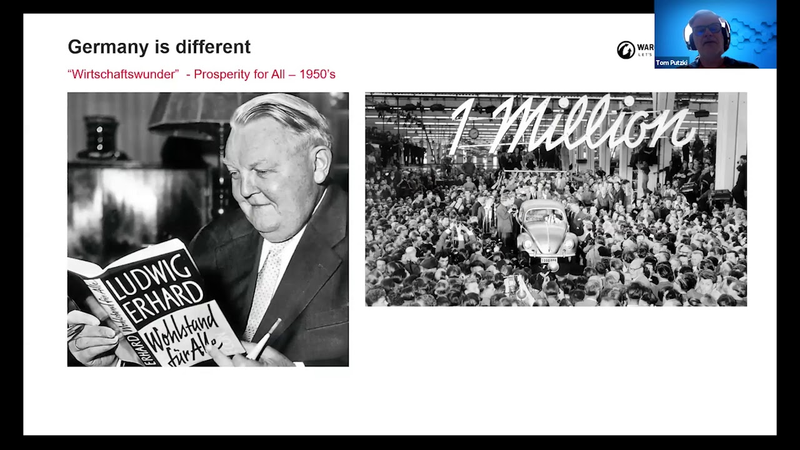
it was more than 11 months when berlin was shut down and all roads ship lines ship lanes and and railroads were blocked by the soviet union and berlin was completely supplied via airlift and this was the first time germans saw that the occupants as most of the german swords directly after the war were helpful and helped german people survive and changed from hostile soldiers to supporters and friends germany is different we have the so-called virtual under economic miracle in the 1950s on the left you see our minister for economic affairs for long years and later chancellor
of germany ludwig erhart with his book prosperty for all and on the right you see the celebration in the volkswagen factory for the 1 million beetle so in the 50s germany was definitely busy with building up the country with bringing prosperity for all grabbing a piece of luck for everybody and um people were working very hard you may all have uh know uh the cliches about germans like working hard being punctual disciplined good engineers and so on and so on and this comes from this area from this era but also from this era comes something which is directly linked to the problems
in the video games industry you have to work you have to work a lot and gaming of all kind is something considered for kids because grown-ups definitely have other things to do and if they have spare time it's better they do something useful with their spare time like sports like learning educating and so on but gaming is definitely something for kids we have the division of germany for a long time here you can see uh us army checkpoint charlie where soviet tanks in the background and u.s tanks in the front were facing each other like a stair-off and for a long time for a couple of decades germany was
uh directly the point between two worlds between warsaw pact and the nato between east and west and was literally in the center of the iron curtain and the berlin wall directly because i love this picture last man fleeing from before the wall was literally built 1968 the student movement started and this was something different and new for germany because this was the first time young people didn't want to listen and obey without uh responding to the authorities anymore this was something new germans are disciplined as i said and germans love to buy like in we also in the nazi area or in the
in the emperor's area from first world war and likewise and this was a big change this was the first time germans started to disobey this went on in the 80s the peace movement in the peak time of the cold war where literally hundreds of thousands of germans went on the streets to protest against rockets against armies against soldiers against everything related to to war to to weapons and so on and so on and this was really an exciting and astonishing time and yeah this left picture is from the bonner hof garden where the biggest demonstration of the peace movement had more than 360 000 people
attending one interesting saturday afternoon and then what we all have in mind is the wall goes down in 1989 berlin wall breaks and one year later germany reunited and celebrating and so on so these were my short steps through the closer german history and what does this all have to say and what does it all have to do okay there is something i wanted to show you as well the left pick shows kindergarten kids with their teachers and the right pick shows elementary school kids with their teachers and it took me a while to pick out here on the right side there are two male teachers two out of in total i think 17 and here on the left side there are
absolutely no male teachers in kindergarten i'm pretty sure this is the same in other countries as well but this is especially in germany meaning for example that german kids don't get in touch with male teachers until the age of say 10 or 12. and to be frankly honest um for games that we have for example world of tanks world of warships and the likewise we can pretty much guess that female teachers won't be telling the kids that thanks is something nice to play with what problems do we face or did we face here in germany so first of all regarding video games video games were as i already told you long time considered as for kids only germany as an example was discussing the
killer games debate for more than one decade things have become a little bit better but this whole uh speech or this whole lecture is all about where does this all come from the company name of wargaming was creating some problems wargaming is in german years not just one gaming genre among others it's translated as creekspiele and this is bad because war is bad and this is really implemented in german thinking german culture german structure nowadays especially public opinion world war ii well you can guess that germany is very cautious regarding what all kinds of world war ii content and of course nazi symbols tanks this is directly affecting once more war gaming tanks are not seen as man toys or highlights of the engineering
tanks are weapons of war and destruction and last but not least the origin of wargaming is belarus belarus or white russia is considered to be the last official dictatorship in europe and if you know our history you know we have some experience with dictators so this is something that we had problems with in germany for a long time examples for these problems when we rented office space both wargaming europe and wargaming mobile were rejected by landlords to rent office space from them because of the company name hey we want to give you our money we want to have nice office for say 10 and in case of wargaming mobile 70 80 people well yeah that's that's very cool that's good what's your company's name wargaming oh no you won't get any space for me the band ramstein most likely known to all of you is
was planned as a cooperation partner for the launch of our air game world of warplanes and we had a perfect launch trailer directly uh cut it on the song foyer fry by ramstein and it was really nice but the band itself refused after the record company and the management of ramstein agreed on working and cooperating together with us the band itself refused to do this because we are wargaming and dealing with tanks german federal armed forces refused to cooperate with us because we do video games we are named war gaming and this is not cool for the army we had an advertising on gamescom 2011. we had some world of tanks motives on uh trams in cologne
we uh received a shitstorm at gamescom due to our branding of these trams and last but not least a couple of years ago we released the title master of orion and we wanted to have a launch event here in berlin in the berlin observatory but they refused to host our master of orion launch event at their place why because the name of the company is wargaming well but as i promised you in the beginning things are getting slowly but a little better as you can see our chancellor angela merkel opened up gamescom 2017 and here you can see her with the gamepad in her hands of course playing in a farming simulation and here you can see her at the gamescom with her minecraft avatar and the german government started to approve high
fundings for german game development which never ever has happened before but now we have a five years program but to be frankly honest uh at the moment is very very slow and uh it's not really doing good i hope this this funding will do much better once everybody's get used to it and last but not least things have changed regarding one other thing as well uh games as a memory culture i've called this slide and this is just as an example i want to show you it's a game called through the darkest of times from a german berlin game developer called paint bucket games and it's a strategy games of leading and making them survive a resistant group in nazi germany in nazi berlin and this is the first
game where officially swastikas were allowed and legal in video games as this this uh screenshots show and it was a long struggle it's not about we definitely need swastikas but it's just about the cultural thing that swastikas are allowed in movies and on tv and in graphic novels but long long time long decades not in video games but this finally stopped and as my timer already rang we have a couple of a couple of minutes for a couple of questions so uh i mean i think what you're really showing uh for me is just how important is to understand deeply the cultural consequences of history and the context in which people are sitting and i think you know
germany is a fantastic example for that because of so much you know rich deep elements of history that have happened in the last you know in my lifetime in the last 50 years let alone beyond that yeah um in fact one of the questions that came up here is this in a world uh games have constantly had problems being pointed out as guilty for a lot of incidents and issues and do you think that the issues found in germany can be drawn as a parallel to what's been happening in other parts of the world um i'm pretty sure yes it it's but let's say the problems started in germany i think a little bit more early than in in other countries because i used to bring other countries as an example how the video games industry is there uh literally uh without any bigger problems it started later than in germany and um yeah but
as you can see the as i mentioned uh violence in video games is a big huge topic long time in germany and it only started a couple of years ago in for example the us so yeah maybe in this case germany was leading the way yeah and i think also it's such a much more sensitive issue in germany than particularly violence um but i think we've actually i think seeing a lot more happening in this space when we saw the world health organization um i think incorrectly stating that there was a specific element called gaming disorder when we we appreciate that there are issues of behavioral addiction and games can be a vehicle for something that's behavioral addiction but it's quite damaging when you think you see a subset of the scientific community uh blaming games when the majority seem to think that there's a wider a separate issue that's not related to gameplay
and so i think to me there's a kind of like a dichotomy there which we still seem to be even though violence itself seems to have gone off the radar to a lot large extent mostly because the data is overwhelmingly stating there is no correlation um i mean are you seeing an improvement in terms of people's perception of uh violent video games as an outlet rather than as a a bad thing uh yeah there is there has been an improvement and things changed in the last couple of years but as as i'm trying to work for for the german video games industry not only with the company i'm with but but also in in the organization game and likewise i i accompany this for more than 20 years now and it's a long long struggle sometimes you achieve something and then suddenly out of nowhere uh there comes a
new election and uh completely different politicians are in in charge and everything and you have to start from scratch everything all over again so if you deal with uh politics with public opinion you need to have a very long breath absolutely i think every medium has had its experiences we only have to read novels like fahrenheit four five one to understand that um you know an easy ride for any medium someone will use it as an excuse to blame and to kind of charge people and i really would love to ask the next question which is about german government opening for game development um ah yeah i mean i'm gonna quickly ask you so um although german government is opening for game development companies in the country these limit uh these limitations and shaming culture relates to uh war does that still continue uh the that's part of the question
we see the german government opening out and supporting game development are they limiting that against war-based content uh yes they are limiting uh it a little bit uh there is a so-called culture test each game that is submitted to this must pass and uh you can have war related games but uh there is a big bud it's it's too in deep to to really stretch out all the the rules and regulations but there are roots and regulations that's good um well not done good but sounds informative uh on that note i'm gonna have to say thank you very much
Summary
The German video game market represents one of the top five global territories, generating approximately $6 billion in annual revenue. As of 2020, the nation boasted 34 million players, with an average age of 37.5 years and a gender split of 52% male and 48% female. The market is characterized by significant spending in hardware, in-game purchases, and digital services. Despite this scale, the industry has historically faced unique cultural and political headwinds rooted in Germany’s post-1945 history, where gaming was long dismissed as a juvenile activity and subject to intense scrutiny regarding violence and historical symbolism.
The industry’s development in Germany has been shaped by a complex socio-political landscape. A long-standing "killer games" debate, coupled with strict regulations on violent content and Nazi imagery, created a challenging environment for developers and publishers. Furthermore, the cultural perception of gaming as a non-serious pursuit—contrasted against the national emphasis on engineering and traditional arts—hindered institutional support for decades. Companies with militaristic branding, such as Wargaming, have faced tangible obstacles, including difficulty securing office space, resistance from potential marketing partners, and rejection from government entities.
However, the landscape is shifting as games gain recognition as a legitimate cultural medium. Recent years have seen the German government begin to implement funding programs for game development and a relaxation of rules regarding historical symbols in interactive media, as evidenced by titles exploring resistance movements in Nazi Germany. While the industry continues to navigate bureaucratic hurdles and a "shaming culture" regarding war-themed content, the inclusion of high-level political figures at industry events and the formalization of government support signal a transition toward broader societal acceptance. Success in this market requires a long-term strategic approach to public opinion and political engagement.