Transcript
[music]
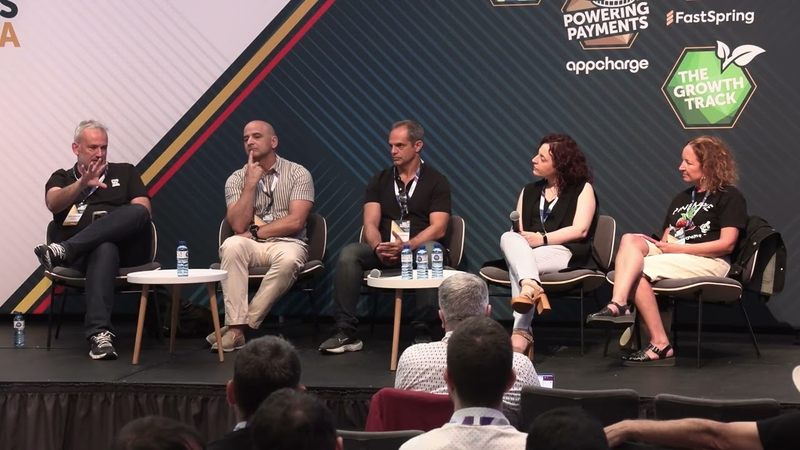
I'd like to welcome to the stage to discuss generally state of AI in games. We've got a panel now that will take us up to take us for 40 minutes up to the end of this track. And we've got host for this panel and moderator is Runner Rahman from Raptor PR. Runner, do you want to come up and bring your panel with you? I believe we've got Henrik from Pickem, Hega from Iba, Ilya again back from Layer AI, Martin from Rovio and Simonetta from Gamehouse. So a big round of applause for our panel, please.
Good morning. I'm Runner from Raptor PR. So Raptor is a B2B tech agency for brands like Poki, EdBrain, Thinking AI. So we work with tech brands creating reputation and supporting growth and so forth. Today's panel is AI in games but we've decided to kind of tweak the subject. So we're looking at we're looking at the positive impacts which AI has for players directly. Well, I'd love to introduce the panel. So if you could start with Henrik, if you could tell us who you are and what you do.
Hello. Okay. So
Thanks, Runner.
Yeah, my name is Henrik Habustan. I'm from Barcelona and actually I'm the CMO of Pickem. A new gaming social platform Uh
based in US. But previously, because I joined this company a month ago. So previously, I've been 7 years the VP of global marketing and publishing for Fun Plus. A very big game developer coming from Asia and Switzerland. And I've been living across the states and Latin America for 10 years. So I've been moving abroad for a long time and I've been experimenting on gaming apps and advertising technology for all my life. And I'm a really, really, really excited guy about what AI is bringing to our industry. And that's the reality why I'm really excited to talk to you guys today.
I have one microphone. So I can pass it over to the next. But hi, my name is Ilya. I work with Layer. Been there for around a year. Based in Barcelona here as well. And we provide AI services and a platform to create content for games, but also content for UA production.
And prior to that, been in monetization space for around 7-8 years. At Unity and I really can see the transformation of the industry in different roles with AI being introduced. So I'm really really happy to participate in this panel, especially since we're talking more on the impact on players. So yeah, really great to be here.
Thanks, Ilya.
Hi. I'm Simona Italo. I'm the CEO of Game House. Game House mainly serves female players in casual gaming both on mobile and PC. Mainly on subscription business. I'm based in Barcelona right now for over 3 years. But prior to that, I was all over. My experience is mainly in virtual worlds and kids prior to this. So, teenagers like Habbo Hotel, Woozworld, and I was as well in charge of the digital studio of Spin
Master, owners of um PAW Patrol, a big toy company in in LA, and and we acquire as well Toca Boca. Yeah.
Hi. Uh good day. My name is Hege. I'm the CEO and one of the founders of Aiba. So, what we do is we protect your players in your communities, and we use AI, of course. And we are um we started out uh solving the the problem with cyber grooming, bullying, radicalization, but what we see is we're able to detect all kind of social manipulation, and we do it in real time, so it can be stopped before the harm happens. And using AI.
Thank you, Hege. Um before we dive straight in, um I'd like to ask one one quick question to each of you. Um
So, Minetta, what is perhaps the biggest misconception of AI in gaming today in your perspective?
So, I think that there is this con- misconception that AI is going to hurt games. I believe it's absolutely the opposite because if anything, gaming is about creativity, and that is what AI will not do well in a while, at least. So, I think that the opportunity is huge for gaming.
Hege?
Yeah, I think AI it won't replace the humans. Uh it will empower us. Uh so, we shouldn't be afraid of it, I think. At least not for the first 10 years.
Thank you. Ilya?
Uh I join Simounetta here. I think the main misconception is that it steals and kills the creativity. I believe it it's not true. It actually enables creative people to produce more content
if they know how to use it. So, it pretty much takes away the painful parts of the job and that doesn't that cannot hurt the games.
I totally agree with what they said and but I'm going to be putting an example of what my team at FromSoftware let's say we started working on AI tools for marketing like 4 years and a half. So, just here in Barcelona. And it was so interesting because I had people in my team that were these kind of artists that they love what they do, right? They've been painting all the time, creating everything. And these guys on the beginning they were like super agnostics to these kind of tools. They were saying this is going to be killing our jobs. This is something that is not not really really hopeful for for what the industry is going to become. And after a year of that what they've been saying is that so many of the those tools were helping them to improve their processes on the creativity, what they've been building, what they've been
creating. So, at the end I think that AI is just a tool that is going to be helping us to improve our creativity and also support the players. It's it's it's something that definitely it's it's here to help.
Amazing. Thank you. So, we've got four sections. The first one is looking at adaptive gameplay and you know how AI can support you know hyper-personalized experiences. Um Henrik, here's one for you. So, what do we say where we seeing adaptive difficulty generally improve player experiences? Your experience. So, where are we see an adaptive difficulty generally improve improve player experience.
So, I would say that for example, one of the misconceptions that are are here is that people always think that
the Asian kind of topics that we're going to be having in AI are going to be the ones that are going to be replacing replacing the human beings replying for example the customers that we have, right? So, I think for for some of the topics that we that we that we've been seeing in my in my past career in in FunPlus, um the automatization through AI tools in order to help the community with those bots that we're being creating in order to reply them, it help us to improve improve improve a little bit the perception of the users when they were asking for questions. And of course on the community side, it helped a lot in order to try to optimize any type of reply that we were creating for them. And also to help personalize a little bit more the type of questions that those users were asking because it learns a little bit about the type of users that are coming into our community. So, it helps them to reply specifically what they really really want to listen.
Um Okay, so can AI support accessibility in ways which it feels overpowering and not patronizing?
Well, I think in our experience is when it starts getting to manipulate you that you stay in the game much much longer than you actually thought and also um when it's not good for you. So, it's it has something to do with the design, I think.
And Simineta, um what does a personalized challenge look like actually in practice?
You mean a personalized challenge for a user, for a player?
a player.
So, what is now, I think, is very small from what my imagination is
and what I believe AI will do. Uh I do believe that uh every game that you would play would be at your level, um at the time you need, um what you need. I think that's where we we are going to be. Uh I'm not sure how long it's going to take because I have not seen that implemented yet, but my imagination, and by the way, my my imagination has been always uh surpassed by AI usually. I don't know how long it will take, but uh I don't know if it's going to be a year or 3 years, but uh I believe my imagination is everyone will play a different game all the time.
Right. So, we we've actually got let's say the best is yet to come in terms of the impact of the new AI technologies. What kind of new experiences we actually going to see? That's very interesting.
Yeah, my my imagination goes on By
imagination means that I think we're we're we're getting closer.
Yeah.
But I I imagine me showing you a game, the same game you will have a totally different experience.
Yeah. Interesting.
Individualized.
Takes us nicely onto the second piece, which is um you know, you guys probably are all gamers here. You know, I was playing First Light recently and it's filled with NPCs and the NPCs still aren't that smart. You know, they're very much stuck on loops and you know, my brain is thinking, you know, as technologists, this could be better. You know, it could be a richer, more interactive experience. But, you know, there is a bit of pushback from community about how much technology is bringing. Anyway, so second section is about worlds and characters that should feel alive. Um Who is going to take this one back? Where have we actually seen NPC memory or reactive behavior shipping successfully? Are there any examples of, let's say, smarter NPCs in your collective
experience?
Well, I can start it out because we have been working with uh kids' games. Um Um we had this client uh which had a huge problem with toxicity, but they didn't know how to start. We got a test and we saw that out from 30,000 players, there were seven that did 90% of all the harm. So, being able to detect those people and also find out why are they toxic, especially the kids. Uh so, the intervention uh and also trying to turn them into nice players can be a huge benefit for communities.
Thank you.
Uh I can jump here. I think probably the first genres that have started adapting uh smart NPCs are RPG games and uh the ones that react to your decision-making,
like Cyberpunk. Uh that is uh probably the first version of it, but that was the way before AI has evolved into conversational AI. And I think the first games where we will see that successfully implemented will be RPGs and most likely MMORPGs where uh your your journey will be reflected in the way they interact with you. I haven't seen any successful developments yet, but I'm I just believe it's it's it's MMO MMORPG games takes they take a lot of time to be developed. So, since the technology has been introduced, I'm pretty sure many of the teams that are shipping the next big hit are implementing that in their pipeline.
And who could who could best answer this? What what are like the technical limitations or barriers from your perspective? Which which are holding back, you know, smarter characters and more immersive worlds which maybe feels by AI?
Ah.
I think there are many barriers. I would say a few. First of all, when you manage a team of people,
Mhm.
I think it's hard to move many people at the same time in the same direction of a strategy that no one has seen before. I think it's hard and and I would say the humans are the biggest barrier, probably. Uh pushing the limits. I think you you almost need my theory and this is you know, I have a 14-year-old that codes and I have my husband that is a programmer and I have me that I'm not a programmer.
Yeah.
And I see that that my kid does not have any limitations in his mind of what is possible and what is not. My husband has more limitations than anyone.
Okay.
I think that the technicians are the biggest limitation. You know, people like me
that I don't know the limits either. I'm a dreamer and I believe everything is feasible. But I think that the humans is the biggest barrier right now.
Interesting. And you know, we're on the mobile gaming industry event. Do do you guys have any perspectives about um you know, how AI is currently impacting you know, um characters and worlds in mobile games today. Are there any state-of-the-art examples which inspired you guys? Or is it still too nascent? What do you think? Too early?
Yeah, I mean, if if nobody else says, yeah, I think it's a bit too early to witness that. I haven't noticed anything.
So, there's there's there's still room. It sounds like there are there's human barriers, there's tech barriers, we're kind of battling our way through stuff. Perhaps there's there's some risk involved, too. Um but it was it's still very much nascent. And how we're doing this is
still how we've been doing it over the last 5 to 10 years. So, we're kind of still very much in the testing prototype phase, you would say.
I think we're just on the beginning of this era. So, there's there's a lot of path to grow. And um but the incredible thing that we're seeing here is how fast is this evolving, right? So, um you start testing a program or a tool that is going to be helping you to improve any kind of processes. And in less than a month, their competitor is advancing with a new tool that it's going to be improving it a little bit more. So, just putting the example of cloth and and chat GPT, right? When you're switching from one into the other, when it's one improving the other. So, at the end, how fast the technology is is improving itself, it's it's it's a very big challenge for everyone to be understanding where where we're going to be in the next I won't say 10 years, I would say in 2 years. 2 years from now it's going to be another crazy stuff.
Yeah, and I and I think everything changed in December this year with cloth. I think that fundamentally that changed everything. Before everyone was using AI, everyone was trying to do this and that in marketing, in creative, in some not gen and I in games. But uh I think Claude made uh G and I uh available to the masses uh to the everyone. And I think that has And the And the velocity they they change. I mean, you don't even know anymore in which model you are. Uh you you I think the other thing is for people like my age uh right now is a revolution of you need to learn faster than even your team. So, I spend a lot of time personally in my spare spare time learning AI and using AI. And I think that's a fundamental from a manager point of view is a fundamental skill.
How many people in your team
Gamehaus?
60.
Okay. And how do you manage governance in terms of different models and tools? Just Just curious how you how you managing that flow.
Um we're pretty um because again, I'm very bullish.
Yeah.
Uh I believe in AI maybe more than than them. Or now I think that everyone believes at the same level. But at the beginning, it was harder. And uh yeah, we we have a governance at a company level. Uh we control it. We put the limits. But uh in general, we don't set limits yet because I think that if we set limits now that everyone needs to believe and understand the potential and push the boundaries, it would be against our own interest.
But we need to think about the costs as well, right? So, that's that's that's the other topic that it
Token maxing.
Yeah, exactly. So, if you're opening up everything and giving unlimited tokens, the cost that it's going to be coming to the companies
Yeah.
it's going to be a little bit like
I'm I'm the CEO and I do the math, right? And my math is this. If I pay $120 for a pro Claude, uh do you think that I can get two extra hours of one developer? Probably yes. So yes, I would pay it. That that's my math. Even if at some it cost 10,000, right? But I think it's it's worth it for now. For for the level that we use. Maybe others, I don't know.
Okay. I also want to follow up on this. What's the cost of not using AI? That's that's what we're spending a lot of time on. And also we should not trust the AI too much. We also have we have a lot of experience and our experience is the AI really wants to be our friend. They don't want to challenge us. Um They give us quite often very bad advices on how to communicate, how to do things. So we
still need humans to have a look, be a little bit skeptical, I think. AI is not our friend.
[laughter]
Yeah.
But it's not our enemy either.
Exactly.
Now, this is very interesting time cuz ultimately we are, you know, creating products to appeal and engage with human beings. One would argue you still need humans to create that content to resonate with a very specific stakeholder audience. But it's from my communication perspective you know, we create the stories to resonate with people in this room for example. Awesome. So the next section is about all about safer communities and how AI could build and engender our player trust and I think this is perfect for Hekka actually. How can AI meaningfully improve improve player trust and safety in your experience?
Yes, so we are empowering the humans. So
the AI is not our friend, not our enemies, but it's the tool. So, we use AI to uh in real time, uh for example, detect stuff that's about to happen.
Mhm.
And when we have trained our AI on uh we have initially used police data. Uh So, our AI are able to predict uh what's about to happening very early. So, for example, uh unwanted behavior, uh unwanted content can be stopped before it actually happens. Uh So, that's one use case. To keep them sa- safe.
Thank you. Um So, do we have prospects on how AI is, you know, reducing, say, cheating in video games? Reducing cheating in video games?
Any experience there?
Yeah.
Well, we I can start out. Uh we can use also to detect spam very early. Uh And when it comes to cheating, for example, it's all about the behavior, understanding the patterns, uh social manipulation. So, it can easily be used to this as well. Uh And especially on cheating, uh it's important to stop it before it actually happens. Uh
Mhm. Um There's a huge amount of UGC and content which comes out of the gaming communities. Um do you think players trust AI tools to moderate content? I'll ask Endrik that.
I think that the in in some part on the beginning, uh for example, on the marketing side, what we've been seeing is um let's say a a year ago or during this last year,
AI kind of campaigns were like the new kind of topic, right? So, it was cool, it was nice, users were willing to see it. Right now, there is a trend of so many users that are starting feeling that, okay, this is a fake kind of thing and I'm not really sure if I'm going to be trusting or not. So, you need to improve yourself on how you're doing all those campaigns and how you're treating this campaign. It's not, as you mentioned before, AI is just a tool. It doesn't reply um um make um the same effect as um the person that that the normal person is going to be doing in a campaign. So, always there's going to be a brain, right, that is creating something as specific that AI is going to be turning in real. But, at the end, uh creativity for creativity, I think AI it's interesting. We're going to be seeing it more and more. Of course, we've been seeing amazing things with the video aspects, with the voice aspects.
But, at the end, uh it needs to be a mix in between the brain that is creating the campaign plus the AI that is transformation transforming the outcome that it's coming for the advertising side.
Thank you. So, Amleta, do you have any experience of has AI been used within Game House communities to keep things safer or or engender more player trust?
We we don't have communities, but uh um in my past, when I was a virtual worlds, uh Habbo Hotel or Vuse World, I believe that AI, maybe not gen AI, but AI has been there for a while. I don't think the users realized, necessarily, that the I don't think they need to know, either, that the tools or how AI is used, um you know, is AI. I mean, at the end is how how do you What is the feature that they see or you know So I don't
I don't think AI per se is an issue for moderation. I think it's a tool. It It really helps us. As Hegg was saying, it will advance on um behavior and it will stop uh risk. But I don't think the users need to understand that. So it's just a feature that it happens that you can maybe you activate positively or negatively, but uh yeah.
Okay. So the next section we're looking at um U-UGC. Um you know, there's this huge amounts of content being created by players and communities around the world. And here comes an incredible piece of technology which developers and publishers could potentially leverage and arm their audiences to create even more um perhaps more personalized experiences or content, maybe huge user-generated worlds. Um Where's this all headed? I'd I'd I'd love to know from you guys. I'd like What What would be
What What are we expected to see in the next say 6 to 12 months?
Well, um we are working on the dark side of what's happening. So uh
[laughter]
Uh I can only say what the police is saying, but like all the bad stuff that can happen, it has also accelerated with the use of AI. For example, AI-generated child abuse material. It can be generated from AI. It it doesn't involve any real humans, but the impact it uh um it gives like what we've seen is uh for example, young people. 20% of all the young people that see this material, they actually take the step and think about okay, maybe that's a good idea. Maybe we should test it. So, that's why we have to stop it very
early now. So, also AI can be used to the bad stuff and it has to be stopped. I don't know if you
Yeah, I I I think AI UGC is at the core of everyone moving forward. I don't think anyone is not going to use it, even my mom uses it. So, I think um learning how to use it positively and how it's integrated in our lives um I think it's going to be a must. I think Gemini the other day was was launching this um feature where you can see even image was generated. I mean, they will have like a an a stamp saying if the image was generated by AI or not. I think maybe that's going to be the trend where you you know, easily anyone can identify if it was AI or not.
But like a stamp.
Yeah, they they what I understood, I didn't see it visually, but they explained it that they have like an a stamp so that you can understand if an asset was created with AI or not. I think maybe that's where regulation is even going to go towards. But yeah, I think that it is going to be in our lives anyway, so there will be some type of regulation, but I don't think it knowing the regulations uh speed, I think it will come in 10 years.
[laughter]
Uh Ilya, love love your perspective with your work at Layer to understand, you know, um how much of a creative partner do you see as AI with from a player perspective you know, over the next few years.
I think a perfect example here would be UGC games like Roblox and any other open world with a lot of creativity embedded into it. And I think this has
always this has already been happening where players are using GenAI to create costumes and assets and especially kids that have don't have any 2D modeling or let's say art drawing skills per se that would be required to generate the asset of the required quality. And I think GenAI definitely enables that kind of creativity where they can you know, prompt it, explain what they want it and and they see it and that's their creation. So, I think it's definitely it's already happening but what will happen next I think we will see a 12-year-old movie producers in sometime near future.
Do you think we're on a threshold of seeing new types of games emergence on say mobile platforms which could rival you know, some of the institutional UGC platforms. So, I'm a dreamer like Sebastian like we've got these incredible tools. You know, I can't draw to save my life
but you know, I can perhaps create some useful stuff with use of technology.
Yeah, it's all right. I don't know if you have heard that the App Store is limiting um is limiting certain categories because they have heard they have seen a a huge increase in in submissions of apps that obviously are not the high quality that they used to be.
Yeah.
So, I think it's it's actually happening but it was interesting that I think one of the ones that they were limiting was tarot apps or something that I never thought that would be the first thing that everyone would be doing. But yeah, so it's happening.
So, is there consensus that we're going to see an explosion in content, not just across mobile app stores, but elsewhere? What do you say, Ilya?
Could you repeat that again, please?
Sure. Do you think we are on the cusp of seeing an explosion of content,
gaming content, because of AI tools? Because you could you could argue is there is there a democratization of gaming creation right now?
Yeah. Well, we have been talking to a lot of the new generation generation that's coming in. And what's good enough for them is maybe what we see as very low quality. So, also understanding that one kid they don't just play one game, but hundreds of games per year. So, the shitty content
[laughter]
might be very well fitted to that generation as well as the triple-A quality.
Thank you. Henrik.
No, I think that this this fragmentation will come and the users are going to be starting to select what they really want. Because at the end we've been seeing, as you
mentioned, there's several companies today that are producing tons of apps on AI, right? And as you mentioned, quality quality wise some of them are just super easy apps that they just created in order to try to create monetization processes or or subscription models based on a niche service that they've been having. But this happens not only in apps. If you check on on YouTube channels, there's a lot of people that are creating content on YouTube just what is about the floration of the type of these trees or whatever. And they just create because they saw in a specific niche with some kind of tools, this kind of podcast directly on made with AI. And they have their audience, but at the end are super niche. I think that at the at the end users are going to be picking the type of content that they are willing if they are really really interested in quality games, they are going to be going into something that is really really strong,
players that are building stuff supporting their growth in AI, of course, but what they are going to be building, they are going to be differentiating themselves. And maybe we're going to be seeing different type of content split it in the stores. Maybe the stores are going to be starting regulating that type of content and the other type of content. Maybe we're going to be back at to the premium ones and non-premium ones. Who knows, but I think users at the end are going to be differentiating a lot on these type of contents. And that discoverability on the App Store is going to be tricky because so many of them. So, ASO is going to be important and how the stores are going to be regulating that it's going to be super super relevant.
Um If you don't mind.
This
Uh I have a a different point of view because I I'm surrounded by nephews, my kids, and so on that they are more or less that age. And they all want to make video games. And they all want to make I don't think everyone can make video games. I I think it's a very hard
hard hard. You can create a game, you cannot create a fun game. And even if you have a fun game, you may not have a business. So, my theory is that not so many are going to come out. Maybe we're you know, there are there are some for sure, but uh in terms of gaming for real, real companies, I I'm I'm less bullish about that than I am.
I mean, anyone can write, but who can write an actual piece that's script that resonates with a person.
Yeah. So there is
I'm a comms guy, but there's an art of making games in terms of gameplay mechanics and so forth. You need to know what that is able to probably create a good game. So I kind of understand where you're coming from. Um
Yeah, on on my point it was not specifically on user generated kind of apps. It was more on this kind of fabrics of apps, of content that they are building this kind of whatever apps
that are in them in the store and and and that's that's my tricky point on what is going to be selected at the end by the by the platform.
No, no, I agree, but that's exactly the point at the end that the users, the players will choose the ones that they like, for sure. But I think it is I tend to tell to my nephews, my son, everyone that this is not as easy as everyone believes. It's like I feel even I think like maybe you shouldn't have studied video games. It's it's not that easy.
You're not going to be creating the new Flappy Bird in just a Yeah, yeah, that's true.
Going on scripted question. We're at we're at a mobile gaming conference. And I also go to console and PC conferences. Do you think mobile gaming is more embracing of emerging technologies compared to say the console and PC crowds? Because, you know, it's it's we do mobile seems to be more experimental and
have bigger cohorts of players and so forth and the console and PC guys will say this is more artisan, this is more real gameplay, you know, that's not real gaming. But in terms of AI adoption and usage, do you think mobile is ahead of console and PC worlds or I'd love to know your your perspectives on this.
Yeah, what I see, yes, because mobile they don't have the They cannot choose not to.
[laughter]
It's And that's that's a very good thing, I believe.
Yeah. And I think that PC or console are really really relying on the type of If you think on triple A, right? So, they have a way more limitations. They Their players are really willing to have this kind of nice experience and everything. And even there's companies that are not allowing to their teams like Blizzard, right? So,
they are not not allowing these these employees to use AI tools in order to to to move on. Yeah, yeah, yeah. And it's it's it's it's something that I've been in a conference this last week and a friend that works at Blizzard been saying me, "We're really really limited in sight in order to use this kind of because the type of users for our games and if the users realize that we're using AI in our game, then the communities are starting blaming us. So, I think it's It's It's going to be a mix. I think it's limiting AI in this kind of companies maybe it's going to be a limitation at the end, but I think it's it's it's a tricky tricky kind of discussion or decision that these leaders are needing to take.
So, there's there's the temperament of the players and the temperament of the industry to take into consideration when you're integrating these technologies?
For me, the difference is mainly the
distribution model that makes you know, the fact that free-to-play works with ads, works You know, it's a different model in mobile in general. Even subscription, but uh I think it it needs to be as I Hega was saying, it's a must because, you know, either the ad networks, either you
know, everyone is is using it. So you kind of need to be on top or someone else will. Well, I think that the AAA or or the console they they have a different distribution model and that helps them to to be different as well.
I think we can definitely see um much higher adoption of AI GenAI in mobile space driven by publishers and the ads.
100% like I haven't seen a decent AAA game advertising themselves with AI
creatives, but in mobile space it's all over the place.
So last question I'm conscious of time. So this is a bit of a treatment question. So in 5 years time what could you know, mainstream mobile game players expect to expect from AI in their games? Who's going to go first? Ilya.
In 5 years?
Yeah. From a player perspective.
Well, myself as a player and a long time MMO lover, I would love NPCs to be reactive and have memory. Like this would really enhance the that's what we started our panel here with. I would love to see that in practice and I was actually dreaming about it though back when I worked in a previous company Ready Player Me. I was imagining avatars being yeah, responsive and have memory.
Awesome.
So I would love that.
Enric.
I'm exactly on the same. So I think that that's one of the key evolutions on the gaming space and it's going to be super personalized for
every every gaming experience. So at the end you're going to be having something really that is going to be built about on your behavior inside the game and those NPCs are going to be replying to you according to what you're doing on how you behave in the game. So it's it's it's going to be a total amazing experience for the players, definitely.
Exciting. Simonetta.
Yeah, I think similar to what I said before because I think I already told my my five years of vision, but I yeah, everyone will play an individualized game.
Awesome.
Yeah, um the top priority of the AI will be for us to have a positive experience in in the games, but also top priority to keep us safe and focus on the well-being. And that's very based on who we are as individuals, I think.
Great. Thank you so much, guys. It's good to have, you know, a positive practical take on how this, you know,
technology is going to impact our lives not only today, but shortly in the future. Thank you.
Thank you.
[applause] [music] [music]
Auto-generated captions from YouTube — names and numbers may be misheard.
Key insights
7 takeaways · ~3 min read- 01AI is currently in a testing and prototyping phase for game development, with the technology evolving so rapidly that tools are being superseded by competitors in less than a month.
- 02Mobile gaming is adopting generative AI more aggressively than the console and PC sectors, primarily driven by the need for rapid experimentation in ad networks and monetization models.
- 03AI tools are effectively streamlining development workflows by removing repetitive tasks, with industry leaders calculating ROI based on the ability of tools like Claude to save significant developer hours.
- 04AI is increasingly critical for backend operations, specifically in detecting cheating and spam by analyzing behavioral patterns and social manipulation before incidents occur.
- 05The future of immersive gaming lies in conversational AI within RPGs and MMORPGs, where player journeys will be dynamically reflected in character interactions.
- 06While AI is a powerful tool for user-generated content (UGC) and moderation, the industry anticipates a future need for standardized labeling or 'stamps' to identify AI-generated assets.
- 07Despite the accessibility of AI tools, the panel emphasizes that high-quality game development remains complex, and players will ultimately gravitate toward high-quality experiences over low-effort, AI-generated content.
Ask AI about this video
Cite this video
Citation
Generating citation…






















Comments