1 free read left. Create a free account for unlimited reading + AI research.
Create free account
Keynote: Workplace Connection & Community.
Key insights
7 takeaways- 01The company utilizes a feedback-driven approach, relying on engagement surveys and focus groups to identify the universal need for connection in hybrid work environments.
- 02The company established five core guiding principles to create a common language that bridges the gap between global studios and remote employees.
- 03To foster a unified identity, the organization implemented visual symbols including a redesigned company logo and branded learning materials.
- 04Operational rituals were restructured to improve work-life balance, specifically through the introduction of 'Zoom-free' Wednesdays and more efficient meeting structures.
- 05Product Madness maintains organizational culture during rapid growth and remote work by focusing on five pillars: storytelling, common language, symbolism, rituals, and cultural ambassadors.
- 06An operational leadership team consisting of diverse representatives from global studios was formed to act as cultural guardians and ensure leadership remains responsive to staff needs.
- 07Organizational resilience is achieved by prioritizing a people-first philosophy that relies on active listening and iterative experimentation to navigate periods of global uncertainty.
Ask AI about this video
Transcript
foreign [Music] [Applause] to kick off this track today we are going to have a keynote panel starting off called workplace connection and community so I'd like to welcome the uh the group on to the stage Marty swinkles Elena bang and Meng Jiang foreign [Applause]
[Applause] [Music] thank you well good afternoon to you all I trust you had a good lunch and you are ready for the first of a series of sessions this afternoon thank you Kate for the introduction Welcome to our session Welcome to our
culture and Community session and I am really together men were really thankful that you've chosen to spend some time with us this afternoon the aim of today's session is to share a few learnings and insights and now let's say 24 to 36 months two to three years in in how connection and community how connection and Community can actually help in uncertain times we've all experienced an enormous amount of sudden change back in March 2020 and three years on we're still dealing with ongoing uncertainty a time where a familiar networks and connections are turned upside down we want to share some of the insights and the learnings and the steps in the decisions that product managers made to continue to strengthen the bond between community and culture you've met product managers you had a quick taster of our culture through the
video and but that's not that all that means they are Pizza yes pizza games plenty of coffee um all kinds of other activities are all part of our gaming culture that's true but as I said there's a lot more it's a great place to work for sure we work hard we play hard um being new to the gaming industry myself I joined in October of last year I'm impressed with a level of activities social interventions and everything else that product Madness actually organizes I spent five years working in e-commerce in fashion and I thought we were at that time we were working hard and play hard but and what matters it's a totally different level that's it that's not the reason why we're here up in stage I actually think that LinkedIn marketed our session as improving the gaming industry culture so that's why we're here but before we do that I want to introduce you to do my
colleagues hello everyone my name is Elaine o'bang I am the global Studio experience lead or workplace at lead and I have a team of workplace coordinators globally who make product Madness the best place to work and hello everyone I'm Meng and I head up our Global Learning and Development Department so my job is all about inspiring all of our employees to fall in love with learning to be mad for Learning and we run various different initiatives and development and training programs to help with that starting from things like leadership and management training all the way through to specific uh tailored and sort of technical training programs and finally my name is Marcus Winkles I'm the director of global employee experience and operations as I said I joined in October of last year so I'm relatively new to the game industry and to product members and ultimately I'm in charge of providing and creating an ultimate and wonderful employee
experience probably and hopefully in a few as a few years down the best in the industry yes so and now that we've introduced ourselves I'll tell you a bit more about our mad story so product madness has actually been around for quite some time and were founded in 2007 as it says on the slides we have over 800 employees in seven Global Studios we are a top grossing leader in Social Casino mobile games entertaining millions of players around the world every single day with six successive standout Games Live Ops and a growing number of development Studios across the world we've been very fortunate to have gone through a period of tremendous growth in the last few years despite the challenges such as the war in Ukraine that directly affected us as we have a studio in the Ukraine and also of course the global pandemic so Elaine just talked about our growth
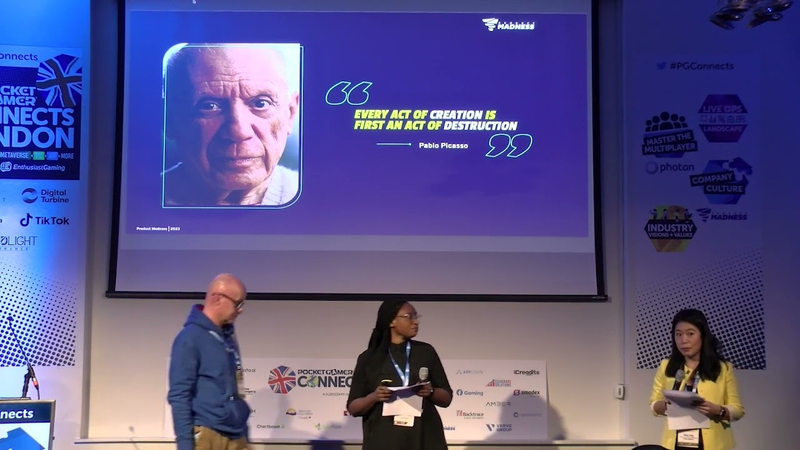
during some very challenging times um and what has actually contributed to this growth was essentially aspired by this quote uh so it's from Mr Pablo Picasso himself where he reads where he said Every Act of Creation first begins with an act of Destruction and so that's how he once described his creative processes so whilst I'm sure the pandemic was a time of Destruction um destruction and Chaos for many of us for product Madness it actually also provided a real opportunity for it for us to essentially reset and grow and recreate so as an example you know gone were the days where we spent five days out of seven in the office next to our teammates but instead we sort of had teammates dispersed all over the globe so no wonder we've seen countless articles and reports in the media citing things like disconnection isolation and how that's essentially impacted personal well-being so as Leaders of an organization we were expected to give
Clarity and Direction during this time of upheaval right that's a fair request I think but to be honest we didn't really have the answers unfortunately um our own sense of truth and the reality were hugely disrupted as well so as uncomfortable as it was um we didn't we still didn't rush into giving any answers away we actually spent a lot of time turning inwards and really focused on what mattered to us and for us that was our employees we ran regular engagement survey so Employee Engagement surveys which also then led to things like focus groups we also emphasize the importance of having regular one-to-ones with our sort of team leaders and team members as well as ensuring that we encourage people to have peer-to-peer connections and interactions as well and last we ran we ran a number of virtual and in-person events social events where we were able to receive lots of candid feedback and through all these various data points we found that unsurprisingly uh
during the sort of the difficult period that we went through yeah people cried for connection and this sense of community the most you know they wanted to feel like they were part of something bigger than themselves but perhaps what was a little bit unsurprising uh sorry a bit more surprising rather was that at the heart of connection and Community lay five core sort of elements the first one is all around stories and how we sort of tell those and share those stories amongst all of us the second one is communication and how we use common language amongst us the third one is all about symbols and how we articulate and tangibly anchor us and bring us together the fourth one is rituals uh and and essentially it allows us that the rituals that we follow that regularly binds us together and the last but not least is our ambassadors who essentially helped to drive our culture forward so when we are preparing this presentation as well we also did a huge
amount of research and one of the things that we discovered as well was that you know this is how these five elements are also the foundational blocks to how National communities and National cultures have built um I'll let Martin and Elaine elaborate a little bit further on on each of these areas So Stories thank you man yeah so how do we create a sense of community when everyone's dispersed all over the world complementing or building on from a vast quote people communicate through stories it's how human mankind learns passes on knowledge and ultimately it's how we become the most dominant species on planet Earth the key results that stories deliver is actually shared experiences despite the physical boundaries this is what binds people together and what creates the connection so what product Madness we started to look at and hone in on employee experience and incorporating the employee voice in everything that we did
in various aspects of our culture but also in in some of the other aspects that men in court to perform Elaine will elaborate a little bit yeah so I'm going to take you through language so as this quote says on here language is very important when creating communities and it actually derives from a similar common route the use of language has become more important than ever as we navigate these complex Global challenges at product Madness we grew during a very unstable time and we prioritize being more connected through words this led us to for the first time articulating our five guiding principles or our core values which I'll take you through so first of all we are people first so people are at the heart of everything we do who are really passionate about the people in our organization secondly we are globally inclusive so that means no matter where we are in the world we are connected and we are together
mad for more we are all mad but also we are always striving to do more together and collaborate in a really good way um Champion together is all about our achievements as a team we love to achieve as a team and celebrate as a team as well customer focus ensuring that we have high quality experiences not only for our players but also for our internal customers or ourselves as well so these powerful words or these five core principles that is our common language led to us rethinking our brand identity so I'll take you to the next slide where I'm going to discuss our Vortex of Madness so we're going to talk about something that's quite important for a second something that's quite important is symbolism in creating a community so basically as you can see on this slide we have our brand new Fantastic
logo with five different sections to it as you can see each section of the logo actually represents our culture and our values and what connects us and then also from that we've actually drilled down to do something quite cool with our logo and not just have it represent us globally but also celebrate our local communities that we created so all our different locations around the world so we've got live we've got London on there as well so this this symbol is very important for us in addition to that we've also created other symbols so we've created symbols that go beyond our geographical borders and we have fantastic learning programs so each cohort builds its own Center of community Through shared experiences stories and their own language and as a result we've created really cool pin badges that Ming's wearing there that we share with all our different Learners as well so now that we've
explored stories language and symbols Martin will take us through the next points around our rituals yes thank you so how can we translate all of these experiences into meaningful articles the answer for product matters was to review our rituals or processes of procedures or in other words our ways of working Clarity around these will help create stronger behaviors so we introduced a weekly Town Hall we introduced All Hands monthly meetings where all our employees from across the world departments and functions come together and share their stories what they are working on what are their priorities what are their workers what have they learned and what are they seeing in addition we created a set of rituals to allow our employees to reflect on these experiences by giving time back so we introduced a zoom free Zoom free
Wednesday we introduced Speedy 30 minutes meetings and we gifted days off and finally we invited a cross-selection of employees across the business to create and Define processes and help us build connections and communities because we believe that they were closely connected to employees and teams around the world and men will continue on that further yeah and I mentioned the fifth pillow The Fifth Element to this were ambassadors um so everything we've talked about the stories the language the symbols and the rituals they all need people at the center of it um the people the Believers the promoters the role models The Advocates whatever name you want to call them they're the people driving it Forward um even again when we think about National cultures it's the leaders and the ambassadors who help us one understand the culture to demonstrate it and three help us along the way if we get a little bit lost so at product
Madness we ensure all of our employees understand that they all have an individual responsibility and a duty to be a cultural Guardian but it's also our people managers and leaders who are our key drivers we set up an operational leadership team and so these are essentially made up of individuals who represent the different voices and perspectives from across the business so whether they're in different locations different departments or represent different games so when we have a meeting which is usually every Fortnight it sometimes feels like a mini un meeting and yeah it's these group of leaders are working alongside what's up with our senior leadership team who create and Define the rituals and ways of working they also help us communicate our stories and use the relevant language and symbols to ensure all of our employees feel a true part of the product manners community and so some of you might be sitting
there and thinking uh that's all one and good but covid is kind of over now um you know we've got new challenges to face so what's product man is going to do to tackle those um and to be honest the answer is still very much um the same answer that we had in 2020. um we still don't know what we don't know and there are still loads more uncertain times ahead but what we do know is that we trust in our process and our and in our philosophy and that is all about putting our people first and really listening to them so this becomes our starting point for Designing our initiatives um with which we're then going to be experimenting with so that crystal ball up there is not really it shouldn't really be a crystal ball uh but more but rather more something that's akin to like a megaphone for our employees to really Elevate their voice so we I leave you with all with this question um what are you going to do to build your culture and your community um in these uncertain times ahead we've been product manners thank you for
listening and we can open the floor up for any questions [Applause] any questions comments or observations can equally that's not really our roommate but if you speak to her so the question was how do you apply for a job at product Madness given everything we shared um if you come and visit our stools we've got a stall um somewhere in the conference G13 G13 and come see one of these people dressed in blue um yeah they're hard to miss and they can tell you more oh and yeah or follow this yellow bolt zappy um any other questions you have a fantastic career website of course it's true that's the answer thank you thank you very much thank you very much everyone [Applause]
[Music] [Applause]
Summary
This presentation outlines strategies for fostering workplace connection and community within the gaming industry, specifically drawing on the experiences of Product Madness. The primary thesis posits that during periods of global uncertainty and rapid organizational growth, companies can maintain a cohesive culture by focusing on five foundational elements: storytelling, common language, symbolism, rituals, and the empowerment of cultural ambassadors.
The analysis highlights that the shift toward remote and hybrid work environments necessitates a deliberate approach to employee experience. By utilizing data from engagement surveys, focus groups, and candid feedback, the organization identified a universal need for connection. To address this, the company implemented a framework centered on shared narratives to bridge physical distances, the articulation of five core guiding principles to establish a common language, and the creation of visual symbols—such as a redesigned logo and branded learning materials—to anchor employees to a unified identity.
Operational rituals were also restructured to support this community-building effort. Key initiatives included the introduction of regular town halls, the implementation of "Zoom-free" Wednesdays, and the adoption of shorter, more efficient meeting structures to improve work-life balance. Furthermore, the company established an operational leadership team composed of diverse representatives from across global studios to act as cultural guardians. This structure ensures that leadership remains responsive to employee needs and that cultural initiatives are driven by advocates at all levels of the organization.
Ultimately, the findings suggest that while specific challenges evolve, the most effective strategy for organizational resilience remains a people-first philosophy. By prioritizing active listening and iterative experimentation, companies can navigate ongoing uncertainty and foster a sustainable, inclusive community that transcends geographical boundaries.