1 free read left. Create a free account for unlimited reading + AI research.
Create free account
Keynote: Building a Scale-up Financial Model
Key insights
6 takeaways- 01The objective of scaling is to deploy capital based on unit economics until the point of break-even is reached, ensuring growth trajectories remain tethered to realistic, cash-flow-aware projections.
- 02Studios must transition from simple profit-and-loss accounting to granular, cohort-based financial models that map the specific time-lag between user acquisition (UA) spend and revenue realization.
- 03Financial models must account for industry-standard payment delays of 15 to 90 days, which create significant liquidity gaps that can be mitigated by leveraging credit facilities from ad networks.
- 04Games with longer lifetime value (LTV) cycles, such as puzzle or merge genres, are inherently more capital-intensive and require millions in liquidity to sustain growth before cohorts reach profitability.
- 05To maintain operational clarity, studios should isolate UA and monetization cash flows from general operating costs, treating UA as a repeatable investment formula rather than a generic expense.
- 06Founders should prioritize non-dilutive funding sources—including revolving credit facilities and revenue-based loans—to fund UA and minimize equity dilution.
Ask AI about this video
Transcript
[Music] [Music] are we all ready now for the cfo insider track which is sponsored by pullum vc and we've got a wonderful uh the wonderful martin mcmillan from poland who i've just been wittering away with chatting about meeting all of you in face in person for the first time in such a long time and it's very exciting as will be martin's talk about how to build a scale-up financial model so i'll just pass on to him very quickly cool thanks a lot uh jackie yeah nice to be back in person right um so we're going to talk about just uh
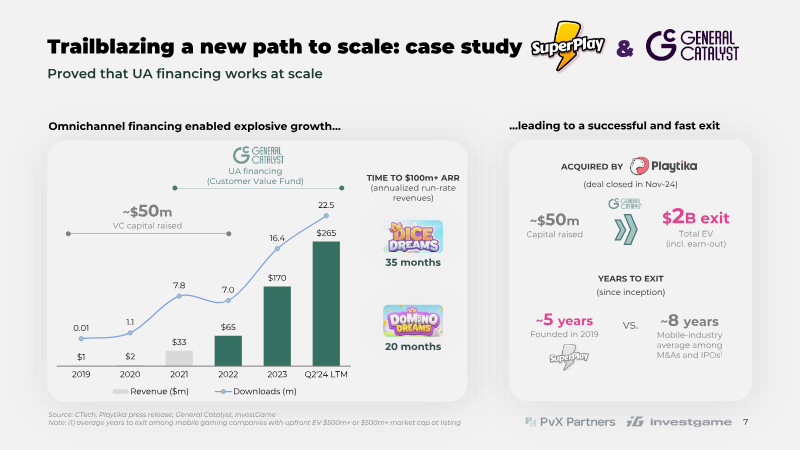
checking things working i mean you probably got it from the uh from the show reel um a second ago but just to give you a little intro to poland what we do and who we do it for so a key thing and why we do sessions like this is around improving for the financial literacy of gaming studios um so game issues typically don't have anyone with their hands on the finances until way later for some reason then excuse me most other most other businesses as a company what we do is we provide revolving credit facilities to game developers um primarily so when they've figured out user acquisition um you can use these revolving credit facilities to fund the user acquisition or most of it um to then scale up in a in a much more efficient way so typically it's used as part of the capsule makes alongside venture capital um to just grow in a in a much more efficient way and for a from fairness point of view less dilutive and keep more control um so one of the things we see as a company the whole time is this idea of like you know soft launch soft launch
soft launch and then bang there's a cut the ribbon moment right we're ready to scale and the um obviously you know some people are able to scale very successfully some people aren't um so what we thought we'd do is is to talk about you know some of the pre-flight checks and so on that we see um our sort of best practice and then talk about how to actually build the financial model to to have some framework to actually um uh actually scale a game so first of all number one ahead of anything else has got to be very clearly understood metrics you've got to have a really good sense of acquisition cost obviously you're not going to know how the acquisition cost is going to scale up as you scale up but you should at least plan for it row ass break break even the day that you're able to break even on your ad spend is super important and then also the ultimate ltd and how long you measure that ultimate ltv over um super important uh to have an mmp wired in um so however you know however it's possible to to track or
approximate all of the attribution in today's world um but it's really important to look at things on a cohorted basis so the mmps provide very good data to allow you to look back and look back at sort of existing performance of um cohorts sufficient retention data to model longer term ltd scenarios so if you were basically on you know if you think your ltv is going to be a year or 18 months or two years how much data do you really need to project that far out now you in in a way you need sufficient retention data to to have a sensible estimate but if you overshoot these estimates you you could find that you're buying users unprofitably and that could kind of really screw the business early on um four kind of sounds obvious like where are you why do you want to get to most people we talk to say hey i'm spending a thousand a day and i want to get to fifty thousand a day spend or ten thousand to a hundred but it's it's like this idea of like this is working here and now we wanna we wanna ramp up and we want to see what happens to the
economics when we start to scale um and then lastly we talked a little bit about cohorts they the you know the number of people we still find say well i'm making this much a day and i'm spending this much a day therefore it's all good who are not looking at it back on the cohort behavior and so the propensity to make a you know if you don't look through the numbers into the cohort data again um propensity to to lose money so when you're actually building the financial model and you know if you have a finance lead or you're doing it yourselves as founders or whoever the ua team um here's a fuse of uh like key ingredients obviously you need to understand your acquisition costs and model how these are going to move over time you need to have a pretty robust roast and ltv model um and that is normally going to be done sort of by you know by country you don't just look at one blended curve you're gonna you're gonna have to go fairly granular on it um the payment terms uh so often we see with ua managers they're just totally focused on the on a p l metric and they're not thinking about cash
so from a cash flow perspective you could be waiting anything from 15 days from the end of the month for some of the fastest paying ad networks and you've got the app stores um in the middle right up to 90 days so you need to think if you're building a financial model you need to care about when you're actually getting paid um you need to try and put in place credit facilities with the ad networks so once you get to a level of spend they'll you know typically come and offer credit facilities um which you should take and you should max out for as long as your ui is working because a credit facility from an ad network is effectively a risk transfer of ltv recovery onto you from you on to them so you should you should max it out whenever available provided your um your ua is working you're starting cash and studio running costs um you see a few different camps here one of the ways we we like to look at it is just like in a clean room scenario so my studio running costs and my offices and so on that's all over here that's well known and well understood and
pretty predictable but what we like to see is clean room economics where we you actually have a separate bank account just for running user acquisition monetization so you can then see the cash you know washing around that system without being clouded by you know payrolls and other things that sort of take you off obviously from a cfo point of view you need to look at the whole thing but we like the idea of clean room economics for user acquisition monetization um you need to be able to build these models they're kind of non-trivial to build and most you know most people hitting the ground to cfo will spend you know weeks and then months and years refining and then suddenly you get to a model it kind of really works through your business unfortunately it's not an off-the-shelf one of these um but something we as a company do is we we often help people build that once they get to a certain level scale we can go very very deep and build very granular models lastly ambition right the last thing you want to do is is be so cautious about it that you you know if you say well i if i'm breaking even in nine months and you know i need two
years to figure out what the ltv looks like you don't have two years to go through a whole ltv cycle because someone's come in copied your game or the world has moved so it's a combination of like you know not being unambitious about it so as finance guys the way we think about user acquisition is just as an investment formula how much in when do i break even how much out and then to calculate and tabulate some of these sort of financial returns so obviously the first thing we want to do is it calculates you know have you got a ua machine um can i put money in and get more money out the other side with known kind of um you know known kind of economics in terms of how long the time frame is going to take so the first thing we really care about makes a massive difference is when do we break even so if you're hyper casual and you break even in three or four or five days it's a totally different model to you know like a merged game which is going to break even and 12 in 9 to 12 months
so that that sort of lily pan that landing pod of basically right i'm break even anything else is now is now just you know profit sets a really different tone in terms of how to build the models so if we look at it if we build up our investment formula we just have a really simple formula here so this is a dollar invested gives me my dollar back after 120 days goes on to make two dollars total ltv within one year so my profit on that is a dollar um and if what we often do is we get is we work with people to break that sort of profit over the over the the length of the entire ltv cycle back down into a monthly return on capital so if i take that um if i take that return i'm going to say it's basically an 8.3 monthly return we're trying to get to an investment equation that says on a monthly basis we can repeatedly invest capital and generate an 8 return which is pretty good um again one of the things we have invested a lot of time and effort as a company is helping people understand these metrics so
we've created a whole suite of financial modeling tools that are just there there's no there may be an email but it's not even verified it's pretty much ungated just a free set of financial tools as a sandbox environment to help you figure out these economics so we never ask you to sync up your data sources we just want it used and and it's used thousands of hits a month coming with people just modeling their metrics and what we're trying to do on this one i i won't go into in this in this talk but i'll leave it to uh if you want just on pollen.vc's the calculator section at the top so this one is about row ass ltv and cashflow and what we're trying to do just in this front slide here is model out you know what does my journey of ltv curve look like and what i pick out the points where i break even i cut off my ltv there's no point in measuring ltv if it's really really flat so knowing when to cut it off and then visualizing what my profit and and timing is there so this is something we continue to invest in um so the next next thing to worry about
or to worry about to put into your model is when are you actually getting paid because if you've got your hands on the the the the rudder of the purse strings you want to know when so if you think about like say the month of january um and you're either uh you know you're you're serving iaps or you're serving ads there's a whole spectrum of when you actually get paid for this so at the shortest uh shortest end you've got um people like you know app love and pain out 15 days from the end of the end of the the monthly cycle right up to some of the other networks unities and fungals and iron sources whose standard payment terms are 60 days later so you've got to factor in up to 90 days of spending and monetizing but not actually seeing the cash so there's your first thing to build into your model in terms of offsets and then the next thing is obviously in terms of ad network credit facilities you know you start on credit cards you start to build up you get an account manager it's a very sort of like a you know step-by-step basis but as soon as you know if you're in a scale-up
phase and you have a credit facility you should be wanting to max this out because as i said it's just risk transfer from um from you on to them um so and again typically the way wax works let's say you've got the you know january's bill is due at the end of february um so again that needs to be also sort of factored in and offset into your um into your financial models um now the thing thing i really want to get across is that even when you've got credit facilities here what you need to be thinking of is your the roast profile the ltv profile of the game versus when the bills need to be paid because some of this is going to determine how much external capital you need in order to actually in order to get there so again fictitious example here there's my revenue being earned on a p l basis i have a 100k credit limit and then it's basically maxed out um so then i'm looking at when i need to pay the bill so if i need to pay the bill for
that um you know am i you know it appears on a p l basis i've got enough to pay it but on a cash basis not the case so the um what this is showing is basically if you're able to you know to draw cash against it and to reinvest and then when you actually get paid by the platform so you need to overlay all of these things um together and figure out cash p l row ass when the bills need to be paid etc um the the key thing is like the longer it takes you to recover the more external capital you need to fund the game so take for example go back to like a merge game with a nine month break even and then a two year ltv if i want to you know i think this game is like working i want to scale it from you know ten or twenty thousand a day up to a hundred thousand days so if i want to spend a hundred thousand a day on that merge game that's gonna break even in nine months
time i'm gonna need 27 million dollars of capital before that first cohort has even broken even in september so think about that in terms of and that's why you see so much kind of venture money going into fuel you know scaling of ua games if it's just being funded in equity so if you're talking hyper casual it's three days money can wash around the system super quickly but when you've got these long-dated ltvs whether it's social casino you know puzzle you know all these categories that the horizons are longer if you want to just to scale up then one of the things we do is we show you how cash negative you would go in order to achieve your level of spend but if if the user acquisition is working then you should want to do it you just need to factor in the different models of how you finance it um so here's some stuff we've seen again we've been doing this for a long time so you know what can go wrong um maxing out of credit lines you know if you get up there and you can't get
extensions whatever all of your all of your campaigns get dropped you then have to figure out how to juggle cash to pay down the credit line etc and then start up the campaigns again it's really really bad for you know for all of the algorithms um you lose you lose a ton of um lose a ton of time and it throws your uh it throws your your um ua modeling off um manage cash so this is this is back to the kind of the clean room economics of just like i've got the user acquisition monetization completely separate on a bank account basis so i can see how much in and out without polluting the rest of the studio's economics there now the the key thing and this is where you know it's always best the best outcomes are where ui managers figure out stuff with the finance team and ideally the monetization team so if everyone sits in their silo just looking at looking at their own kpis on the p l basis um the the thinking is very disjointed when everyone kind of works together
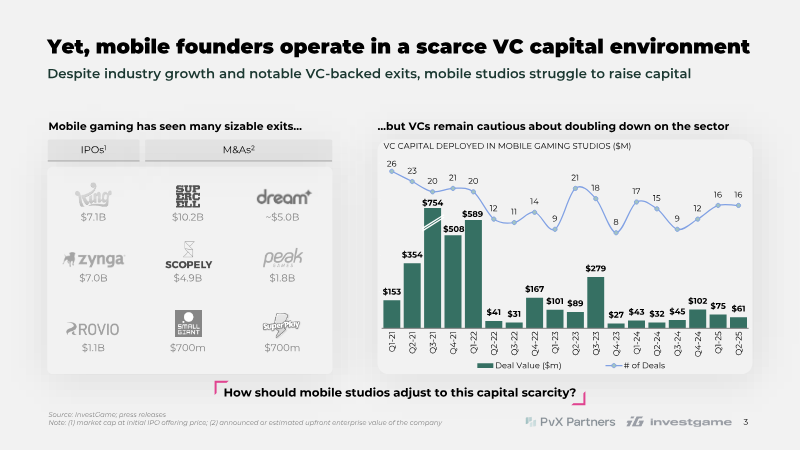
and figures out if we've got this user acquisition machine how can we scale it then that's when the best outcome happens whenever it becomes everyone's circular problem so managing cash is a is a really important thing um so planning for sufficient financing so what is your model telling you and how are you going to finance it do you need 27 million dollars to scale your merged game maybe not maybe there's other ways and then lastly don't fall is this is not set and forget so i think everyone in this room knows these metrics have to be mode it's not they're going to change around chop and change every day um this was really interesting so this was just picked up this is just from the from the press i don't have any kind of particular insights but um interesting that you know metacore had raised something in the region of i think 22 million bucks of of equity that is pulled from crunchbase and then saw this headline which is great so you've got a game which has obviously got long long ltv long uh recovery periods but they've got a mismatch right it's very capital intensive to build this sort of game so obviously then they
take a you know their their investors a supercell gave them a credit facility they didn't chuck in 108 180 million of equity um so that's how they sought to to mismatch it which i thought was super smart um in terms of how you can finance this gap then i mean the lazy way to do is just go and raise equity because it's it's dilutive it's really expensive etc but then there's different ones so there's venture debt which is term loans there's revenue based loans which is loans that you're expected then to put into user acquisition return for a revenue share you can go to a bank for a credit facility typically it's pretty pretty rigid they don't really understand um this world you can go to a publisher and give away 50 60 of your revenue simply because you don't have enough cash to scale ua or you can do non-bank revolving credit so like they're you know us and and there are a couple people in the same space provide these sorts of facilities that are tailored exactly for this um for this world it should be a really dispassionate um
process in terms of you start off you know with your cheaper source of capital and you you go through this capital stack until uh and you keep spending until the unit economics don't work so you got your credit lines free cash sitting in the bank some people still use credit cards for their miles credit lines loans against future revenues and then right at the bottom of the stack vc funding so at some point as you go through that the economics of acquisition will stop working and that's where you pull back and stop so the last thing is like knowing when your machine is running at full capacity um so this you know compared to the other one's a fairly gopping looking slide but the the point of pulling this up is basically to show so once you've got the core economics done what we typically do is we work with the studio to say like figure out go much much more granular figure out all of these things and build unfortunately this doesn't exist as a nice pretty website calculator but we we spend a lot of time modeling these things and we show the different scenarios this is if you just fund the
whole thing in equity if you fund the whole how much can you do with debt and compare all the different debt products together so it's really about building models that help you make informed decisions to keep your scaling path on track um last one here i'm going to zip for x amount of time definitely helps to have a cfo with some with relevant gaming experience building these models is not traditional for a kind of cfo function think about capital efficiency make sure you are using the right form of capital within the business for the right risk profile of project um do care about dilution you know right now we're in a super frothy market but if the market turns founders who are raising you know x amount of venture capital you know are going to be on the wrong side of liquidity preference think about your capital mix and potentially raise less equity and more debt to achieve the same results that was it for me i've gone a minute or so over i don't know if we've got any time for questions
[Music] [Music] you
Summary
Building a scale-up financial model for gaming studios requires a sophisticated approach that integrates user acquisition (UA) metrics, cash flow management, and strategic capital allocation. The primary thesis is that studios must move beyond simple profit-and-loss accounting to create granular, cohort-based models that account for the specific time-lag between ad spend and revenue realization. By treating UA as a repeatable investment formula, developers can determine the precise point of break-even and optimize their growth trajectory without over-relying on dilutive equity financing.
Key findings emphasize that financial literacy is often a late-stage development for gaming studios, yet it is critical for scaling. Effective modeling requires a "clean room" approach, where UA and monetization cash flows are isolated from general studio operating costs to provide a clear view of performance. Studios must account for the significant payment delays inherent in the industry—ranging from 15 to 90 days—and leverage credit facilities from ad networks as a form of risk transfer. The analysis highlights that games with longer LTV cycles, such as merge or puzzle games, are inherently more capital-intensive, requiring millions in liquidity to sustain growth before initial cohorts reach profitability.
The methodology focuses on building a robust capital stack that prioritizes non-dilutive funding sources. Rather than relying solely on venture capital, studios are encouraged to utilize revolving credit facilities, revenue-based loans, and ad network credit to fund UA. The ultimate goal is to maintain a dispassionate, data-driven scaling process where capital is deployed until unit economics no longer support further investment. By integrating these financial frameworks, founders can maintain greater control, minimize dilution, and ensure that their scaling ambitions remain tethered to realistic, cash-flow-aware projections.