1 free read left. Create a free account for unlimited reading + AI research.
Create free account
Increase Engagement, Stickiness & Revenue Opportunities with Real-Time Voice & Video
Key insights
6 takeaways- 01Integrating real-time voice and video into 3D environments increases user engagement and platform stickiness by enabling features like spatial audio and photorealistic human video streaming.
- 02The infrastructure supports over one million concurrent users per session and currently handles 50 billion minutes of traffic per month across hundreds of mobile applications.
- 03The service model includes a baseline of 10,000 free minutes per month and provides developers with real-time usage monitoring and technical support.
- 04The platform maintains compliance with global privacy regulations, including GDPR, while scaling to support massive, high-concurrency gaming environments.
- 05The technology is platform-agnostic with SDKs for Unity, Unreal, and web environments, utilizing hardware-accelerated video decoding to ensure minimal performance impact on mobile and desktop devices.
- 06Latency and packet loss are minimized by using AI-driven routing through a global network of selective forwarding unit routers, bypassing the inefficiencies of public internet paths.
Ask AI about this video
Transcript
[Music] [Music] okay so i just wanted to ask who'd heard of agora before this show so just as i thought not many people we're actually a pretty big company we're enlisted on the nasdaq we've got 1100 employees worldwide and we're 80 technical so we're developers and we're all focused about low latency high quality voice and video to apps and games we do 50 billion minutes per month in voice and video traffic and we power many of the big platforms in the world and quite often we're asked to keep that sort of under under nda so we it's not advertised but we provide real backbone for voice and video communications for some of the biggest players out there
we are in the app store now we have 244 android apps 269 ios mobile games all using agora voice and video there's a few a few of the games just listed down below there so we really focus on streaming voice and video with the lowest possible latency and close to zero packet loss and we can scale to over a million people in a particular session so on average we're twice the speed of the public internet and i'll explain how that works at the end of this um but yeah typically we're twice the speed of the of the public internet between sending packets between any two points in the globe and we're close to zero packet loss we're able to record the streams push them to cdn which means to youtube facebook twitch any rtmp interface we can push push the streams there and we've got sdks for every type of platform you can imagine um we provide hands-on technical assistance for developers so people like
me will get involved in your project to make sure that it's integrated correctly in the most efficiently way possible um and we provide real-time statistics so you can see how many people are using the service and there's something called live beats so in real time you can you can completely monitor the usage of your users on agora and where gdpr which is the privacy laws compliant and we can even control whereabouts in the world your voice and video will flow if that's a requirement as it is in some parts of the world we give every developer 10 000 free minutes per month and we have a global startup program to help you even more than that to get from where you are today to become successful because your success is ultimately our success so these are the sdks that we provide now every platform you can imagine like i said unity and unreal being big ones in the gaming area but personally i've been getting quite involved in the website of things lately and some of the demos i'm going to be showing you are around a-frame vr for the web um but
yeah like i said we we can put our sdks into any platform that you're working with so typically um video and voice are used um in mobile games to be able to see the other players that you're playing against that's really useful in poker for example when you're trying to judge you know the expressions on the other person's face it really adds to the game to have the video in there um here's um a bit more of like a team a team effort where you've got lots of people playing in a particular game it's nice to be able to see the expressions on all of their faces to increase the engagement and the um the usage of the platform and people coming back to it the stickiness of it and the long-term value of your users if they can sort of feel there's more of a community and that you're building around around the game or use of the game and as well as being available on web is a picture of that working just fine on mobile as well and things like echo cancellation which can be a problem when you're playing out voice and video
alongside um video communication we take care of that as well so whatever audio is coming out of your game is also cancelled against the input of the microphone of the people's voices so you don't get the audio coming out of your speaker for your game going back into your microphone and being heard all over the place acoustic echo cancellation is probably the hardest algorithm in all of this and that's something which is really important and key to agora's platform another another idea is to have all of your users using the games to have a big fan wall so you know someone else an audience person could be watching everyone playing perhaps in some sort of competition esports again driving engagement with prizes to get people to come back and want to partake in in playing your game and for prize money and being able to see everyone that's currently playing at the moment with lots of little statistics overlaid on top of their video this is something that we do as well um so moving on to slightly more advanced use cases spatial audio is the ability to have a sense of where
people are in in your gaming world so there's there's two main controls here pan which is the left and right of your ears but also gain volume and depending where all the other people are in the 3d world you get a sense in 3d space of where they are and we're able to control the pan and game in real time across all our sdks to give you that feel of being immersed in a 3d environment okay so moving on to some of the sort of what i call futuristic but exciting stuff here's an example this i recorded this in my bedroom actually recently hopefully this is going to play um this is augmented reality recorded on my iphone screen so even though i'm looking through my camera these these guys here are being i won't try and full screen it they're being streamed in live into the into the um into the scene you can notice that the uh the shadowing works well and this is 3d video which i can
actually move around them depending on where i am it'll it'll change to give a different angle so this is live video being broadcast into a 3d environment as i open my draw there you could see that the shadowing updates and takes effect this works on a mobile device it doesn't require a very big footprint to download because we're streaming video in real time phones are designed for decoding h.264 and vp8 with the advent of things like zoom and facetime so this type of technology is already built into the chips of your phones um here okay that's good here we've got a 3d virtual environment and i've put a video of myself um into this environment this was just taken of me standing in front of a green screen this is a static video where the the green is b is being uh made transparent so even though we're in a 3d virtual environment you're able to include real human video rather than just cartoon type of things that you're typically familiar of seeing in like
meta verses etc okay now i'm going to show you not just so that was a static three that was a static video within a 3d world here is here's a video um which moves around again this is this is a video recording i made it myself in front of a green screen but this time it's being streamed in um rather than being in in the actual scene this is being streamed in over over video telephony and i'm able to move move that video around inside my inside my 3d environment so i'm i'm kind of picturing games of the future where you're actually interacting with video representations of your friends in real time able to shoot them etc and and move around in that world this is this is all done in a web browser actually using web vr and x xr from um a massive project which involves the likes of mozilla and hundreds of other developers that have come together to put to put vr um in into browsers it works on an oculus headset it works
across the board you just go to a url and bang you're using this this demo right here putting it all together i've got a demo now and i'll just so this is two browsers side by side the box on the bottom left is my webcam then using ai we're putting a virtual green screen onto my webcam and then broadcasting that into this web vr the two different browsers are two different views it's going to have me in both of them because i did them on the same computer with the same webcam etc but again this is live video being streamed into a virtual environment nothing to install worked in a web browser the lowest possible latency the highest possible quality etc but again bringing photo realistic video into games and 3d worlds with very little footprint on the machine that it's running because it's reusing all of the um hardware algorithms in the chip in the cpu and the gpu to do your video rendering and decoding etcetera
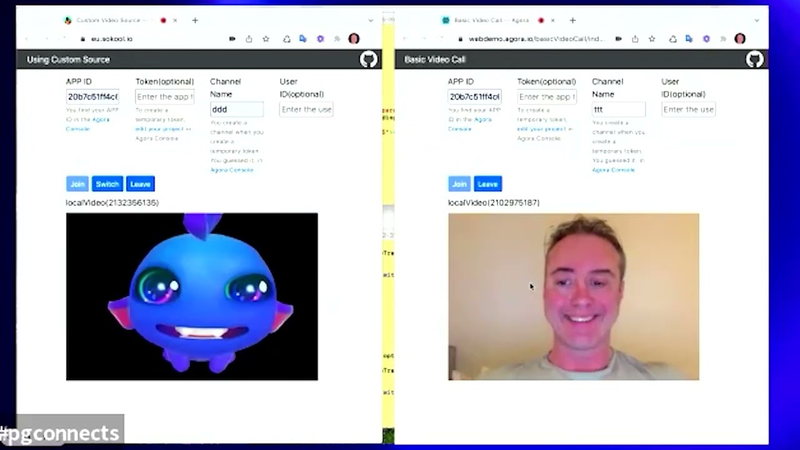
so again using like your facetime um algorithms for providing this so on the left i'm just looking around as if i was on a headset um or in a 3d game and you can see the other people in there which are represented by live video now this doesn't have to necessarily be a human face if you don't want it to be just gonna skip out of this but it's possible to drive avatars or characters using your face the beauty here again is that your gaming engine wouldn't have to know anything about the avatar on the left he could be streamed in using video calling such that people can own their appearance in other people's worlds you don't have to roll out a new version of your game every time you want to have a different set of avatars people are streaming themselves into your game using standard video telephony
in 3d to provide their appearance and this is quite cool because it's using ai to track the positions of my face and it's controlling this avatar um in real time and this again is something which is just emerging now the the ability for gpus on phones and laptops to be able to track your face and to be able to change that into blend shapes which control the animations which are available on on standard um you know 3d rigs and models and animations to be able to control all that in real time without any green screen behind me etc so i'm just going to quickly explain now how come agora is faster than the public internet at home we're all just connected to the internet how can it be possible to be connected to other people without installing specialist hardware which is twice the speed of of the regular internet right um i've got a little demo of me here with a friend in into us or a colleague in india this one doesn't work quite as well with audio what you get to see here is on the left is a standard webrtc call and on the right is using agora's network and
on the right it's almost a second faster between the uk and india and back yeah a second faster for your packets to go there and come back than just using point-to-point peer connection which is pretty much what everyone else is using and also we we get close to um it says 15 milliseconds for the round trip time and i'll explain why that is compared with 600 milliseconds and we're able to get next to zero packet loss and the way that this works this is a bit of an old diagram but i'll just quickly explain it that the way that we all connect to the internet are using isps like you know the 700 isps in the uk 15 000 in the us people that provide internet to people at home and the way that your isp allows the packets to flow from there from their um ip network to another isp is through these inter isp relations and people the companies will tend to go for the cheapest route and all of these tier one networks which provide the connectivity between different worlds and regions they're all in competition with each
other so they all charge peering um costs appearing so you're in your packets will tend to go over the cheapest possible route and this is a true case taken from the thousand thousand eyes report that if you're sending your packets from mexico to washington they don't go the green route where you'd want them to they go to russia and back because that's the cheapest way for them to send those packets and that's where everyone's sending their packets so you end up with a lot of packet loss and congestion but because agora has what we call sfus or selective forwarding unit routers in every isp tier 2 network around the world we're able to send your packets over our own preferred fastest route which is continually monitored in real time in fact we send your packets over three different routes all driven by ai to ensure that they're going the fastest possible distance as short shortest possible distance so that's the reason how agora because we're in every isp2 every tier 2 isp around the globe able to bridge between
the different isp networks we're able to send your packets from a to b more reliably and on average twice the speed and that works in and out of china as well um so just this is taken from the thousand i'll eyes report that if if you're on google cloud for example and you want to send your packets um between where that red circle is from europe to to asia your packets actually go all the way around the other way around the world because it's much cheaper for them to do that rather than just over that little bit there but agora who's got um presence in every data center for tier 2 is able to bridge that gap and send your packet straight across that bit there and that's um everything from me in a nutshell any questions wow thank you very much i i learned something yeah that was that was fascinating i'm gonna go and what's that thousand thousand eyes reported thousand dollars reports network report i've got a link to it because it's like it's very expensive but you can have a yeah i probably for the full report but
it was fascinating just to see how that that works so i mean you showed a lot of great um examples there um of of tech have you got any live games using some of those interesting video examples or you would like to talk about it because you're kind of providing the tech and well it's a mixture there's i mean ali here is head of head of sales for emir he can talk more about that in a bit we should come and meet us afterwards yeah but um there's and some of them are under strict nba so i have to be careful but give us those first um my email address at the bottom there and i i meant what i said if any of you would like to put any of these things into your apps and games my job is to help you do that okay i'm available to do that yeah has already got a question out there in the we've got a question in the middle yes we're gonna get a mic are we getting mike coming at you it's on its way hello hi um i just actually had a question wondering about um how your how it all functions if you're doing a cross-platform game do you still have such low packet drop-offs
yep so our sdks will will fit into different platforms depending on where your game is and our sdks take responsibility for sending those packets between the different platforms they go over the agora network doesn't matter whether you're connecting from ios android or unity etc it's all using exactly the same technology to root those packets on the back end fair enough that's good question i've got any more questions out there i know sorry i've got a couple more to go be lunch soon um yeah and i i mean i think is there is there a limit because you mentioned as well that there was some free every developer gets some 10 000 minutes a month is there a limit to the size of a developer that can kind of work with you are you are you mainly focusing the aaa guys or is a no there's no there's no limit at all i mean um and the other side we can have up to a million people receiving those streams and ultra low latency around the world which means you'd get through your 10 000 minutes very quickly if you had millions of people connected um but no there's no limit to the size and we've got architects and and developer evangelists at every level and like i said we have a startup program which
will give you a million minutes and other support to get you going and we're really there to help companies or startups really even individual developers to to get off the ground and i've got ideas that you know i could share with you which which you might find useful to work with i'm just busy helping everyone else to actually go and do it myself yeah no well fantastic thank you so much another round of applause for use for ben and agora as you say you can meet ben afterwards and agora have a booth as well you can go and chat to them about that and make some those really cool cool uh implementations so [Music] [Music] you
Summary
The integration of real-time voice and video into 3D gaming environments serves as a primary driver for increased user engagement, platform stickiness, and revenue growth. By embedding high-quality, low-latency communication tools directly into gaming engines, developers can foster community interaction, enable esports broadcasting, and facilitate immersive social experiences. These capabilities allow for advanced features such as spatial audio, which provides directional sound cues in 3D space, and the streaming of photorealistic human video into virtual environments, bridging the gap between traditional gaming and the metaverse.
The technical infrastructure supporting these features relies on a global network of selective forwarding unit routers positioned within tier-two internet service providers. This architecture bypasses the inefficiencies of the public internet, where data packets are often routed through suboptimal, high-latency paths to minimize costs. By utilizing artificial intelligence to monitor and select the fastest transmission routes in real time, this approach achieves significantly lower latency and near-zero packet loss compared to standard peer-to-peer connections. The technology is platform-agnostic, offering software development kits for major engines like Unity and Unreal, as well as web-based environments, ensuring consistent performance across mobile and desktop devices.
Operational data highlights the scale of this technology, which currently supports 50 billion minutes of traffic per month across hundreds of mobile applications. The platform is designed to scale to over one million concurrent users per session while maintaining compliance with privacy regulations like GDPR. To support developers, the service provides hands-on technical assistance, real-time usage monitoring, and a tiered access model that includes a baseline of 10,000 free minutes per month, with additional support programs available for startups. By leveraging hardware-accelerated video decoding already present in modern mobile devices, these integrations maintain a minimal performance footprint, allowing for sophisticated real-time interactions without compromising game stability.