1 free read left. Create a free account for unlimited reading + AI research.
Create free accountWhitepaper DiGRA
1 free read left. Create a free account for unlimited reading + AI research.
Create free accountWhitepaperDiGRA
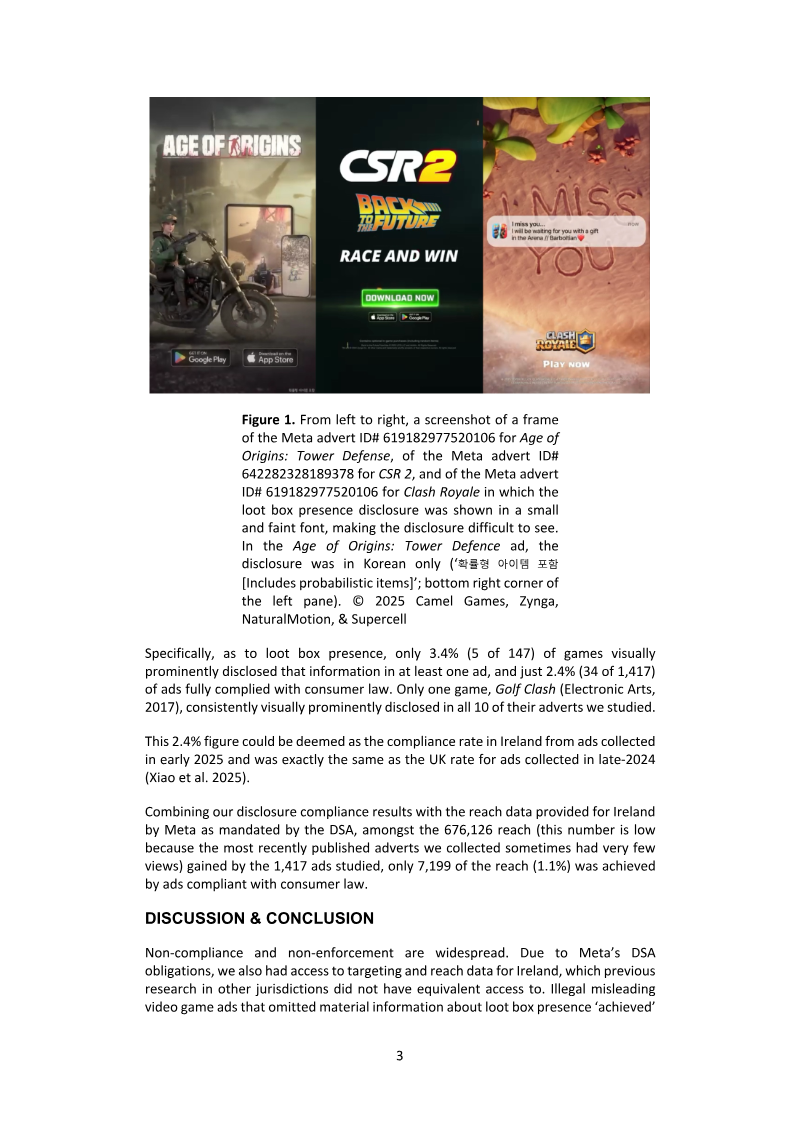
Loot boxes are randomized rewards bought with real money, and UK advertising rules require their presence to be disclosed to consumers.
This study examines whether video game advertisements on social media comply with UK advertising rules requiring disclosure of in-game purchases and loot boxes. Loot boxes, which are randomized rewards purchasable with real money, are common in popular games and have been linked to problem gambling, which motivates the regulatory requirement that their presence be disclosed to consumers. The author analyzed publicly available ad libraries from Meta and TikTok, a qualitative review that built on earlier findings of non-compliance on app store listings and two Advertising Standards Authority rulings against game publisher Hutch Games.
Compliance was low across both platforms. Of 188 Meta ads for 63 popular games, only 21 (11.2%) disclosed in-game purchases and just 13 (6.9%) disclosed loot boxes; at the game level, only six of 63 titles (9.5%) disclosed loot boxes in at least one ad. On TikTok, among 130 of the most-watched game ads, only nine (7.0%) disclosed in-game purchases, and seven of 100 ads for games containing loot boxes (7.0%) disclosed them. Using TikTok's unique-user estimates, the study calculated that roughly 89.8% of UK impressions for loot box game ads came from non-compliant advertisements, equating to about 292.6 million impressions.
The author concludes that the vast majority of video game ads on social media fail to disclose loot boxes, signaling that advertisers need clearer understanding of their legal obligations and that players and parents require stronger protection. The study's scope is limited to a sample of UK-targeted ads from selected popular titles, and the impression figures rely on platform-provided estimates, but the findings point to widespread regulatory non-compliance in game marketing.
Each row is a game or company this document names, each column a document, oldest first. A mark means that document names it. Select a row to see those documents.

DiGRA · 2026

DiGRA · 2026



DiGRA · 2026
PocketGamer.biz · 2025