1 free read left. Create a free account for unlimited reading + AI research.
Create free account
Hypercasual Games & Real Multiplayer, a Marriage Come True!
Key insights
6 takeaways- 01Deterministic networking engines now enable physics-based, real-time multiplayer that remains performant on low-end hardware and unstable network connections.
- 02Stumble Guys achieved over 15 million organic downloads by prioritizing real-time multiplayer and low-latency architecture from the earliest stages of development.
- 03Scaling real-time multiplayer requires server-side validation for anti-cheat protection alongside the strategic use of bots for onboarding and matchmaking efficiency.
- 04Cost-effective infrastructure pricing models for concurrent users, often around 25 cents per unit, have made real-time multiplayer technically and financially viable for developers of all sizes.
- 05Hypercasual gaming is shifting from simulated bot-driven experiences to real-time multiplayer to address player disillusionment with fake engagement.
- 06Integrating social features like interactive lobbies, clan systems, and structured tournaments transforms hypercasual loops into competitive ecosystems that improve long-term retention.
Ask AI about this video
Transcript
i'm delighted to say we've got um to kick things off we've got an old uh not that old but a friend an experienced friend not an old friend a friend of the show and uh the head of growth for photon engine the one from mr mark val who's gonna uh he's gonna come in and open the track mark how you doing doing fantastic it's good to see you chris has been missing oh isn't it i know what yeah you can't actually see me for some reason i'm in like i mean there's a shadow there i don't understand that you should know that the light has to come from the front i've obviously not got myself the uh selfie stick it's it's getting darker earlier here usually i can uh i can get away with the lighting from the from the the way it'll be fine but yeah we're now at 600 000 developers and still growing at photon and um
uh yeah it's been 15 years now of uh building multiplayer games so uh wow and you don't look a day older you don't like it neither of us look at dale when we first met mark 15 years ago yeah that's great that's the great thing that's the miracle of games anywho i'm not gonna you don't hear me uh chatting with mark we can do it over there at some point um i'm gonna let you give your deliver your speech about hyper casual games and real multiplayer and marriage come true i believe that's the title it's a good title yeah you guys will share my screen right you ready to launch that yeah share your screen there we go all right let's have a look look at that that's very nice you've got you've you've put our logo and everything so i'm here in the background uh i'll come in with some questions stuff at the end but i'll let you uh let you crack on now that's all right yeah fantastic let's do that okay if there's anything just jump in don't hesitate so uh thank you everyone so yes my name is mark val so i've been in the online industry for a bit more than 20 years um i both build studios
for uh unity but also ubisoft and also grew playfab from zero until the acquisition by microsoft live in operation platform and now at photon engine for the next leg of uh gaming because definitely multiplayer as we heard many times today the metaverse is growing and multiplayer games are going as well and definitely it does have an impact on or market since most of them grows in games that are actually making a lot of money are multiplayer games so all of the games that have a heart are games that are multiplayer those aren't half a heart they have live game operations you can have friends chat with them things like that but it's not real time connection and um the talk today is about hyper casual games so what we can look at is um where are hyper casual games and as you can see at the bottom they take a large part of games that are downloaded
every year so the question is if they have the majority of kings why aren't there in the top of these games so definitely what we can define is that they don't necessarily have a great retention or conversion and um multiplayer very much help in those sense and that's what we're going to investigate today and how we can do it with hyper casual games but first let's look at the origin of hyper casual games so the first branded hyper casual games on mobile was flappy bird made by don guyan which is from vietnam and i met him in 2014 and very humble and definitely like his goal was to create create a game that puts a smile in the face of people that uh everyone enjoy but definitely a game that is super easy to uh to play and his mindset was that you have to be in a bus
um and have an ends up holding the rail and still being able to play your games really was just one input with your tom and that was the old mindset of the game and then making a bit funny and there you have it yeah flappy bird um so um yeah keep it simple um if we look at nolan bushnell what he did at atari that was that was the the mindset of all the games from the 80s and started with the 90s just keep it as simple as you can so that people can get hooked and talk to their friends and make them come um and that's what happened with flappy bird people got hooked and and every good and bad ways um so flappy bird all went all the way up to 50 million downloads and that is just in a few months and um and that was too much for for don he wanted to have a positive game that makes people happy but indian was everyone was frustrated all the way to iced tea so when you reach
the game that is so viral that everyone talks about it on the news but also the forbes on the business insider everyone was talking about flappy bird but then since uh he is you know the master of his own game he decided to shut it down but still a very good impression about what is hyper casual all about and in terms of multiplayer games well there is actually multiplayer games that are hyper casual so you can think about agario and obviously slitter the ios anyone today can go on their browser type any of those two games and still play these games had you know hundreds of millions of downloads both of them they were extremely popular they were for example for slitter that i owe the most searched game of the year think about it that's how big it was like super easy to use anyone have a browser can play the game and then just move on forward there's a you know 200 to 250 players at the same time
and um you know like then it went on on mobile and it was on top of the mobile store for a very long time and um and still today you can see it from time to time pop up as being at the top of the most downloaded games so definitely extremely popular so what happened with the i o so that's the extension name and then what we had was tons of dot hio games and still today they are everywhere but there is a major issue with the majority of all of these games is that they are fake multiplayer games so it means that they use butts to mimic players and the whole point is to improve retention because when you start a game and you see other players right away you have this feeling of oh i belong in there i want to beat these people i want to if they are able to do it i can do it myself and um so um uh bots that are mimicking are great but then at one point obviously uh players saw that it was fake and uh then they start leaving so
um so the big question that we can ask ourselves is um instead of making uh hyper casual games our multiplayer that are fairly you know low graphic and all that how can can we make a visually great hyper casual multiplayer game on mobile and uh for the many years that i've been at play fab but also at the photon engine i pretty much received the sign playing from everyone which is too hard i prefer to use spot only the phones are too slow connections are too slow and in the end like it's too expensive to do that so they rather just wrap a really small game and throw it out so that was uh heartbreaking because definitely we can see that multiplayer works and it's where to put in the effort so um so then we actually look into ourselves so full-on as i said earlier we've been there for a while we have you know thousands of live games so why don't we ourselves make a
game so photon i've never you know made a game before so why not um we have all the competence to build a game but we are not a production studio so anyway so we set ourselves okay let's let's do it like super short term uh let's try to hang for all the phones that is out there and um that is actually very very not expensive to run um so we are lucky at photon we uh made tons of templates in the past so it means uh we have you know all kinds of uh style of games are it's already all wired for unity so we pick actually one of our templates and uh teamed up with another studio called kitka to build a game and what is great with this template is that it holds all the physics solve moving elements and whatnot and what happened is that we release stubble guys so stumble guys got released um a bit less than a year ago and uh went on to conquer
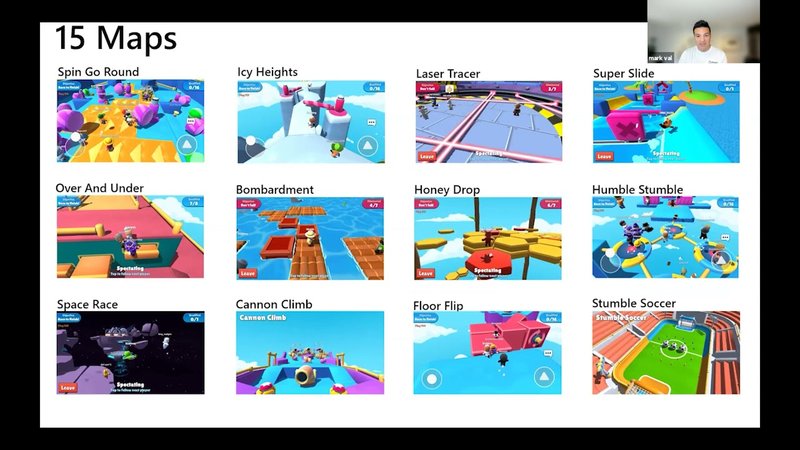
the web let's call it like that so it's 32 players um which is um uh you know quite good for on mobile and it's fully deterministic so it means the engine which that we have it is called quantum um is very much based on physics and all of the transfer that is happening on the network is extremely fast it's on the inputs that you're sharing so it means that we can target very low-end phone and also very bad crappy internet that you find pretty much worldwide um so in that end it's very short gameplay it's about five minutes um but then if you want to play just one round because there's three rounds to to win an actual game it's about a minute so the whole goal was that you start a game you can jump in in the game learn the game fast and then moving forward and that's what we did so we have this wonderful game that is available today and it has 15 maps and all of the maps use a different
technique in multiplayer regarding teleportation but also bringing players around but also a lot of moving assets that is important for making the game engaging and people to have fun the goal of the game is to eliminate other players so when you go through a first round you go in a map and then you you know you have a random map that comes and then you can move in forward um so that went very great and uh another thing that we implemented is tournaments um a great thing that is um that very much improved retention is our tournament system so as you see ten percent increase on the players actually played the tournament that is huge so that's one recommendation i could tell you regarding uh april casual multiplayer is to implement such a system and then you will actually rip out the rewards so stumble guys extremely successful
people love it the players love it and it has good reviews and still going and it went all the way up to uh to reddit where people you know someone asked why does tumble guys battle while on the play store have better physics than fall guys because every as you have seen we sort of got got inspired and the community manager at uh fall guy actually said well you know that's fake it's fake multiplayer it's just too good and um that is that is some nonsense so obviously for us we know this is fully network all the players are real there's nothing fake so that was pretty much a check mark saying okay we did it we even uh convinced like others that this is this is actually extremely good and um if we look at our kpi um then the the game the the two spikes is when it went out in various stores and got promoted by the stores themselves we've never did any user
acquisition no marketing it's 100 organic and the game is doing very well so what started as an experiment on how to uh you know make a hyper casual multiplayer games ended up being something extremely successful and as of today there's you know 15 million plus download and still growing it will go with time and now the team is iterating on it putting more love to the monetization aspect of the game so obviously the revenue will go up and it's also available now on steam so as you can see it's possible nowadays to have hyper casual games on mobile working worldwide and um the majority of our users actually are in areas that have very bad latency i'm talking you know like philippines but also vietnam india and um and the game plays very well as well the players are happy so it's entirely possible for you to do
the same and um and use actually the same template that we have because it's available on the website so the question you have to ask yourself if you have never did any multiplayer game in the past is when to implement multiplayer where where do you start so multiplayer is one of the aspect that you have to implement very much at the start um you know more than often there's you know game single player games that comes to us and say hey i want to make a game with player where do i start unfortunately you have to rip off a lot of the codes because the objects that you have moving in your screen you want them to be network and to do that you have to think about it from start so as usual plan and define what you want to do as soon as you can and and then move forward um so now i'm going to go through a few tips there's a lot of content and we have quite short time uh but let's uh let's let's try to get to dive and give you as many tips as as possible
so obviously your goal is to bring the players together as you see at the bottom that's actually pokemon go so it's either physical or in virtual or in the metaverse doesn't matter the point for you is to bring the players together as for us and the stumble guys you can see it right away in the lobby and you have interaction with the players right away the idea behind it is the power of agglomeration the more people you put together the more people feel that they belong to something and and that's the key here is that the players have to have this interesting value regarding the game that they feel not only that everyone is equal but you can talk to anyone it's also a good way for the players to teach the new ones how to actually play um so the power of glamoration is the 80 20 world which is that 80 of your players will be in 20 of the space that you have um and and then other players would be around
so i'll definitely you want to bring multiple modes there's different characters psychologies of the players and you want to give a little bit for each of them you can look at the zip flaw in term of your uh analytic to define which areas in your game that actually attract more players and how we can bring more love to these areas so that they stick more to bring more players after that so it's a good way to go forward and obviously you have to own your community when i say own your communities mean that on the web yeah you need your own reddit page uh you need your own forum so that your conversation regarding your player doesn't go elsewhere and definitely try to communicate as much as you can with them so that you can start a dialogue and then have a good impression with the players and then gather value and then bring it back again so it's all about lobbies the lobbies is the first place the player would go you have to give some power to the players which
means that if i want to play with my friends only i have to be able to do it or if i want to make sure that in my room my friends are there plus some public slots it needs to be there as well and you need to be able to report players that are behaving bad because it ruins the game for many it just takes one troll to ruin a game of 64 players and and then you know you need a way to either squelch kick him and definitely being able to report that player and as you saw as i said earlier fake multiplayer is bad but bots are good so what i mean by that so when the player starts to play the game for the first time it's very important for that person to understand what he needs to do and if you take that player and put him right away against others which has higher skills it can be very very you know hard and fine that he just cannot do it so the best way is to use bots and actually have on boarding process so that the
player finds it easy because there's that rule in multiplayer where obviously you want the players to to to win a lot but not too much so if you make them win too much they're gonna actually leave so it has to be hard at one point but at the start it has to be easy enough that they understand the game mechanics and then can move forward and bots can be used that many ways as friends and co-op and but also to replace players that left the game and uh and then you want the bots to replace him that's another technique so in short you should keep the player engaged and the boss does a very good job at that even as i said earlier games that rely solely on bots is not the way to go you need to create a community so you need actual actual real players to improve uh your various metrics for monetization and also for conversion rate to
higher paying players and definitely for retention matchmaking is often the place where people put less energy and this is the place where actually you should put a lot of energy matchmaking can be automated it can be filtered uh it can go by team size it can go by score by range it can use you know you can use the mathematic of true skills or elo scoring in terms of creating a bell curve of what is the the sweet spot let's say to be matchmaker with the various players and the point in of matchmaking again is to find players that are pretty much as good as you so that you can have fun with and it's a bit hard you win sometimes you lose sometimes and the whole point is to have you know this this habit of going and knowing that you're going to have the fun and as you do your matchmaking sometimes there's just no players and you know there's no players to play around you so you need to expand that search so every seven seconds you're
gonna search more players regarding the score or maybe the area around you so that you have you know maybe some higher latency but still your networking algorithm will be able to compensate for that so very much you have to think about matchmaking as one of the key aspect of your game and when the game goes there's multiple games like for example here call of duty or a battlefield uh where there's an imbalance in the team itself where you know like a team is much better than the other one and those match usually lasts about like 30 minutes in case of hyper casual games obviously it's shorter it's five minutes or so but it's totally possible in two opposing teams that player starts to leave so you have to rebalance those teams so obviously if it's a competition with leaderboard you might not want to compensate but when it is a public game where everyone can join join and have fun it's very important to rebalance those teams and um
and manage the players in their proper way and then we have cheaters and hackers if you want to do a peer-to-peer game which is a lot cheaper to run obviously because the simulation happens on the device of the players rather than a dedicated server or cloud virtual machine you will have to take care of your players because now when you do peer-to-peer uh you can sniff the ip and then from the ip you can define a region and then to fishing in the game you can understand more about the player and eventually go all the way down to calling the person which is what virtual then did um many many times actually there's a bunch of videos on youtube regarding his actions uh but still you have to protect your players so it's important to do your architectures in a way that the players are protected and also to promote fair play which means that everyone has a good chance to win um so in that end cheaters you have to be careful
especially you have a very popular game and if you have leaderboards definitely you're gonna have tears if you have tournaments you're gonna have cheaters um so try your best to uh to mitigate cheaters the best way you can and a good way to do that is to use a deterministic engine a bit like how we did with fall guys because the physics is what limits the players and then on the server side you can actually put some rules so that the player cannot move for example faster than one meter per second or that he cannot well you know you will be able to put barriers in short so i've put a big pizza of all of those recommendations um each of those require a good amount of work to implement properly but still once you do it one it's a lot easier to do it again so i encourage you to start at um you know start tomorrow or yesterday to implement multiplayer in your game you're gonna rip the reward that's 100 sure so where do you start so there is a
a lot of content and videos online there's also books um you have to understand two things regarding multiplayer both how to implement it as a developer but also how to convert your players so that you become more you know engaged in your game and uh and create a habit so you have to go on both sides to really master how to uh build multiple games and then if you need inspiration well you know there's tons of it so um obviously you can go in the stores and look what's going on already but you should look on another platform as well so rec room is always on the verge of creating the latest one you can find squid games obviously in rec room and a lot of good ideas regarding what will make a player understand a game very quickly and actually engage and wants to you know outperform other players and then you can look in also a very popular game like overwatch where you have a game browse where players can create their own room create can create their own rules
and that way you're gonna again see another perspective and that game would be a first person shooter and how they do it and it's very interesting to see the virus implementation on how to create a game that is very simple to understand but also easy to play and then again if you want another one so there's rec room as i said earlier or roblox um so rechrome is in vr and roblox obviously is on pc and um so rec room has a way to create various components by the players again and it creates very nice gameplay to get inspired off so um uh and then through all of that if you want to start then us at photon as i said earlier we've been doing that for a very long time we you can build pretty much any kind of games on top of our topologies that we have either it is the deterministic simulation as i was talking about or if you want to build a 200 player games as well using our latest engine called
photon fusion you're welcome to pick it up it's free and you can start today and obviously we support all the topologies i was talking about earlier so hopefully this will this give you a few tips on how to move forward and uh multiplayer and how you can also start with hyper casual games and also have your own success so because if we can do it you can do it as well that's 100 sure and i'm sure that chris would love to have his own hyper casual games as well of uh mastering events planning and a lot more which could be a game and and you're definitely welcome to yeah i'm i'm inspired i'm uh i'm inspired by stumble guys i've got a i've got a game called fight night it's very similar it's a lot of but it's a multiplayer shooter but i know it's time to guys it's great i'm going to be straight on to that after this um
i love it i love it i love the fact that the actual four guys guys are getting trolled by your having having better anyway that was so funny because when when that happened it was like what that was like okay this is happening this is real but they actually said we're gonna find that and said it's my friend tonic oh do you know you should put some yeah yeah it's already they've sold they've stalled it they don't care i'm sure that was incredible that was like 15 years of of insight and ideas came into one i was trying to make some notes and like each of those pages had loads of great details so anybody making multiplayer games these videos will be made available afterwards might also is powerpoint though i don't know but definitely the video will be so you will be able to look through it frame by frame in a bit of a slow away and i'm picking lots of great ideas out and you're totally welcome to write me write to me and uh i'll send you the pdf it's a pleasure each of those slides each of those
slides actually is a presentation on its own yeah well i i feel like it's always detailed it's a few questions yeah i got a few questions though that i might as well try and get him we've got quite a few questions in the audience i'll i always go to name ones first so i'm gonna go with zara first because there's a lot of people quite shy but uh zara says does all this apply to mobile games like all of your points i guess it depends how complex your your your game i guess what you're saying i'll say i'll say pretty much yes um because it doesn't matter the device in the end those are principles of gaming it's really to the core which means that um both i'll say that on mobile the big difference is um obviously the device itself screen size and all these things but it doesn't matter it's all about putting players together so that's something that you can manage on your own definitely and then regarding like um uh handling the connection then that's that's usually
what people fear which is you know this mobile i'm gonna go in the tunnel i'm gonna lose connection and then it's going to come back well those are elements that you need to implement on the server side which is how to authority join how to actually join a game that has been played for the last five minutes and i was not there and then i come back and play so all of these elements you have to take care of it and usually you know you're actually networking in general will take care of that but as for us for photon it's already done so you can really concentrate just on the gameplay itself and then move forward i would say the important thing with mobile is that the devices themselves like here the pixel 6 pro well we don't see it well and um you know it has eight core or 12 core something like that is there's so much ram uh you can play very very very hardcore games on my phone and um you know i can talk about 5g and all these things but still on 4g you have a really good connection and um and lte and whatnot um so so you'll be fine yeah yeah definitely i i remember
the old uh old days you used to play a bit of an intensive game and your phones you skipped a hot candle after a while but uh no more um there's quite a lot of questions here about different things one question it was interesting um which i it kind of occurred to me as well i think i may have missed something the question goes are you saying that photon assists with stroke manages matchmaking and cheap prevention or are those third-party services i think because you were rattling through quite a lot of things yeah that's right that you can handle or things that people need to plug so photon as pretty photon has everything from the start it means that um you can do the old matchmaking you can you know decide to be a host yourself you regarding cheating well you depending on the topology you choose as i said earlier well you can put some rules on the server side to prevent cheating and then obviously if you use the deterministic engine that we have which is called photon quantum then you already you know did 60 plus of the work regarding cheating
um so in those sense um yeah that's great you're all set yeah i think i think there's a that kind of ties or links to a couple other questions i'm going to tie it together here which which is about who who your key audience are you've got six hundred thousand votes that's a lot right so that's you know that's kind of like a you know you develop a base and um what one of the questions is what size company do you typically work with and another is what's the model like does it very is it obviously you said you can get the tools for free but i'm presuming you charge at some point otherwise yeah that's right so is it based on usage or is it is it like a license fee how does your model typically work yeah yeah definitely yeah those are all good questions so um so forth fusion which is our latest engine is free up to 20 concurrent user so in short um we charge per ccu so depending on how many players you have in your game that's what you're going to pay so it starts at 25 cents
per ccu so it means that a ccu first if you want to get all the way down to mau is that you take your mau that you aim let's say like a million mau and you divide it by 20 or 15 and then you have your deau with the daily active users and then you divide it again by 15 or 20 and then you have your ccu so you can imagine you will have a bill between you know like 300 to 800 dollars to manage you know 800 000 to a million uh multi-active players so cheap now it's all about size that's what i keep explaining to everyone that was the same at playfab so it's a so we make it so cheap right that everyone wants to use it and then after that it's all about reach and then regarding reach um it's for both triple a's but also very much in these so we were targeting very low end nds until a year ago and now you need a bit you know you need a bit of knowledge and unity
to get you started but don't make use for everyone fair enough absolute novices probably it'll take me quite a while to just get my game started but i'll have a go um final question is a few more but i'll have to move on says final question i want to throw at you which i think is quite an interesting question actually i mean because you you mentioned a a lot about the kind of fake multiplayer like bots yes that's right i i guess the question is i quite like playing uh a you know agora dio and and games like that and hold io and the various ios does it matter do you think to most players so it's fake versus real multiplayer i mean presumably you also this is the question so you miss mechanics so the main thing is that you miss the community aspect of the game so for example um like first agario and sister.io are real multiplayer games but then if you look at paper.io whole dot io all of these are fake and the thing is that once you are able to create clans once you are able to communicate onto your build to set goals as a team then that's when your retention really
kicks in because all of a sudden you put value in people and when you put value in people it just makes you come back you're going to wake up in the morning and say hey what my friends did during the night and you want to catch up so um so you know bots like they're doing on holes that i owe and paper and all that is good but it's really you know hash hassan and sit like this so if you want to really rip up the reward you put a bit more work and then you get a community aspect of things and that's when you really start to monetize fantastic and well you mentioned like a 10 retention increase with tournaments and stuff as well i'm sure a lot of people are looking at going okay so we have this sdk it's called tournament sdk to be so original and we're like yeah why not why not implement that as well and see what happened because there's not that many studios that use it actually and um and then we saw wow you know this thing is is really good and that's the whole point of engagement where you have a
player that um that that um wants to invest more in the game and wants to compete and because here's the main thing and that's that's the same thing if you play any skills game you know like those bingo games that are skill based or um you think that you're the best but you actually are not so and then when you get into tournaments that's when you know people that really really really wants to prove themselves which starts to grind and improve their skills and eventually get at the top of the tournament and this is a key factor because if you can make uh public virtual tournaments and you grow your crowd base that's when you can get to the next step where you can make real money tournaments and when you get there then obviously there's the old twitch verse with the verse and everyone's gonna start talking about that and that's what you're going to reach at one point so um so it's a good it's a good way to but improve your retention improve your virality because people
will say hey i'm super invested into that come see me and then uh third it will well you're gonna make more money so why not so that's part of the name of the game well i'm gonna have to move on cause we're only a bit late i'm terrible with terrible keeping to time but that was really great uh really insightful i advise everybody to get in touch with with mark he's very lovely guy and uh obviously he knows his onions there and there's so yeah it seems like this is the way to go multiplayer so thank you thank you mark i'm gonna i thought are you coming back for a panel i don't know uh you are later on as well so i'll see you yeah that's right you
Summary
Hypercasual gaming is undergoing a fundamental shift from simulated, bot-driven multiplayer experiences toward authentic, real-time competition. While developers historically relied on artificial opponents to mask technical limitations and boost retention, this strategy often falters as players become increasingly sophisticated and disillusioned by fake engagement. The transition to genuine multiplayer is now technically viable through deterministic networking engines, which allow for physics-based gameplay that remains performant on low-end hardware and unstable network connections.
The success of titles like Stumble Guys, which secured over 15 million organic downloads, underscores the efficacy of integrating real-time multiplayer from the earliest stages of development. By prioritizing low-latency architecture and global connectivity, developers can foster deeper player habituation through community-centric features such as interactive lobbies, clan systems, and structured tournaments. These social elements transform simple hypercasual loops into enduring competitive ecosystems, significantly improving long-term retention compared to single-player or bot-reliant models.
Scaling these experiences requires a balanced approach to technical infrastructure and player management. Developers must implement robust anti-cheat measures, such as server-side validation, while strategically utilizing bots to assist with onboarding and matchmaking efficiency. To support this transition, cost-effective pricing models based on concurrent users—often priced around 25 cents per unit—have emerged to ensure accessibility for both independent creators and large-scale studios. By moving away from artificial competition, the industry is creating more sustainable, viral, and monetizable gaming experiences that leverage the inherent social nature of mobile play.
















Comments