1 free read left. Create a free account for unlimited reading + AI research.
Create free account
Mastering the Market - Ideation for Your Next Hypercasual Hit
Key insights
6 takeaways- 01Developers should categorize concepts into four quadrants—moonshots, gold mines, clones, and gambles—to evaluate the risk and innovation potential of each project.
- 02Effective product positioning relies on data-informed iteration, focusing on adapting existing concepts into accessible experiences rather than blindly chasing top-chart trends.
- 03Market timing is critical, as player interest follows a predictable lifecycle where audiences eventually tire of overused tropes and seek fresh, innovative mechanics.
- 04Success in hypercasual gaming requires a systematic ideation strategy that balances trending mechanics with sufficient novelty to avoid saturated 'red ocean' markets.
- 05Indie developers should consider partnering with experienced publishers to overcome the high costs and complexities associated with user acquisition and creative testing.
- 06Hypercasual retention is driven primarily by core gameplay quality rather than the frequent, event-based update cycles typical of mid-core titles.
Ask AI about this video
Transcript
and next up we have andre from sunday and he's going to talk to us about mastering the market ideation for your next hyper casual hit hey excellent good stuff so i'm going to leave it to you and um i will transition into the lovely sofia by the end of it because i've got to go off and do another panel so um have fun and uh tell us all about uh getting the next hit oh that's the fear right okay yeah thank you very much so i will start uh yeah hello and welcome to this talk uh thank you very much for joining and your interest in this topic as mentioned the topic is like mastering the market ideation for your next hyper casual hit like that's that's a catchy title right so yeah let's let's jump right in first of all i just want to give you a quick overview of the structure of this talk so that you know what we will be uh
talking about and looking at in the upcoming 20 minutes so first of all is kind of a disclaimer i want to show you a way how you can ideate and not the way right because there are many ways and this is just one of many ways so um yeah that being said in the first part of the talk like the first three slides i just want to quickly outline the thinking behind this approach that i will show you and then of course i will explain the approach and the tools that you can use a bit more in detail all right so let's start with the question why um why should you work with the market um because you can say like yeah i want to be creative i want to be free right why should i orient myself at the market and at some point i agree you shouldn't look at what's currently the top charts or trending because you can have a high chance of failing when you do so right because the hit games are uh are already released they have been tested ad campaigns are running so um you are just
running behind right because the publisher that publishes the game um already has his machinery set up to push the game and of course everybody looks always at charts so there's a high chance that you just make a me too product right but i think it still makes sense to analyze the market so you can set yourself we have boundaries to ideate in and this way you can still profit from current trending themes mechanics but you can kind of systematically explore these themes and mechanics yeah we are talking about the why i think you listened so far and this is the important part here it still makes sense to analyze the market right because you can then profit from trending themes and mechanics but you can kind of systematically explore uh these um things with the tools that we are going to look at and what's also important you can make sure that you are not ideating too far away from your
audience and what your audience likes because games that are scalable on the market of course have kind of a resonance right so um yeah that being said let's look a little bit of the yeah the bigger picture so to say and that picture starts with you and your awesome idea of course right but that picture is incomplete you are not acting in an empty space there's also the audience that you want to like entertain with your idea that you want to uh pitch your idea to right but this picture is still incomplete because there's also the competition that tries to do the same thing and as we all know in hyper casual there's a ex a very fierce competition right extremely fierce competition so things to keep in mind always when you ideate you are not alone on the market and it really makes sense to contrast your ideas uh to your competition and check has there a similar idea already been tested maybe you find the mvp test with smart use of app intelligence tools right if you see like ah there are lots
of similar ideas popping up then it definitely makes sense to keep ideating in a different direction to just yeah to stand out like our blue friend here right and not just like be one of many products and also it makes sense to kind of reverse this view and think of how your audience will interpret your idea idea in contrast to the competition right and it's really important that your audience understands and recognizes what's different and novel about your idea when you think about the competition right think about it they see lots and lots of ads for games so so just imagine how will you game hold up to that competition right all right um another quick preamble that explains the philosophy of this approach that we are going to look at is like the concept of red and blue ocean so what does it mean like a red ocean means you compete in an existing market with the same product you try to beat the competition of
course and you capture more of an existing demand so let's use the example or not analogy of like uh consoles right so playstation versus xbox it's more or less the same product same services they are competing for the same audience and um this is really like super hardcore right they have to buy expensive aaa studios to develop exclusive games so it's really really a war out there right and in contrast to that you you have this concept of a blue ocean right this means you create a new market for yourself with a different product and because of this you make the competition kind of irrelevant because you're not competing directly with them as in the bloody red ocean right so um let's say and to keep the analogy of consoles this would be nintendo with the wii back then and motion controls they didn't compete in this graphics arms race and now with the switch as well right they created their own market and do not directly compete and kind of can yeah own their own
market so they create kind of a new demand so what does it mean what does that mean with in connection to hyper-casual ideation so the goal for ideation is we want to profit from market trends when ideating but we don't want to drown in the red ocean right so we want to differentiate our ideas enough to stand out so that we have kind of a blue ocean for us and um just to be clear what i mean with market in that way of thinking um it's like a market can be a hyper casual sub genre like runners or like the simulation games asmr games right that's what we consider a market in this talk here so it's not the hyper casual market as a whole okay all right um yes let's look at uh the tool that i mentioned so and it's called the market opportunity navigator of course i didn't invent it myself uh when you google market opportunity navigator you can learn more about the smart
people that made the tool but yeah let's have a look at it right so first of all we see two x's so on the y-axis we have a potential and that's a potential to make a hit game for us right and on the x-axis you have the challenge to pull that uh concept or game off right how challenging is it what we can also see are like four quadrants here and and uh top right corner um we have the moon shot so a moonshot is a hit game that really differentiates itself from the competition think about high heels right it was a huge success it really kicked off a long lasting trend in my opinion when you think about how hyper casual games look before stickman more abstract simplified and they just pulled it off and made like a female character more sophisticated backgrounds and stuff um so they really really kicked off something new right so these would be the kind of games that you would put into this quadrant
in the top left corner we have the gold mine and the gold mine tries to capitalize on the trend and yeah create different products based on it right so yeah i don't explain the games but there are lots of female themed games that came after high heels right so you would put these kind of games when you analyze the market into this section all right bottom left corner we have clones ethical stuff aside a clone means you compete with the more or less the exact same product which of course doesn't make a lot of sense we talked about it in the red ocean stuff before i mean the challenge is low you just need to clone it but also the yeah potential as mentioned in the beginning of the talk ad campaigns are running it's really like yeah not not recommended to do this and last but not least in the bottom right corner we have like the gamble quadrant and in the gamble quadrant um you compete with a totally new product right so it's completely different from the moonshot and the gold mining stuff that's currently happening so that's
really when you on purpose go in a totally different direction okay let's quickly summarize what this means for ideation and how we can use this right so the goal for ideation is that you understand the current market situation as mentioned a market can be a sub-genre whatever by mapping games into these quadrants and what this allows you if you already have an idea you can compare it to these ideas or you can even use it to ideate based on what has not been done yet right so if you see for example okay that is my moonshot game i see there are more and more games popping up that are differentiated let's say this game was a runner right then you see oh there's puzzle adaption of the theme and uh there's a simulation game with it you know and then you can see what's already been done and this kind of guides you a little bit into a new direction that has not been explored yet and increases the chances for you to to profit from the current trend without doing exactly the same or only very minimal um variations
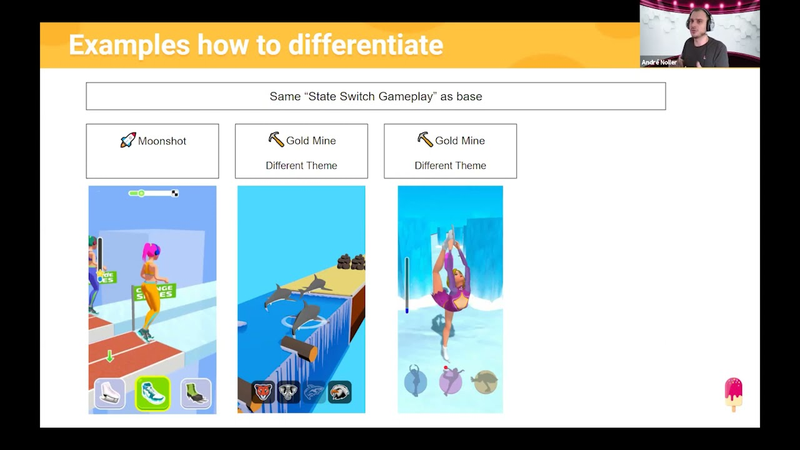
all right um to keep it not too theoretical i've prepared some examples so the moonshot game that i picked is um shoe race and for me it's the moon shot for like the state switches right i call it state switching gameplay that's my market um and yeah i think you all know the games right so you have these buttons at the bottom at any point or some points you can switch the state of your uh avatar or game object in accordance to the uh according to the environment to like for example this way uh here win a race up against your competitor so now let's look what games for me were kind of after that in the gold mining phase so there's animal transform right so it's really more or less the same gameplay but it's a radically different theme so there's also a theme that you can explore right it mustn't be a mechanic or something that's also a theme that you can try out um or for example cutting edge it's also
kind of the same gameplay but they vary the theme but also maybe a bit the mechanic you can change the pose of your character to evade obstacles or collect objects so there's also a bit of a differentiation in the terms of mechanics and last but not least another example is like um uh ninja hands that's really yeah gold mining also this concept of state switching but they changed more they changed the camera but still if you compare to the other games if you would see it from the point of view of the audience uh it's still recognizable as these kind of games right but something's different about it something's normal the camera is different it's more combat focused than being typical runner or race so yeah i hope these examples helped you a little bit um uh to get an idea how you can work with this and there's another way how you can use this tool and think about the market it has to do with a little bit of timing right what to do when so what do i mean
with this a little bit like a game loop this market uh quadrants they they work a little bit like in a loop in a cycle right so um imagine like this when you use that tool and you pick your moonshot market a product and then you see more and more gold mining products pop up here it gets fuller and fuller here and this is an indication that maybe at some it's like very lots of ideas have been exhausted right the easy themes have been taken the popular other mechanics have been taken so it's really like starting to get literally crowded red ocean alert and then maybe sometimes it makes sense for you to say okay i take a gamble instead of competing also here uh if my idea is not different enough if i cannot find something um i take the gamble and go all in and you can plan your product strategy a little bit like this right so still for each phase considering these timing amounts you can still try some things out right so in the gold mining phase you can really look for unused mechanics for that trend play around with the 3cs
camera controls character try different themes or even try to go back into the charts like six months or even a year ago and maybe you can revive the old hit with the new mechanic or theme right so there's lots to play with that's that systematic approach that i mentioned in the in the intro um yeah and in the gamble phase of course you on purpose do exactly the opposite of what's currently happening in the market in hopes of becoming the next moonshot sure the potential is a bit lower but still um it's a bit harder to pull off but yet to become the next moonshot you have to take a gamble sometimes right and of course like these other sources that you can use but i think you all know them so yeah i won't go much into detail about this now cool um yeah i see we have a little bit of time left so um let's quickly summarize uh the goal for this i talked about it is understanding what uh your market phase is currently um focus your ideation and yeah as
mentioned i have prepared a little bonus slide that kind of explains why i think uh this cycle exists right so this graphic that you can see here is taken from the book called the creative curve i highly highly recommend it you you read it it's really good um and the author talks about having the right idea at the right time which is super crucial for hyper casual and um yeah i give you the tldr but still please read it because it's oversimplified of course but basically what this concept is all about is that if something in that case a game or product idea is too new and you means unfamiliar we we tend to fear it right that has to do with our like cavemen monkey brains you know like if you see a pattern in the environment and cannot make sense of it we tend to shy away from it and it's the same for a product imagine again your audience right you see an ad and you have no idea how this mechanic
works or what this theme represents it's super niche right then usually people don't people don't throw the phone away and scream right but they they they are a little bit like you have this not so good feelings like that skip or you ignore it completely right so that's the stuff um about preference and familiarity but over time if we repeatedly see things we crave actually for some novelty right because it's like yeah okay i got it but then it's like oh that's something new right that's that's a gold mining stuff we talked about before and if we see something over and over again in all variations we tend to lose the interest on the subject or topic completely right and i think most of you already got it you can kind of map this to that market opportunity so in the gamble phase it's really a high risk that you pick something super unfamiliar like be the mechanic that players don't know how to control so there's a high chance and
this is why it's lower that that you will alienate players because simply they have no idea what to do with it right um and the moon shot goes into this direction where you can really have the peak like that's the perfect point here the sweet spot but you still see there's a lot of difference and you can easily you have fail when you try to become the moonshot but at some point when you find something like for example high heel step right the look somehow was not too triple a and too detailed too realistic somehow people still considered it to be hyper casual for example there also it was more or less the gameplay it was the gameplay from cubesurfer and a tiny bit of roof rails maybe um but uh that was maybe you know what pushed it up that curve a little bit because people saw the gameplay oh okay it's hyper casual mechanic but it looks different might be interested you know because they saw this stacking games repeatedly but it had that novel theme on top right so this can really be what made this game a moonshot right and then you have that short opportunity window in the
gold mining phase where you can really capitalize on that trend we talked about it explore in the different directions and this is because the people then saw it but then they crave for novelty right and then you can use that for example female theme and combine it with all kinds of different to really capitalize on that newfound trend and that need for novelty uh in your uh audience and then of course we come into the region of clones like you see like if you clone exactly the same game people kind of yeah okay i got it like it's not novel enough like doesn't interest me and of course if a mechanic is overused and that's what i meant before like when it's overcrowded in that top-left gold mining phase then then it's like people people will have seen it you know if these games already exist imagine as shown in the beginning from point of view the audience they saw it and saw it and saw it and if you just have a tiny difference then that might decrease your chance of actually reaching a huge audience and also um entertaining them
yeah cool uh yeah still have a bit of time left so yeah thank you very much for listening please excuse that i forgot to share my screen in the beginning like but yeah i still uh hope it was interesting for you here's my email or we can connect on linkedin if you have feedback for me or just yeah want to connect and yeah if you now have questions i would be really happy to try to answer them thank you fantastic oh thank you andrew for such a fascinating talk it's uh great to get an insight into sunday and for those who don't know in the audience sunday are actually our sponsors uh for the hyper casual the big hyper casual pitch our first ever hyper casual focus their big indie pitch that's coming up later on this afternoon though we are welcoming more than just uh you know the normal people that we uh have on board so yeah massive thank you to sunday for being a sponsor for that and for helping make it happen but in the meantime we've got
quite a few questions so if it's alright with you andre we'll dive straight in so the first question is as an indie developer you sometimes feel you've made a moonshot game but but we cannot market ourselves or get ua because of our budget what can we do space is saying they think they've made a great game but they maybe haven't got the budget to explore a lot of the things that make hyper casual work what advice would you give to them come to us like really like really like you really need a publisher because like you know hyper casual market is crazy and you really need like you said budget but you don't only need the budget you need the experience and knowledge of scaling a game you need to produce creatives you need to test the creatives you know you need to know how to use all the sdk networks and social networks to market your game so we really can provide that and in that case really like uh come to us of course yes sunday yeah um and next up is uh your innovation can quickly become a common
trend how do you ensure you maintain your success suppose yeah it's quite a difficult one that one if you make something that's a hit and then the market jumps on it yeah yeah um yeah so in that case like nothing lasts forever right so so it's just we we all die it's the same with the trend they also die so in that case it's really important to be fast work with a good publisher really i can hi i was a indie developer myself stalk me on linkedin so it's really important to work with a good publisher that can scale your game quickly you know that has an automated routine and can really push it up the charts because yes as you mentioned there there there will be people watching you there will be even people watching publishers like us uh it's an open secret i guess the industry that they even look at the tests and you always have to try to be faster and height another reason to work with a publisher by the way and um yeah and then it's be fast make your game great optimize the kpi is also something a
publisher can help you with but for example with get escape it's now almost one year old and we are still getting uh really really good numbers with the game so there is a chance that if you make a great game you can also really monetize it well and make it a long lasting hit and then you are on the top and it's getting harder for others to catch up because we talked about it earlier right if others come with more or less the same game but you are already at the top it's hard for them to catch up and people will play your game better game yeah definitely the next question we've got is are there any other game types which are great at hitting the gold mine area of success do you think games like shooters are hard to innovate in for example like first of all with hyper casual nothing is impossible right so so take yourself for example take the tool put pick a game where you think like hey there is a shoot for example johnny trigger that's a good example right that was yeah a good hyper casualized shooter in my opinion they got inspired by this indie game my friend pedro bullet and bananas cool game by the way and yeah
but that's how how you can adapt to hyper casual you know like i mean that that's another talk but you can find lots of talks about what makes a hyper casual game so really try to take indie games and yeah make them hyper casual that shooter is possible everything that has can reach a huge audience is possible of course in hyper casual it says for non-gamers and whatnot but think about it the majority of players are between 30 and 50 so there's a high chance that they know what the shooter is right people played doom back in the days so just think again from the view of the audience think a little bit back like research what's the biggest biggest age group in the audience then just think back like what games do they know and pick those games and try to hyper casualize yeah um next up i'm going to go to a question from efren studios if i was to start a hyper casual game today what would what do you think would be the best place to start also they're they're saying can they schedule a chat with you i suppose they can reach out to you via your email
to grab you yeah yeah definitely definitely they can reach out i'm not sure i really got the question like where i suppose what the mean is if you were if someone came to you today i suppose this i can open this question up to the whole audience if someone came to you today and said i want to make a hyper casual game is there um you know well they're saying they're asking about the genre is there a genre that you think works best or is there just a rule that you would say to keep in mind when creating a um a hyper-casual game yeah yeah that's really about that red ocean stuff so yeah the first instinct is to say a runner because runners work well on mobile for different reasons but but i would really really play lots of hyper casual games just like look for the big hyper casual publishers like and play their games right and just go through their go to the app store search for the the publisher right and then just play their games to get a feeling for what's for what hyper casual is like so before you start making these games i
highly recommend familiarize yourself with these games know what makes these games work for the audience and then you come to us with your prototype and we'll see if we can fit in the last few questions uh do you have advice for indies looking for the right publisher you know what what would you say to someone looking for a publisher specifically what should they look out for that's something what you prefer like there are there are super big publishers that are super super successful of course but again red red ocean and blue ocean let's take that example right so if you go to the big publishers they are super successful they know their stuff they have good automated processors but many want to go there right and there are publishers in the class of sunday that are like a bit of blue ocean right so so so so we also know how it works how it goes but with us you have maybe with a smaller publisher or growing publisher let's say it like this because we are not at the end yet uh you you just get maybe better service you know we have more time to talk to you so i mean we are still
growing our business already but we are trying to staff up and and and really provide every developer the best service uh possible so i think yeah that's the red and blue ocean thinking yeah and i will sneak in the last question which is there is such a drive for community behind games right now however that can make games high maintenance uh does that mean that they leave the gold mine zone should you not invest into user retention uh you should always uh uh invest in user retention but at least for hyper casual from experience the retention comes from great gameplay so you don't need like in mid-core games different events every week sure you can make like when you have that seasonal stuff like halloween for example are coming up christmas you can try it but you don't have to do this in hyper casual you know that's a really good thing like if you have a great game that has um a good amount of content you can you can scale the game to a huge audience you know like some games have 200 million downloads so
really the sky is the limit so if the gameplay is good and engaging the creatives are good and converting people over to the game right think about the audience then there's you don't have to do it on the same level let's say it like this as mid core uh games sure you have to do updates if the game is great and players want more of that experience you give it to them but the good thing about hyper casual is you do updates maybe on a weekly two weekly basis measure how how your update performs and then just like you know keep going and going and going in germany there's this word like salami tactic it's like you you edit slide by slice by slice but at the end you also have the big saucers right so yeah yeah that's fantastic well thank you andre we actually got through all the questions so thank you so much for being here sharing everything and you know like i say again obviously i'm the big indie pitch manager so a big thank you to sunday for sponsoring the pitch later and we're excited to see all the great hyper casual games that maybe some in the audience are going to be showing off um but yes thank you for being in here on our hyper casual and social games
track and for sharing all of your wisdom with us yeah no problem yeah i hope it really it was useful because i'm sure i certainly enjoyed it and uh given the questions in the chat i think the audience enjoyed it too so thank you so much perfect you're welcome have a good time bye-bye youtube bye you
Summary
The hypercasual gaming market is characterized by intense competition, requiring developers to adopt systematic ideation strategies rather than simply chasing current top-chart trends. The primary thesis is that developers should analyze market sub-genres to identify opportunities that balance trending mechanics with sufficient novelty to avoid the "red ocean" of direct, saturated competition. By mapping game concepts against a framework of potential and challenge, developers can strategically position their products to resonate with audiences while maintaining a distinct identity.
The methodology for this approach involves categorizing games into four quadrants: moonshots, which introduce significant innovation; gold mines, which capitalize on established trends with new themes or mechanics; clones, which offer minimal differentiation and are generally discouraged; and gambles, which involve high-risk, experimental concepts. This framework helps developers understand the market lifecycle, where trends eventually become overcrowded, signaling a need for either further iteration or a pivot toward a new "blue ocean" concept. Success in this space relies on timing, as audiences initially fear unfamiliar mechanics but eventually crave novelty before ultimately losing interest in overused tropes.
Key industry insights emphasize that hypercasual success is not merely about creativity but about understanding the audience’s familiarity with specific mechanics. While indie developers often struggle with limited budgets for user acquisition and creative testing, partnering with experienced publishers is recommended to navigate the complexities of scaling and optimization. Furthermore, while user retention is vital, it is primarily driven by core gameplay quality rather than the constant event-based updates required in mid-core titles. Ultimately, the most effective strategy involves continuous, data-informed iteration and the ability to adapt existing indie concepts into accessible, hypercasual-friendly experiences.