The mobile gaming landscape during the first half of 2019 underwent a significant structural transition, characterized by a pivot from traditional in-app purchase models toward ad-based monetization strategies. This shift is underscored by a 15 to 20 percent year-on-year decline in average revenue per paying user and average revenue per daily active user within the casual gaming sector. While mid-core genres, specifically role-playing and strategy titles, maintain their position as the primary drivers of revenue and conversion, the broader market is increasingly defined by the dominance of hyper-casual games.
Player engagement metrics, including retention rates, session lengths, and overall stickiness, experienced slight downward pressure across the industry. Classic genres such as card, casino, and word games continue to exhibit the most resilient performance in terms of retention and session duration. To mitigate rising churn rates, developers are being urged to prioritize the development of robust endgame content. Simultaneously, China has emerged as a critical high-value region for effective cost per mille, further influencing global monetization strategies.
Publishing practices are evolving to meet these challenges, with industry leaders leveraging sophisticated data analytics to streamline development pipelines. By establishing strict performance thresholds—such as a 50 percent day-one retention requirement—publishers are able to identify high-potential titles early in the lifecycle. This data-driven approach allows for the rapid optimization of gameplay and lifecycle performance, ensuring that resources are concentrated on titles capable of sustaining long-term engagement in an increasingly competitive and ad-centric market environment.

GameAnalytics · 2026
GameAnalytics · 2026

GameAnalytics · 2025

GameAnalytics · 2025
Tenjin · 2025

GameAnalytics · 2025

GameAnalytics · 2024
GameAnalytics · 2024
GameAnalytics · 2024
Tenjin · 2022

GameAnalytics · 2021

GameAnalytics · 2020

GamingReport · 2025

Mistplay · 2023
GameAnalytics · 2019
Sensor Tower

Adjust

InvestGame
Bryter · 2026

Almedia · 2026
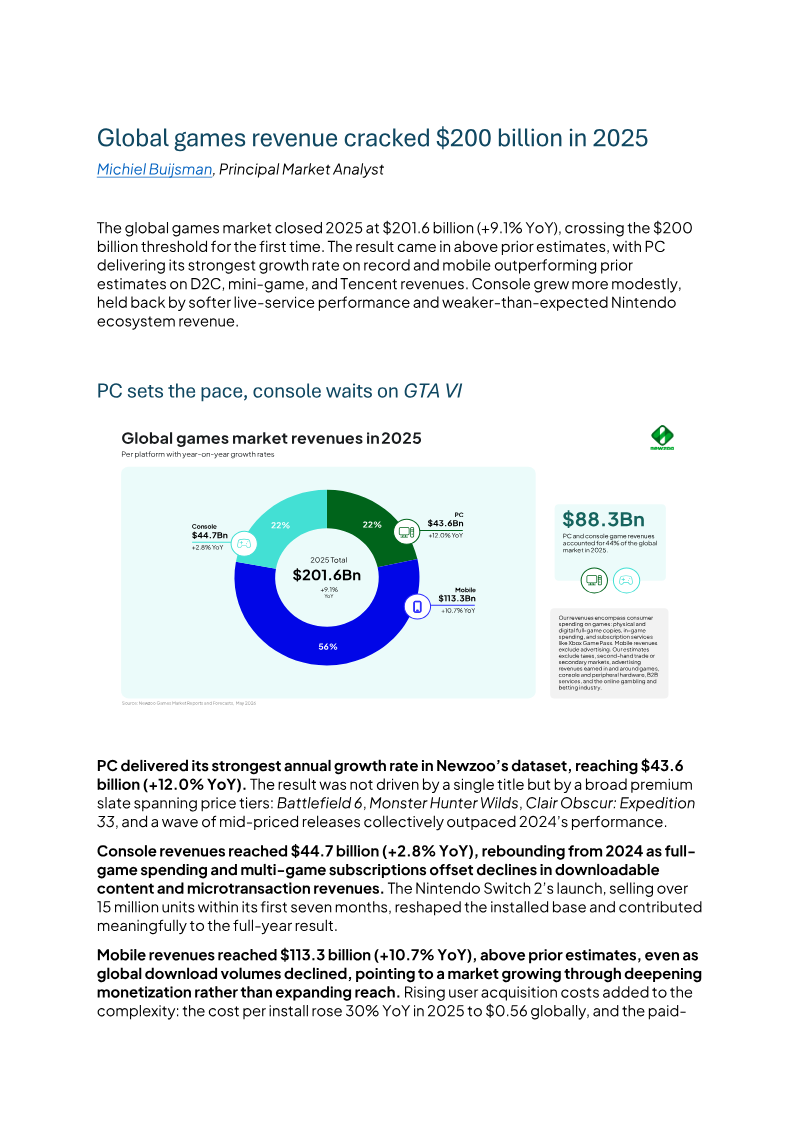
Newzoo · 2026

Sensor Tower · 2026

Sensor Tower · 2026

AppLovin · 2026