1 free read left. Create a free account for unlimited reading + AI research.
Create free account
Global trends in hyper-casual games
Key insights
6 takeaways- 01The hyper-casual market is highly volatile and hit-driven, with a small percentage of titles capturing the majority of total market share.
- 02While the broader casual gaming market grew by 50% during the study period, the arcade segment appears to be entering a stabilization phase following rapid expansion.
- 03Arcade games remain the primary driver of the hyper-casual sector with an average of 4.5 sessions per day, though the segment experienced a 20% decline between Q2 2018 and Q1 2019.
- 04Top-performing arcade games achieve a day-one retention rate of 42%, but long-term retention is poor, with only 2% to 5% of players remaining by day 28.
- 05Due to high player churn and limited game lifespans, developers must utilize cross-promotion strategies based on player affinity to optimize user acquisition costs.
- 06Future industry success is increasingly dependent on predictive analytics and behavioral modeling to identify churn risks and target specific player segments.
Ask AI about this video
Transcript
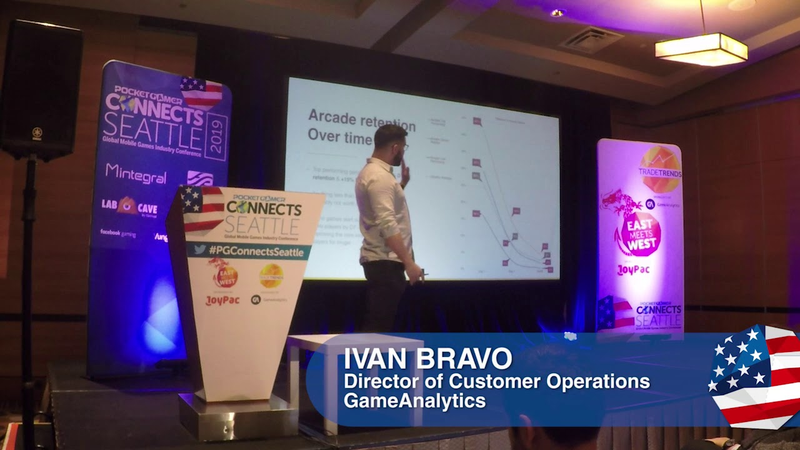
so hi hi everyone it's great to be here in Seattle I'm going to share with you one of our latest analysis of the industry where we've tried to detect the hyper casual genre and try to understand better how their players behave for these analysis we looked across our database for a period of a year from q2 2018 and still q1 this year and we put together some industry some benchmarks on hyper casual with deep dive into retention and then some ideas from how to bring retain and reengage your your players the first time is that we had when we when we started doing this analysis was to understand what are the games that we should include the reason this was a challenge is because hyper casual is not yet absolute category which is what we
normally use to split our our benchmark reports so what we had to do is look at some of the biggest hyper casual publishers that work with us and look at their games and understand how those are categorized in the in in the app stores what we realize is the majority of hyper casual games are categorized as arcade and casual more arcade than casual so we started our analysis trying to focus in industry generous the first thing that we looked at is Dow and by looking at that we understood that play our players love arcade arcade is the highest performing general based on the a you it has three four times more players than the average general and the other thing that we that is really interesting when we compare the Dow for per general is that you can see apologies Vista small
but you can see that we've split this in low performing median into performing games we're looking at this chart you can see that they the four in daily active users when we come top performing hyper casual games arcade game sorry with medium is a lot more steepness a lot more deep than with other general and this means that it's a it's a market that we're a very small number of a games get the majority the big the biggest share of the market this a much much bigger difference compared to other generous after comparing the different generous we try to deep dive and to these two casual and an arcade generous and understand how the market is fluctuating for those when we look at casual games we realized that the the market is growing is growing quite a lot it's growing by a fifty percent compared to the last period the period the same period last year and
surprisingly our key gains are actually going down they're going down by twenty percent which is something that we weren't expecting regardless of regardless of these this general going down still is the top-performing game and the poor top performing general in the industry and there are some explanations for for this fluctuation the explanation that makes more sense for us is the hyper casual the hypogastric boom started a couple of years ago now and it's worked quite growth quite rapidly over the last period and how I said normally happens with this kind of strength it comes to a point where the marketing the market will stabilize so it's normal to see to see a dip now and then we're probably will see a more steady growth without so
much fluctuation regardless arcade is still still pretty much killing it is the top-performing game when we when it comes to number of players the top performing general sorry and so far this analysis the down analysis can tell us how you know uh how popular the games are but realistically when you're monetizing your games based on our for sizing there's two other main KPIs that are as important as the number of players which is the number of sessions and how long those regions are so basically how many ads can we serve how good can we monetize those games so when we looked at the session count the first thing I mean the first thing that we see is the arcade still again the winner there's a lot more sessions compared to any other general five times more than the average
general and if we take into consideration our kid has 167 million per year dot per day will be 460k that gives us an average if you compare it to the daily active users that we saw before of about 4.5 sessions on average per player per day compared to casual which has three point seven sessions it's a twenty percent is it twenty percent more sessions so casual arcade are no perhaps that different in terms of the the way the players play the number of sessions a day they will have recording play do both are played recording later in the day barricade again presented 20 percent more sessions than their casual however when we look at the length of the
session so they played a lot but the sessions are not particularly long actually they are one of the smallest the shortest sessions for against all the generals with six minutes on average compared to the industry average which is 14.5 cash flow in the other hand is quite this this is it's it's outperforming the industry average with 19 minutes this makes a big difference in terms of how the games play like how the players played these games and what is how they engage with them how long the sessions are so so far we've looked at that and we've looked at sessions length number of sessions in session length and what we could see is catchment hypercar over a different arcade arcade is the general
that aligns better with what we understand is hyper casual we can also see that casual games are growing and on the other hand arcade are are going down a little bit which makes that along with what we saw in the first light the big difference between the number of users that top-performing games and medium and low performing games get makes it a really competitive market and marketing techniques are not only a nice to have but actually something that is fundamental to success to succeed in that with hyper casual games so now if we have a look at retention um comparing across all the generals we can see that arcade the retention they want for arcade performance quite well the top performing games the top performing generals trivia with 49 percent and we can see that arcade has a 42 percent they want a retention which is which is
not bad compared to other genres actually this is something that we also see when we speak to publishers 40-tooth of a recurring number which means like if you have if you're hyper casual game has over 42 percent retention you have a gem there that probably everyone's gonna try to to get of your hands and publish on the other hand we can see that anything below 30 percent 25 30 percent it's probably no worth keeping as it is its nest a forty forty percent of retention day one is a very important KPI to get your game published and when we look at the trend on retention for hyper casual for arcade games in particular we can see that even though there are quite competitive at least are performing games are quite competitive
retaining players day one there is a very quick decrease in the retention and by day 28 the majority of games are not know able the the medium of hyper casual sorry arcade games don't retain more than 2% of the players even top performing games don't do a lot better than that with only a 5% and no performance gain low-performing games don't manage to retain any users on average this means that it's a very rapid you know the the churn is quite quick and in arcade games so leaves us with a question of how are we going to you know being such a competitive market and and having being so challenging to retain players over a month what is that we can do to retain and re-engage our players and the first the first thing that we need to do of course is to
understand player turn so one something that you can do to understand player churn is looking at - like cohorts and create different splits to compare different bills of player features to understand what is the point of churn of your game and of different segments of players in particular this might allow you to make changes in the game and improve retention slightly however us we can see the majority of arcade or hyper casual games seem to come with an expiration date and it's really hard to retain players beyond the first month so if you can't you know it if it's a bottle that it cannot be win one the best thing that you can do is find workarounds so those players are still displays are still valuable and we know for what we know about hyper casual players they tend to play a lot of different hyper casual games so one
strategy that's working quite well and we've we've tested with a couple of customers now is to try to identify the point of turn of your games and include those high-performing players that are about to turn or have just turn and bring them over to your new titles by including them in your ua campaigns this typically gives you a much better CPI because the the you know that they are Finity with this general and with your games in particular normally is high and also a much better performance after install because you can select the players that you know perform well based on their behavior and play in previous games aligned with this because we know that this is a it's the new strategy that's working really well we're working in a couple of new products that are quite interesting one is in further tributes and the other one is
predictions what we're trying to do with in production prediction to infer actually it's in particular will help we're help-help studios understanding their players by exposing some features that will not be visible with a naked eye things like what is their affinity with a particular sub genre we're going through a more excessive categorization of of our different games to be able to target very specifically players that are affinity have affinity with your particular sub general and other things like what is the context in which they play whether they are commit players evening players weekend players all the things that you can in fear from the data of their players but they are not they are at a glance and in predictions which which will allow people to compare or to understand what is the likelihood of your players to perform a specific action what is the day when they are
more likely to churn etc so what's this space because these are two very interesting brothers that we're hoping to release very soon and get in touch if you have any any feedback on this products or how you would like to understand what it is that you what are the features that you would like to see and your to in you know it's all to understand better you play your bass I don't have the time but I believe that there's still some time for any theorem thank you nice charts there earlier I saw some be to have any questions if you've am it's early in the day yes dead lag then I guess I was looking at the charts yeah you say there's a massive kind of drop of it is is your general
advice that people more there's more space for people to come into the hyper casual audience cuz you're focusing on that there is space so it's a little bit so that there's a huge market the market is huge but it's a market that where the distributions you know it's very irregular compared to other yeah so top so it's totally hit or hit by Steven yeah if you see like how happens are there other products in the markets like it's something similar to fast-moving consumer goods where you know they're like very very linked to how popular those products are yeah so that's why it's really important to working your marketing and make sure that people knows those games because it does it will I it relays a lot and and good marketing furnace alright thank you very much event and I'm sure you can ask him [Applause]
Summary
This analysis of the hyper-casual gaming sector, based on data collected between Q2 2018 and Q1 2019, examines industry benchmarks, player behavior, and retention strategies. The study identifies the arcade genre as the primary driver of the hyper-casual market, noting that while arcade games command the highest volume of daily active users and session counts—averaging 4.5 sessions per day—they suffer from significantly shorter session lengths compared to the broader industry average.
Key findings indicate that the hyper-casual market is highly competitive and irregular, characterized by a "hit-driven" model where a small percentage of titles capture the majority of the market share. While casual games have experienced 50% growth, the arcade segment has seen a 20% decline, suggesting a stabilization phase following a period of rapid expansion. Retention remains a critical challenge; although top-performing arcade games achieve a day-one retention rate of approximately 42%, this figure drops precipitously, with most titles failing to retain more than 2% to 5% of players by day 28.
Given the inherent churn in hyper-casual titles, the analysis emphasizes that marketing is fundamental to success. Because these games often have a limited lifespan, developers are encouraged to adopt cross-promotion strategies, leveraging data on player affinity to migrate users to new titles. This approach improves user acquisition costs and post-install performance. Future industry advancements are expected to focus on predictive analytics and behavioral modeling, allowing studios to better identify churn risks and target specific player segments based on their unique engagement patterns and sub-genre preferences.






















Comments