
Transcript
So Crest, it was named three times during the Morids podcast. So it's like calling the Beetlejuice. So Crest, Crest, Crest, and here you go. Well, let me set it up. So you interviewed Morates from Lightseed Ventures. Extremely likable guy. So Crest, I wore my Patagonia jacket. I don't have a vest for you. Handing it to you to respond to the great podcast interview that Mishka did, his fourth interview with Moritz, the Chris has done one actually. Chris has done one. That's true. God, do you just want to like him though? Like he's like such a nice, easygoing, easy to talk to guy and he seems to have a grasp of all the things that's going on. But telling you, dude, the entire podcast was a contradiction. Like he just kept contradicting himself over and over again. And the two biggest issues again are the exits in gaming are not big enough for light speeded of a fund this size. and two the perverse incentives
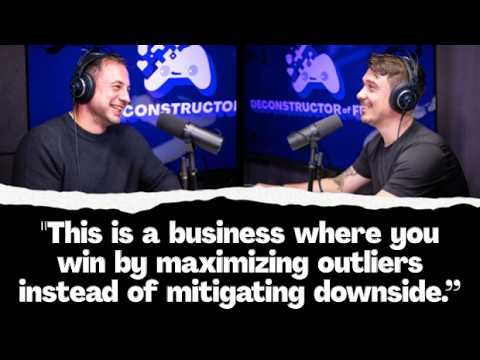
around managing money versus returns right and so he tries to discuss this but he completely contradicted himself when he said this so he says VC is a business that you win by outliers right and he did the back of the envelope math $7 billion fund 15% ownership in any company a 3x return would require $2 billion which would imply listen 300 00 billion dollar to 500 billion dollar of exits in value or public equity or M&A. Right? He says this. So sales of companies or IPOs of 1 to5 billion are not material to lighteed. And then a few minutes later he said we don't need $5 billion exits to gaming to work out for gaming investments in Lightseed. We max out at about a hund00 million valuation. So 300 to400 million exit would be fine
for gaming, right? This makes no sense. It is return math versus scale math for exit, right? So a $300 and$400 million exit is absolutely mice nuts for Lightseed by his own calculations, not mine. Right? They have small funds that actually would benefit tremendously from exits like this. But Lightseed, it is immaterial. Okay, full stop. exits don't even exist like this in gaming and that was kind of discussed on the valuation perspective which was a really good question by Mishka which he completely didn't answer but the multiples are just too low to justify these type of investments at this scale right yeah and then everything's kind of already gobbled up right now as well the consolidation all right so the second big issue that we keep talking about and I think this is the last time I'm talking about this the perverse incentives around management fees was just really not explain explained by him at all. Like he only claims that a few people are impacted by management fees
within these organizations. I would argue that the entire organization is funded by these management fees, right? The organizational leadership and around these organizations is all paid by these management fees, which is perverse because they're not incentivized to actually return. They're incentivized to raise, right? versus smaller funds with smaller organizations can't make significant money on the 2% management fees because it's too small of a fund, right? They get paid based upon returns, right? So small funds in general have more in line incentives where the success of the founders is tied to the success of the VCs, right? So in essence like what what seems to be happening and he kind of articulated this in his own way honestly is that these big funds you collect these massive management fees you pay all these minions marketing and PR folks to push the company brand and the personal brand in I mean there's no one better at [ __ ] promoting the personal brand than this Lightseed dude
right than Morance himself. This creates brand equity to get involved in better deals, right? Which ultimately leads to get more funds from LPs under management to continue to hire these marketing and PR folks to pump up the brand and to continue to invest in more companies, right? It's like the ultimate Ponzi scheme, right? I mean, it's it's like a definition of Ponzi scheme, right? The only thing that's missing here is the actual exit, right? And the returns that are supposedly going to be coming, but those have not come yet, right? And we don't see those yet, right? except for the really early stuff that they've done. So the smartest people are disrupting the status quo and taking away from the incumbents. That is not what's happening in this market at all. At all like there is everything's an incumbent right now, right? Like 60 70% of this business is being driven by incumbents, right? And growing, right? So I don't know what he's talking about. And then market growth is very small. Like there's all these tailwinds he's talking about. Yes, the market will grow this year and we'll be good this year,
but I don't think we'll be growing next year. And the market is still growing at 3% versus 20% for the last 10 years. So, it's like Morris is the ultimate hypester, right? He like he knows how to hype things up and and he is the master of this grift in my estimation. I mean, he does it even better than A16Z. A6G just has more resources to throw at it, right? These are the points I've been making for the last like five years or four years. Again, not just me, game changer guys, Mitch guys that are [ __ ] allin, all these guys are talking about the same thing. He's saying it but not saying it, you know, in his own words. So that's my take on his interview. I have a question like how would you structure the incentives for VCs? Because the typical management fee model is 20 and two. So basically you get 2% of management fee of the entire fund size and then you get 20% of the return after the investor has been paid. So if your fund returns you know 1 billion you get 200 million out of that.
And of course with funds this big it typically is that the management fee is taken out of capital deployed and not the overall capital that is gathered. So you're not incentivized to actually just gather and sit on that and just collect interest. But Chris, like how would you see it structured that would be better for LPS? I mean, I think you have to keep it small, right? First of all, that's like the primary way so that you have blind incentives, right? And then second of all, I just don't think that some of this content stuff is actually venture capital investable. It just doesn't make sense. So, riddle me this though, right? So, the evaluations get updated as more information comes in, right? So, like when a company IPOs, that's a moment of reevaluation in the portfolio, right? So when I think about like what is the next moment the games industry is going to face where it's like okay let's you know let's define this relationship it's got to be the supercell IPO right like that's got to be the next thing that's going to define what the markdowns are
on the VC sheets right I mean Scopley's off the table right like what else is there that's going to give us a big moment of reevaluation of the portfolios well the one thing Morris did say that is actually accurate is that we are in a point in time right they do have these longer time horizons Right now, first it was like 5 to seven years. Now it's 7 to 10. Soon it's going to be 10 to 15, right? Like so no one you're going to have to get [ __ ] Nostradamus to predict the valuations at that point in time, right? But if indeed the IPL market opens up and Supercell and or Epic go public and they do poorly, that's really bad, right? Really bad. But if they do well, that's actually very good, right? because that means that valuations will then go up for their book in theory, right? If any other companies they've invested in are even around at that point, you know, like they have a longer time horizon to think about. And so that makes it much easier for the grift, right? Because they don't have to have immediate returns. They don't know need to know what happens next year, the year after,
five years, [ __ ] even 10 years, right? Like they could just sit there and grift all the they want and market the [ __ ] out of their funds. And as I said, the big marketing grift of this stupid speedrun thing, which doesn't make any [ __ ] sense at all, right? They just keep marketing the [ __ ] out of that, right? The jewelry is still out. Like, what do you mean doesn't make any sense? Like, we don't know that. Like, in the end, they might be finding really good companies and getting access on deals early on. It does not make sense for a $7 billion fund to be investing a $1 million in early startups. Like that makes no sense, right? And the shotgun approach, you're basically creating false hope of all these people and then all of a sudden like when it comes down for a they're not involved with it at all and they're forever tainted, right? They even capitulated. That doesn't make sense. They're not investing in games anymore. They're investing in all things techreated and consumer related, robots and all this other [ __ ] obviously,
right? Because it doesn't make sense for games, right? It doesn't make sense for in this market, right? I thought it was funny how poor Morris for 15 minutes had to deal with your speedrun questions and he was like, "Dude, like why do you keep asking him about my competitor's program?" He has strong opinions on it just like Mr. press and I wanted him to kind of steal manand them and I wanted to just kind of look at from different sides because I think it's not true to say speedrun doesn't work after they've done what four runs and saying like this is [ __ ] I understand Chris's point and I was just trying to approach it from a different point because the jury is still out. It could work really well. Yeah. We got 15 20 years though. Yeah. Exactly. we're going to be [ __ ] dead by the time it's like, you know what I'm saying? Okay. And by the way, the last thing I want to make sure that people understand is that I don't think venture is necessarily broken for everything, right? Like clearly there's tons of
investments in AI that make a lot of sense right now and who knows what's going to happen there. I am only talking in the context of gaming, right? Gaming tech, gaming companies, right? This is my only context here. So, well, to wrap this one up, number one is Morates is the most likable guy I've heard on a podcast with you, Mishka, in a long time. And the way that he presents the information, I found as someone who doesn't live and breathe this every day, like very interesting and consumable. And he helped me really understand it. And so, Crest, I actually agree with you on that contradiction. And I was like, wait, if this is mice nuts to lighteed, then anything in our world is like not ever going to touch that. So I I I kind of even from my like ignorant like I don't live this. I was like one of these things is not like the other in the true Sesame Street fashion. So I did kind of get you on that point. And what was interesting is just understanding the different landscape of VCs as well. Like
A16Z does it very differently than they do it. So So thank you for that. Thank you, Morris, for putting yourself in a position where he knew that this was going to happen. And that takes a lot of guts. I so I got to give him a lot of credit for that, too. I'll give one sentence. Pessimists get to be right. Optimists get to be rich. So, Mores is an optimist. And I hope he get to be rich at the end of the He's already see the thing is he's already rich. Like Andrew Chen or maybe he's getting rich. How about that? Andrew Chen's already rich, right? like where are their incentives, you know, to see these companies thrive and grow and become successful. He actually even said the truth out loud is like they only focus on the ones that are the winners. Yeah. The winners, right? Which is the true OVC and many founders don't understand. They think they get investment from a company like let's say you know you name it or a fund and then there's no like interaction. It's like guys you're not moving the needle. That's why they're not calling. Well, the one other thing he said is it is not my job to keep
investing in you. And I was like, which, you know, again, if you're a founder taking that money, we talked about like zombie companies before. If you take the money from a big fund and you're not working out and they don't continue on, you have a little bit of a stain on you.
Auto-generated captions from YouTube — names and numbers may be misheard.





















Comments