Key insights
5 slides
Core design
The Paper Mario franchise integrates flat 2D characters into 3D environments.
It intentionally collapses the distinction between two-dimensional planes and three-dimensional environments.
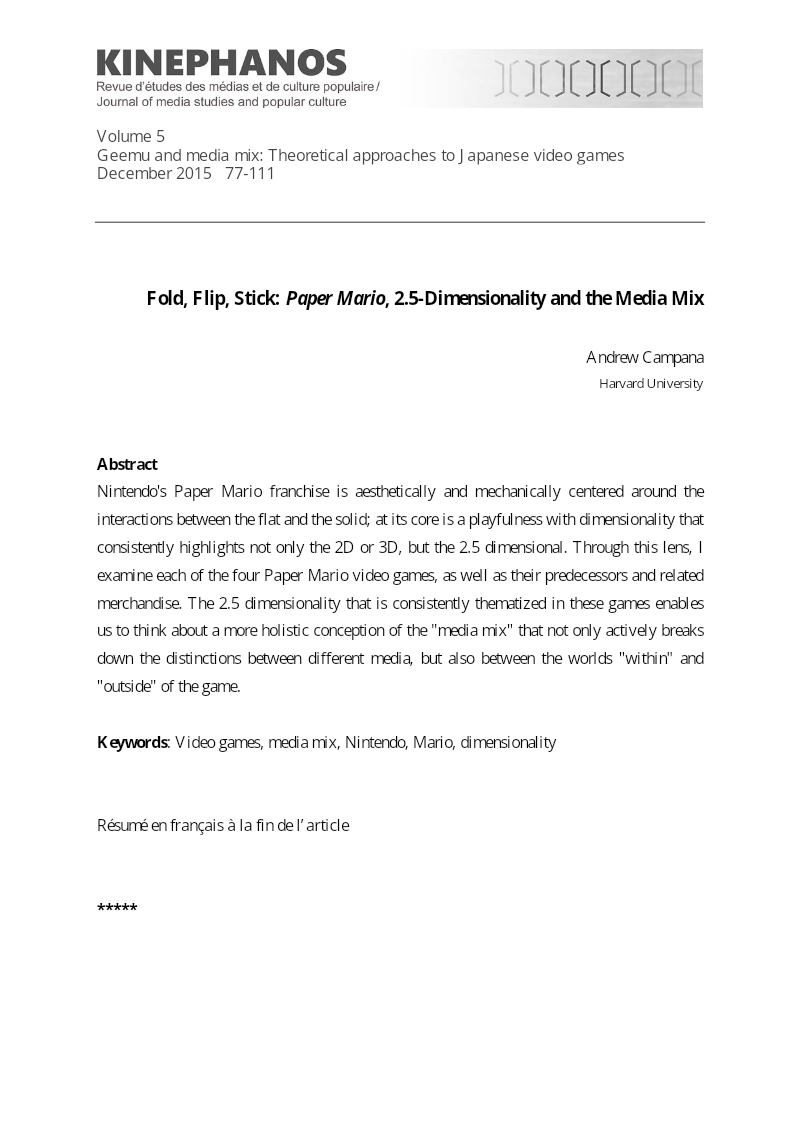
Key concept. The Paper Mario franchise utilizes '2.5-dimensionality' to integrate flat, 2D character designs into 3D volumetric environments, creating a core mechanical framework.
1 / 5
- 01The Paper Mario franchise utilizes '2.5-dimensionality' to integrate flat, 2D character designs into 3D volumetric environments, creating a core mechanical framework.See it on page 35
- 02Gameplay mechanics in later titles, such as folding, flipping, and sticking, require players to actively manipulate spatial depth rather than treating it as a purely visual aesthetic.See it on page 20
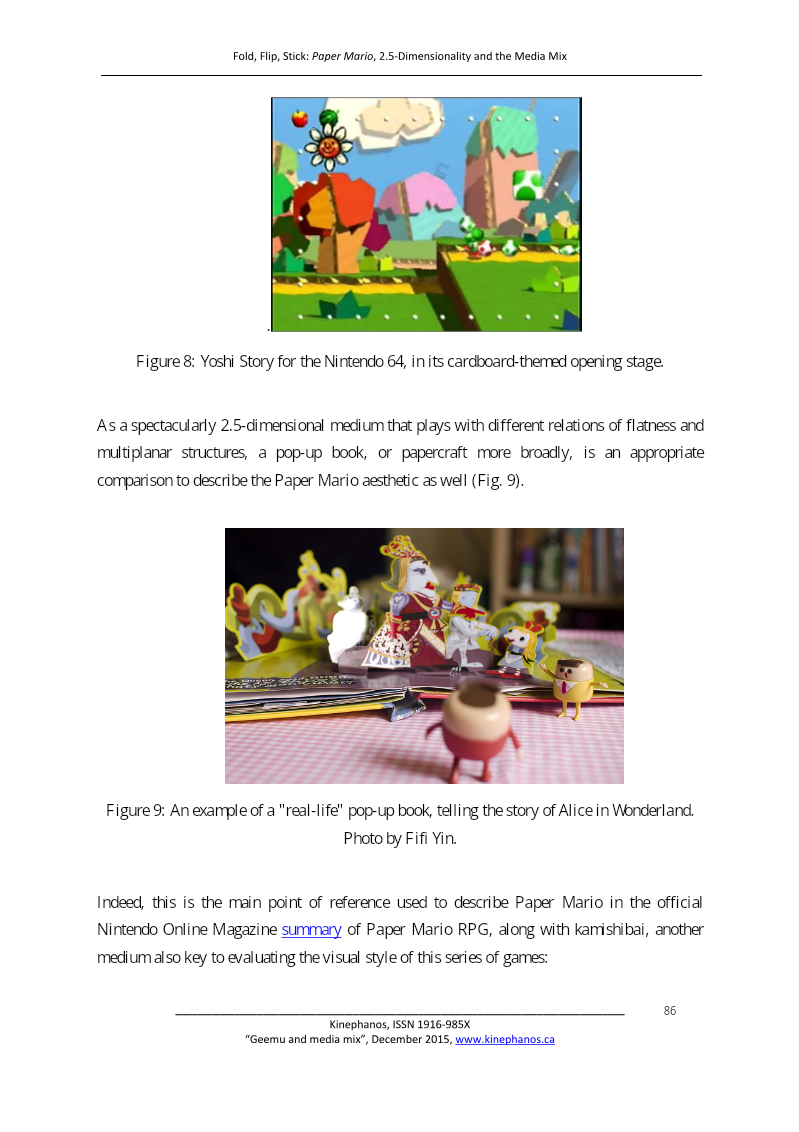
- 03The series draws design inspiration from traditional media forms, specifically Japanese kamishibai theater and pop-up books, to inform its digital spatial construction.See it on page 10
- 04By incorporating real-world objects into the digital environment, the games function as a self-reflexive commentary that challenges the artificial boundaries between 2D and 3D media.See it on page 31
- 05The franchise exemplifies 'media mix' theory by blending video game software with physical-world tactile mechanics to create a unified, immersive experience.See it on page 1
- 06The design philosophy suggests that the divide between digital gameworlds and physical reality is porous, positioning the act of playing as an embodied engagement with the software's construction.See it on page 25
Ask AI about this report
Summary
The Paper Mario franchise serves as a definitive case study for the concept of 2.5-dimensionality, an aesthetic and mechanical framework that intentionally collapses the distinction between two-dimensional planes and three-dimensional environments. By integrating flat, paper-like character designs into volumetric digital spaces, the series draws upon traditional influences such as Japanese kamishibai theater and pop-up books. This design philosophy evolves from mere visual flair in early entries to a core mechanical foundation in later titles, where players actively manipulate spatial depth through folding, flipping, and sticking mechanics.
These design choices function as a self-reflexive commentary on the nature of digital materiality and the history of gaming. By incorporating real-world objects as interactive elements, the series highlights the artificiality of dimensional boundaries and challenges conventional media categorizations. This approach positions the game as a performative experience, where the act of playing becomes an embodied engagement with the construction of the digital world. The games effectively blur the lines between the internal logic of the software and the physical reality of the player.
Ultimately, the series demonstrates that the relationship between digital gameworlds and the physical world is porous rather than absolute. By utilizing hypermediation and tactile mechanics, the franchise exemplifies the media mix theory, where video games, physical merchandise, and real-world objects coalesce into a unified, immersive experience. This holistic perspective reveals that the perceived divide between flat and deep space is an arbitrary construct, suggesting that modern gaming aesthetics are defined by their ability to transcend traditional media limitations and foster a complex, interconnected relationship between the screen and the player.