1 free read left. Create a free account for unlimited reading + AI research.
Create free account
'Flirtual Reality' and designing for female gamers

Key insights
6 takeaways- 01Effective engagement relies on prioritizing high-quality, innovative mechanics over gender-specific aesthetics or patronizing stereotypes.
- 02Game design should emphasize social interaction, deep customization, and clear progression paths to naturally attract and retain female users.
- 03Successful titles like The Sims demonstrate that focusing on engaging gameplay loops—such as social status building and narrative goals—achieves broad appeal without alienating segments of the player base.
- 04Studios should analyze the specific behavioral data of their existing player base to inform design decisions rather than relying on generalized, gender-neutral assumptions.
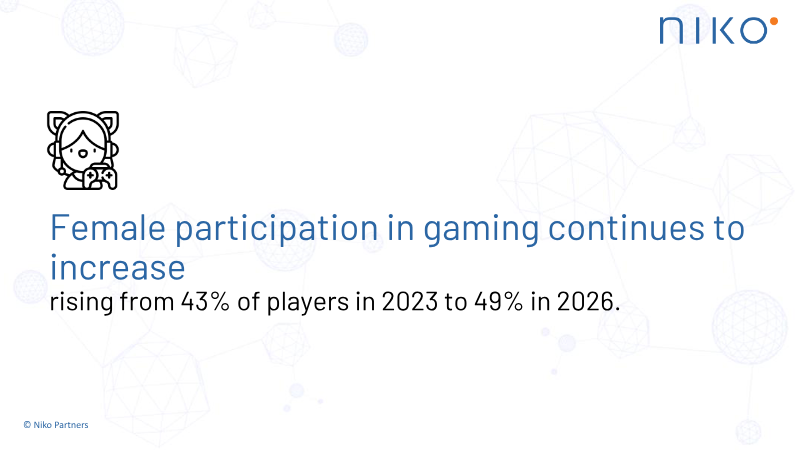
- 05Female gamers represent a high-value demographic, spending 35 percent more time in-game and 31 percent more on in-app purchases than male players.
- 06Developers should prioritize authentic community building and organic growth over aggressive, gender-targeted user acquisition strategies.
Ask AI about this video
Transcript
welcome to our booth salon in the nordic game conference i know you've just got off the stage haven't you from your address that you were doing how did that go it went super well um i mean i think for the first time i've seen so many women attend the games conference which was fantastic i think by far i think female representation in the nordic games conference is by far the best that i've seen in any of the conferences so far it was a packed house and the discussions and the questions were super engaging so it was a fantastic that's great because your talk was on designing for female gamers wasn't it yeah and looking at some of the games that you've created and the idea of virtual reality yeah yes what is flatule reality so virtual reality is about gamifying flirting and dating so what we've done is we've essentially picked up so we've gamified the human aspect of personal relationships and totally gamified it so we use building romantic encounters as a core game loop and on
top of that we allow our players to you know build social proof we allow them to customize their avatars build an entourage of friends explore locations and go on virtual dates so it's it's a social world that we're building and that's what virtual reality is about so is it because obviously your demographic is mostly female and is it that social interaction that social world that kind of grabs female game what what is it that female gamers love right so for us uh when we initially launched we thought it would be a bit more gender neutral even though the game was about socializing and exploring we knew that would appeal to a female audience but we didn't know that it would appeal to such a large extent our demographic is consistently on an average 75 women between the ages of 18 to 30 and they love the whole flirty conversations but at the same time they they like the customization they like the dress up they like the conversations um the virtual world um also unlike other virtual worlds we we provide our
female players like with you know form and structure there are clear missions we're eventually looking to evolve committed relationships even marriage and you know the whole soap opera around relationships into the game so that's something we're looking forward to bringing in because what are some of the common misconceptions or mistakes that people make when they're designing games for women i think mostly i think game makers haven't woken up to the fact that there are female gamers and when they do try and design games for women they tend to make it very girly very feminine you know it's almost like a stereotype that you're catering to which i believe is not the best way because that seems patronizing to female gamers for us i i i think we never chose to build games for women foremost we chose to build a game that was fun it was innovative it was playable most importantly and we knew it would appeal to women but we didn't build it specifically for women we we realized that women are our target audience and i think it's important to understand that men and women both
consume and play games differently like they do in everything else in you know most in in real life as well i think that's true for gamer behavior as well um and and that's what we went with our feeling we know that we have a game that appeals to men and women but more women and that's our targeted audience and that's how we we've learned to listen to them and we learn to give them what they want because you see it with um so angry birds for instance that was a very gender-neutral franchise both men and women played it right and then suddenly angry bird stella came along and lo and behold a pink bird and it is that isn't it i guess like you're saying designing games for both sexes is can you think of any other successful games that have done that i think the sims was a great franchise um the sims then eventually also ended up being 65 percent women but there were also men playing playing the game there's nothing wrong with designing
games for women but i think it's important to understand how women tend to play games and it's important to not be patronizing to them i think that's that's very important i think women gamers are an underserved market and game makers are now waking up to the fact that they're hey there are a bunch of female gamers yeah and there's this they're very interesting statistics so flurry the analytics tool yes they did a study last year on how men and women consume games and they actually discovered that women tend to pay more on in-app purchases than men do oh that's interesting so and they pay 31 more than in on in-app purchases and women also spend 35 more time in game as compared to the male gamers wow so like female gaming is quite a lucrative market absolutely absolutely and this is something i think now game makers are waking up to the fact that they're thinking oh hey that's a market how do i serve it yeah and suddenly now they're scrambling to make games which are you know very female but you know these female gamers are like hey we've always been
around and now you're waking up to us so i think there's a fine balance that needs to be maintained has any has your user acquisition strategy varied kind of in targeting this market we went very broad uh with user acquisition when we ran uh experiments but more and more we saw female gamers respond to us and then over time we stopped doing user acquisition and now we get organic traffic and it's largely female players who are coming back and playing our game who are retained within the game who are monetizing well for us so i think that's we've seen that transition as well that no matter what kind of ua we did user acquisition we did we saw females respond to us more as compared to men so yeah is there anything that frustrates you about how female gamers are often portrayed or female in no not particularly i think now the games industry is more open it's more welcoming it's uh i mean even as game makers for female games i think we've
gotten a very warm reception from the games industry as well as now people are suddenly waking up to the fact that female protagonists even within games uh need to be you know more representative and i think that discussion is happening and that's so that's a welcome change i think that's that's definitely something that the industry is needing and it's going towards and that and then that's fantastic nice and you're not going to turn around and try and create a different version of of your game that targets the mail market as well or no they're going to keep it yeah we're gonna keep it uh focused to our target audience awesome great well thank you so much for taking the time out from the conference and well done again on your on your talk thank you very happy to have a chat
Summary
The gaming industry is increasingly recognizing the significant economic potential of female players, a demographic that has historically been underserved. Research indicates that female gamers represent a highly lucrative market, with data showing they spend 35 percent more time in-game and 31 percent more on in-app purchases compared to their male counterparts. Despite these figures, many developers struggle to engage this audience effectively, often falling into the trap of using patronizing, overly feminine stereotypes that fail to resonate with the actual preferences of female players.
Successful engagement with this demographic relies on prioritizing high-quality, innovative, and playable game design rather than creating gender-specific products. Rather than forcing a "girly" aesthetic, developers should focus on mechanics that emphasize social interaction, customization, and clear progression. For instance, virtual worlds that incorporate social proof, avatar personalization, and structured narrative goals—such as romantic progression or social status building—consistently attract and retain female users. These elements mirror successful franchises like The Sims, which achieved broad appeal by focusing on engaging gameplay loops that naturally attracted a majority-female player base without alienating other segments.
Ultimately, the industry is shifting toward greater inclusivity and better representation of female protagonists. Developers are encouraged to move away from gender-neutral or stereotypical approaches and instead listen to the specific behaviors and preferences of their existing player base. By focusing on organic growth and authentic community building rather than aggressive, gender-targeted user acquisition, studios can foster long-term retention and monetization. The current landscape suggests that the most effective strategy is to design for fun and engagement first, allowing the game’s inherent social and structural features to naturally attract and sustain a diverse, yet predominantly female, audience.