1 free read left. Create a free account for unlimited reading + AI research.
Create free accountPresentation Ludic Language Pedagogy
1 free read left. Create a free account for unlimited reading + AI research.
Create free accountPresentationLudic Language Pedagogy
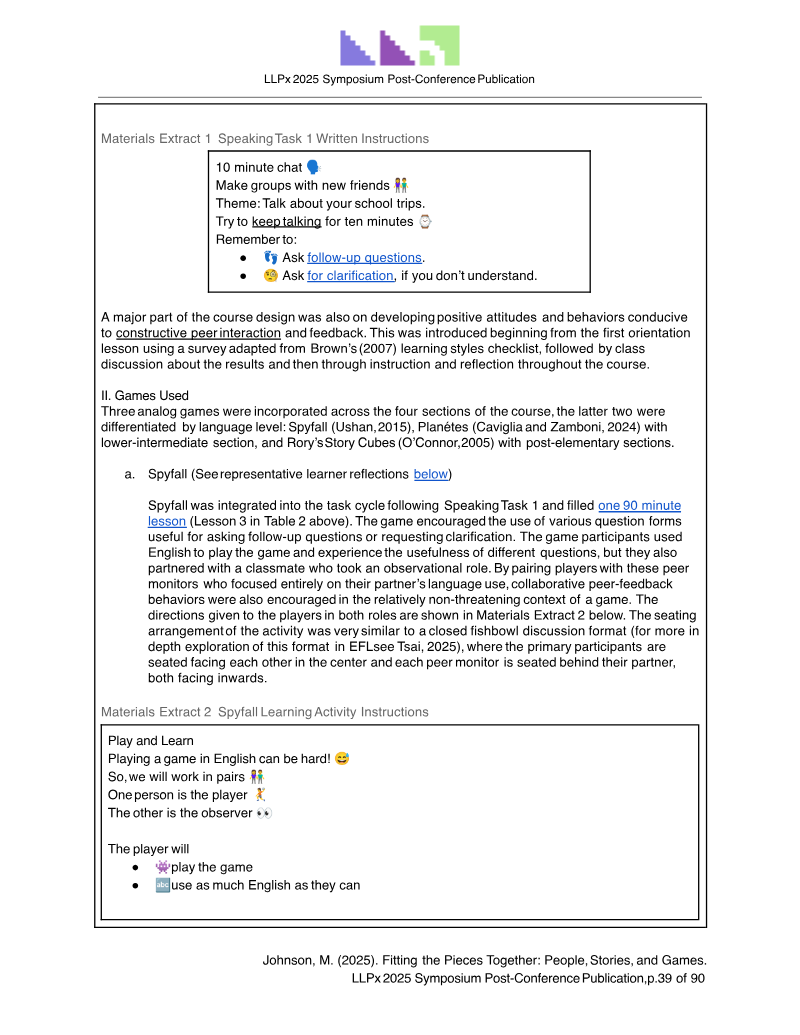
Integrating games like Spyfall, Planétes, and Rory’s Story Cubes within a Task-Based Language Teaching (TBLT) framework supports language development.
Key Strategy. Analog games effectively foster oral narrative and collaborative interaction in university English courses.
This reflective analysis examines the integration of ludic practices into a mandatory first-year English conversation curriculum at a Japanese national university. The primary objective is to demonstrate how game-based learning can be effectively aligned with institutional requirements, such as strict grading rubrics, while fostering student engagement, communication skills, and collaborative learning. By employing a Task-Based Language Teaching (TBLT) framework, the curriculum utilizes analog games—specifically Spyfall, Planétes, and Rory’s Story Cubes—to provide structured, meaningful contexts for oral narrative and interaction.
The methodology involves a cross-sectional, exploratory approach across four sections of the same course, involving 93 students. Data collection relied on student transcriptions, self-assessments, and reflection worksheets, which were analyzed through reflexive thematic analysis. Findings indicate that games serve as effective catalysts for social interaction and language production, though their success depends heavily on the instructor’s ability to mediate the activity and provide clear, visual rule explanations. Peer monitoring, where students observe and provide feedback on their partners' language use during gameplay, emerged as a particularly effective strategy for balancing communicative tasks with a focus on linguistic form.
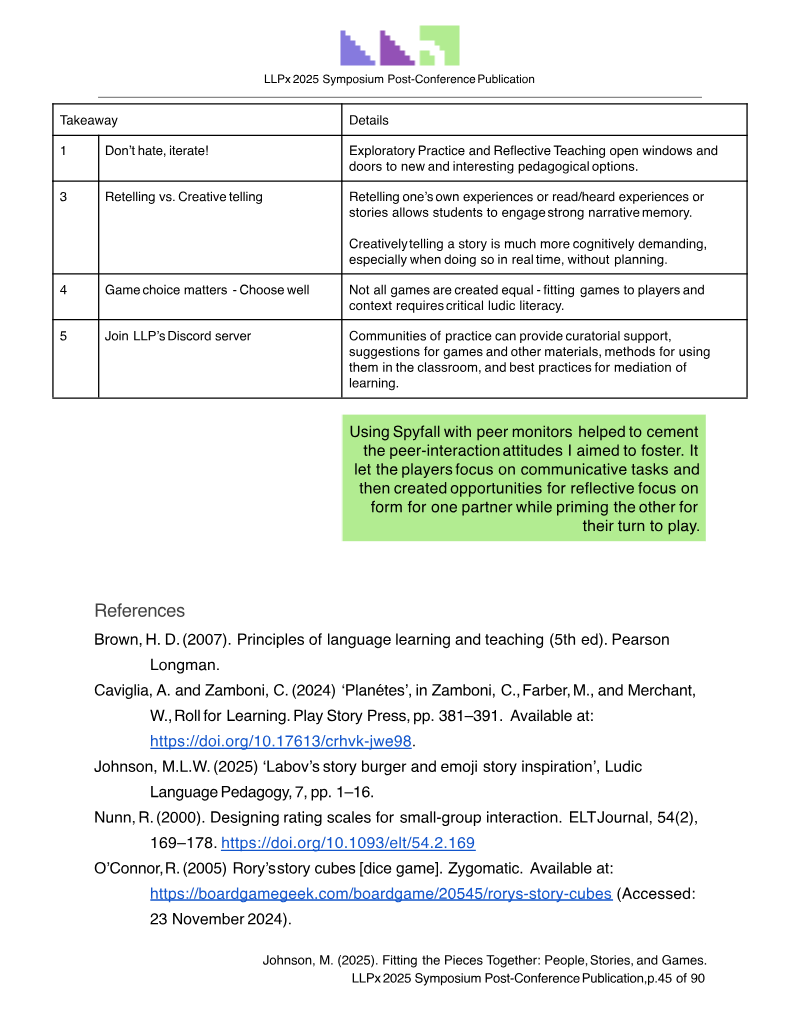
The analysis concludes that while games offer a fertile ground for pedagogical innovation, they require iterative refinement. Challenges such as time management and the cognitive load of creative storytelling highlight the necessity for better scaffolding and the inclusion of intermediary analytical stages between collaborative creation and individual retelling. Ultimately, the study advocates for a flexible, iterative approach to teaching, where educators leverage games to create a "space" for play that supports both student agency and the development of essential communicative competencies.
Ludic Language Pedagogy · 2026
Ludic Language Pedagogy · 2026
Ludic Language Pedagogy · 2026
Ludic Language Pedagogy · 2026

Ludic Language Pedagogy · 2026
Ludic Language Pedagogy · 2026
Ludic Language Pedagogy · 2026

Ludic Language Pedagogy · 2026
Ludic Language Pedagogy · 2026
Ludic Language Pedagogy · 2026
Ludic Language Pedagogy · 2026
Ludic Language Pedagogy · 2026
University of Toronto · 2026