1 free read left. Create a free account for unlimited reading + AI research.
Create free account
Fireside Chat: What do Game Developers Really Think About Monetisation?
Key insights
6 takeaways- 01This transition toward native integration reflects a broader maturation of the gaming industry, aligning financial performance with the artistic and experiential expectations of modern players.
- 02Developers are increasingly demanding greater control and transparency over displayed ad content to protect brand integrity and prevent the promotion of direct competitors.
- 03Gamers are three times more likely to prefer native, integrated advertising formats compared to conventional, disruptive ad breaks.
- 04The industry is shifting away from forced video content and jarring ad breaks, which are now widely recognized as detrimental to long-term user experience and retention.
- 05Approximately 75% of game developers now prioritize non-intrusive monetization strategies, such as ambient in-game placements, over disruptive advertising models.
- 06Immersive monetization solutions are being implemented as additive revenue streams rather than replacements for existing models, aiming to maintain profitability without compromising player immersion.
Ask AI about this video
Transcript
and now we are going to move over to the fireside chat um which is going to be moderated by dave bradley from still media he's going to be talking to kristen rivers from ad in mo and chris wright from adam mo the subject being what the game developers really think about monetization are you there dave and guests hi stuart can you hear me okay i can hear you dave so i'm gonna hand over and let you crack on good luck thank you very much thanks stuart great uh what a great introduction there um to the idea of of new ad formats um very exciting talk right now i'm very pleased to welcome to the stage sporting some new
branding i'll let them introduce that in a moment our friends from adinmo um so this is a talk called what do game developers really think about monetization and we've got kristin rivers who's the uh ceo and founder of adding mo and chris wright who's the cto at mo i'll let them introduce themselves and their experience a little bit more in a moment but just to set the scene for a second every um every year and regularly pocketgamer.biz um does uh a survey we we survey the developers uh in the world uh it forms the backbone of our mobile game developer trends report which we produce and we're working on one that will be out at the end of the month and we're very very grateful that this time we've been supported by adenmo and um the results just came back in we ran the the survey questions online uh for a month in um august and um our partners adam had some some questions in there and each time we do one of these surveys as well as taking a temperature of the
industry and looking at demographics and so on we also asked some questions about an area that's of specific interest and we've been looking at her ad monetization formats very pertinent to this this topic so i won't give anything no spoilers because i think some of that will come out during the course of this conversation but that's the that's the backstory that's kind of where we've um where we've kind of arrived at the conversation here so that's the the kind of set in the scene um i'd now like to um ask our guests to introduce themselves chris let's come to you first of all um yeah that's it if you'd introduce yourself please and what's your background what's your route into this yeah sure hi stuart hi everybody um so i've been so i've been in the games industry since 1995 which is going back a long time um so i started off as a software engineer back in the day back on kind of playstation 1 and pc um worked on a game called playing crazy i then got involved in mobile so i was one of the original guys at one of the big mobile games publishers i played back in about
2000 that was really interesting that was when we were doing whap and then the very early um java games and all of that sort of stuff so that was a i was a really interesting ride and i i headed up game publishing and development for i play um i play got got bought in 2007. got bought by oberon and i left then and i spent i spent three years kind of doing a whole load of different things i did a whole bunch of development and publishing i did a bunch of work for who that worked for capcom i worked on some microsoft stuff i worked on crackdown two i worked on some ea games as an ex there exec producer that sort of thing and then in 2010 i co-founded the analytics company delta dna so i started out with a friend of mine mark um we started that tuesday end of 2010 um that was really interesting i had a lot of kind of learnings from building uh back end server infrastructure that that company was very successful um obviously it got bought um it got
bought last year by unity technologies and it's now the analytics platform behind unity um and then i joined i knew kristen actually all the way back on we worked together at iplay so we've been talking about atomo for a number of years um and some of the stuff i did at delta had some connection to that so so when the opportunity joined so i joined and actually invested in adamo at the same time the start of this year as we we raised our first kind of uh seed round so yeah that's that's my background fantastic thank you and yeah um kristen uh tell us about yourself introduce yourself please and also maybe you want to say something about the uh the new logo over your shoulder as well but firstly what's your what's your uh what's your background what's your name and yeah you know as chris mentioned i think this is the third time uh the third company i've worked with chris at i feel like you know it's like jake and ellwood from the blues brothers we're getting the band back together you know it's exciting to be working with chris again uh yeah so background um i didn't i didn't start out in games unlike chris i was a gamer
but um i kind of i started off at apple computer they brought me over to the uk uh my my first uh introduction to the games industry was at digital at i play digital bridges i play alongside chris uh and then spent a lot of time uh from there out in asia um working for a number of mobile entertainment and digital entertainment companies uh lived in beijing for a number of years uh singapore for paramount pictures led the digital distribution team for paramount and yeah as chris mentioned you know this is an idea that has been a long time forming um and it was great to kind of get the um get get the nugget to the genesis of the idea out there and started about three years ago uh with a major investment raised earlier this year and now we're kind of firing on all cylinders as you mentioned we've got a new branding which uh certainly i think everybody will agree is much nicer looking than the previous logo that we were out that we're running with the branding wheel arriving with that's great thank you and so here's what what we're going to do um for this fireside chat i've got some
questions i want to ask you about what ad and mo are doing on the theme of what do game developers really think about monetization i know we've got some stats from that survey which we'll tease in this in this chat just for those listening in if you have any questions uh for kristen and chris drop them in the q a box at the bottom of the um of your zoom window i'll keep an eye on that you guys don't have to worry about that i'll bring those up at the end we'll kind of go through what we've got here so um i want to talk about the first stat that we that we saw now um is there a slide for this i don't know whether you've got one if not we can just go into the request there we go okay so this is something very revealing i think that um uh that's uh hold on a second let me just grab the ah there we go i see it perfect so this is um this is something very revealing i think this was one of the questions in the survey um and the question was what are your top three features when integrating with the monetization platform and there were some pretty clear answers and you can see there
that the 75 percent said that their most important thing was it does not interrupt gameplay so uh chris let's come to you first again um i mean i was kind of quite surprised by the how definitive that was maybe you weren't but what do you think it means in practice can you um can you give us some examples and dive into that a little bit yeah i think i mean i thought that was really interesting i think you're right we kind of thought that that would be kind of high up but the i the fact that that came up not only the top but at such a strong level was was really really telling um i mean we've had ads in games really in games since they're kind of the free to play space so in the last 10 years it's become more and more important as part of monetization and we've done it really badly so far we've done it almost like tv we've done it as a you know as an ad break you have to go and you have to watch an ad in the middle of your experience or at a point when you know you're trying to play the game it doesn't feel very good and we've tried to make it a bit more interactive with rewarded ads but it's never been particularly
feeling like it's a part of the game experience so the idea of trying to get ads more integrated into the into the game so it doesn't interrupt gameplay um you can see why that that is such an important part because at the moment it feels like we are you know 20 years ago in the tv where you had these ad breaks and and tv has moved on um and you know you're starting to see kind of ads much more integrated into the tv experience and same with games that you know i think people are looking at ways of trying to make it much more part of the experience so that i think that fits with that kind of interrupted part the ease of integration you know again we're seeing so many different sdks you've got to put into your game and it just it affects the you know the playability and the performance of the game so making that easy and simple to integrate and just a part of the build experience has to be really high up so so not a huge surprise but i think the strength of of that push to to non-interrupted gameplay and making kind of ads part of the experience rather than being
a separate thing um is really telling and how things have kind of moved on in the last five to ten years yeah absolutely and it you know it speaks to one of the themes i think of this track that's coming up the other stat in there about transparency i'll come to in a minute but um uh but kristin let me just come over to you as well just to just to weigh in on that um does that surprise you and how does that kind of um play into that sort of drive your philosophy what how does how is adam moe uh responding to that kind of desire from developers yeah no great point back the only surprise i have is it's not higher right we all hate these interruptions both as gamers and developers um it's it's it's not unique to the game's world as chris said i mean any immersive experience whether it's movies you know much before watching a movie in uh in the theater or using netflix uh our attention is a premium and to to have to interrupt it is horrible the i think the um the thing that is a surprise to me um is the different types of genres that
we're starting to see these um animal ad units used and now you know look when we started the company we we thought it would just be an animal admin units are just being sports games and real world games places you see billboards already right right natural fit um i i continue to be surprised every day as developers and publishers reach out to us and show us integrations they've done uh things that we haven't thought of some of them very obvious like fashion games we're in a couple fashion games that was obvious we should have found that i should have thought of that one but other ones you know puzzle games uh where the puzzle pieces uh themselves maybe uh ad units or card games where it's the backs of cards there's a lot of neat places and i think we haven't really fully explored all the different ways that these ad units can at the very least fit into the gameplay possibly even enhance the game experience chris has a lot more experience on this than i do of course as um you know through his years in the industry right right so you we're talking about kind of if you like i forgive my kind of inaccurate server sort of an ambient advertising right so we're talking about kind of billboards
we're talking about uh people um like like in a movie you have maybe kind of product placement so you're talking about that kind of that kind of experience um chris yeah did you do you want to add into that how is adding mode kind of delivering that sort of experience that people are seeing ads as they play it's very yeah i mean that that's that's very true dave i mean it's very much you know that kind of product placement or the digital light of home you know the idea of you know walking down the road and you're seeing on the side of a bus shelter you've got kind of ads playing so we're so used to that experience we're so actually when we watch films we expect there to be a coca-cola can or we expect there to be you know um uh and actually a live brand in in the bar when we see that and again on sports we expect to see you know the branding on the side and it feels strange when that isn't there um you know kristin's right that actually we're starting to see it go beyond that it's not just those kind of pure billboards and it's pure kind of sports it's becoming part of the kind of the the whole experience and you've seen that in films i mean it's
not just um it's not just the real world films that have uh product placement you see kind of product placement all the way through even in the future you see kind of and they'll maybe change the brand slightly or they'll retro it if you're doing something back in the you know in the 1930s but they try and fit it and make it feel more like the real world or the world you're trying to to um to work within but it grounds it it gives you um kind of um things that you you see in your real life and you can ground them in the in the experience and so the same sort of thing is happening in in tv and it's definitely starting to happen in games and that's what we're all about is making making the ads feel like that part of the experience rather than being something separate and a jarring experience right right see that that's that's interesting to me it brings me to my next question because i i actually i totally get the idea that that ad units like that actually help with the world building as well you know that's that's great and also i think kristin it was fascinating that you know you're looking at outside of things like sports games and simulations but this brings me to a question and it kind of goes back to
that slide again um where the third thing that people were interested in was the fact that um developers wanted transparency of where their ads are showing so that sort of makes me think well if you're serving ads inside somebody else's game do they have any sort of trepidation about this um you're adding to their world what sort of extra responsibility to do you folks have um chris you want to run with that first yeah i think i mean this this comes a bit from the experience of delt as well so we we ran our um as a part of the the delta technology still is is a thing called smart ads which was uh ad mediation so we got quite involved in the ad space and one of the things we found in a lot of the kind of feedback from developers was they never got to see what the ads were being displayed in the game that you kind of handed over this experience and okay it was a separate thing it was a rewarded ad separate from your game but you couldn't see what it was and lots of developers wanted to control they didn't want their competitors games to be advertised for example they didn't want things that kind of interrupted with their brand or
they didn't want casino games so on um but you could never get access to that and it was very much separated off the ad tech always felt completely separated from the game and that's so much more important when you're actually doing it as part of the game experience so one of the things that atomo does and we're building into our technology is this ability for developers to see see the ads so they can see what ads are coming in they have much more control over the transparency is there i mean i'm a big believer in transparency across the board that you can see you get access to your data you can see what's actually happening um we provide as much as we possibly can and something we did a lot of delta and i'm really kind of aiming to bring into adamo as well is trying to make it as easiness transparent as possible so developers kind of buy into the technology and that kind of fits into the ease of integration as well but definitely into this transparency and this ability to see to see what happens i mean why why would you not want to and as we start to get more integrated into premium games and into big licenses it's going to become
so much more important and you know you see that with with films they do a lot of product placement and very much defining what ads can go into that so we want to provide that kind of level of um accessibility so people can see see the ads that are going through and then have some kind of control over it as well yeah absolutely um uh i'm conscious that we're sort of about halfway through so what i'm gonna do is um i'd like to take my next question straight to kristen and you feel free to kind of weigh in on on that point there but actually i'd just like to sort of swerve this a little bit and we've the question we asked was about um uh was about what developers thought but kristen do you have any kind of sense about what end users think of this as well yeah yeah and that's an interesting question um because that is you know that they are the they're why we're all doing this right uh it's for the gamers and if um if we're not creating better experiences for them they're gonna leave the games turn out etc um look we did um first of all our our premise has always been there's no click-throughs on this we
don't we don't want users to leave the game experience i think that's one thing that we hate about the traditional ads today is you interrupt the game experience with an ad the user didn't want anyways and you know as a developer your best case scenario is they click out leave your game probably to download another date right you know 95 plus of all the ads you see here for other games so that was uh that was really important to us for from the uh from the game experience uh on that side i think um we did uh we did some research ourselves and we um we saw when we asked uh users about their their preference you know it was clear it's very simple that if you if you if you give the user a choice of do you want an interruptive 30 second video ad that you have to watch to get back to your game or a banner ad that you're going to accidentally click when you're trying to click the next level or button or something like that or would you rather have the the ads kind of natively and as you said uh immersively brought into the experience of course they're gonna they're gonna prefer that and we've seen that it's about 3x preference so yeah i mean to me this is a win for gamers absolutely and if it's win for
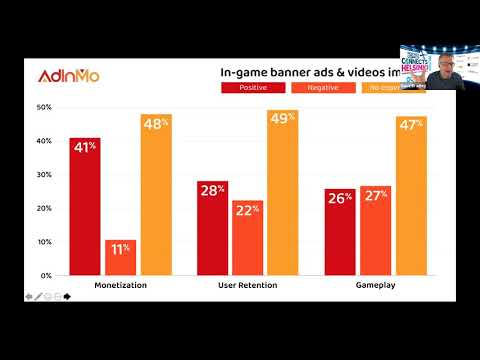
gamers now we just have to turn that into a win for developers and of course a win for the advertisers no absolutely that's that's good actually i'm going to stay with you um kristen for a sec for a sec there um i know that one of the themes of this uh this track is about monetization new ad formats and you're going to be joining a panel i think probably straight after this so so you're going to you've got to stay right there but um uh obviously this is a topic that's very much in the zeitgeist at the moment um we saw audio mob talk about it as well yet from the survey data it looks like the majority of developers are still relying pretty heavily on in-game purchases and rewarded ads there you go you've got to slide you're okay way ahead of me there you are great great so um this is kind of how people feel about uh about their um uh about their their uh their ad forms they're using at the moment and also we saw that still people are using those kind of traditional methods so do you want to speak to kind of this start a little bit about how people feel and also just do you see a big change
coming um yeah i'll i'm gonna touch on this but i think uh i'm gonna hand over to chris very quickly because he uh you know with his depth of expertise i think can address this really well but yeah look you know from it from developer perspective the when we look at the the things that they care about um you know the banner ads we know video ads they um they're great for monetization they're kind of okay at best if not uh really crap for uh for retention and game play and all the other metrics that we care about so yes you can make money uh from these types of ads from traditional ads while you're pissing off your users and so you know i think that's a it's nice to actually get some uh some granularity to the data i think at a high level this is something that we certainly expected to see um some of this kind of feel and it's nice to kind of see that that expectation has very much been borne out right right chris um what do you think yeah i mean as kristen said it's it's good to see that people start
are getting some positive feedback on this though um and it's not you know from a monetization point of view it's not too bad but it's still not great and you know i think specifically around the user retention side of things that um people feel that um certainly banner ads and kind of standard ads are not great for keeping users it pushes people away and it interrupts the game experience so yes it's good for making money um and obviously that's part you know a big part of this but it has a negative impact um and the whole point of this is to try and make ads much more a good experience rather than a bad experience so we want to keep that kind of monetization we want to keep the fact that you know it's making money for for developers because that allows them to build new games and it allows them to to make money off the games they have but we want to make sure that it's not impacting user attention and they shouldn't none of these things should impact they should at least be neutral if not a positive experience on gameplay and user retention rather than having
a negative experience and so that's that's the big thing that we need to change if we're going to make ads are really i i you know an integral part of the game experience rather than something that is kind of slapped on or forced and in front of the user rather than um actually properly connected into the game experience right right right and in fact actually just as a follow-up question from that obviously developers are pretty uh have got a lot of experience with working with other ad forms does your platform sit alongside others i mean if someone is pretty wedded to the idea of in-app purchases or whatever else or another new ad format they can they can use adding mo's uh ad units as well right absolutely i mean we're additive um ideally we hope this is where everything's going to go but um right now you can use you can you can have bananas you can have your kind of standard video ads as well um and there's a whole chunk of the game experience if you think about it you know if you're playing a game for 30 minutes or 45 minutes or even less than that you maybe have 30 seconds worth of a video but actually the vast majority of the
game experience is is playing the game so we allow a much from an advertiser point of view we can put your ads in front of the the user for a much longer part of the game experience so the whole of the gameplay or chunk of the gameplay rather than just at these very specific points and so we you know we fit in a completely separate part of the game experience without interrupting and without getting in the way of the game um so we're definitely additive we're much better from an advertising point we don't have we're not a performance so we are it's brand awareness it's putting that brand in front of people rather than forcing them to click on the brand and go to something else which is which is also not a very nice experience um but we're much more you know we're much more able to um to get that are these brands in front of users in a in a much nicer way rather than actually forcing users and yes you can obviously keep on doing your rewarded videos or all the other kinds of monetization that you have in the game great great we're kind of running towards the end of
the um of the chat now i hope stuart will let us uh press on for a few more minutes i think we're kind of into the buffer zone just to remind everyone who's watching if you've got questions for uh for adding more for these guys drop them into the q a box at the bottom i can see we've got one i'll come to that in a second but while anyone's kind of contributing there um uh kristen and chris i'd like to just come to you with a question what's um what's the single most important lesson you've learned while building adimo um kristen what do you think oh gosh um that's a that's an interesting question i think the um it's for me it's been it's been learning throughout the whole process you know this i i came into this uh with a very clear vision of what i thought the uh the in-game advertising industry would look like and this was you know looking back three and a half four years ago now um and and then sometimes i'm a little bit too stubborn in that think of that vision so having folks like chris uh who have this fast experience uh my co-founder mike who who brought in some of the things that i
was maybe not um did not fit into my vision originally like the transparency that chris mentioned uh originally and that to me now is a no-brainer the idea of sharing this information why wouldn't you and yet nobody in the ad industry does this um that's been that's been the real learning for me is just understanding that that uh that vision sticking to the vision as uh as as a as a guiding star but also understanding that you know i'm not the only person with uh with great ideas in this company uh about how to achieve this and so listening to those people more uh is probably been a learning for me that's great and chris you you know you've got a lot of experience too what was the best thing you know what was the single most important lesson you learned while uh we're building adam i think and actually i think this has been all the things i've done is kind of staying really focused so picking one thing and and really focusing on it and doing it really well so you know where i play we were we were mobile games publisher and that's all we did and we were successful because of that at delta we were an analytics company aim purely
against um and by being really focused on one thing it it really allows you to to build a really good single kind of um solution and atomos okay it's the same you know we're very focused on building um in-game advertising and dynamic in-game advertising in the mobile space so that being really focused i think is really important that's great so we've got a couple more minutes so actually i'd like to just put to you one question that's been dropped into the um to the q a box um this is from an anonymous viewer brand advertisers are cutting down their spend due to kobe 19. wouldn't that reduce uh cpm's uh art dao and brand based networks like adding mo um can you talk about the trends you saw this year yeah that's an interesting question again um look i think across the board as we see the digital uh advertising spending across the board uh is being hit by coping no doubt about it and that's across all advertising channels um what we're seeing though is is i think twofold first of all
dying dying industries dying advertising channels so tv print uh that was going away and we already saw that trend over the last few years and that trend is now accelerated you know they're not coming back those ad channels are are effectively gone now so any advertising spend is coming into digital and second of all we're seeing that certain brands are leaning in uh throughout this whole time uh combat will end you know whenever it does whether it's one month from now or one year from now it's gonna end and everybody that does advertising is gonna need to come back to this um but in the meantime we're already seeing certain brands that are they're leaning into the space and some of them are the kind of obvious brands you might see i mean if you've got kids who who are on any digital devices you probably couldn't go more than 10 minutes earlier this year without seeing a disney plus ad as an example but other brands you know the fmcg consumer package goods brands they they continue to have to sell their products and they continue to advertise so just finding new ways to advertise including uh in games gotcha and
uh chris did you have anything to add on that on the uh the kind of cobin 19 question and it's an effect on revenues and things no i mean i think other than what you know christian was saying that you know it has it's gonna have an effect across the board and it's definitely having an effect on on the older um more traditional brands but it's gonna go away i mean and we've seen certainly in the games industry that it's it's actually positively impacted games so we're seeing and you know we're seeing an increase um just because the games industry is is is rising so we're seeing that go up i mean it's having a small impact on cpm but not that huge specifically because we're focused on a new area so people are picking into this as a new opportunity for getting brands out into in front of people and games is always going to be an interesting place because that's where as well millennials are it's where the the audience is if they're not in front of tv and they're not in front of web so games is definitely the place that advertisers want to be yeah absolutely and it's also i one thing that i always have to remember about games is that people's relationship with the game lasts many more hours than it does with the film or with the or with it or the tv you
know so you know the tv program and uh and in fact someone will immerse themselves in in a game world whether that's a puzzle game or a you know or open some kind of open world adventure for many many many hours you know and and so their relationship with it is very important so we're kind of almost out of time i imagine stuart's going to crop up shortly and uh introduce the next guest um i just did uh want to kind of remind everybody that we've got reports coming out based on this survey um so uh pocketgamer.biz is currently in the process of um compiling all the results from the all the survey which included uh questions that weren't about um uh ads so that's their way and that survey will be out at the end of the month expect that to be downloadable in the pdf format for on the um 30th of september from pocketgamer.biz um we're very grateful for adding mo's uh support for for that and that whole survey will be there and guys i think um with some of that data and your own uh uh data and uh research you're putting out your own report as well this year aren't you
that's correct yeah so there's um some specific questions that we asked of the uh of the respondents which we'll uh we'll be packaging up into a report uh probably slightly after uh the pocket gamer one i think we're uh we're gonna take a little bit more time you guys obviously uh have a bigger team and can pull this together very quickly we're gonna take more time at it but shortly after years we should have one now that's great and uh uh and i think both of those reports would be will be will be fascinating for people it's it's good to sort of take the temperature of the industry occasionally and put some of those those kind of uh numbers and uh put some numbers on those assumptions and then put those numbers in context so we'll see that from both so look thank you very much to uh my guest from adam chris wright and uh uh and kristen thank you very much now i think stuart is about to make sure that kristin goes on to the next panel so i'm going to give you your round of applause unfortunately we're not we're not here in person so you won't hear i'm sure the uh the the next time we get to meet will you'll hear the the applause of the audience in person better but that's for me thank you very much for your time stuart i'm gonna i'm gonna hand back to you for the year dave thank you very much i think you stay there thank you dave thank you
chris um we um we obviously know each other from a long long time ago yeah great insight thank you very much and as someone who sold a print business about seven or eight years ago it's always good to be reminded what a smart decision it was you
Summary
The modern game development landscape is undergoing a significant shift toward monetization strategies that prioritize player retention and immersion over traditional, disruptive advertising. A substantial majority of developers, approximately 75%, now favor non-intrusive methods that integrate seamlessly into the game environment. By utilizing ambient placements such as in-game billboards or organic product integrations, developers can generate revenue without breaking the player's flow. This transition reflects a broader industry movement away from jarring ad breaks and forced video content, which are increasingly viewed as detrimental to the user experience.
Data suggests that gamers are three times more likely to prefer native, integrated advertising over conventional formats. Beyond the aesthetic benefits, developers are demanding greater transparency and control over the specific content displayed within their titles. This level of oversight is essential for protecting brand integrity and preventing the inadvertent promotion of direct competitors. Rather than replacing existing revenue streams, these immersive solutions are positioned as additive tools that allow studios to maintain profitability while fostering a more cohesive and engaging world-building experience.
This evolution in monetization mirrors the wider digital transformation occurring across the media sector. Much like the strategic pivot away from legacy print media toward digital-first business models, the gaming industry is actively refining its approach to align with contemporary consumer expectations. By embracing technology that respects the player’s time and attention, developers are establishing more sustainable long-term engagement strategies. This focus on native integration represents a critical maturation of the industry, balancing the necessity of financial performance with the artistic and experiential demands of a global gaming audience.


















Comments