1 free read left. Create a free account for unlimited reading + AI research.
Create free account
Finding New Audiences for Your Mobile Games
Key insights
7 takeaways- 01Successful cross-platform scaling, as demonstrated by titles like Hero Wars, relies on integrating robust transaction engines and seamless cross-platform play.
- 02Web and PC environments reduce customer acquisition costs and eliminate installation friction, while larger screen real estate supports better social features and re-engagement of lapsed players.
- 03Expanding mobile titles to web and PC platforms generates an average revenue increase of 20% for every dollar earned on mobile.
- 04Cross-platform strategies allow developers to bypass restrictive platform fees, improve user acquisition attribution accuracy, and utilize localized payment methods.
- 05Developers should validate cross-platform viability by testing with a vertical slice before committing to a full-scale rollout.
- 06Partnering with a merchant of record is recommended to manage the complexities of global tax and payment logistics during platform expansion.
- 07Future industry growth depends on reducing technical porting overhead and developing sophisticated cross-platform advertising frameworks to sustain long-term profitability.
Ask AI about this video
Transcript
without further ado i am very you know happy because i haven't seen him in ages uh mika from azalea is going to talk to us so amika is going to hopefully come online any second um and we're going to be talking about finding new audiences oh apparently he's not quite here yet sorry i missed that note so mickey will be there surely i think we've been having a few technical issues so one of the one of the reasons why i like doing the monetizer track itself is because i find the whole principle about how we get the balance between finding the awareness interest desire and action of a player and making sure that we get the best possible revenue for that game thinking about what makes the players
excited and desire the experience of the game and how we satisfy that through various means i've been doing a lot of work looking at how you can take principles from mobile and pc and bring them together to find more consistent ways to be able to create you know sensible affordable uh revenue opportunities but there's another aspect of this and that's the we're not just talking about in mobile games we're not just talking about revenues we're also talking about audiences so we have this fantastic kind of opportunity in games mobile games in particular which is very different than almost any other medium there are very few mediums where you can actually both attract revenue uh by showing advertising inside games particularly through rewarded uh models but also where you can actually identify audiences through other means as well so we're doing a lot of work with those guys trying to work out you know with lots of good games industry people just try and work out what the best balance is to make sure that you don't annoy people and you create you create these greatly emotionally positive experiences through
playing games um so i think we have mika uh has now um arrived i believe we'll find out in a second oh there he is uh so yeah mika's here now so mika as i say is from azalea uh mick's got a great background he's been involved in a whole bunch of stuff i think you know a tilting point weren't you i think you were in um uh oh i i i forget because i've seen i've seen you for such a while i i'm doing all the different places i've known you when you and you've done some amazing stuff uh and obviously you're now exactly a superscale that's what i was thinking of and yeah yeah yeah i i've been around 15 years of mobile so it's uh yeah that's like crazy it's crazy exactly anyway it's lovely to see your face and i'm i'm looking forward to hearing what you've got to say tell us all about finding new audiences for view mobile games yes so i'm going to do my screen sharing here cool i'll uh i'll turn my camera off but i'll let you know if i can see the screenshot yeah yeah all right
so it should be visible yeah yeah that's great okay so uh hello everybody first of all um i hope uh everyone is healthy and doing good today um and today i wanted to talk to you about the opportunities that lie beyond mobile platforms and how to find new audiences by going cross-platform um and today we have only about 20 minutes on the on the presentation and then we do a q a so it's going to be brief but hopefully opens up the curiosity for everybody about this topic and and kind of expanding expanding beyond mobile platforms um and at xola we see actually mobile market as a huge opportunity to offer for more freedom for developers to sell their experiences directly to their players while being able to grow their games beyond the restrictions of the mobile app store um so today i'm going to take you on a ride to the likely future that's going to definitely be more cross-platform than today
okay so uh we started there off a little bit so who the heck am i uh i'm nicole i'm originally from finland currently based in berlin germany i've worked in the mobile game industry for well actually over 16 years now so i i've been counting it in a variety of companies and roles from anywhere from producer business development to product management at companies like rovio wuga tilting point the super scale and i currently work at exo last the interim director of business development for europe so that's me all right so what is excellent anyways um so we started as a company over 15 years ago and we've been handling transactions for video games ever since our offices are in los angeles perham russia korea and berlin in a sense uh xli is is really a video games business and transaction engine
so what what that means is we actually enable publishers and developers of all size to market sell and optimize their games no matter the platform okay so i want to start my presentation today by talking about the current top crossing moba games of 2020 first and the ones that have a cross-platform version so kind of get a look at the last year before we talk about uh this year so i found a few interesting tidbits here when looking at the ones that have uh indeed a desktop or a web version available so there's there's the obvious suspects like pubg fortnite kensington impact that was released last year late last year so that was a pretty pretty successful launch but also i noticed a little over a week ago raid shadow legends released the pc version uh just just over a week ago and if you haven't checked it out it's actually pretty good so that that's an interesting trend of of where the market is definitely going
so we see more and more these highly crossing mobile titles are kind of looking into having a full cross-platform or you could say multi-platform strategy all right so let's talk about this here um and the key challenges for for mobile game publishers and developers like so number one challenge is really discoverability still i mean this is the the age-old issue that's still there and it's you know more saturated by the year and how to make your game scene in the case you don't get featuring or you don't get that launched virality uh i missed the sea of hundreds or you know i guess even thousands of games being released weekly globally if you think about it and one way to approach this challenge is to take your game to new platforms and increase your visibility and i will be talking about some of the benefits and opportunities with that approach a number two challenge and this is a big topic of
course right now i'm sure here at pgc as well and it's on the mind of everybody who works in the industry the number two challenge is really the idea fade application coming into effect you know and and this is this this is left many asking whether they can reliably predict their return of investment from their marketing campaigns as they were used able to and that really the short answer is not as well as they did before so no matter what sort of programmatic algorithms you have at play it's definitely a more foggy prediction that you're doing especially at higher expense and it's important to consider different strategies like diversify diversifying your spend across new platforms it's definitely a more sure way to tell exactly how you're spending and how your marketing is performing so being able to kind of spread around your marketing budget that you may not be able to use do the idea fade application come into play and you know one thing to note is on web and pc
if you are releasing the game um you know on a website or something like that uh where you own that site and you own the space you can really own the tracking so there's no limits to attribution you can do on the web or a pc version if you use a launcher so number three and four challenges so scaling to the app stores you know i mean it's always been a challenge with that 30 platform tax if you will um whereas pc and web you know if you're selling uh directly to your launcher or your website your game and and basically you're you're writing your game there obviously that scales better because there's no 30 cut that anybody's going to take you out of that so your ui profitability will be better straight from the straight line back all right so let's talk about the telltale signs uh that we've seen some of our partners have and and the reasons that they've come to us so this is pretty interesting
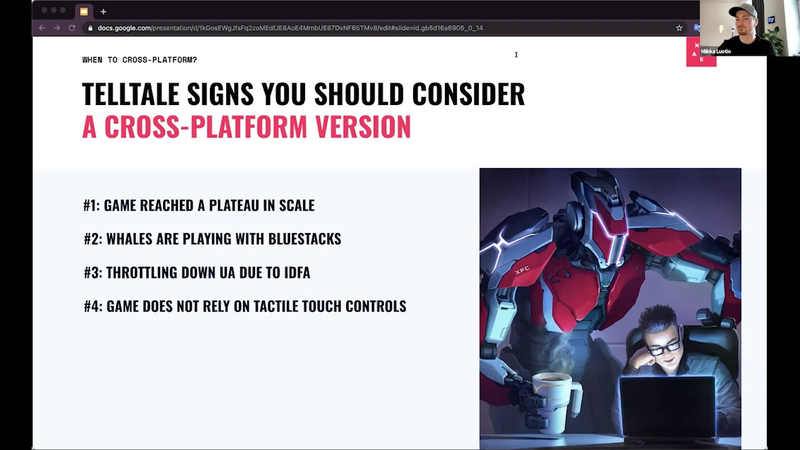
because like all of you who work with uh you know publishing or development you can certainly check for this city science so number one is obviously the pretty obvious one so you really reach the plateau in game growth and you realize that the only way to really grow is to add new platforms and usually design for this is when you're you're doing a paid marketing for example you're trying to scale the game up you're trying to increase the marketing budget your game has been on the market for a couple years and you're just able to increase it in increments but you know it's kind of stated out and that's a good sign that hey maybe you should consider this kind of uh strategy number two bluestacks so bluestacks is an emulator uh for android uh android phones that you can actually allows you to play any apps or games that are made for android on pc or mac so we've what we've seen is some of our partners actually noticed in their metrics that many of their whales or big spenders or kind of vip
players are actually playing their game through blue stacks while they're doing uh joining uh webinars and conferences or doing zoom call if they're playing their game or they're side loaded here on their desktop and that's a that's definitely like if you you're able to see the metrics that a lot of your big spenders are actually you know this is their main way of playing that should be a good telltale sign that maybe you should consider a cross-platform version on the desktop and then number three idfa i said before it will make make it harder to exactly track your marketing campaign performance as as we were able to before on on the on mob space which means that really the more you spend the less accurately you can spend it right so that's in a nutshell i mean people there's all kinds of people saying all kinds of things but it will it won't be as trivial as it was before that's for sure and number four um really something to consider here is the issue that um you know how your game controls are
uh utilized because when you think about like oh i just want to put my game on desktop well the issue is that heavy on games that are heavy on controls really like engaging tactile touchscreen controls don't really convert that well i've seen that at romeo when i was working at rovia we had pretty much quite a shotgun approach for angry birds like putting it on every single device available where you know in many cases you can really see that if you take a a very tactile touchscreen game and you you put a mouse cursor on it it takes away the fun so i mean that's something to always consider all right so let me talk to you about a recent case with one of our partners nexters and their their game hero wars um and nexters they came to us with the challenge of wanting to grow hero wars and scale it beyond what the mobile app stores could provide so there is a plateau in a sense there they were looking for new audiences and finding those new audiences for their game in order to grow their product more and
the solution for this challenge was to really take their mobile game port it the web using a webgl building a dedicated site where players can actually play hero wars directly on their browsers without having to install their mobile version so at xola we integrated uh payments for the in-app purchases like pretty much what you normally get uh what normally app stores actually do so they have their store apis and whatnot we uh we built give them the support for the in-app store and and also the customer support for all the transactions that they're doing also uh player inventory management so when you buy something on one device we enabled them that that that item will be available on all devices you play right because we're talking about cross play and not just cross-platform the results were great actually nexters found a good improvement in the conversion rate uh they reached new markets with
local payment methods that we were able to provide like japan and are now able to grow and scale their game further than ever before and a testament to that is uh just to give you an idea so in one month the users made transactions via 245 different payment options and increase the revenue by 10x turning our partnership 10x so that's that's an encouraging story i would say okay so which platform to expand so you know we talked about the web a lot but there's obviously more there's like pc is an option for some games like raid shadow legends like i highlighted earlier they've done that up that you know root of going straight to pc so let's talk about a bit about the opportunities and challenges we need to approach so due to the improved browser support like webgl is finally ready for prime time and this is like you know uh this is the
reason why i'm speaking these companies are coming to us and they're like hey you know wait a minute we can have enough uh you know penetration in the market by doing a webgl game because enough producers support it right and it's a good option for games that are 3d or visually demanding so that's really that's really the enabler there as well and it's especially good if your game is built using unreal or unity because both of those engines are building like on a daily basis improving the ability to support a webgl version while you're you're you're working on mobile um and uh for web games it's important to remember the cost per acquisition will actually you know because on web games if you have a webgl version of your mobile game uh it's not cost per install because there's no install process so the cost per acquisition is really lower uh usually uh what i've seen versus mobile so it's actually cheaper to get
acquire users on a web version obviously also the fact that they they don't have to install anything and the game loads instantly and they got the page helps as well um and also you have to remember the the web allows for a larger screener real estate for social uh chat and community features to be site loaded um and of course the same for pc i mean you're gonna you're gonna have much more screen real estate so you can have multiple features that you know really your your core core players your your vips can have all the all the all the social interactivity and chat and clan uh activities visible while you're playing html5 is another good way to take your mobile game to web but it's more suitable for simpler and lighter games but also enjoys better browser support as webgl still i mean but obviously webgl is improving on a daily basis on how browsers are supporting it of course pc last but not least um is the best for immersive experience
but with that player expectations increased dramatically so keep that in mind so if you launch the pc version of your mobile game one thing to note it's very important to consider using a launcher um and uh the reason for that is if you have a launcher it allows you to really own your player data and track and tracking and all of that so build your customer base uh in a good way all right so what to expect when going from mobile the web or let's say mobile pc so first of all um uh the key factor in deciding whether you should invest the resources and supporting your game to other platforms it's it's it's a big big decision to make right so what i've seen before is some of our partners done a simple test campaign to you know with a vertical slice demo of the game or prototype before investing fully into the project so basically uploading a a sort of first playable
version of webgl or or even a pc version and and trying a quick user acquisition campaign to see how how your cost per acquisition could be would it be cheaper and also what is your day zero and day one engagement and if you see a positive response to that in the kpis as well you know that that can give you the kind of like last push to actually jump the line and invest on a multi-platform cross-platform strategy and you can also of course expect to have a positive bleed effect where people um who get the web version or pc version you know likely will actually also download a mobile version so you know organics on your mobile download should should increase as well so you know you're effectively increasing your mobile mobile customer customer size customer uh group as well and then uh you know try one one interesting tidbit here is that you could you could also try targeting your lap spenders so people who
for whatever reason they stop playing uh the game so when you have a new uh new release of a new version that's playable on web or pc obviously you can you know if you know those players you can look to kind of re do some retargeting and target those players again and promote you know over different social media ad channels that hey dude yeah you haven't played played the game our game for a while check out the new web version so that might be a good way to reactivate your player base and uh financially for a web person i think just for financial expectations what we've seen is that you can realistically expect to earn an extra 20 cents for each dollar earned for your mobile game so basically if you earn a dollar on your mobile game you can calculate that you're getting uh 20 cents of extra by having a web version so that's that's like an interesting interesting bit there
um and one thing to note is that um when you're adding a new version of your game this will add live operations overhead so think about like webgl i would just specifically that one i would uh suggest think considering it as like you have ios android and then you have webgl so uh you will have to uh size up in terms of live operations and obviously deporting and you may need some help there and and there's definitely companies that can address that uh address that issue um and we've seen this this be one one topic always when you start talking about okay so remember um when you're going for a web or pc there's no platform tax so so this is an important thing to remember for example our commission at excel is uh five percent versus app stores uh 30 so shameless plug there uh definitely something to consider in the in the business uh business planning for doing cross-platform versions and if
you're interested of any of anything i've just discussed i'm happy to answer more questions even offline after this presentation you can email me i'm on the discord at pocketgamerpg connects discord so you can find me there for any questions i think that'll probably be the best way yeah thank you anything so that was great um yeah yeah and uh like i said yeah the the disco would be a great place to have a conversation but we have a couple of questions uh which i can compose to you i mean uh i mean i i'm gonna chuck one at you first which is uh you're saying that um you think webgl is now ready for prime time do you think that there's a lot of developers out there who understand that it's come a long way particularly on pc i mean it has come amazingly far um but there i think there's still restrictions on the way some people use it on mobile because of some of the browser implications on uh you know the way apple are handled things you know do you have any kind of like particular views i mean um yeah what is it that we need to do to help people understand that you know webgl
can be useful yeah i think i think the you know the market data that's that's uh about like for example webgl browser support and how what is the consumer penetration they're like how many browsers you have installed all around world that can can render like webgl you know in an effective way so uh i think it's you know it's still relatively fresh but like for example like i said the example that i've seen is you know uh from one of our partners managed to do 20 cents for every dollar that they earned on mobile so 20 cents on the web version means and this is a game that's that has millions of downloads so definitely there is um there is the audience and the support is there i think on the mobile side mobile web gl um support it's it's a little bit a little bit more difficult um topic i have actually haven't researched into that but uh certainly will now after this question well the thing in my head was always
that there were two things that were problematic with webgl i mean obviously there was a technical thing i think that's separate um the the the ease of monetization the frictionless monetization wasn't something that was easily available now i mean obviously yeah i don't want to plug you guys because that's your job but i mean there are teams you know you guys are one of them there are others out there and obviously other providers do exist who do make that process easy and you know if you can make that that sign that process and payment process simple then it's no different from any other um transaction you make online um yeah i think that's that's something that i think a lot of people are worried about and there is a genuine barrier because every time you get someone to fill a form in they're going to you know not want to do it the joy yeah and and also yeah absolutely and also the big challenge there is that if if you're selling directly your in-app purchases directly to your players in the web um you have like you have a choice either you you find a payment of uh payment of record like merchant of
record or then you act as your own merchant of record which means that you might have to have legal entities in all over the world in places where you're just like oh my god this is too crazy for financial and logistical reasons so you know uh it's important to kind of find a partner there that can can be merchant of record uh you know the same thing that apple or google are doing they're doing hanging all the taxes and vip stuff as well while processing that which is not a not a trivial thing to to no no it's not and i i was joking and there we just it just you had me laugh obviously because of the previous um conversations that happened uh around uh how large tech companies uh handle their tax issues but that's a different subject we're not gonna get into um i'm sure that's all been solved by now um let's talk instead about um the uh the question that dorian uh has just asked which is how do you um uh look at the payment process so is it not problematic
for example i mean i i know we'll answer this because i've done some stuff with blockchain but i'll let you answer it uh you know how do you avoid apple getting annoyed that you're sending stuff outside of their app store yeah yeah no that's that's actually uh fairly simple so i mean i'm not a legal expert and uh you know take take my word uh with uh you know just as a friendly advice so i would just go check out the apple uh app store uh guidelines so you go to section 3.1.3 b yeah you will actually see a section about multi-platform services so essentially what they state there and i'm just paraphrasing what i've read uh is that they state there that if you have a multi-platform version obviously you can sell whatever you're selling on that other platform as long as the same items are available for the players on the mobile version right and that there's no huge uh limited exclusives that you're selling
on on this other platform that you should have all the content and things to buy also available on the mobile and of course you know you you need to keep generally a good rule is to i mean you look at steam you look at other platforms as well beyond mobile they have the same rules the prices have to match for the players the content has to pretty much match um and as well as promoting to go promoting your users to go buy somewhere else outside of the platform like even on steam you know it's it's not a good good idea right like so you definitely want to you know keep the mobile players spending in your mobile keep them happy there but looking at this as a multi-platform strategy i it's it's as far as i can tell uh there's no issues and we've already you know had this ride with that two large mobile publishers so uh it's definitely possible yeah when i worked on a blockchain title where we had items which have blockchain sold on um the web and they were usable
in the game but they were not sellable in the game because we couldn't obviously sell blockchain out in the game but the key as you said there was it's a bit like books you can have a bookstore and have books that aren't available on on the in the actual uh outfit stuff to be purchased you can't you can't promote them that's the key thing yeah exactly you have to be careful with the promotion like cross-promoting uh different stuff in a different platform i mean technically you should always try to contain your players in one platform instead of trying to like make them go back and forth obviously that's not yeah we know that people do yeah people like you said earlier people do go and use their pc in some circumstances when they go but they're the minority of players and generally a player will have a device they go to for that particular game uh right so one quickie um so um oh actually it's actually an answer to the uh oh no there is a question here i i
slipped ahead so the question was from uh haristo where do you see the mobile game industry 10 years from now uh where i see the mobile gamers to 10 years from now i i see it more as you know there's less there's going to be less talk about like platforms it's it's basically distributing your game is going to be distributed to all the screens out there um and i i foresee a future where that will be uh you know easier to do and it will be a self-evident thing like um if you if you contain your game to be mobile only then you really have to have a good reason for it like controls or something that's it's exclusive to that platform um that game and i think you know i i see the future being way more cross-platform from the get-go the tools that we have available will be better so that you can basically have your gaming experience on any device that you're looking any screen that you're looking it will just be available there and i
think the technology to enable that will get so much better that in 10 years we won't even think about platforms we will just that's a game and it's accessible exactly everywhere i mean i'm just thinking about the xbox game pass on android which i am absolutely in love with uh because i can basically take my razer controller and i can play skyrim completely off the back of my phone without even blinking uh oh my god i've gotta have a decent connection fair enough but it's not just about streaming but it's about this accessibility and realizing the content is about the moment of play for the player not about what platform we happen to build it on but what i love about it from again from a live ops point of view is that actually the same stuff to manage a pc or a console or a or a mobile game at the back end is the same stuff yeah and whether you're using webgl whether you're using on the other platform doesn't matter the important thing as you said it's got to be a game experience that's going to work on those other platforms yeah absolutely and like i i
hope to see a feature where um developers don't also need to think about too much of the overhead you know the porting and the live ops that things things will get easier uh where the business decision to put your game available for more and more people uh will be just so good that uh it's it's it's a you know this is something where the industry still needs to develop yeah exactly and it takes us being able to monetize it and i think you know the next thing will be how we're going to see advertising working cross-platform but that's a different subject for another time uh i'm not sure anyone's dealing with that one yet um but yeah mika always a pleasure sir love to see you hopefully we'll be grabbing a beer together again soon yeah look forward to it man thank you
you
Summary
Mobile game developers are increasingly shifting toward cross-platform strategies to mitigate the challenges of market saturation, discoverability hurdles, and the limitations imposed by restricted tracking protocols. By extending mobile titles to web and PC environments, studios can bypass restrictive platform fees, improve the accuracy of user acquisition attribution, and leverage localized payment methods to reach broader global demographics. This transition represents a fundamental move toward a platform-agnostic future, where the priority is delivering a seamless player experience across all screens rather than adhering to device-specific constraints.
Expanding to web and PC platforms via technologies like WebGL or dedicated launchers yields substantial economic benefits, with data indicating an average revenue increase of 20% for every dollar earned on mobile. These platforms offer lower customer acquisition costs and provide instant access to content without the friction of traditional installations. Furthermore, the expanded screen real estate facilitates enhanced social features and serves as an effective mechanism for re-engaging lapsed players. Successful implementations, such as the scaling of titles like Hero Wars, demonstrate that integrating robust transaction engines and cross-platform play is a proven pathway to increasing both revenue and long-term player engagement.
To successfully navigate this transition, developers should prioritize testing with a vertical slice before committing to a full-scale cross-platform rollout. Partnering with a merchant of record is also recommended to manage the complexities of global tax and payment logistics. Looking ahead, the industry must focus on reducing the technical overhead associated with porting and live operations to ensure these strategies remain viable. Future growth will likely hinge on the evolution of monetization models, particularly the development of sophisticated cross-platform advertising frameworks that can sustain long-term profitability in an increasingly interconnected gaming landscape.

















Comments