1 free read left. Create a free account for unlimited reading + AI research.
Create free account
Finding Hypercasual Publishing Success: Lessons from Rocket Sky! & OverTake PG Connects Digital #2
Key insights
6 takeaways- 01The development lifecycle for hypercasual games has compressed significantly, with the time from initial prototype to global launch now measured in weeks rather than months.
- 02Continuous optimization requires the use of A/B testing, server-based game settings, and advanced ad mediation to maintain profitability as individual titles reach market saturation.
- 03Small UI adjustments can yield massive performance gains, as demonstrated by Rocket Sky!, where moving UI elements to the primary focal point halved the game's CPI.
- 04Successful scaling relies on identifying satisfying, unique mechanics that perform well in video advertisements, a strategy that drove the growth of the title OverTake.
- 05Publishers like Kwalee mitigate risk by acting as partners who provide developers with essential engineering, marketing, and monetization support to build a diverse portfolio of titles.
- 06Hypercasual success is defined by the ability to optimize Cost Per Install (CPI) and Long-Term Value (LTV) through rigorous data analytics rather than creative intuition.
Ask AI about this video
Transcript
talk more about hyper casual let's uh talk uh to simon uh so we've got simon um from kwali who's gonna talk about finding hyper casual publishing success lessons from rocket sky and overtake simon i'm gonna pass over to you sir oh you're on mute there you go nope i'm off me now hi guys um yeah i'm going to talk about what makes hyper casual publishing success i'm just about to share my screen uh just a quick uh a few facts about quality uh carly's the uk's biggest hyper casual games publisher we're actually the fourth largest casual publisher by downloads on the app store
um we've done over 400 million downloads now we our founder david darling also founded codemasters and we have people like andrew graham who is the designer and lead program on micromachines and then lots of our other senior staff including myself have run their own devtoo studios both large and small and we bring all of that knowledge to our publishing business and it's you know we're not just a publisher that doesn't know your the developer's business we have actively worked as developers and now know it from the other side um currently that team is uh between 75 and 80 people um it's it's rapidly uh changing all the time so i um we're i've got a new person starting my team for instance on monday uh even during lockdown uh it's quite
difficult for new hires but um we are still expanding and we just recently added a second studio in bangalore and we started ramping up there on the publishing side because we are both a developer of hyper casual games and a publisher of the people's games we grew out of being a developer ourselves and then um just over just over a year ago maybe 18 months ago we decided we would apply our knowledge of hyper casual development and publishing our own games to helping other developers make big success out of what they were doing we've concentrated on the the area of hyper casual i don't really see that as a genre it's more a business model so it encompasses lots and lots of different genres from driving
to sports to uh to space and rockets as you'll see later on in this uh presentation um some of our biggest hits have been things like draw it jetpack jump and shoot it 3d um but i we're going to talk about two in particular in this presentation and that's rocket sky and overtake we now have a dedicated publishing team um which there's some other people uh in those penis characters you can see there that i've displayed on the screen um i'm the one in the middle with the running attire because that's what i do in my spare time is doing really long running races um we also have a much larger supporting team of about 30 people in areas of tech support so we can you know give engineering support to developers
we've got marketing monetization uh servers uh you name it we can we can apply it to and grow your team from just the development to all the other functions so i'm going to step into our first example [Music] we rocket sky was our first major uh signing and our first big success and it was our first published game that we took through to to global launch it was developed by uh dp space we were based in latvia and russia and we launched it last summer in 2019 it's carried on uh i have it going from success to success and it's had over 25 million uh downloads to date
when when we first got this game uh it had simple compelling gameplay which is required you know if you're gonna have a hyper casual hit um it also if you wanted to upgrade your rockets and manage your fuel you had these upgrade buttons uh within the game now he also had a lot of content and he's polished even from the start and what we did notice when we first tested it it had amazing retention um probably some of the highest retention we've seen in in the game i'll give you it had a day one retention of 60 that's 6-0 um it's very rare you see a
game with people returning on the second day with that sort of level unfortunately though it had a fairly high cpi as cost per install around about 50 cents which in order for us to fully launch this globally that would have been too high and so we did a lot of work on on that so the first thing that we did is um we did run a lot of ads with a lot of variety and a lot of different animations and a lot of different setups and so these weren't changes to the game they're all pointed to the same game we were roughly able to iterate changes to the look of the game and this ui just by changing the ads and seeing which ones were more appealing and once we
had that then we could it helped us to lower the cpi okay and then once we had a lower cpi we then use a lot of the systems that we were building including sort of server based game settings a b testing our sophisticated ad mediation and we developed along with side this game our first version of our advanced analytics platform that we have used in all our games since um and then read more recently we've we've added auto bidding uh to this game which allows us to make very very quick changes to the prices we're bidding on as uh in the game or um and you know except in bids from various um ad placements in the game
really quickly and then the probably the biggest thing that we did in terms of cutting the cpi in half which is what we needed to do to globally launch the game was we moved the speed and the fuel meters onto the rocket um i'll show you in the next slide here so this is what it looked like before so your eye was drawn always to the top because as you play in the game you need to keep an eye on the fuel and the temperature um so what we did was move these gauges down onto the rocket and just by doing that it helps to concentrate your eye on where where the actual game place happening which is the rocket and that allowed us to half the cost per install um along side all of these changes we established our publishing process about the working of the dp space which we've now extended to work with
other devs and part of that is that we have a lot of sort of human touch and it means we have automated systems and we have a lot of them but we like to keep that personal touch and feedback going all the way through from the first time you uh present a prototype to us to all the way through to a live game like rockets night um the thing where we excel is we've got a real eye for design uh as well as monetization and i think that comes from a track record um as a as a developer and and it has a knock-on effect you know changes the design have effects on the key metrics such as retention play time and auditization okay
so the results that you saw from uh all of our improvements to rocket sci uh resulted in the 25 million downloads uh plus it got number one free up in it uh in 11 countries including the uk australia and germany it was number one game in the arcade category in 52 different countries and the last point there is it had a strong return and this is a financial term for both us and the developer um there's an example of that in the first six months it made such significant profits that the developer had a revenue share well well into six figures i can't actually confidential reasons uh going into any more detail moving on to overtake um
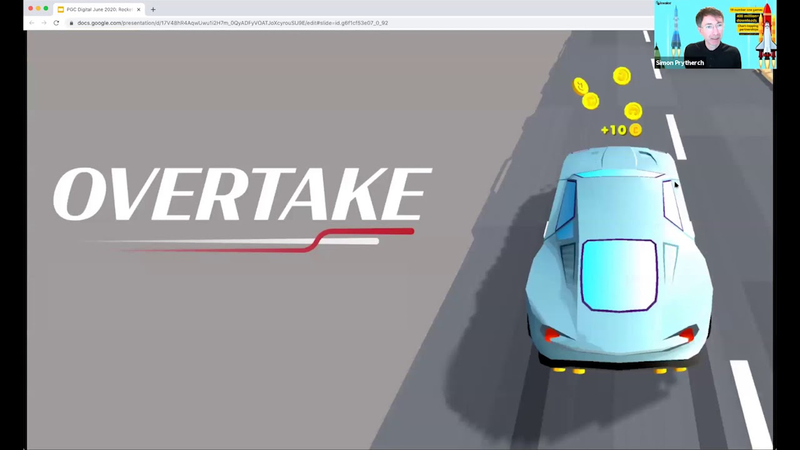
overtake is a much more recent game um so this is uh seven months later after than uh rocky sky we published it in february 2020. um during that first month we had two million plus downloads and this isn't like from from zero to two over two million is very quick uh in terms of ramping up um and this is one of the things that we've learned you know when when you've got something that's uh game changing in terms of a a mechanic and because this game was probably the first hyper casual truly hyper casual driving game we've seen where you touch the screen and it as you when you touch the screen the car accelerates and then moves over to
the left and overtakes the car and then when you release from the screen it breaks and moves into the right but it's a very simple mechanic but sophisticated uh movement this is uh developed by pranitis a very talented developer from romania and just to show this sort of speed we went on on this game um i think we initially tested it in mid-january and we'd signed the game by the end of january we soft launched it two weeks later so it was a very fast movement honestly when we first saw the game it as i mentioned earlier it was the first three hybrid casual driving game we've we had a yeah we've had uh our own driving games uh previous first and we've seen other driving games with nothing that that felt truly hyper casual in the
driving genre um it was very satisfying i mean those near misses you can see in this uh animation is what drove you on and that's the thing that felt really satisfying um being able to overtake and then pull back in just before hitting the oncoming traffic um and it translated well to our video ads so we were able to get really really low cpi's on this um and then combined with the ltv which is long-term value value which um with a high 40 plus day one retention we were able to uh yeah make good money and scale this very quickly the ltv on it was okay to begin with but what we did the in the very tight
frame time time frame uh between signing and release was we used our experience in our automated systems to increase that ltv especially around uh ad placements that timings um increase that ltv by 50 and this label was then once we saw that increase it you could see the profit so that that allows us to take the market to the market quickly because you need um that margin because as you as you scale it erodes your cpi's okay and as you can see we pushed it to to number number one within two weeks and that was a big effort from both our teams and and the pranitas teams
must say big thank you to the developer for that there was yeah a lot of long hours in being able to do that so the results we we saw with overtake uh was we had number one game again in uk australia and a lot more of the countries we had the number one uh racing game in 33 countries uh we did over two million downloads in the first month and the figure i mentioned earlier where we changed the day zero uh we saw that ltv carry through to you know um to further through the life cycle to 48 so the key learnings we've got from from these two games and other hit games that we've published are the following
the first one's about lying your vision we've lived aligned our vision with our devs so um we tend to when we start working with a developer and we will uh work obviously working closely with them in terms of prototypes uh from from an early stage and we encourage developers to send us videos even before they've got working builds and in some cases we do things like uh cpi tests with a single level um and then once we've got a prototype we test that um but in this case um both of us believe strongly in testing ideas on on the sort of live audience and the players on the store um we have learned to trust
uh that and we test on yeah thousands of users a day and and that the metrics that we get back from that is much more power more powerful you know data speaks much more powerful than anyone's opinion um what i will say about these two devs is they're both mature what i mean by that is they produced both produced lots of different games in lots of different genres not just hyper casual games and so they understand um development cycle they understand how to structure their code and how to integrate various sdks i mean we've which is unusual and you know and we've um developed our own technical support team that helped developers that aren't so
mature as these these developers to help with uh maybe a developer that doesn't have as many um hit games behind them the other thing so i need the other thing we find is that the developers work best with we have strong daily communication and and they trust us and we trust them and if that if that is missing then you you're not likely to produce a hit game with it and it's something that we work on on a daily basis as a team the second principle is is we're not looking for perfection i mean both of these games came to us as solid prototypes but they
weren't perfect in in any manner um we knew when we saw the games that we could see potential to change them in various ways and so we could see there were different ways that we could experiment um i'll give you an example in overtake when we saw we could see that the um the overtake mechanic was very cool but we could see that also that a lot of players um had crashes but the cool thing was having near misses so what we did was adapt the gameplay in a way that allowed to have a player to have more cool near misses than not so cool clashes um and the final thing is both of these have initiative innovative
and sort of cool mechanics so it's not just about the fact that they look really good in ads um the mechanics there is at the time when it was introduced was not seen in many games and felt good for the players and finally we've learnt to evolve over time it's a very fast growing market market hypercasu if we didn't evolve and change over time we would not be the success we are now um as an example i think when rocket sky was first uh submitted we only had one person in the booking team um we've now grown to by the end of this year having 25 people
in the publishing team and the larger supporting team uh is totally probably about 50 people uh when you count out all the functions um we have now done as i mentioned earlier over 400 million downloads as a company that means we know hyper casual games inside out and not just as a publisher we have developed a lot of our big successes ourselves so we know what works and we can advise developers because of this one of the things that we've learned from our experience is how to accelerate that time from testing our prototype through to signing through to soft launch through to global launch and some of our earlier titles like rocket sky may have taken months now we measure the timelines in weeks you know in that cycle
and then i think the final point is is key and and one of the things that sets quality out is different from a lot of other publishers is we look for long-term relationships so we're not looking just for one hit game from from these developers or any other developers we look for a long-term relationship so even if you haven't had a hit game with us we've got you know tens maybe hundreds of developers now actually um that are submitting prototypes to us on a regular basis and i've seen the growth in all of those developers from the time they first started uh working with us to now and all of those are considered as part of our kwali family and yeah all of those developers also will we have like an inner circle of quality
developers that we work closely with and that's growing more and more and we're running our own sort of virtual hyper casual conference uh later this this year which will uh incorporate all of those developers that we work closely with that's it for me i'll open it up to questions um great stuff thanks simon uh like i said i think it's fascinating sort of seeing how this hybrid casual space has gone from people creating small games to actually it's all about the process of optimization and really narrowing down the simplicity user experience and the kind of pleasure that comes from playing those games yeah and you know creating that teeth we have a couple of quick questions that i've got a lot of time but um the first one is um do women play overtake yeah uh they do a lot of our gains have um
almost 50 50 men and women and overtake is in new zealand it has a majority men um for our titles but there are a considerable amount of women um i don't have it in front of me i think it's about 30 okay um again i've got some there's too many questions now for the time we have available um the next one is if hyper casual games are having if hyper casual is all about ltv versus customer acquisition cost why do you want more games in your portfolio why don't you just keep putting your earnings into the same game so if you found a game that's already going to be earning you more won't you just pump all the money into the game that's giving you a uh improved um ltb versus customer exhibition cost each day each game has an amount of scale it can get to based on yeah the number of new people
that want to play um so in order to to grow one of the reasons is we want to grow a portfolio so that we can pass [Music] and we do this already plus users around from similar games and but another thing is that over the players of overtake aren't necessarily going to want to play rocket sky or draw it or shoot it 3d but there will be games you know if you into puzzle games and they want to place you to 3d for instance where it's there because again but in answer to your question we can't just keep piling money into a game it gets to it it gets to a level where um it doesn't matter how much money you put into it there's only so big and there's so many people per
day that we're gonna download exactly i think there's a life cycle and it comes down to me that for games that have long term retention mechanics it's a lot easier to focus on that one game but when you're dealing with sort of you know snackable content for one of a better phrase um you're dealing with moments of incident of play and in those cases there is like you say the scale point and a longevity point and a retention point and now after a certain point the and i think this is something that uh rotten talked about before is that yes you might have low cpi initially but as you try to get a greater proportion of the people in the game in the space who want to spend you know what to take to spend time in your game they become increasingly difficult to find and increasingly more expensive to find yeah but to it again the extent we mean we've got games that have been successful for two or three years and they're still
doing millions and millions of dollars per month okay um and these two are prime examples of that yeah no and you continue to invest in them as a result yeah whereas you would stop with others i think i don't actually think the risk factor isn't well you know you you don't know what the trend isn't going to end up being you don't know what game is going to end up being the one that's going to last for two five years whatever it might be and so as a publisher you need to sort of spread that risk then you yeah and some things come back you know like like draw it was a massive success at the beginning of last year for instance and it's had boosts through throughout this year which you know sometimes is you know it's hard to see why but yeah you get trends that yeah resurfacing api i have so many questions we want to ask you uh about analytics tools about your marketing stack about kobe 19 i just can't because of the time so i will have to say thank you very much for that okay thanks
oscar maybe i'll come back to the next one and talk about those yeah let's talk about that next time and i look forward to when i see you again in person uh you
Summary
Hypercasual gaming success relies on a rigorous, data-driven publishing model that prioritizes rapid iteration, user acquisition efficiency, and long-term developer partnerships. As a leading publisher in the sector, Kwalee emphasizes that hypercasual is a business model rather than a specific genre, encompassing diverse gameplay styles that share a requirement for simple, compelling mechanics. The core thesis posits that while high-quality prototypes are essential, success is ultimately determined by the ability to optimize key metrics—specifically cost per install (CPI) and long-term value (LTV)—through sophisticated analytics and iterative design adjustments.
Key findings from the analysis of titles like Rocket Sky! and OverTake demonstrate that even games with strong initial retention require significant post-prototype refinement. For Rocket Sky!, moving UI elements directly onto the game’s primary focal point—the rocket—effectively halved the CPI, enabling a successful global launch. Similarly, OverTake achieved rapid scaling by leveraging a unique, satisfying driving mechanic that resonated well in video advertisements. These cases highlight that publishers must move beyond mere intuition, utilizing A/B testing, server-based game settings, and advanced ad mediation to scale titles profitably.
The industry landscape is characterized by a shift toward accelerated development cycles, where the time from prototype to global launch has compressed from months to weeks. Successful publishers act as partners, providing engineering, marketing, and monetization support to developers. This collaborative approach mitigates risk by building a diverse portfolio of games, as individual titles eventually hit a ceiling in market reach and user acquisition costs. Ultimately, the hypercasual market rewards developers who maintain high-frequency communication, embrace data over opinion, and focus on creating innovative, "snackable" gameplay experiences that sustain engagement over time.














Comments