Key insights
5 slides
Anxiety design
The game's design mirrors anxieties of contemporary Japanese society.
Affective design and procedural rhetoric address the rise of 'hikikomori' (social withdrawal), which affects approximately 1% of the Japanese population.
1 / 5
- 01Animal Crossing: New Leaf serves as a simulation of socialisation that reflects Japan’s status as a 'muen shakai' (relationless society), where interpersonal bonds are increasingly difficult to form and maintain.See it on page 1
- 02The game employs 'affective design' and procedural rhetoric to mirror the anxieties of contemporary Japanese society, specifically addressing the rise of 'hikikomori' (social withdrawal), which affects approximately 1% of the Japanese population.See it on page 20
- 03Mechanics in the game, such as limited dialogue options and unpredictable NPC behavior, intentionally restrict player agency to simulate the vulnerability and powerlessness often associated with the horror genre.See it on page 11
- 04The game’s economic structure simulates 'affluenza' through a consumerist loop where players are encouraged to take on debt to expand their homes, which in turn facilitates the growth of the shopkeeper Tom Nook’s business.See it on page 10
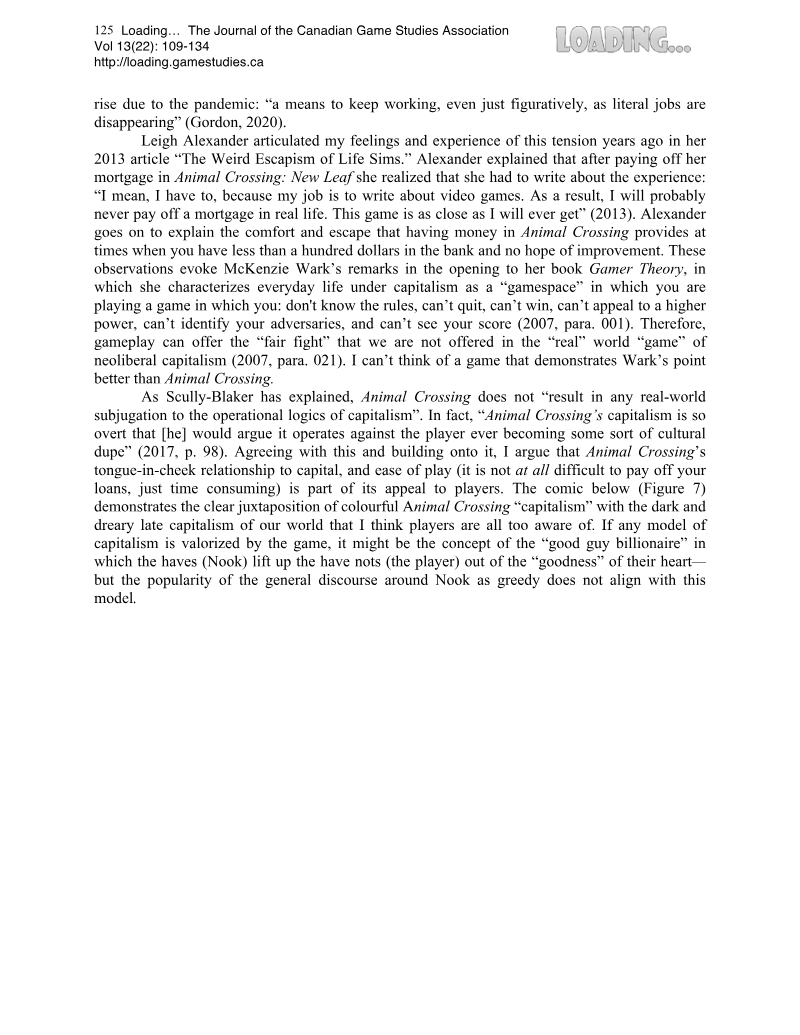
- 05Despite the game's seemingly light-hearted aesthetic, it presents social interaction as an uncontrollable and demanding endeavor, challenging the neoliberal celebration of individualism by highlighting the inherent difficulties of community building.See it on page 8
- 06The game maintains a morally ambiguous stance, neither forcing players to participate in its consumerist systems nor providing a clear path to success, thereby forcing players to reflect on their own social agency.See it on page 14
Ask AI about this report
Summary
Animal Crossing: New Leaf functions as a critical simulation of the social isolation and economic precarity defining 21st-century Japan. By framing the game as a response to the country’s burgeoning relationless society, the analysis posits that the title operates as both a community-building sandbox and a dystopian critique of neoliberal consumerism. The core thesis suggests that the game’s mechanics—specifically its debt-driven economy and materialist focus—force players to confront the inherent tensions between individual agency and the restrictive structures of a capitalist framework.
The game employs procedural rhetoric and affective design to mirror the anxieties of post-bubble Japanese life. Through the strategic use of futile interaction and blind agency, the experience intentionally limits player control, utilizing techniques often associated with the horror genre to simulate the unpredictability and powerlessness of real-world interpersonal relationships. These design choices challenge the neoliberal ideal of the autonomous individual, instead highlighting the difficulty of fostering genuine connections within a rigid, formulaic social environment.
Ultimately, the franchise serves as a pedagogical tool that encourages players to interrogate their own ethical roles within both virtual and real-world contexts. Rather than imposing a singular ideological conclusion, the game provides an ambiguous, open-ended space that reflects the existential realities of modern society. By navigating these simulated challenges, players are prompted to reflect on the complexities of community and the limitations of agency in an era defined by systemic isolation and economic instability.