1 free read left. Create a free account for unlimited reading + AI research.
Create free accountWhitepaper Ludic Language Pedagogy
1 free read left. Create a free account for unlimited reading + AI research.
Create free accountWhitepaperLudic Language Pedagogy
The game functions as a digital commons, enabling university students in Japan and the UK to bridge geographical divides.
Key Function. Animal Crossing: New Horizons enables university students in Japan and the UK to bridge geographical divides and engage in cross-cultural dialogue.
Animal Crossing: New Horizons serves as a vital pedagogical platform for fostering cross-cultural dialogue and environmental awareness among university students in Japan and the United Kingdom. By utilizing the game as a convivial tool, the project addresses the erasure of place often inherent in globalized digital environments, particularly during the isolation necessitated by the COVID-19 pandemic. The central thesis posits that virtual spaces can function as a digital commons, enabling participants to bridge significant geographical divides while critically examining their personal ecosophies and local environmental realities.
The study demonstrates that collaborative play and the establishment of shared in-game policies facilitate deep reflection on complex topics such as sustainability, property rights, and community ethics. Through the integration of game-based activity with critical discourse analysis, students successfully articulated their individual philosophies regarding ecological values. These findings suggest that virtual environments provide a unique, low-stakes setting for students to engage with real-world social and environmental challenges, transforming the game from a mere leisure activity into a structured space for academic and ethical inquiry.
Ultimately, the project concludes that the efficacy of such digital initiatives relies heavily on the alignment of pedagogical goals and the active facilitation of dialogue by educators. Despite logistical and technical hurdles, the use of interactive digital spaces proves to be a robust method for promoting international collaboration and critical thinking. By grounding these virtual interactions in the context of local identity and environmental conservation, the research highlights a scalable model for future educational practices that seek to harmonize global connectivity with a nuanced understanding of local place-based ethics.
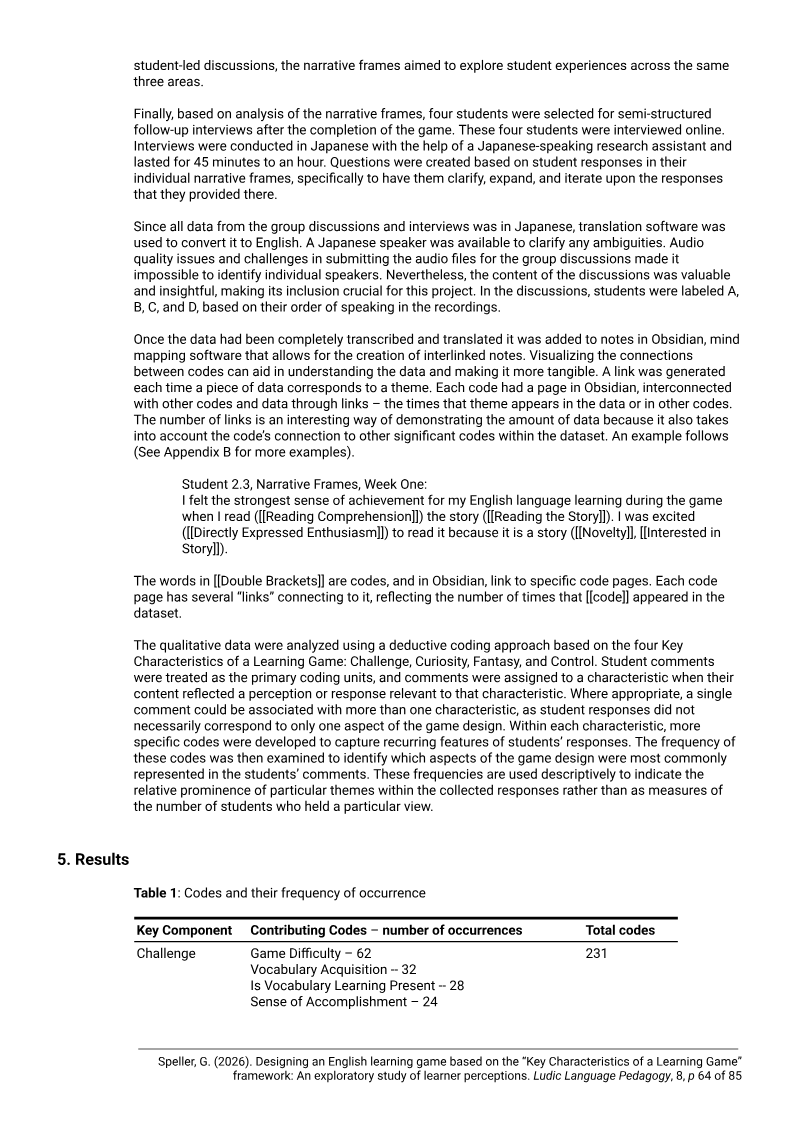
Each row is a game or company this document names, each column a document, oldest first. A mark means that document names it. Select a row to see those documents.
Ludic Language Pedagogy · 2026
Ludic Language Pedagogy · 2026
Ludic Language Pedagogy · 2026
Ludic Language Pedagogy · 2026
Ludic Language Pedagogy · 2026
Ludic Language Pedagogy · 2026
Ludic Language Pedagogy · 2026
Ludic Language Pedagogy · 2026
Ludic Language Pedagogy · 2026
Ludic Language Pedagogy · 2026
Ludic Language Pedagogy · 2026



Ludic Language Pedagogy · 2026
International Journal of Role-Playing · 2026