Key insights
5 slides
Market Concentration
Two titles account for nearly half of all esports viewership.
League of Legends and Counter-Strike together generated nearly 45% of the total 2.7 billion hours watched.
Page 7 of the report45%
Share of total hours watched by League of Legends and Counter-Strike.
- Total hours watched
- 2.7 billion
- Tracked events
- 2,000
Platform Dominance
Twitch and YouTube Gaming hold a significant majority of the esports viewership market.
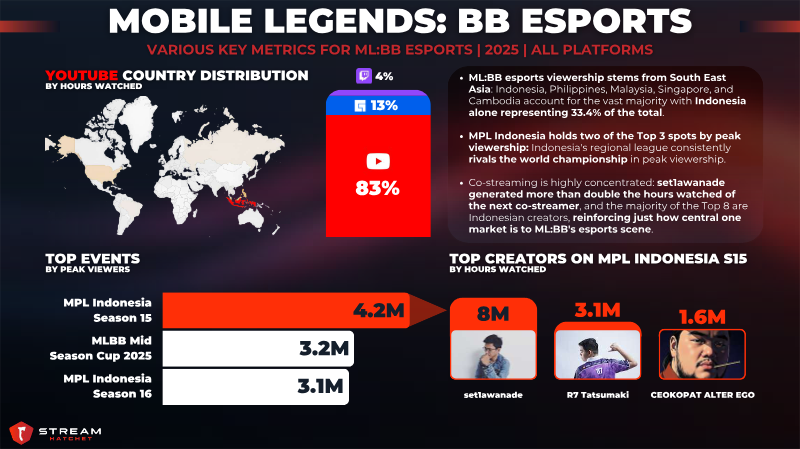
Mobile esports tournaments achieve higher average viewership per event.
Platform Share. Twitch and YouTube Gaming maintain a combined 84.1% market share of total viewership.
Page 6 of the report84.1%
Combined market share of Twitch and YouTube Gaming in total esports viewership.
New Engagement
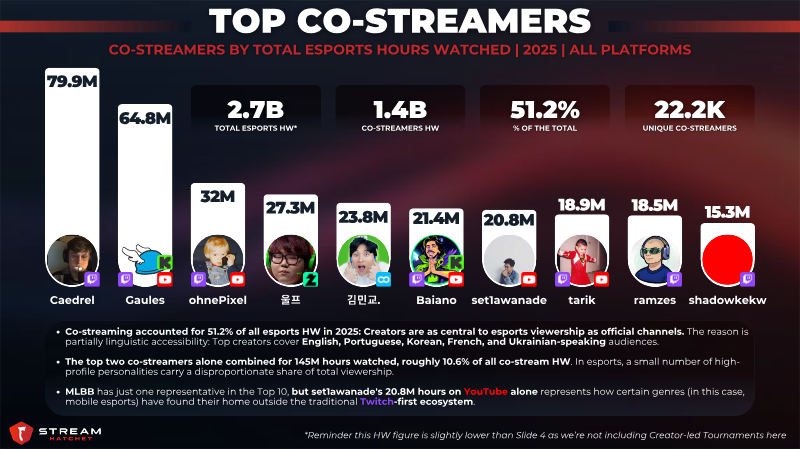
Co-streaming has become the primary method for esports viewership.
This model now accounts for 51.2% of all esports hours watched.
Think of it like watching a sports game with a friend who's also a commentator, adding their own unique perspective.
Brand Impact
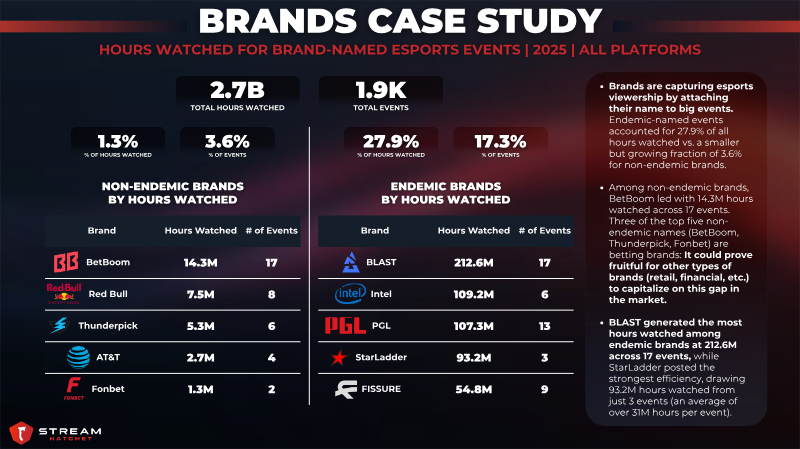
Brand-headlined tournaments contribute significantly to total esports viewership.
These tournaments generated 29.2% of total hours watched. Non-endemic companies, particularly in betting, are increasing their market share.
Growth Drivers
Future industry growth relies on data-driven engagement and regional league structures.
These strategies are key for sustained growth and audience retention.
1 / 5
Ask AI about this report