1 free read left. Create a free account for unlimited reading + AI research.
Create free accountWhitepaper DiGRA
1 free read left. Create a free account for unlimited reading + AI research.
Create free accountWhitepaperDiGRA
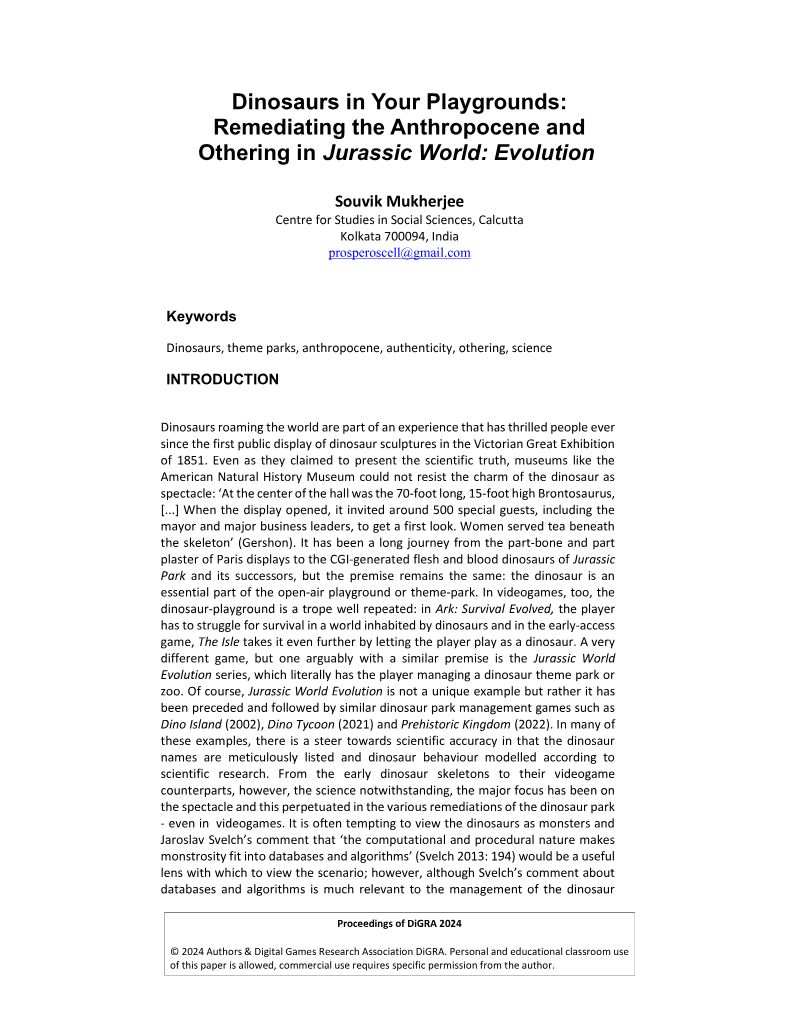
The paper examines how dinosaurs are represented in theme-park and playground contexts, using Jurassic World: Evolution as its central case.
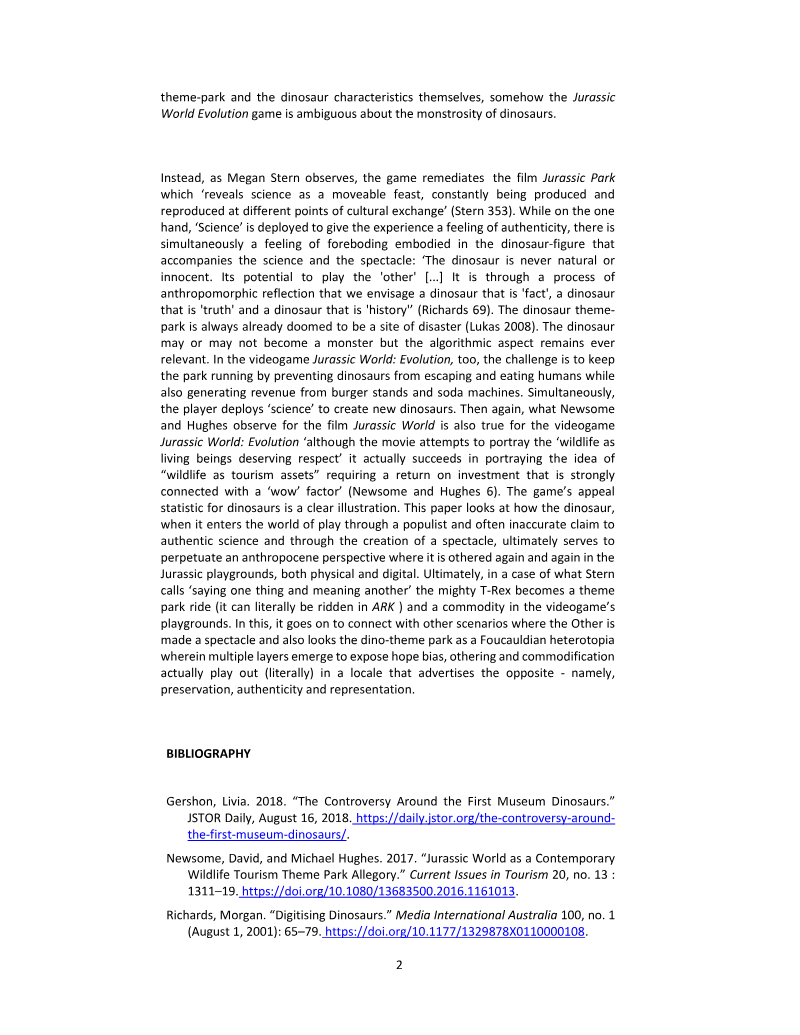
This paper, presented at DiGRA 2024, examines how dinosaurs are represented in theme-park and playground contexts, using Frontier Developments' Jurassic World: Evolution as its central case. Its core argument is that the dinosaur, though framed through a claim to scientific authenticity and spectacle, ultimately perpetuates an Anthropocene perspective in which the animal is repeatedly "othered" across physical and digital playgrounds. Tracing a lineage from nineteenth-century museum displays such as the American Natural History Museum's Brontosaurus exhibit through Jurassic Park and its successors, the author situates the videogame within a broader tradition of dinosaur-as-spectacle that persists even where scientific accuracy is nominally pursued.
The analysis draws on theoretical frameworks from Svelch on the procedural control of monstrosity, Stern on science as a "moveable feast," and Richards on the dinosaur as a constructed "fact" and "other." The author argues that the game's management mechanics, which involve containing escaped dinosaurs while generating revenue from concessions and designing new species, mirror the algorithmic logic that governs monstrosity. A key finding is that Jurassic World: Evolution remains ambiguous about whether dinosaurs are monsters, while simultaneously reducing them to "wildlife as tourism assets" whose value depends on a "wow" factor, a conclusion the author draws from comparisons with Newsome and Hughes's study of the film.
The scope of the paper is primarily textual and conceptual rather than empirical. It does not report survey data, sample sizes, or quantitative game analytics, though it references the game's appeal statistics for dinosaurs in passing. Its scope spans the Victorian period to the present, and it considers a range of comparable titles, including Ark: Survival Evolved, The Isle, Dino Island, Dino Tycoon, and Prehistoric Kingdom. The paper concludes by characterizing the dino-theme park as a Foucauldian heterotopia in which hope bias, othering, and commodification unfold beneath a rhetoric of preservation, authenticity, and representation.
DiGRA · 2026
DiGRA · 2026