1 free read left. Create a free account for unlimited reading + AI research.
Create free accountWhitepaper European Conference on Games Based Learning (ECGBL)
1 free read left. Create a free account for unlimited reading + AI research.
Create free accountWhitepaperEuropean Conference on Games Based Learning (ECGBL)
The paper identifies a gap in the design of SEL games for Indian children.
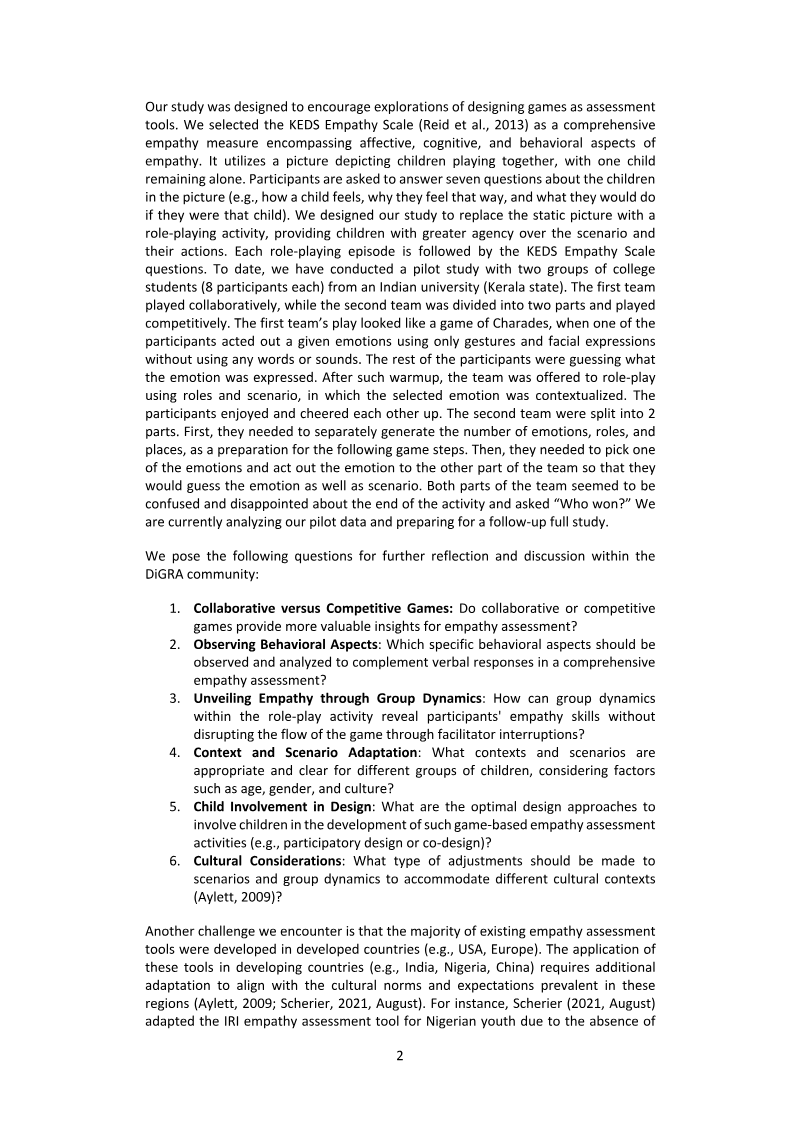
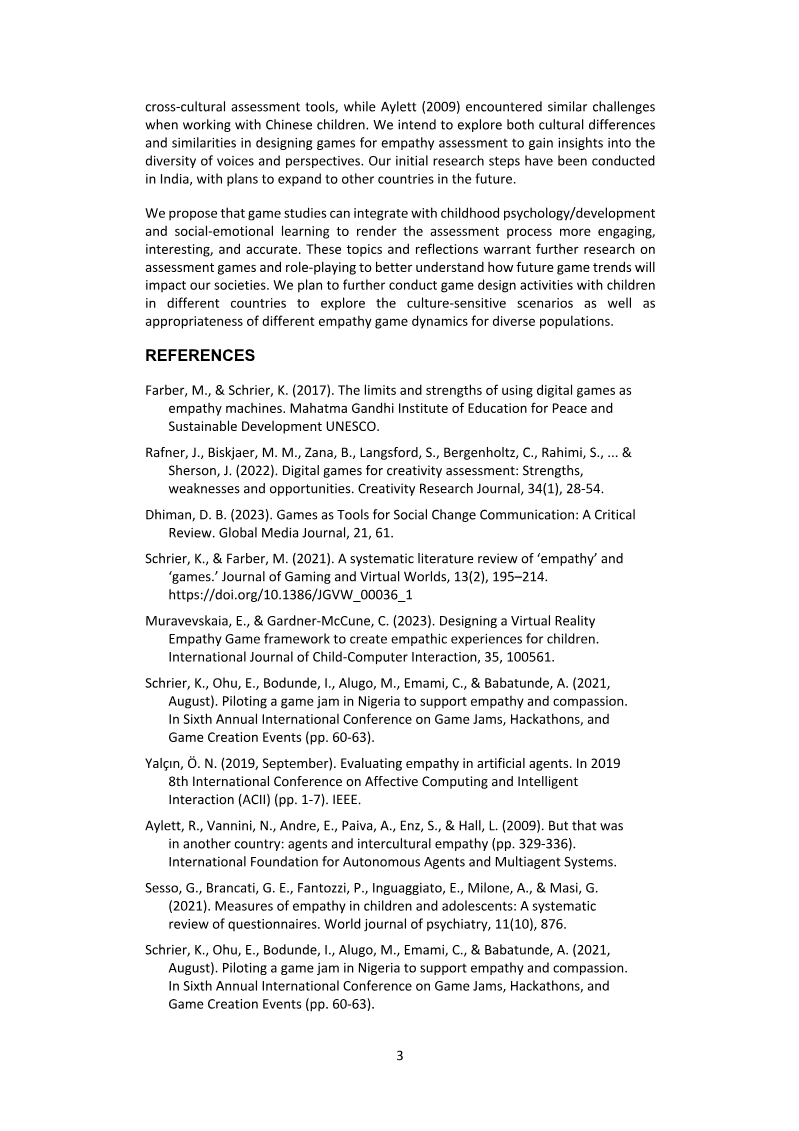
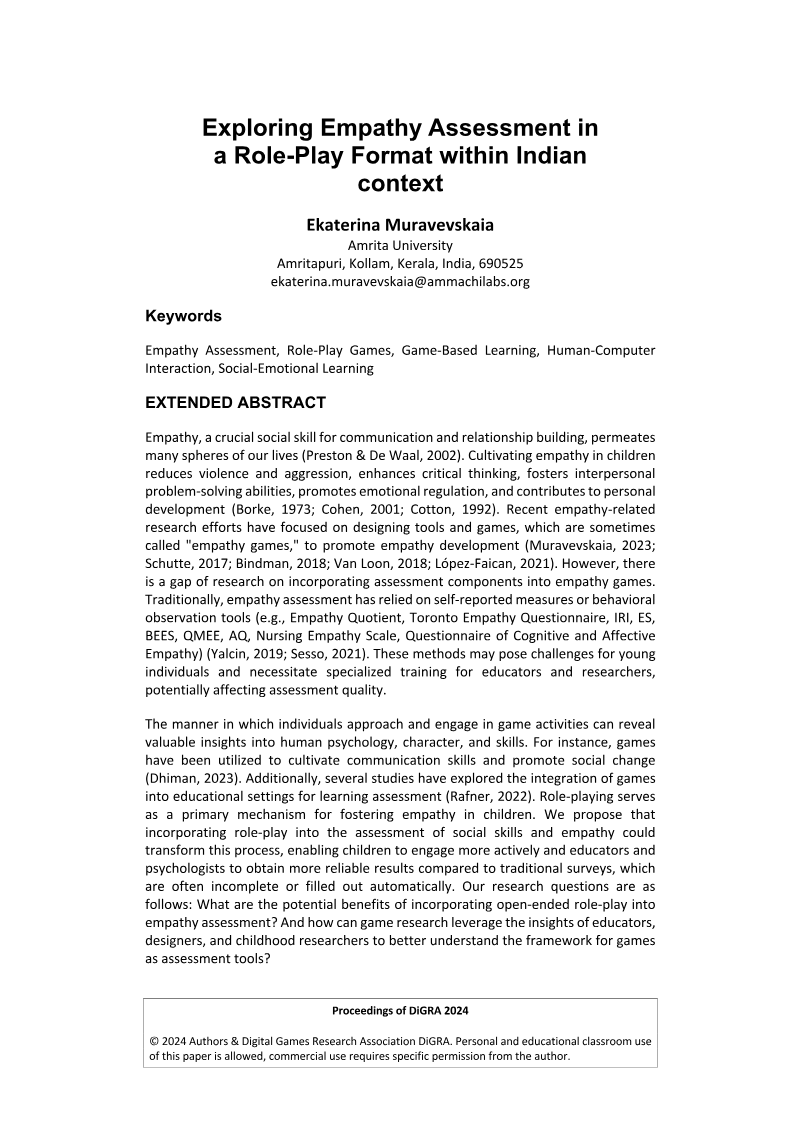
This paper addresses a gap in the design of social-emotional learning (SEL) games for Indian children, an area that has received little research attention. The authors adapt the Integrated Design Framework for Playful Learning (IDFPL), which considers cognitive, affective, and socio-cultural dimensions of learning, to create a non-digital role-play activity built around charades. The activity was designed to help children express and recognize emotions and was informed by the Kids Empathy Development Scale. The work asks how affective and socio-cultural elements of role-play can support SEL for Indian youth and how the IDFPL can be applied in rural Indian settings.
The study's evidence comes from two pilot tests conducted with six master's students and ten lab professionals facilitating roughly 80 rural Indian children across four 45-minute sessions. The activity moved through icebreakers, emotional charades, and team role-play, with audience members guessing the emotions and scenarios being performed. Observations indicated positive outcomes in relatedness, observational learning, goal orientation, motivation, interest, and self-esteem, with children responding well to familiar play patterns and progressively harder challenges. The pilots are described as preliminary, and the authors note that the findings are observational rather than the product of formal measurement.
Several challenges emerged that shaped the design implications. Hierarchical dynamics between children and adults limited peer-to-peer feedback, collaboration, and learner agency, as children tended to follow facilitator directions and communicate primarily through the facilitator. The authors attribute these patterns partly to cultural and school norms that centre the teacher over peers. Based on these results, they recommend culturally sensitive facilitation, gradual transfer of control to learners, and reliance on observational learning and social reinforcement. The authors plan further mixed-methods research, digital adaptations of the game, and the development of an SEL framework tailored to the Indian context.
European Conference on Games Based Learning (ECGBL) · 2025
European Conference on Games Based Learning (ECGBL) · 2025
European Conference on Games Based Learning (ECGBL) · 2025
European Conference on Games Based Learning (ECGBL) · 2025
European Conference on Games Based Learning (ECGBL) · 2025
European Conference on Games Based Learning (ECGBL) · 2025
European Conference on Games Based Learning (ECGBL) · 2025
European Conference on Games Based Learning (ECGBL) · 2025
European Conference on Games Based Learning (ECGBL) · 2025
European Conference on Games Based Learning (ECGBL) · 2025
European Conference on Games Based Learning (ECGBL) · 2025
European Conference on Games Based Learning (ECGBL) · 2025
European Conference on Games Based Learning (ECGBL) · 2025