1 free read left. Create a free account for unlimited reading + AI research.
Create free accountWhitepaper DiGRA
1 free read left. Create a free account for unlimited reading + AI research.
Create free accountWhitepaperDiGRA
The Central Energy Trust Wildbase Recovery Centre sits within a Massey University veterinary hospital in Wellington, New Zealand.
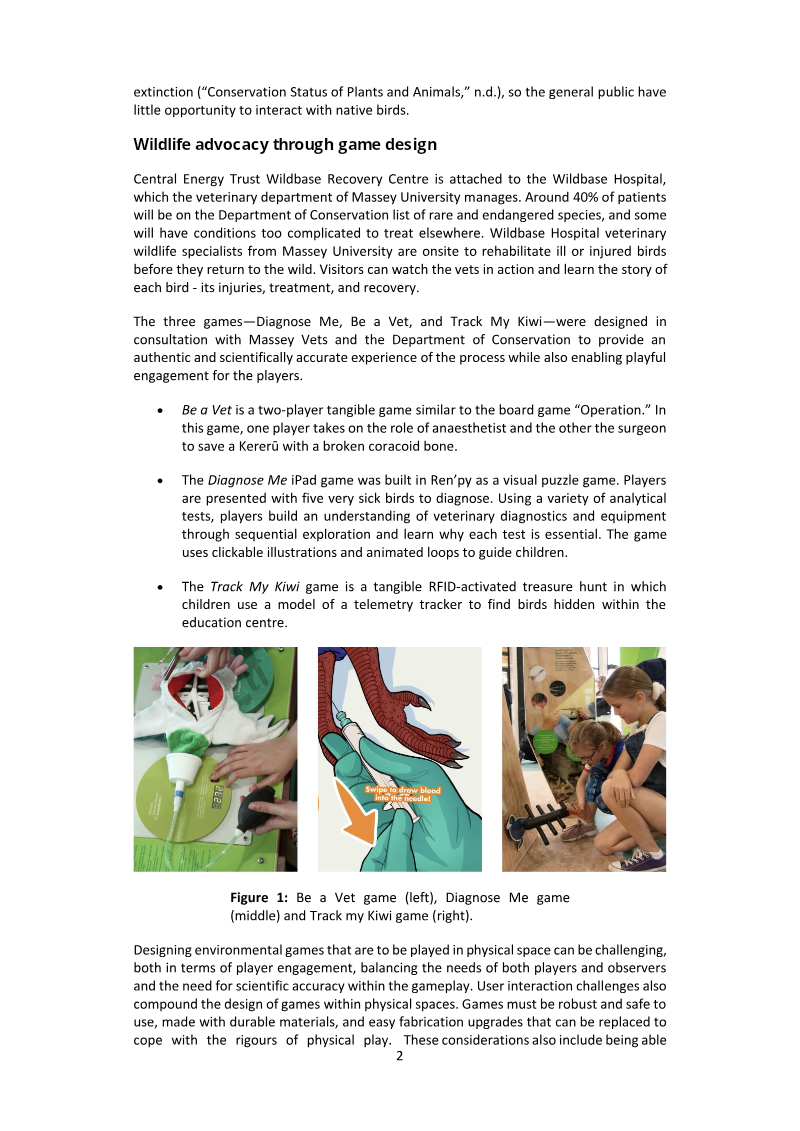
This paper presents the design of three game experiences for children at the Central Energy Trust Wildbase Recovery Centre in Wellington, New Zealand, a facility attached to a Massey University veterinary hospital that rehabilitates injured and ill native birds. The games, Be a Vet, Diagnose Me, and Track My Kiwi, combine tangible, digital, and hybrid elements to teach children about bird health, veterinary practice, rehabilitation, and conservation, with the aim of encouraging wildlife advocacy and stewardship of native taonga. The work is grounded in the premise that games in museums and experience spaces can give visitors agency over complex information, and that children are especially motivated when learning occurs through meaningful, experiential activity.
The design approach was developed in consultation with Massey University veterinarians and the Department of Conservation to ensure scientific accuracy alongside playful engagement. Be a Vet is a two-player tangible game modeled on the board game Operation, in which players take on anaesthetist and surgeon roles to repair a Kererū's broken coracoid bone. Diagnose Me is a visual iPad puzzle in which players work through five sick birds using sequential diagnostic tests, while Track My Kiwi is an RFID-based treasure hunt using a telemetry tracker model. The authors identify practical challenges specific to physical play, including durability, safety, balancing the experience of players and observers, and maintaining scientific fidelity within simple mechanics.
Reported visitor figures from the first six months indicate roughly 42,000 visitors, around 250 per day, and 45 school groups totalling 2,119 young people. The Kererū surgery game was the most popular exhibit and sustained consistent engagement despite notable wear. The conclusions emphasise establishing sound scientific foundations before designing mechanics, keeping games short with one or two learnable steps and immediate feedback, and avoiding overly serious framing so that children form positive memories that support later understanding of conservation work. The paper notes that further learning material prompting children to reflect on their experience could strengthen the educational outcomes.

DiGRA · 2026

DiGRA · 2026



DiGRA · 2026



DiGRA · 2026



DiGRA · 2026



DiGRA · 2026



DiGRA · 2026



DiGRA · 2026

DiGRA · 2026



DiGRA · 2026



DiGRA · 2026

DiGRA · 2026
DiGRA · 2020