1 free read left. Create a free account for unlimited reading + AI research.
Create free accountFinancial report Capcom
1 free read left. Create a free account for unlimited reading + AI research.
Create free accountFinancial reportCapcom
Distilling the key insights…
Capcom’s 2008 fiscal year marked a significant milestone, celebrating the company’s 25th anniversary with robust financial performance. Net sales rose 11.5% to 83.1 billion yen, while operating income surged 36.6% to 13.1 billion yen. This growth was primarily fueled by the home video game segment, where high-performing titles such as Devil May Cry 4 and Monster Hunter Freedom 2G significantly exceeded projections. These results validated the company’s long-term structural reforms, which prioritized multi-platform development and the "Single Content, Multiple Usage" strategy, designed to maximize the value of intellectual property across mobile, arcade, and film media.
The company’s operational success relied heavily on the proprietary MT Framework, a development environment that streamlined cross-platform production and improved R&D efficiency. While the home console segment thrived, the company faced challenges in its domestic arcade operations, leading to a strategic pivot toward a "scrap and build" model to improve profitability. Simultaneously, Capcom aggressively expanded its global footprint, particularly in the North American mobile market, where it achieved a top-five publisher ranking. These efforts align with a broader goal to rebalance regional sales toward a 2:5:3 ratio between Japan, North America, and Europe.
Looking forward, the company remains committed to sustaining a 10% annual sales growth rate and a 15% operating profit ratio. Strategic priorities include strengthening internal development capacity through acquisitions, such as K2 CO., LTD., and navigating operational risks including rising development costs, software piracy, and the inherent volatility of hit-driven markets. By maintaining rigorous corporate governance, independent oversight, and a producer-led development structure, the company aims to balance creative innovation with the financial discipline necessary to navigate evolving hardware cycles and competitive global landscapes.
Capcom · 2026
Capcom · 2026


Capcom · 2026
Capcom · 2026
Capcom · 2026
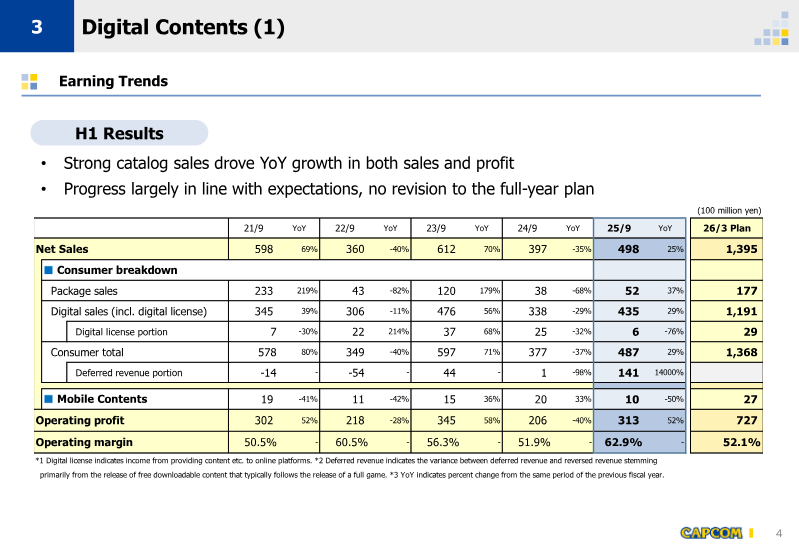
Capcom · 2025
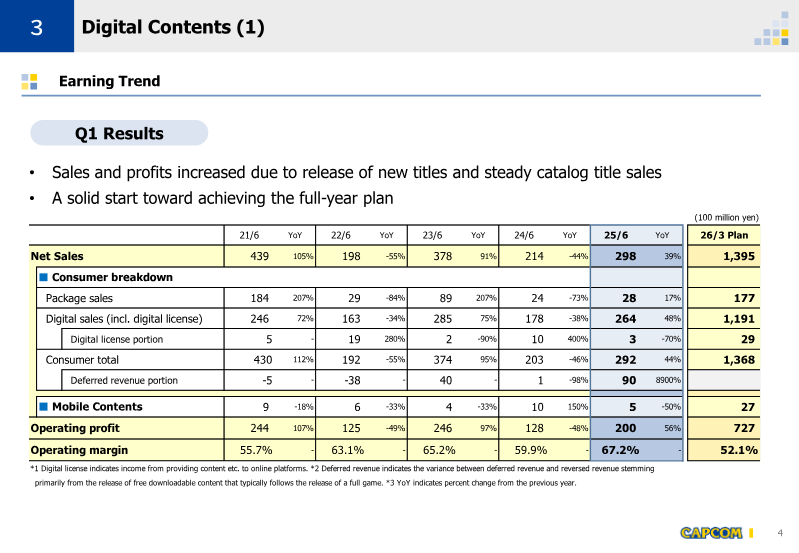
Capcom · 2025
Capcom · 2025
Capcom · 2025
Capcom · 2025
Capcom · 2025
Capcom · 2025
The Game Business · 2026