Updated Jun 1, 2026 by Capcom
Financial · May 12, 2026
Published by Capcom
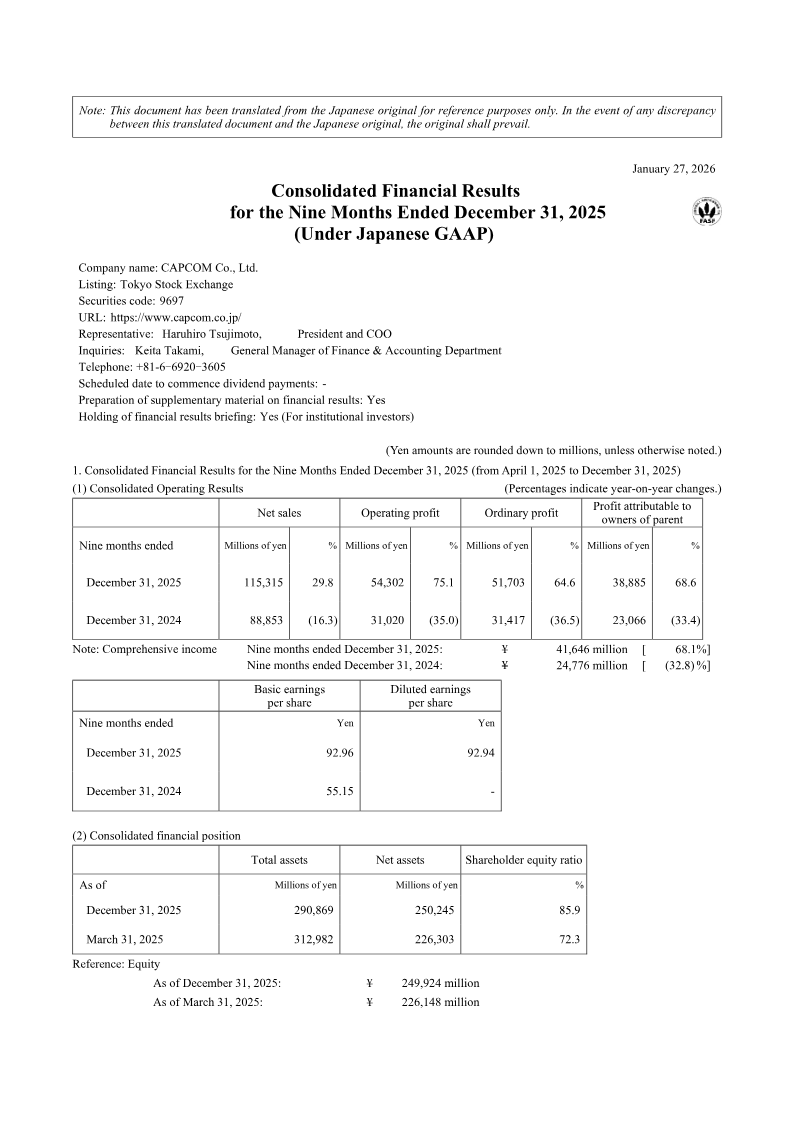
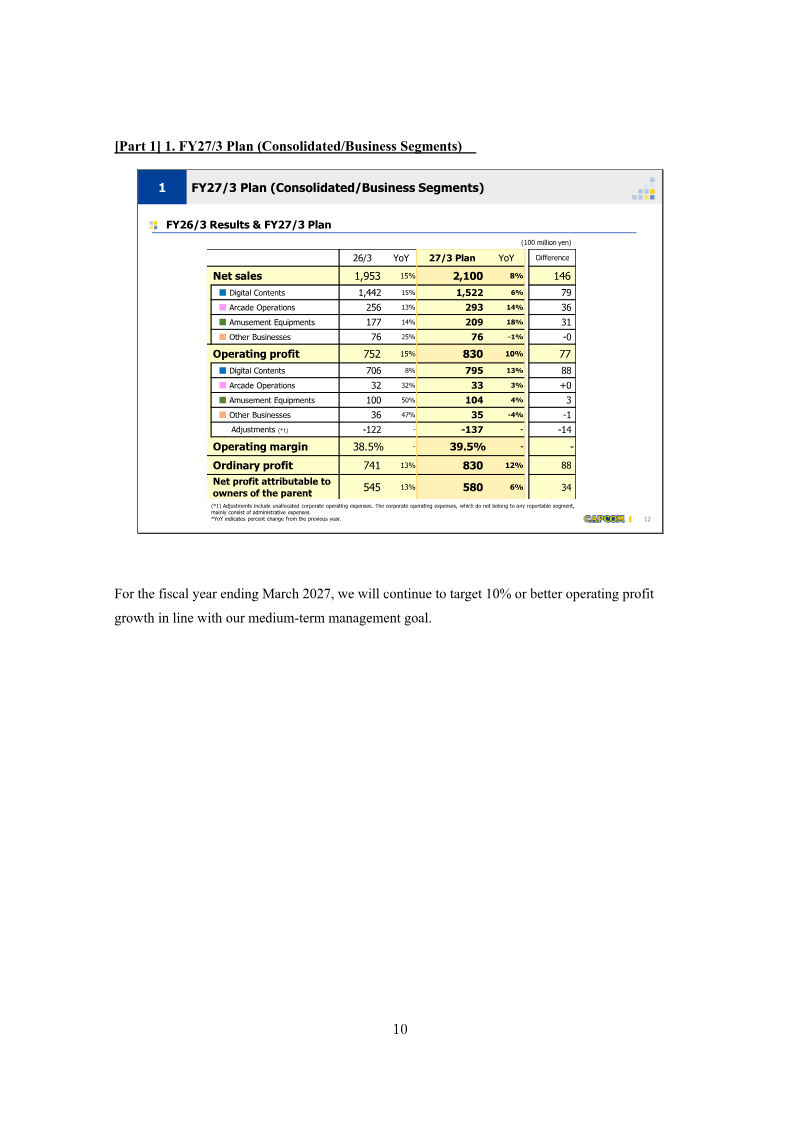
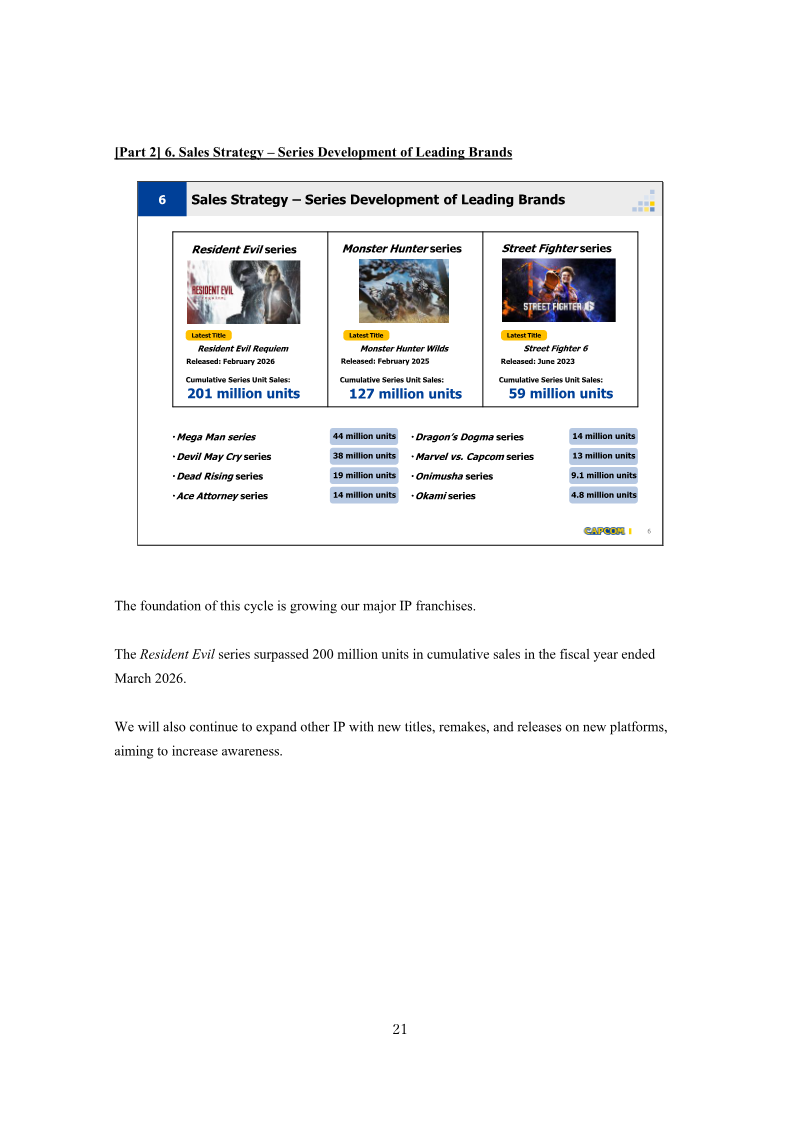
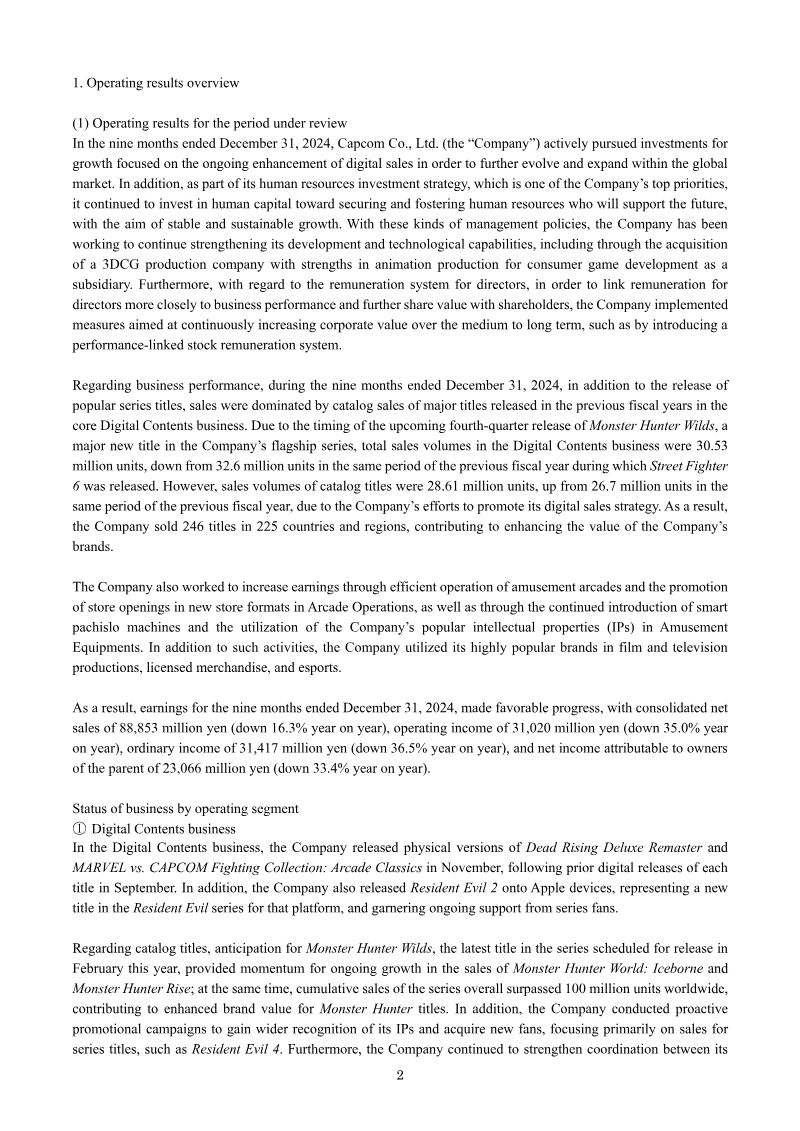
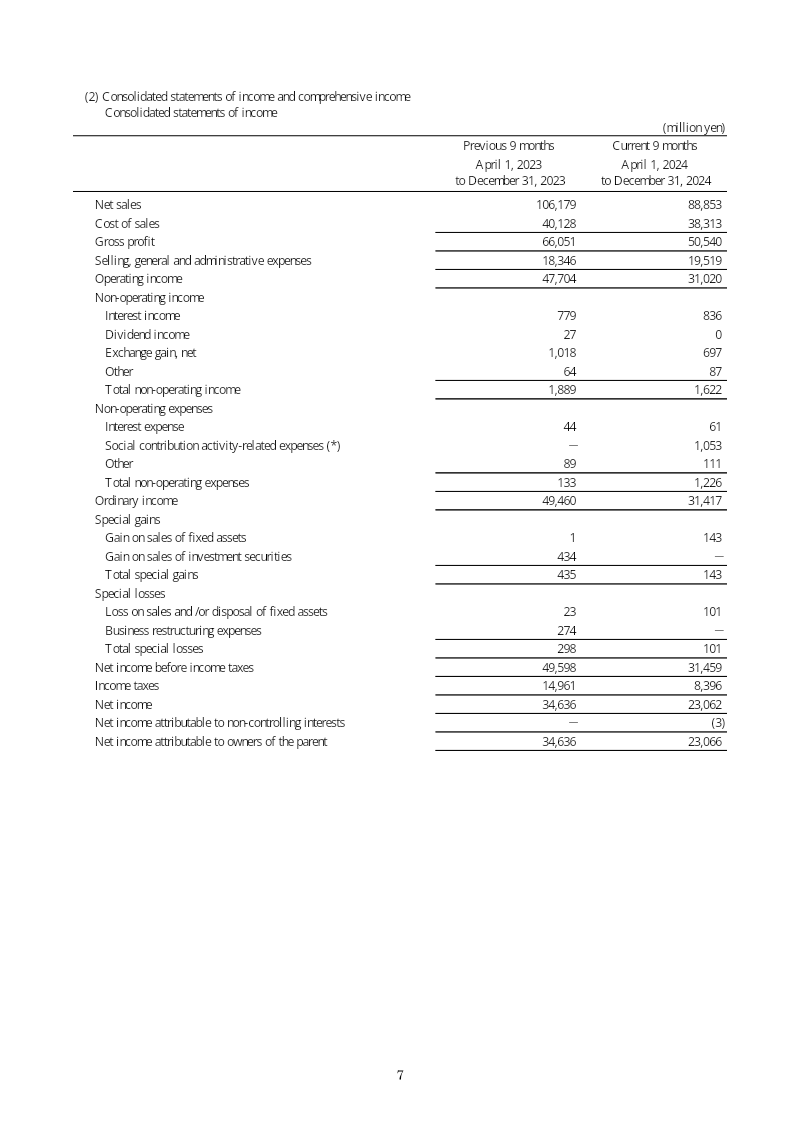
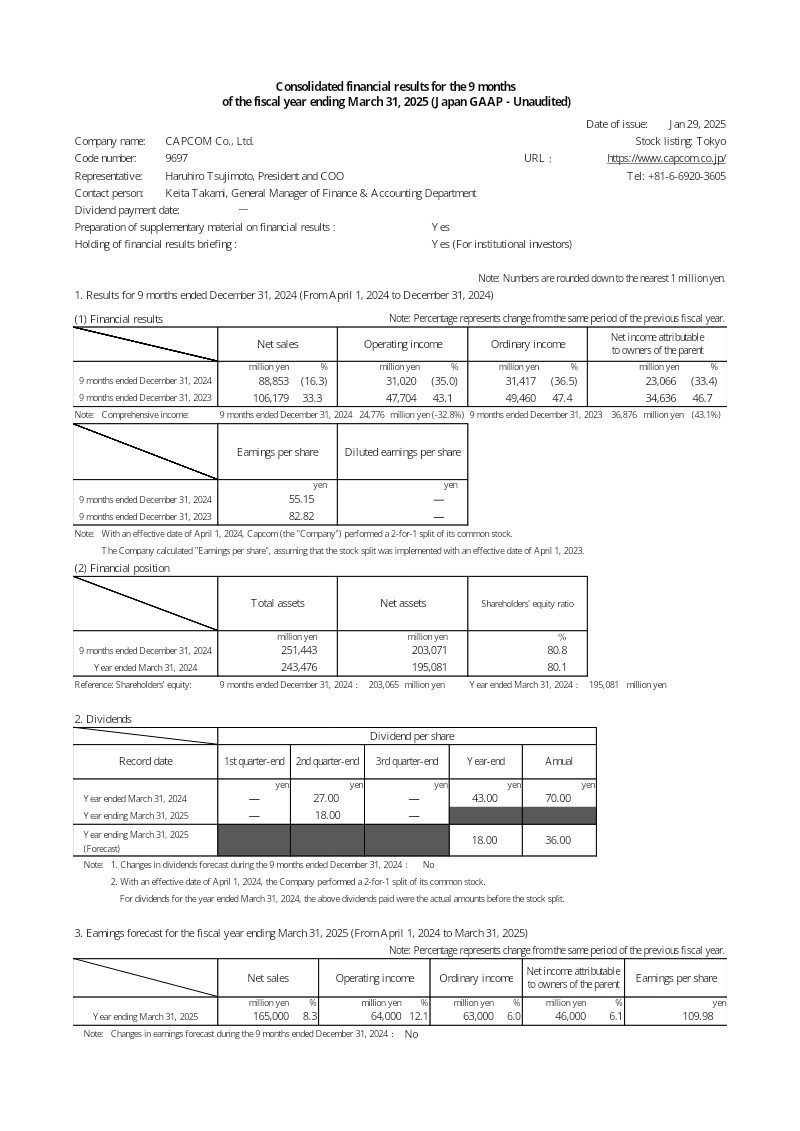
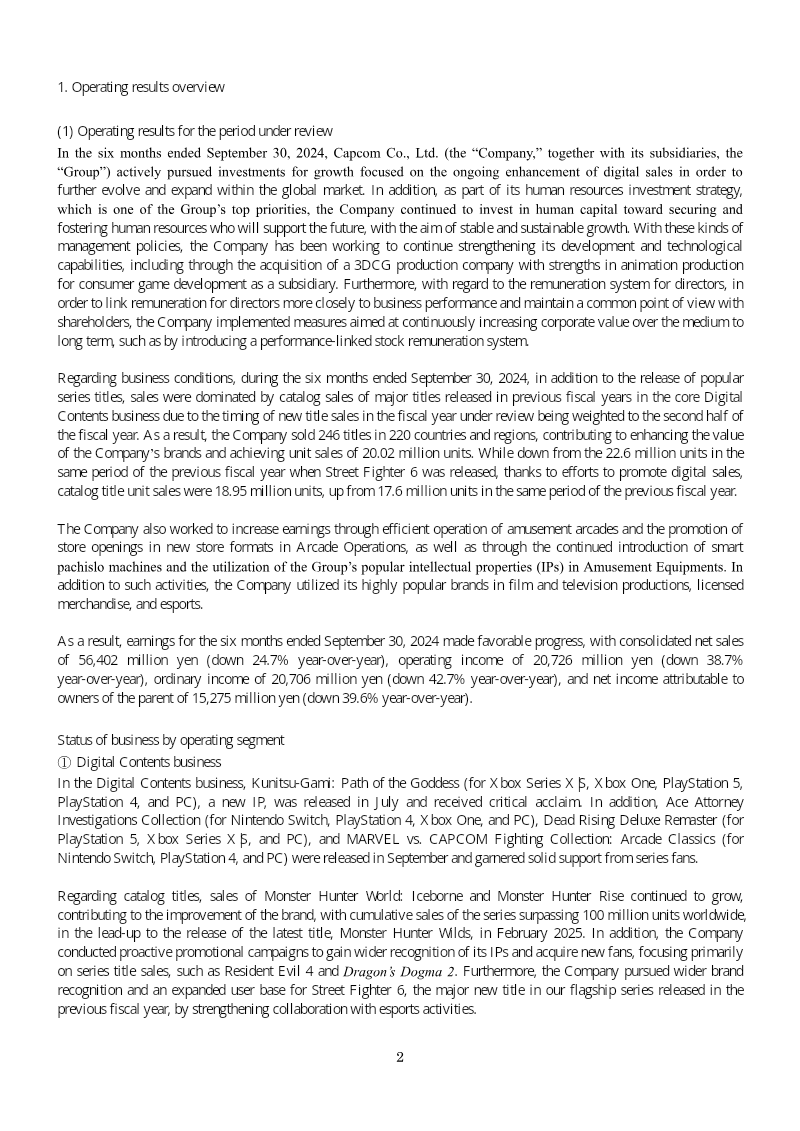
Capcom achieved a historic peak in FY26/3, reporting net sales of ¥1.95 billion and operating profit of ¥752 million—both up 15% year‑over‑year. The surge was driven by strong new‑title releases and catalog sales, particularly through digital channels, and marked the company’s highest cumulative unit sales at 5.9 million. Retail expansion reached 61 stores, including the first overseas Capcom Store in Taipei, underscoring a growing global footprint. Looking ahead to FY27/3, Capcom targets more than 10% operating‑profit growth and ¥2.1 billion in sales, underpinned by a steady pipeline of new IP launches such as *Pragma* and an expanded catalog strategy. The company plans to release one new machine per quarter, aiming for 53 000 units across four titles—including Biohazard RE:3 and Resident Evil 7—while projecting net sales of ¥209 million and operating profit of ¥104 million. A key focus is deepening IP monetisation through e‑sports, media tie‑ins, and mobile extensions, with an expected 18% year‑over‑year increase in pachislo volume and intensified expansion into emerging markets. The FY26/3 earnings report also highlights significant workforce growth, with an annual addition of over 100 developers and the integration of AI tools to enhance efficiency. Financially, net sales rose 14% YoY to ¥1,259 bn and operating profit increased 18% to ¥508 bn, while maintaining a strong cash position that balances shareholder returns, employee compensation, and reinvestment. Diversity metrics improved, with female core‑role representation at 15.7% and paternity leave utilization at 79.7%, reflecting a broader talent strategy aimed at sustaining long‑term innovation and market leadership.
CAPCOM Capcom Co., Ltd. (TSE Prime, 9697) FY26/3 Earnings Summary FY27/3 Plans Mid- to Long-Term Growth Strategies
Part 1 ・Major Takeaways P3 Financial ・Performance Trends (Consolidated/Business Segments) P4 Summary and Plan ・FY27/3 Plans (Consolidated/Business Segments) P12 Part 2 ・Capcom Group Management Philosophy and Vision P1 Mid- to Long- ・Group Management Goals P2 Term Growth Strategies ・A Business Model to Support Future Growth P5 ・Financial Position Summary P1 Supplement ・Major Financial Information Summary P2 Forward looking statements Strategies, plans, outlooks and other statements that are not historical facts are based on assumptions that use information currently available and reasonable judgments. Actual performance may be significantly different from these statements for a number of reasons. In the entertainment industry, which includes Capcom, performance may be highly volatile because of diverging user needs and other changes in market conditions. Factors that can affect Capcom’s performance include: (1) the number of hit titles and sales volume in the Home Video Game Business, which accounts for the majority of sales; (2) progress in developing home video games; (3) consumer demand for home video game consoles; (4) sales outside Japan; (5) changes in stock prices and exchange rates; (6) alliances with other companies concerning product development, sales and other operations; and (7) changes in market conditions; (8) natural disasters, disease outbreaks, economic crises and other
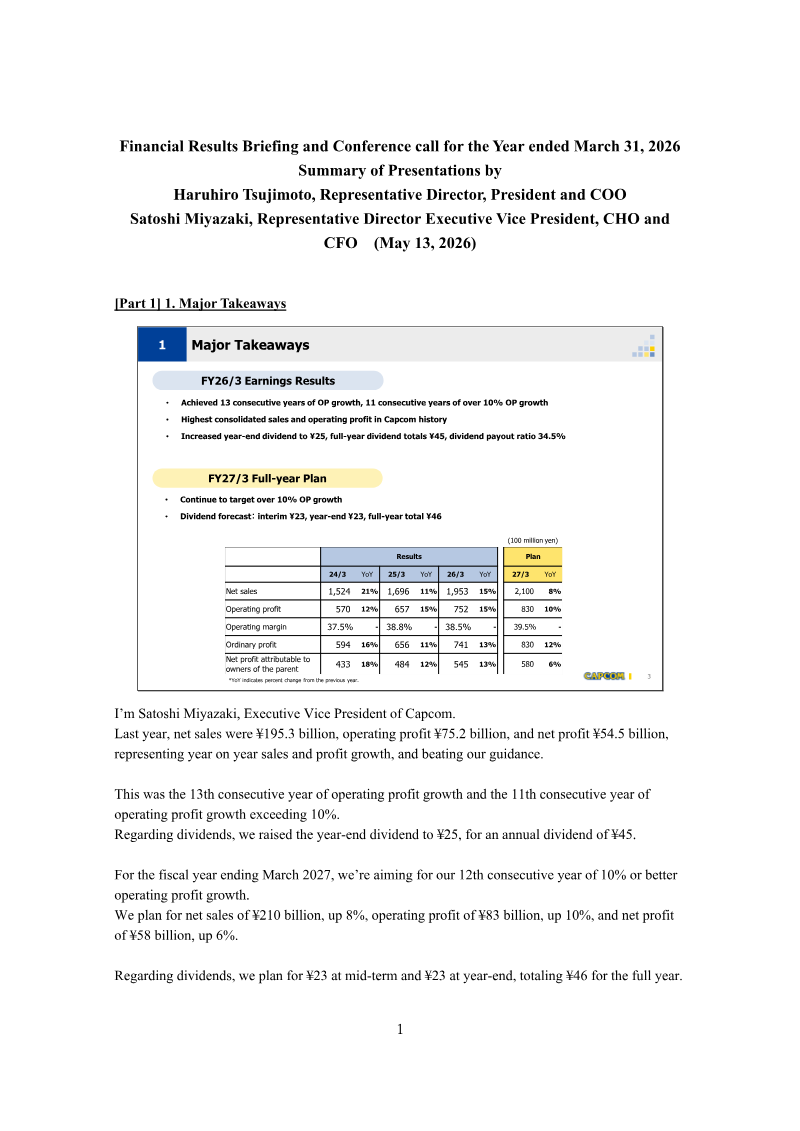
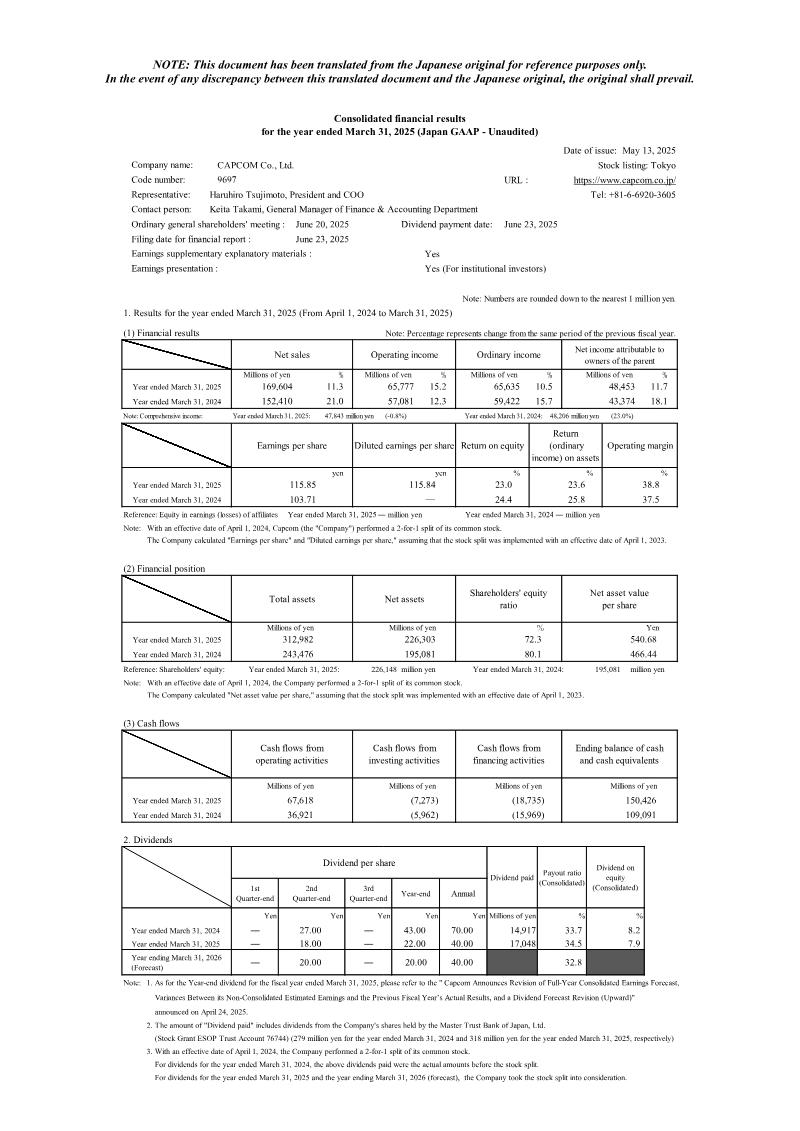
FY26/3 Earnings Results • Achieved 13 consecutive years of OP growth, 11 consecutive years of over 10% OP growth • Highest consolidated sales and operating profit in Capcom history • Increased year-end dividend to ¥25, full-year dividend totals ¥45, dividend payout ratio 34.5% FY27/3 Full-year Plan • Continue to target over 10% OP growth • Dividend forecast: interim ¥23, year-end ¥23, full-year total ¥46 (100 million yen) Results Plan 24/3 YoY 25/3 YoY 26/3 YoY 27/3 YoY Net sales 1,524 21% 1,696 11% 1,953 15% 2,100 8% Operating profit 570 12% 657 15% 752 15% 830 10% Operating margin 37.5% - 38.8% - 38.5% - 39.5% - Ordinary profit 594 16% 656 11% 741 13% 830 12% Net profit attributable to 433 18% 484 12% 545 13% 580 6% owners of the parent
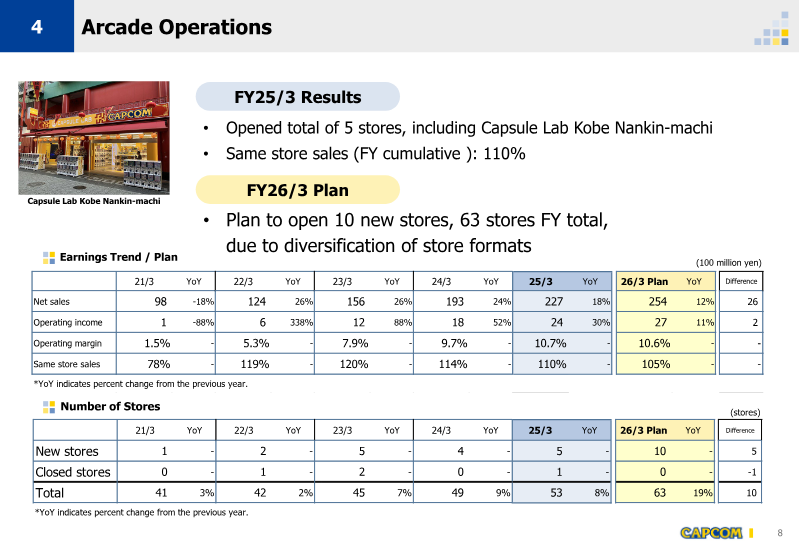
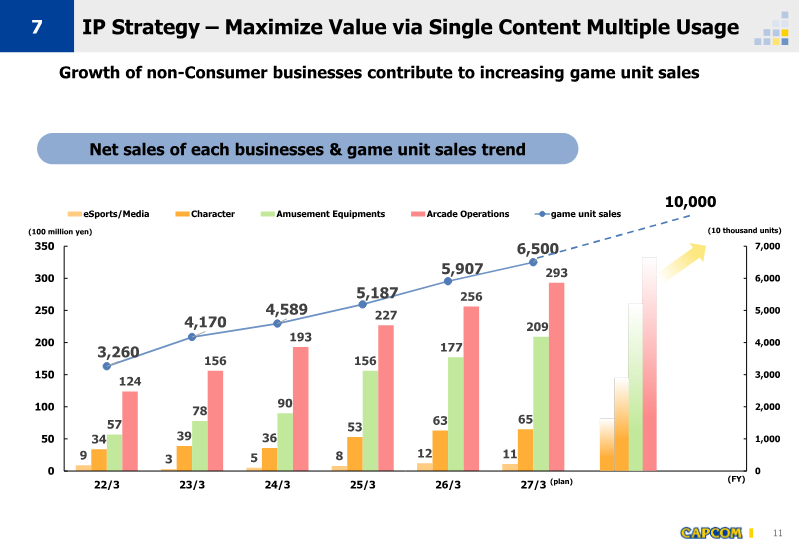
> **[Chart page]** This page contains visual data — view in PDF for the best experience. FY26/3 Results (100 million yen) 22/3 YoY 23/3 YoY 24/3 YoY 25/3 YoY 26/3 YoY Net sales 1,100 16% 1,259 14% 1,524 21% 1,696 11% 1,953 15% ■ Digital Contents 875 16% 981 12% 1,198 22% 1,251 4% 1,442 15% ■ Arcade Operations 124 26% 156 26% 193 24% 227 18% 256 13% ■ Amusement Equipments 57 -19% 78 36% 90 16% 156 73% 177 14% ■ Other Businesses 43 43% 43 0% 42 -4% 61 45% 76 25% Operating profit 429 24% 508 18% 570 12% 657 15% 752 15% ■ Digital Contents 453 23% 535 18% 598 12% 651 9% 706 8% ■ Arcade Operations 6 338% 12 88% 18 52% 24 30% 32 32% ■ Amusement Equipments 23 -3% 34 46% 41 20% 67 63% 100 50% ■ Other Businesses 15 54% 14 -6% 8 -38% 24 181% 36 47% Adjustments (*1) -69 - -87 - -96 - -110 - -122 - Operating margin 39.0% - 40.3% - 37.5% - 38.8% - 38.5% - Ordinary profit 443 27% 513 16% 594 16% 656 11% 741 13% Net profit attributable to 325 31% 367 13% 433 18% 484 12% 545 13% owners of the parent (*1) Adjustments include unallocated corporate operating expenses. The corporate operating expenses, which do not belong to any reportable segment, mainly consist of administrative expenses. *YoY indicates percent change from the previous year.
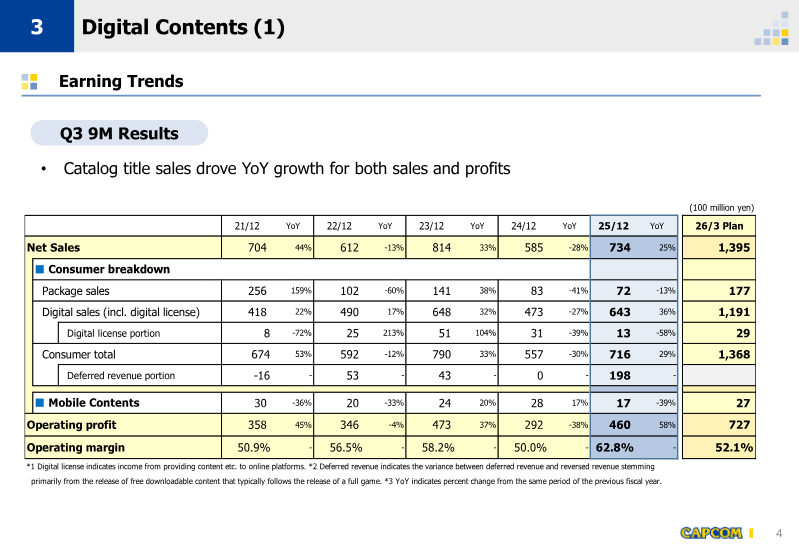
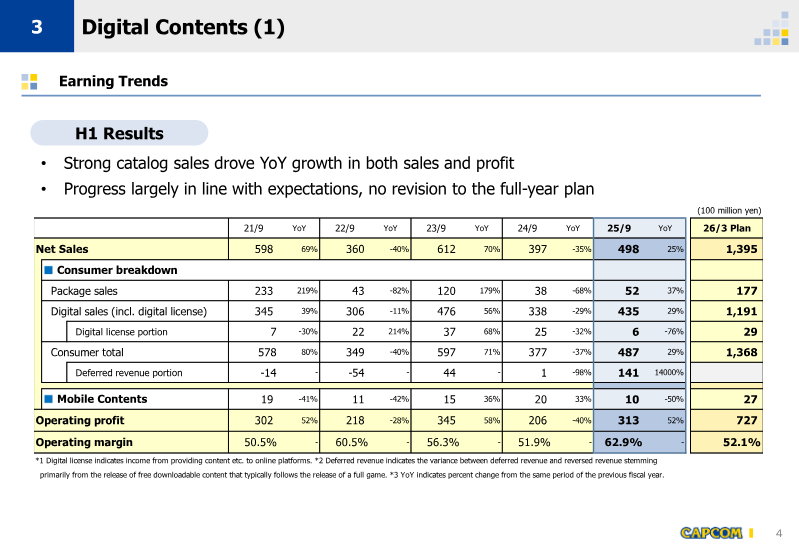
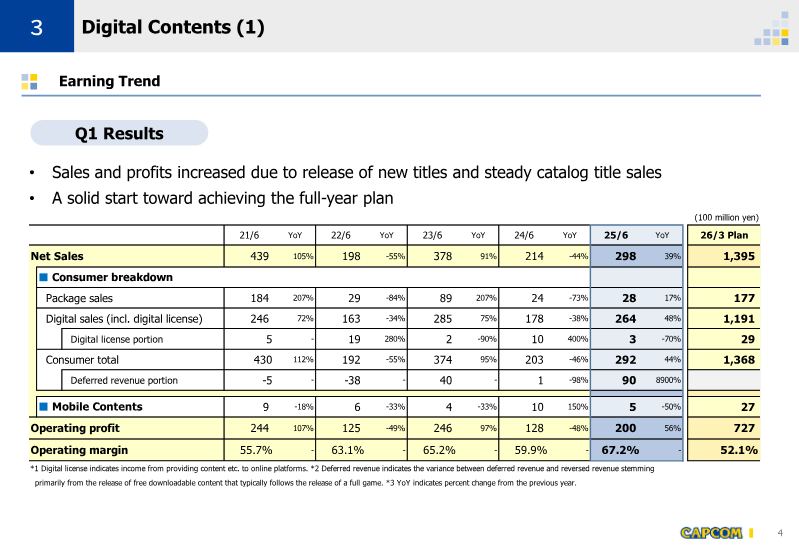
> **[Chart page]** This page contains visual data — view in PDF for the best experience. Earnings Trend FY26/3 Results • Sales and profits up, supported by flywheel effect of new title releases and catalog title expansion (100 million yen) 22/3 YoY 23/3 YoY 24/3 YoY 25/3 YoY 26/3 YoY Net Sales 875 16% 981 12% 1,198 22% 1,251 4% 1,442 15% ■ Consumer breakdown Package sales 300 44% 180 -40% 193 7% 180 -7% 162 -10% Digital sales (incl. digital license) 533 11% 773 45% 969 25% 1,036 7% 1,256 21% Digital license portion (*1) 9 -70% 70 678% 73 4% 34 -53% 36 6% Consumer total 833 21% 953 14% 1,162 22% 1,216 5% 1,419 17% Deferred revenue portion (*2) -19 - 38 - 47 - -198 - 123 - ■ Mobile Contents 42 -35% 28 -33% 35 25% 34 -3% 23 -32% Operating profit 453 23% 535 18% 598 12% 651 9% 706 8% Operating margin 51.8% - 54.5% - 49.9% - 52.1% - 48.9% - (*1) Digital license indicates revenue from providing content etc. to online platforms. (*2) Deferred revenue indicates the balance of deferred revenue and reversed revenue typically associated with free downloadable content made available after the release of a full game. *YoY indicates percent change from the previous year.
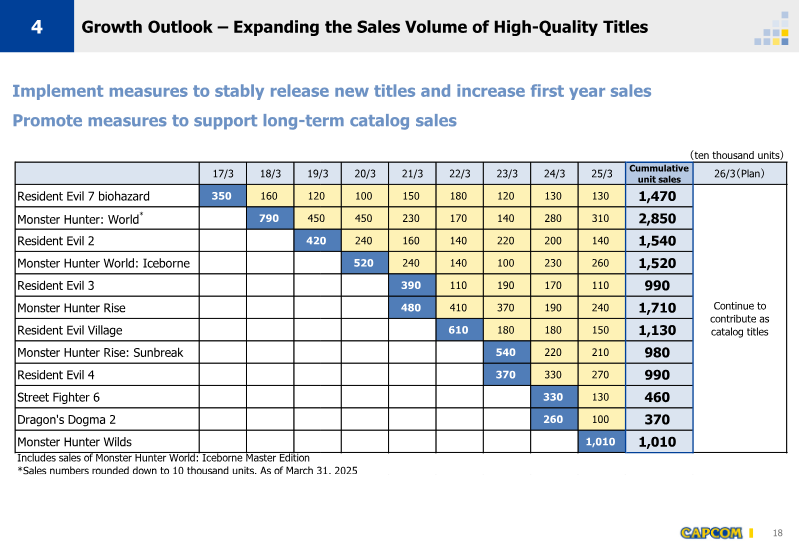
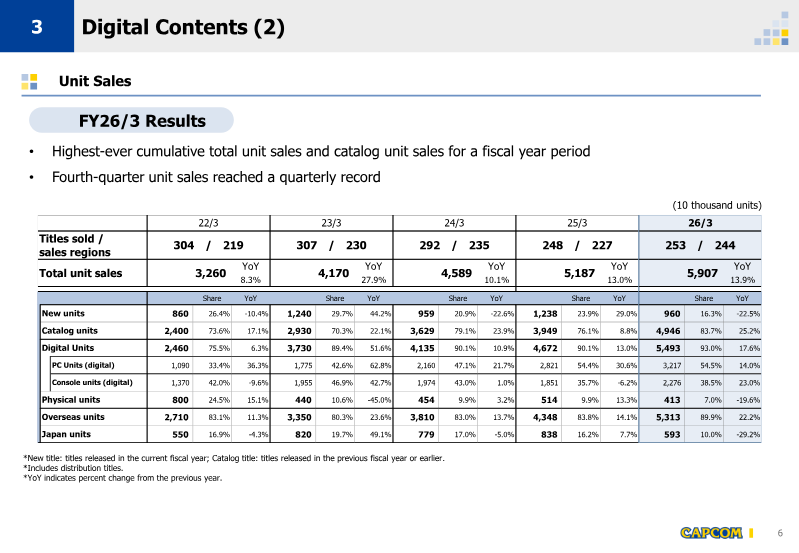
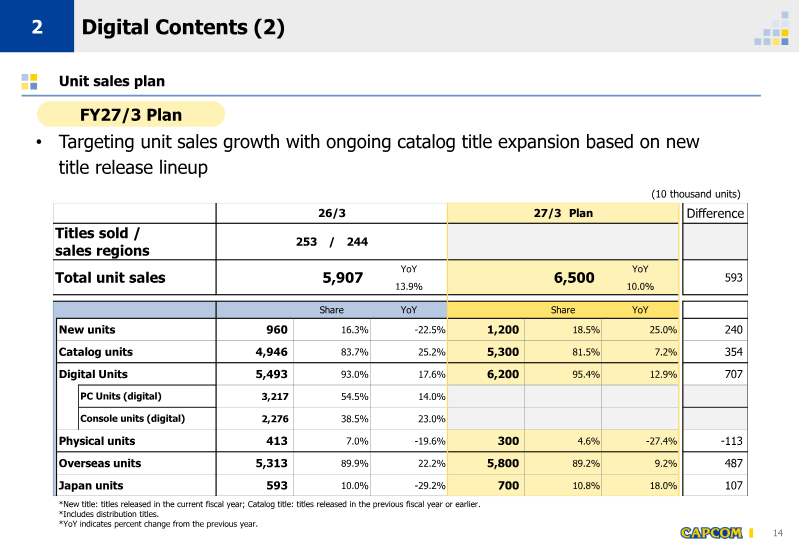
> **[Chart page]** This page contains visual data — view in PDF for the best experience. Unit Sales FY26/3 Results • Highest-ever cumulative total unit sales and catalog unit sales for a fiscal year period • Fourth-quarter unit sales reached a quarterly record (10 thousand units) 22/3 23/3 24/3 25/3 26/3 Titles sold / 304 / 219 307 / 230 292 / 235 248 / 227 253 / 244 sales regions Total unit sales 3,260 YoY 4,170 YoY 4,589 YoY 5,187 YoY 5,907 YoY 8.3% 27.9% 10.1% 13.0% 13.9% Share YoY Share YoY Share YoY Share YoY Share YoY New units 860 26.4% -10.4% 1,240 29.7% 44.2% 959 20.9% -22.6% 1,238 23.9% 29.0% 960 16.3% -22.5% Catalog units 2,400 73.6% 17.1% 2,930 70.3% 22.1% 3,629 79.1% 23.9% 3,949 76.1% 8.8% 4,946 83.7% 25.2% Digital Units 2,460 75.5% 6.3% 3,730 89.4% 51.6% 4,135 90.1% 10.9% 4,672 90.1% 13.0% 5,493 93.0% 17.6% PC Units (digital) 1,090 33.4% 36.3% 1,775 42.6% 62.8% 2,160 47.1% 21.7% 2,821 54.4% 30.6% 3,217 54.5% 14.0% Console units (digital) 1,370 42.0% -9.6% 1,955 46.9% 42.7% 1,974 43.0% 1.0% 1,851 35.7% -6.2% 2,276 38.5% 23.0% Physical units 800 24.5% 15.1% 440 10.6% -45.0% 454 9.9% 3.2% 514 9.9% 13.3% 413 7.0% -19.6% Overseas units 2,710 83.1% 11.3% 3,350 80.3% 23.6% 3,810 83.0% 13.7% 4,348 83.8% 14.1% 5,313 89.9% 22.2% Japan units 550 16.9% -4.3% 820 19.7% 49.1% 779 17.0% -5.0% 838 16.2% 7.7% 593 10.0% -29.2%
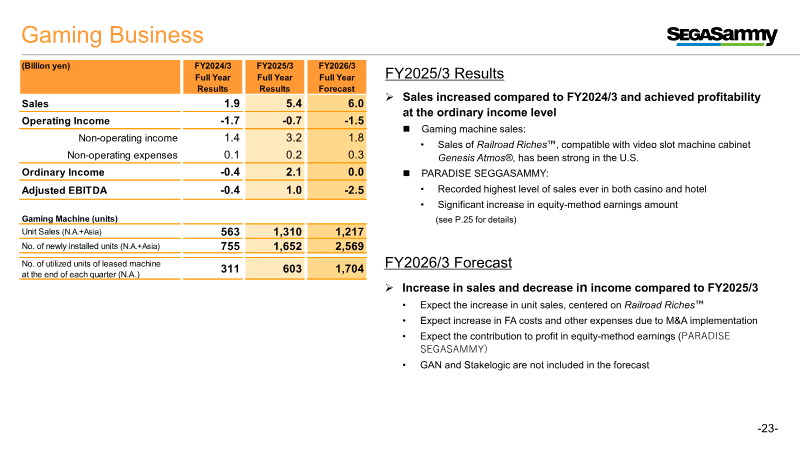
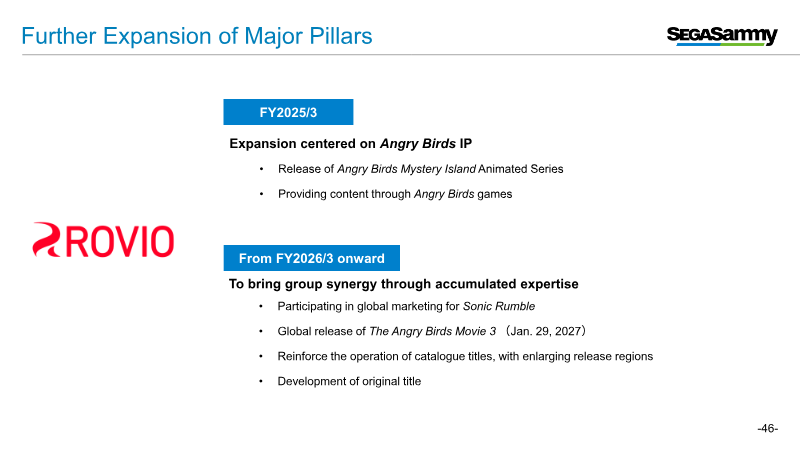
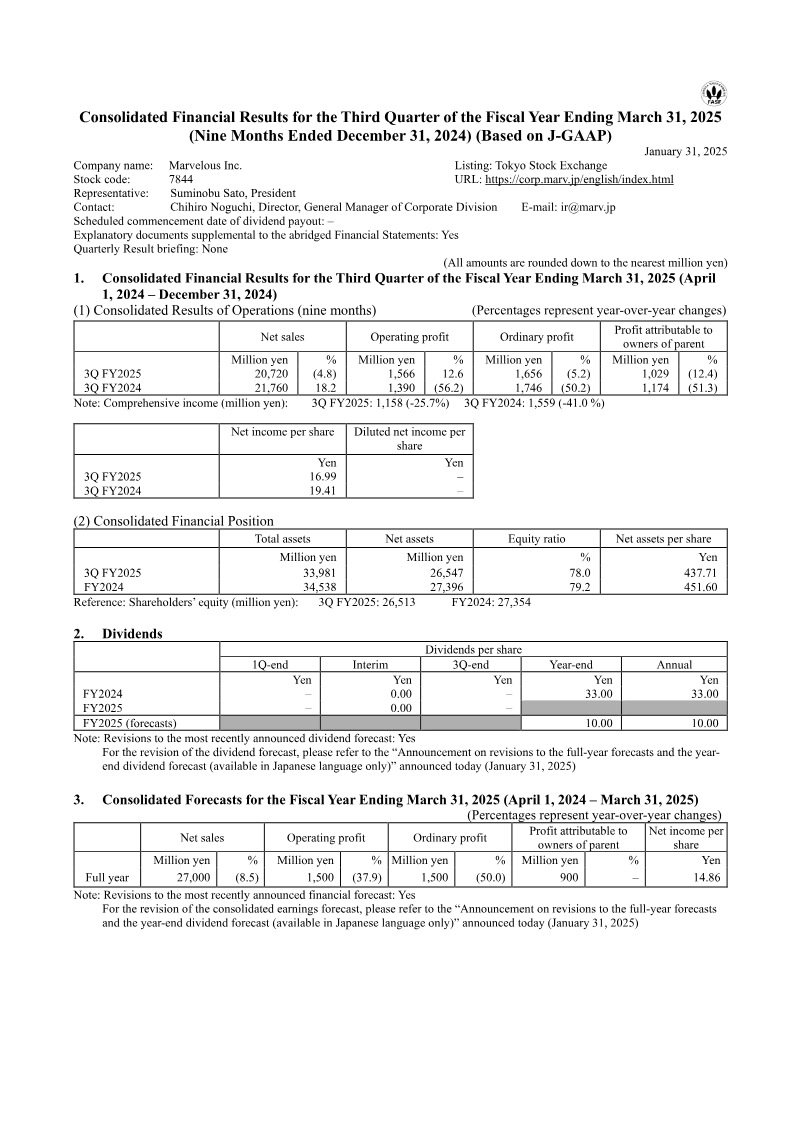
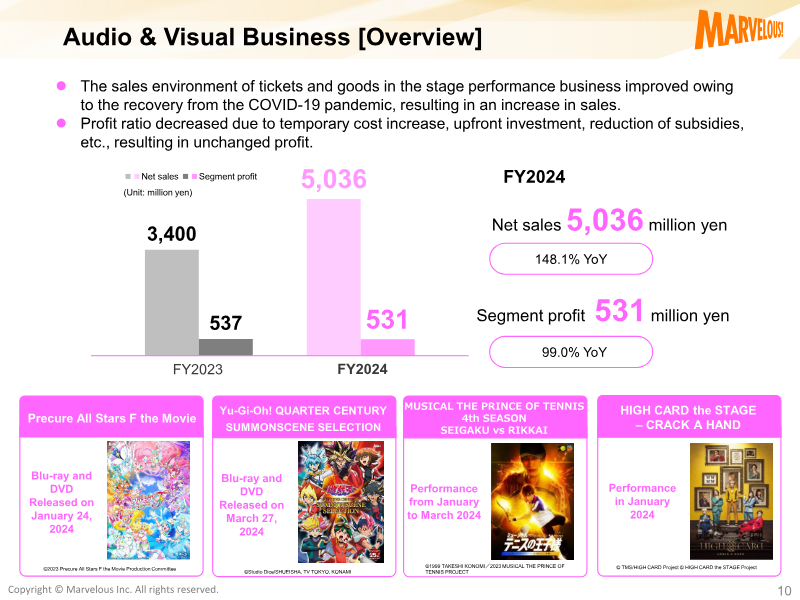
Sega Sammy’s financial performance for the fiscal year ended March 2025 reflects a transitional period characterized by strategic restructuring and the expansion of global intellectual property. While net sales and operating income saw a decline to 428.9 billion yen and 48.1 billion yen respectively, net profit rose to 45.0 billion yen following the divestment of Phoenix Resort. The Entertainment Contents division remained a primary growth engine, bolstered by high-margin repeat game sales and the successful integration of Rovio. Despite a temporary downturn in the Pachislot and Pachinko segment due to a lack of major releases, the Gaming division achieved profitability through record-breaking casino performance at Paradise SegaSammy and robust slot machine sales in the United States. The medium-term strategy centers on a transmedia approach designed to maximize the lifecycle value of core franchises. This is exemplified by the Sonic the Hedgehog brand, which saw significant licensing growth and substantial box office success, paving the way for a multi-year pipeline of films and animation through 2027. To sustain this momentum, the company is reviving legacy titles such as Virtua Fighter and Shinobi while investing 20.93 billion yen to acquire Stakelogic, targeting the North American online gaming market. These initiatives are supported by structural reforms in European operations and a commitment to human capital, including specific targets for cultural diversity and female leadership by 2031. Looking toward the fiscal year ending March 2026, a recovery in sales to 475.0 billion yen is projected, driven by a strong pipeline of new titles and the revitalization of the Pachislot business through innovative cabinet systems. The company maintains a disciplined capital policy, targeting a 50% total return ratio for shareholders and a cumulative adjusted EBITDA of over 230 billion yen by 2027. Furthermore, Sega Sammy continues to prioritize ESG benchmarks, maintaining high ratings for gender diversity and climate change management while navigating the complex regulatory requirements of international gaming jurisdictions.
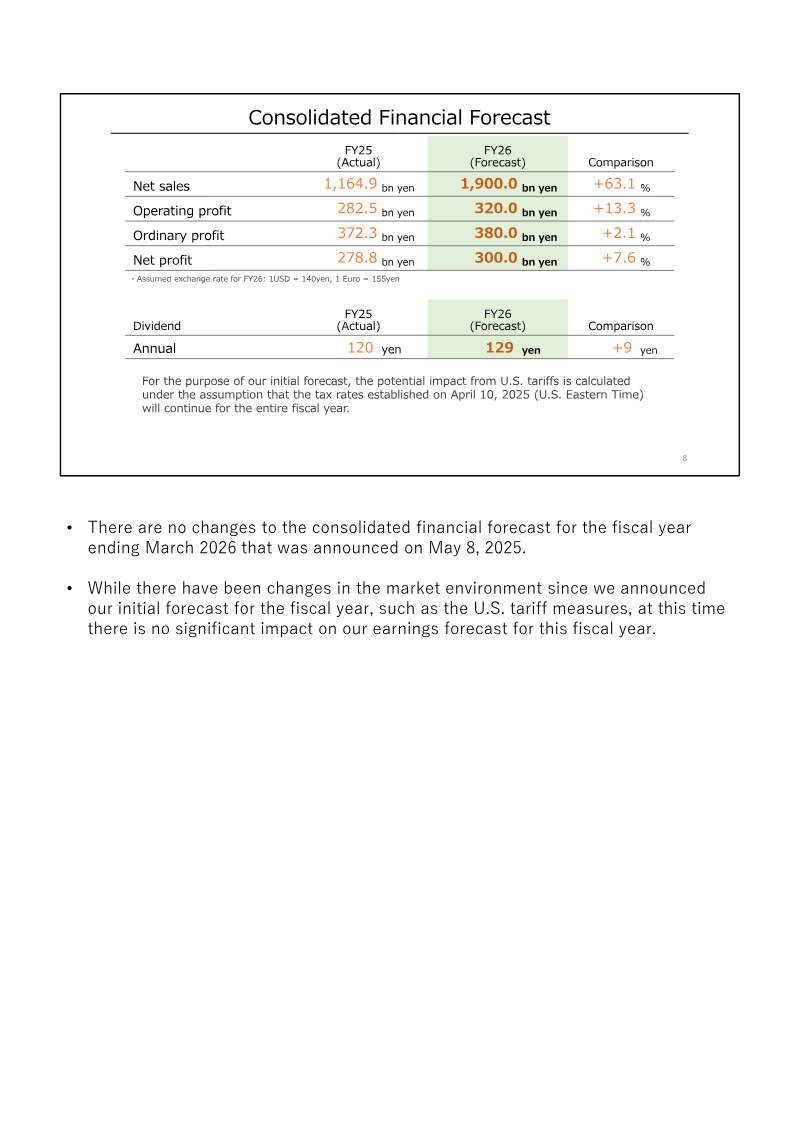
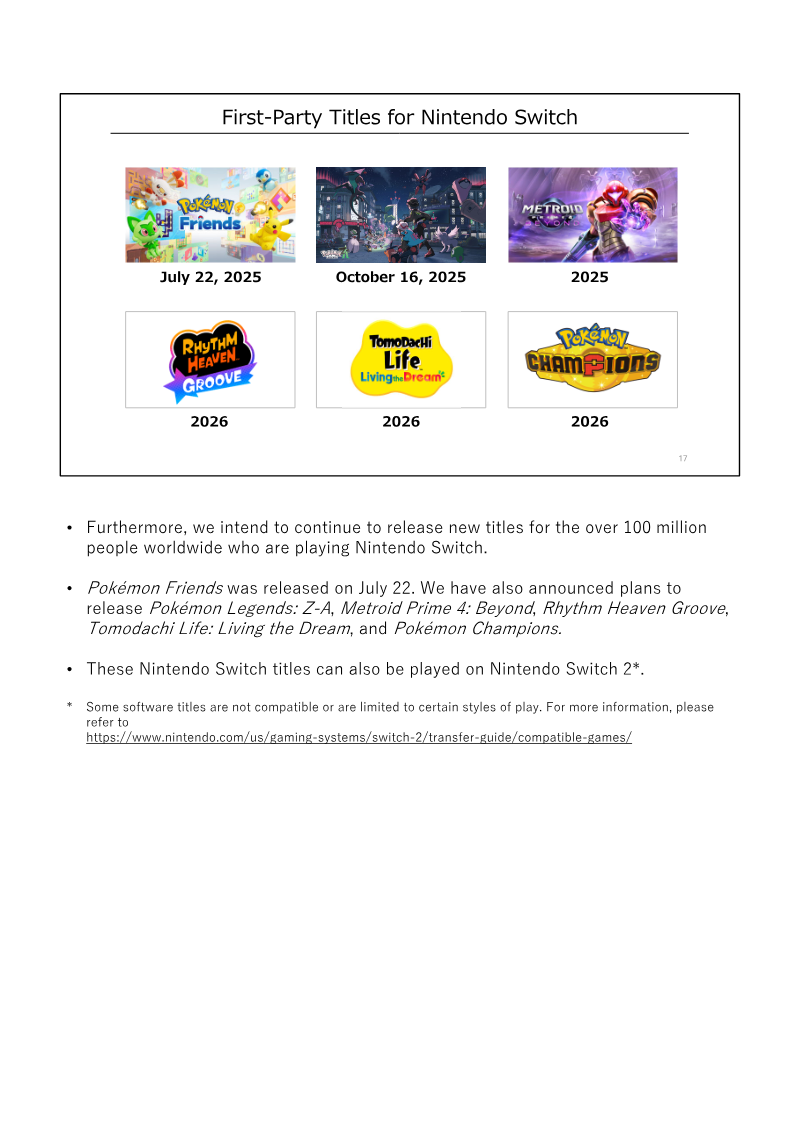
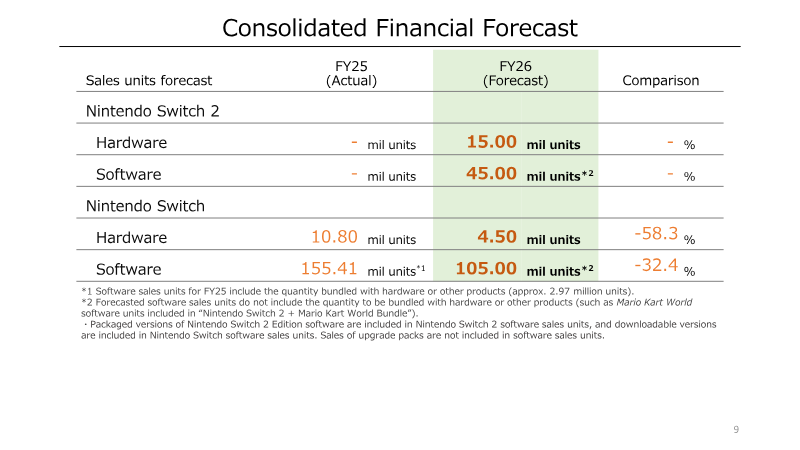
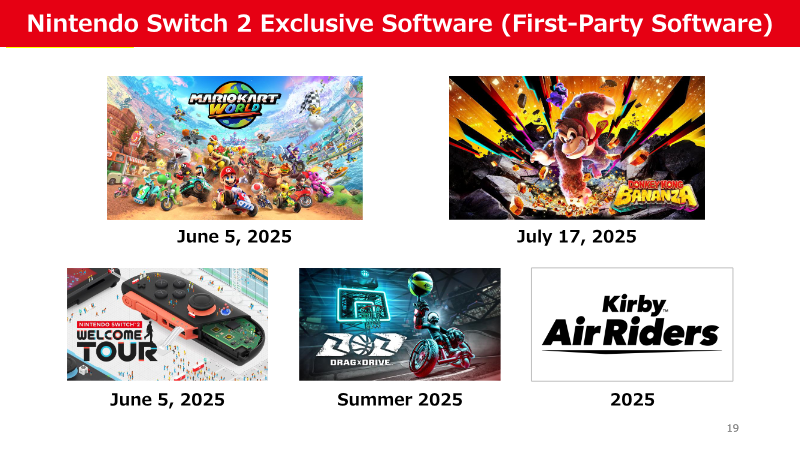
The financial results for the fiscal year ending March 2025 reflect a period of significant contraction for the company, characterized by a year-over-year decline across all primary performance metrics. Net sales fell by 30.3% to 1,164.9 billion yen, while operating profit decreased by 46.6% to 282.5 billion yen. This downturn was largely driven by a 30.9% decline in revenue from the dedicated video game platform segment, which remains the company’s core business, accounting for the vast majority of total sales. The decline in performance is attributed to a cooling demand for the aging Nintendo Switch hardware, which saw unit sales drop from 15.70 million in the previous fiscal year to 10.80 million. Software sales also experienced a contraction, falling 22.2% to 155.41 million units. Despite these headwinds, the company maintained a robust digital sales strategy, with the proportion of digital revenue increasing by 3.3 percentage points to 53.5% of total platform software sales. Geographic distribution of revenue remained heavily weighted toward international markets, with 76.4% of sales generated outside of Japan. Looking ahead to the fiscal year ending March 2026, the company projects a recovery, forecasting net sales of 1,900.0 billion yen and an operating profit of 320.0 billion yen. This optimistic outlook is anchored by the planned launch of the Nintendo Switch 2 hardware on June 5, 2025, supported by a robust pipeline of new software titles and upgrade packs. The company continues to leverage its intellectual property through diverse channels, including visual content and theme park expansions, while maintaining a focus on long-term engagement through its established user base of over 100 million annual playing users.
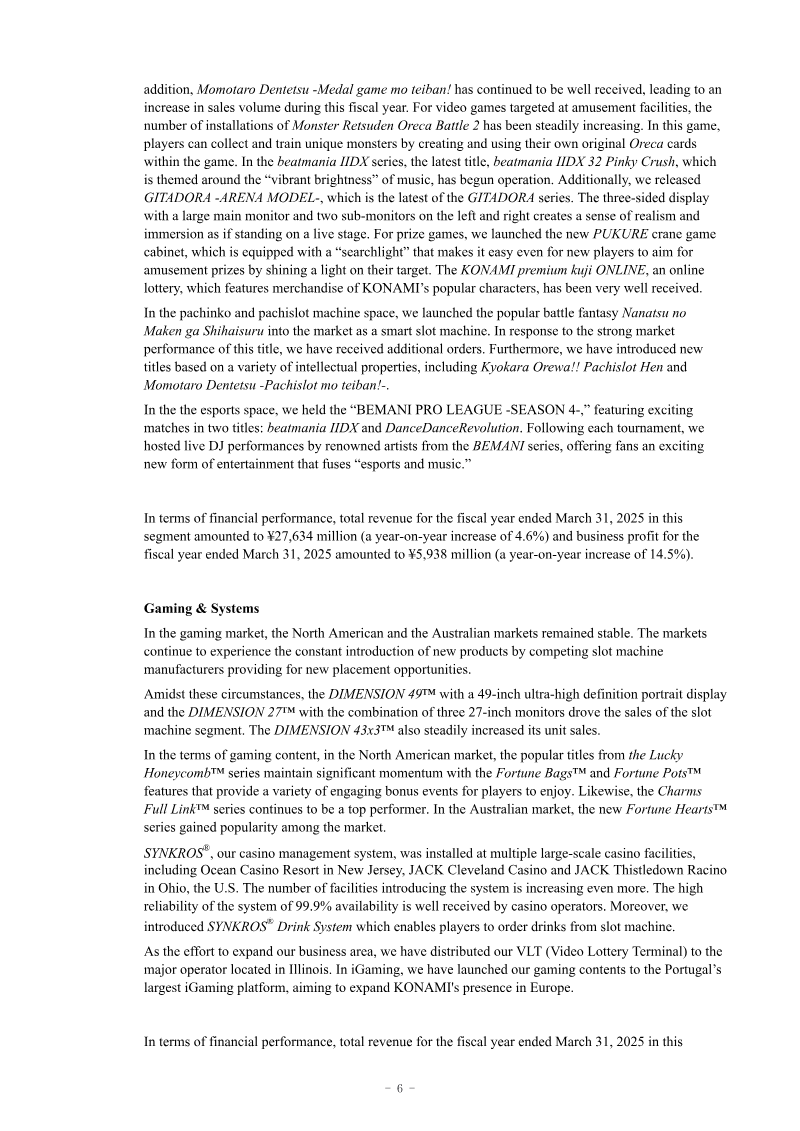
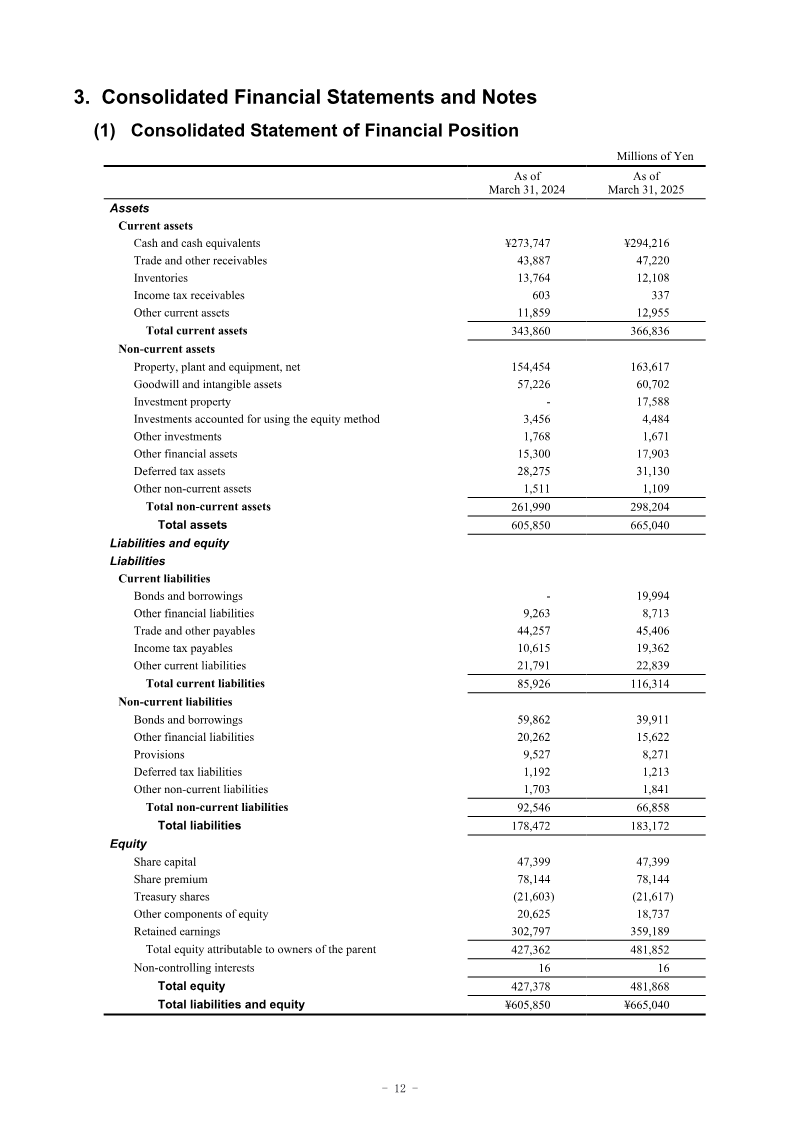
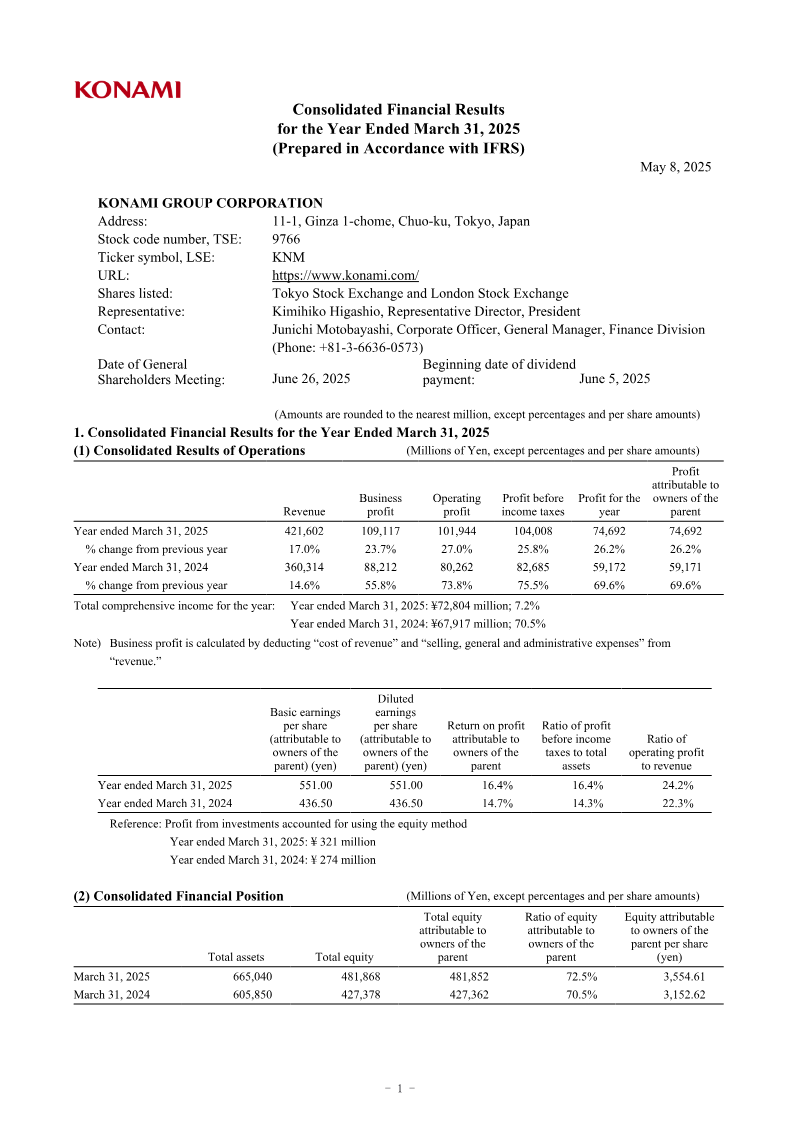
Konami Group Corporation achieved record-breaking financial performance for the fiscal year ending March 31, 2025, characterized by a 17.0% year-on-year revenue increase to ¥421,602 million. This growth trajectory, which marks the second consecutive year of record highs across all profit categories, was primarily propelled by the Digital Entertainment segment. A 22.5% surge in revenue within this division, fueled by the robust performance of key console and mobile titles, solidified its position as the company’s primary financial engine. Operating profit reached ¥101,944 million, reflecting the efficacy of the current business strategy and operational scaling. Diversified growth was evident across other core divisions, with the Gaming & Systems segment recording a 7.4% revenue increase and the Amusement segment growing by 4.6%. Although the Sports segment faced a minor contraction in business profit, the company maintained a resilient financial foundation, concluding the period with ¥294,216 million in cash and cash equivalents. This stability has enabled a shareholder-friendly capital allocation policy, resulting in an increased annual dividend of ¥165.50 per share. Looking toward the fiscal year ending March 31, 2026, the organization maintains a positive outlook, projecting continued expansion. Strategic initiatives for the coming year include the launch of new game titles, the enhancement of casino management system features, and the further scaling of the Pilates Mirror and outsourced sports facility operations. With a dividend increase to ¥166.00 per share already projected, the company remains focused on leveraging its diversified portfolio to sustain long-term profitability and market leadership.
Thunderful Group’s interim report for the first quarter of 2024 details a period of significant financial decline and aggressive corporate restructuring. Net revenue fell 27.7 percent to 391.7 MSEK, while the group recorded an operating loss (EBIT) of 184.4 MSEK, a sharp reversal from the 19.2 MSEK profit reported in the same period the previous year. This downturn was driven by a 35.5 percent revenue drop in the Games segment and a 25.7 percent decrease in Distribution, largely due to weaker market demand for Nintendo Switch products and the underperformance of the internal title SteamWorld Build. To address these challenges, the group initiated a restructuring program aimed at annual cost savings of 90–110 MSEK. This process involved a 72.4 MSEK write-down of capitalized development costs following the cancellation or divestment of twelve game projects. Strategic shifts include the divestment of the German publishing subsidiary Headup GmbH and the sale of Nordic Game Supply’s assets to reduce net debt. Despite these pressures, the group successfully extended its Nintendo distribution agreement for the Nordics and Baltics through March 2026 and reported 13.9 percent growth in its Amo Toys division. The report covers the group’s global operations with a focus on European and Nordic markets for the period of January to March 2024. Financial data indicates a strained liquidity position, with cash and credit facilities dropping to 130.9 MSEK from 329.3 MSEK year-over-year. Management secured a bank waiver conditional on asset divestments and maintains that current funds are sufficient for continued operations. The overarching strategy moving forward emphasizes a simplified games portfolio, more rigorous project validation, and a balanced risk profile across internal and external development.