VideoDeconstructor of Fun
AI GAMING REVOLUTION: Shaping the Future of Play with Pieter Kooyman
19 Sept 202370 min video
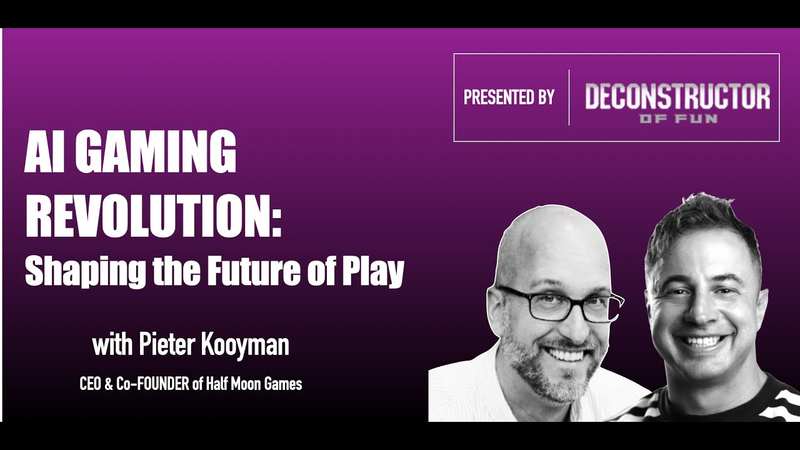
[Music] everything welcome welcome everybody to the deconstructor of fun podcast today my guest is Peter koyman founder and CEO of Half Moon Studios Peter you're a former Chief advertising officer of Miniclip gigantic huge mini clip with so many games such a big audience being a chief advertising officer was probably a lot of fun a very cushy nice job how come you're a Founder right now and welcome to the podcast thank you thank you great great question um the mini clip Journey was an incredible one I I joined many Club I was there for 13 years um and uh I joined in 2008 uh when the company was going already millions of dollars in in Revenue and I was able to see that through uh for 13 years and to keep growing the
business um I had to a business that now does hundreds and hundreds and hundreds of things dollars uh in in Revenue um and it was an incredible journey in the first five years the the Journey of miniature was about the pivot from being primarily a web-based business to then almost 100 of mobile business which required to change in people in processes in technology uh and and in products uh so it was a huge period of pivot which was very very interesting professionally for me uh then the second phase a miniature was one where we sold the business to attention incredible uh achievement and that then really almost immediately led into the third phase of um let's call it hyper acquisition um we you know by the time we saw the business attention we were about 200 people uh and um by the time you know I left we were
13 Studios 800 not 900 people and still going right so after I left um the so the new CEO saw chowdy took over from Rob small the former the founder and now the president uh miniature there's now required stuff away Surfers EIP incredible IP really excited to see them they're going to do with that um so yeah how many clip I was ads monetization I did marketing I had accountability for marketing and business intelligence as well so I added like you said a cushy eventually a cushy c-level job um with with all the purchasing benefits that come with that but to answer your question uh the one thing I haven't been able to do is to do from nothing to some I joined mini clip uh I joined when it was already up and running and to an extent successful but I was never able to do uh that Journey myself and always had the aspiration to do that always had the
ambition to do that but because things kept going so well immediately whatever I never really had the chat so so you have the experience of 1 to 100 and you want to do the zero to one like that's the uh that's the passion for for being a founder call me crazy yes I will I will most this is crazy you have done it right you had you yourself had the aspiration at some point to do that you have done that um uh it's it's a it's a it's a burning desire all right it's something you know the the founder of miniature Rob small uh is you know he was a huge example to me uh you know my boss for for a number of years and and the amount of things that I was able to see him do the difficult decisions that he had to make uh it it always just kind of fed the Beast you know yeah I I get it I have tremendous respect to towards all the founders so much respect for for jumping on the grind but at the same time I
think I think it's always crazy like I'm I'm like I'm like a rabbi I should tell like if like somebody wants to convert I'll tell don't do it this is not the religion you want to jump in I think the same thing I did at Founders I'm like don't do it it's too hard it's not gonna be fun it's nothing it's nothing that you imagine it to be but then those who say I know it's going to be a tough path but I still want to do it despite everything you say okay you're ready for the uh you're ready for the journey so your journey has been a fast one I mean you're a senior executive you've seen it all your position at Miniclip was was such a tremendous one because as you said it went from a nice profitable web company to a gigantic mobile publisher almost a conglomerate with all kinds of games and we're talking about ad Revenue the type of games that Miniclip was doing were high audience probably a lot of um in-app in app ad Revenue as well as app Revenue so you've seen it all you've uh you've
experienced it all how has it been transitioning to to the startup like how big are you now how long have you been working on it and I know that the first five months you worked on your first product use a lot of AI and launched it to the test Market inside five months so walk me through the first steps the zero zero yeah sure yeah so we're now seven people strong uh we're fully remote Studio I'm based in London but we've got people uh cross across the board um when we started earlier this year like like all startups we were a blind sheet of paper we had no admob accounts we had no analytics we had now GitHub repository uh and there was no notion pages with wonderful process documents um and so in order to build all of those things I galvanized the team and I said listen we're going to build something in five months because that's how we will establish all of those things that is how we will oil the wheels of this
organization and so what what we did is we chose a relatively simple mechanic um because you can do something really complex but the more complex the longer it takes we chose the word scramble mechanic and we looked at picture quiz games uh in in the space and we looked at what type of content they had and then we were very conscious about reimagining that picture quiz content um and so we we not only build the game we needed to build 2 000 rounds you know let's call it 20 days of gameplay um and we did that by utilizing lots of generative AI tools and a huge amount of automation um so the first the first game um was was developed but the system that we built was uh production line if you like um overnight our system creates a new
batch uh of picture quizzes so we we give it uh clear instructions as to what it is that we want to be introducing around the idea or a topic and then we have picture Tinder that we use I'm gonna make it fun um where we review all of the pictures that come through so we swipe writes or which way right yeah we swipe was right left um in order to see which images work for the rounds that we have in mind and which ones and do not um so that's how in a five month period we were able to build a fully pledged Pap um with 2 000 rounds but the objective was not to make a successful game the objective was to oil the wheels of the organization the ftue is for the monetization of attention and not industry Norms um it doesn't even have a back button to the main menu it's not the product that is that is
going to blow us away uh as an organization but this is so hard and I think a company needs in order to get how did you get to this approach of we need to ship first we need to get the Reps in like that is a very seasoned smart approach uh and not the other sort of let's make it perfect let's come out of the gates you know yeah with all the bells and whistles it's a very very mature approach so how did you how did you approach to it thank you thank you um so we did an I did an investment route for the business uh in in John and Feb uh and I picked my investors very carefully uh uh uh not just for the money but also for the advice thank you and I went around in January to all my founder friends uh and and I went to all of my investors and I said okay so tell me in my first six months what are the things I should be doing and one of the things that I shouldn't yeah
um I I I've ignored I've ignored some brilliant advice ignore that but some advice I did take and that was it people said Pete chips get going launch and learn make mistakes build the organization build capabilities and take it from there and you're so you've raised um about 400k in sort of um Angel round what's called an angel round sound like even official precede and in this Angel round do you have any VCS you or do you only have like former founders it's it's a industry friends and family yeah let's put it that way so um I'm not gonna name any names they're pretty cool yeah so and we've got what I'm basically leading is you have people who you truly trust yes who can give you the the right attention because they know you as a person and they want to help you and that also built a little bit of a different Dynamic and it also because you took money from your I'm sure they're not pinched for cash but
nevertheless you borrowed a Fiverr from from a friend and you kind of feel obliged to you know perform now that uh it's a different than than just a VC who has other people's money and then just throw it around into into companies that they've invested is that like the way you're thinking as well it is I I did just go down the VC route earlier this year I had a lot of conversations with lots of people um AI is pretty hot now ai was even hotter back then right this is just off back of GPT and mid journey and 11 labs and these hundreds of millions of dollar rounds um ultimately at the time I made the decision to continue to be Scrappy right um the the kind of approach that I want to take in the business about uh marketing and is is not one where we will continue with the tried and tested mobile marketing idfa
um you know Sharpshooter approach it's just not going to work so as an organizational behavior we have to do things differently and one of the one of the kind of other philosophies of the business is that we you know we tell ourselves that what we are continually trying to do is to reimagine marketing like let's not go to those tried and tested methods let's see what else we might be able to do with generative AI in order to do things very very differently using we've developed um but I I get sidetracked um I I did have an opportunity to take to take money from from from BC's back back then but I think the behavior the scrappy Behavior the growth hacking Behavior the pressure of singing with a finite amount of time I think those are really great behaviors for an organization to get into at an early stage of its existence I agree I agree it's uh you didn't make
your life easy and that's uh that's a good thing especially in the beginning so you have seven people like how is the uh like what is the organization like like what kind of people do you have and what kind of a hats are you wearing right now yeah it's a where we've we've done I think a really fantastic job of putting together an absolutely fantastic small team that can operate like a big team right that's that that's the whole idea that they're kind of the the three pillars of the organization were reimagining the quiz we're reimagining marketing but we're also reimagining the organization right so I'm really I'm really trying to be super purposeful about um you know we now live in a post-coveted world we live in a post-generative AI world we live in a post idfa world yeah and what kind of organization now that you know all these things now that I know all these things what should that organization be like
um and so when you look at the team there's this kind of four major things that that from a from a reimagining the organization that is happening through our uh the the org right so the first one is the concept of multiple hats I've only hired people that can do at least two jobs so my data analyst is also an experienced data engineer my game developer has also dabbled extensively in game design my head of growth he also does his own video editing and I discovered recently that he's not a bad front end Unity a digital developer as well um so so multiple hats for me is a really conscious decision for the organization uh I believe that in in a small organization like this with tools like generative AI um you can amplify uh people people's
jobs in in a huge way and I think for small organizations the area of the specialist uh the error apologies The Specialist is is all so I think generalists is really where it's at like I said augmented by these uh tools that we can now go off in yeah it makes sense I mean once you start hiring Specialists then specialists want to hire other Specialists because that is the way they've worked before so I can do this and I need that and I need this and this is how the organization should function these are the processes these are the Productions so forth and so forth I actually posted something about this on LinkedIn there was a an executive a very high level like people don't know and I won't tell which executive I'm referring to but that person said to a founder that you should never hire AAA talent in your company and the founder had a very small company and that was a very divisive um opinion to give from this very high level mobile executive from a very very
very good company a very creative company as well and uh and people were of course on the face of it very against it but I think he was talking about these issues it's like once you start hiring Specialists your organization will blow up in in size in costs and the speed will be reduced the quality will be increased but are you you're not able to pay for the quality at this stage and you have to focus on the medium that you're making your game to and then that founder was working not going to reveal on whether it's mobile or or some other double a type of a format but um wasn't working on AAA games so hiring AAA Talent was that was something that that was told to avoid um regarding regarding the point that you made so multi-hats and generative AI is this thesis um or almost like a core value of your company how do you share this inside the company and how do you use it with growing it like do you sit down and say hey this is AI we I need you to do multiple things
but you will have ai at support this is how it will work at this point we're not gonna work in any other way like how do you um disseminate this this rule or this thesis yeah I think that's a really important question because you can have all the values in philosophies you like but if you don't talk about them um it it has to start day one so when I started speaking to talent for the organization some of which I'd identified um previously people that I've worked with in in the past the data analysts this is an example there's an example you've got to start day one right just to set this expectation because also the data engineer that I was talking about he's now actually learning front-end development in unity I mean he's learning development in reacts right so he really embraced the option he really embraced the opportunity um of being able to wear multiple hats because for him it allowed him to learn and continue to learn a huge amount and
not do any of the boring um because that's that's also something a lot of Specialists keep doing right and like you said especially it's higher Specialists because they then they can hand over the boring stuff that they don't want to go to the specialist that work yeah yeah I've had I heard the same thing like I've had privilege of working with all kinds of talent I'm not saying one is better than the other they're different and they're needed for different types of games but it was always interesting to work with talent coming in from AAA where they would mention hey we need I don't know um graphic performance engineer you're like I've worked in mobile games for 12 years I've never seen one like I maybe have seen one like maybe they work in central function at a large corporation and they've been done something I've never had one on my team like what is this what does this person do how have I gotten till this point without ever meeting this crucial Allen that is absolutely necessary to hire
yeah so uh and again I don't mean that this is a bad thing but this is like the mindset and and the expectations are so different and if if that is not a clear sort of a communication of how this company functions then you'll end up in a situation where where the people are kind of pulling the company towards different direction that your original thought so um no go ahead can I jump because I think it's just really interesting because you know so many of these things um I'm starting with right you call it value for for the business um I think I'm right I thought otherwise yeah otherwise I wouldn't be be kind of pushing this this agenda forward but I'm just interested from your perspective because you started Savage in 2019 yeah 2020. right pre-covered pre-gen AI you could still use idfa at that stage um the the things I talk about right so the
multiple has Concepts leveraging generative AI as much as possible automating like crazy is something that we do I think a small team is absolutely critical because the communication is clear it's a flat structure everyone knows exactly what's going on there's no Chinese Whispers the things that I talk about does it resonate with you and if you were to start Savage now which clearly you don't you know perhaps want to do how would it be different yeah so that's a that's a very good point I think it's it's what I'm what I'm kind of like talking about and raising these things is like how do we disseminate this sort of information because uh with my starting I was so eager to start where I did all the mistakes of uh of a first-time founder and that is like moving too fast ahead before aligning with the people who you who you've chosen to start this with and that ended up like that led to negative scenarios where we had to part ways with with a couple of the co-founders during the uh the first two years
um and it's a it's it's very unfortunate and I would blame myself for that for not being strong enough in clearly communicating what type of a product are we making how are we making these products and it was more of because I started the company with many people who I hadn't worked with before due to various reasons again these are all led to my investment thesis on that have changed dramatically since since this but uh but that led to sort of a projecting uh the experiences and and kind of like thinking that what I know and understand and believe to be true is probably what everybody else believes it's true and when I would say it oh but this is the truth right and they're like no no no no no this is not how I see the things this is not how I see the market this is not how I see these type of games and if these things uh come like Surface after you've started the company that's a bad thing because now you have to work on the alignment of the core
um and um and Alignment takes time it takes a lot of effort it's very frustrating and you're not hitting the ground running so so that's why I'm kind of like you know very very adamant on who are you working with who are your business partners have you aligned them before usually those teams that have worked before together tend to share the same experience experiences they've aligned they speak the same language if you say something no one like Peter's out of his mind it's like no no they trust you they know you they they know your experience and and um and and you know them so that when they suggest certain things that should be done you're like yep I trust you I I understand what you where you're coming from but if you wouldn't if there would be coming in from a different inspector and having different view on what good looks like you would have a lot of challenges and that those challenges that misalignment would be then rippled through the the rest of the organization and that's that's the biggest biggest hurdle that startups tend to have
yeah the greatest Miss about communication is that it actually took place yeah nice thanks thanks for sharing that yeah yeah so uh so I think I think you're doing it in a very right way and you have clearly great advisors uh who are pushing you in the uh in the right direction uh making sure that that you actually focus on shipping and and making the product versus anything else that comes after because I think the first stages from from you know start of the company to Angel or precede rounds to seed rounds to up to series A should be all about the product and I know that there will come in people whose opinions I very much respect who would say Hey you have to slow down you have to write your values you have to write your mission you have to do this you have to do that all these underlying things will help you to scale very much true post series a let's get the product let's show the traction let's get on the
on the runway let's pick up the speed on the runway maybe the tires are coming off the Runway already a little bit and now let's read the manual on how to fly this thing or write the manual of how to write this thing like most important is the start and the destination and making sure that that who you have on your bus or on your plane um are Travelers and even if some of their detractors doesn't matter because you're on the wheel but as it moves forward then the alignment is super important especially the alignment of uh investors because the more investors you have the more power the investors have the more Hands on the Wheel there will be and if the hands are pulling to different directions uh the plane is gonna crash yeah yeah and and I I think that's again the kind of identity the behavior the approach of the investors I think you know if I think about the big decisions that I need to make for the business going forward one of them is you know
who do I align myself with what is the right type of investor what is the kind of relationship that I'm looking for with them and you know at the moment I am in in active conversations but yeah with a lot of them one of you know one of the best bits of advice that I got from my advisors was uh Pete this is as much you doing DD on them as it is them doing DD on you um and it's led to some very interesting scenarios where you know the investor and I we both went into the meeting I'm like I'm ready to do DD on you and they were ready to do the tea or made I mean it was an interesting Dynamic let's let's finish yeah but I'm you know I'm usually grateful for that advice from one of my investments yes I think so if you have a chance to listen to the uh the podcast that they did with Joe chippy about growing an organization so he has gone from you know starting his company uh to series B already and um two rounds during and post covet
at 20 plus males so you know raising money in this environment he's him and his coven are able to do that but what he tells you about Investors is like they've gotten a lot of no's because they're building um a platform or um a staff service like however you want to how you wanna you know call it soulston heated rule for example which they abide with is they only take an investor on who they can have dinner with as in that they would enjoy a dinner with them or yes okay yeah because as it moves forward the role of the board becomes so important especially post B everybody has to be aligned everybody has to be working together effectively and so there has to be the social capital that has to be built along with performance Capital so um having good relationships is very important but in your current stage in the beginning I would say it's not that important because the influence of the
investor is very limited because of the share that they have and going forward even the investors that you will get in the beginning often times are not the strong like are not the ones that you're going to have in the in the later rounds you know they will play through the pre-seater seed maybe to series a and after that their their contributions kind of ended and the bigger boys will come in or or girls or however you want to put it the bigger funds will come in and they have a totally different ways of working while some funds are only focused on that first zero to one so you know definitely definitely work with with uh with people who you like working with and whether it's the dinner roll or the coffee rule for the pre-seat I was fortunate enough to have both of the investors in our company makers fund and play Ventures I knew them on a personal level for years before before starting my company and even play Venture guys I knew before they started play Ventures so for this type of uh
um trust uh is is uh is is very important so I I wouldn't know what to tell you how it is to work with an investor who you don't know so that's not me I only I only had investors who I knew so that makes I think that's great advice thank you yeah yeah kind of like kind of like your uh your angel round so for me it was it was the uh that was the same information but um um so talking about AI specifically I think you know most of the people are definitely interested about that there's this tremendous opportunity for a smaller organization as I said everybody's wearing multiple hats it kind of enhances your work it enhances my work first question that I sent you on this podcast were generated by AI yes David so I use it but um but let's talk about a little bit about existing Studios and and see suits for example like you've been at the sea suit of sea suits Miniclip is as big as it can get to be honest like under under especially tencent you have endless endless cash you can buy anybody your audience is
insane it's you know operated out of Switzerland if I'm correct it's a right smack middle of Europe just just you know just ruling everybody but uh house should uh c-suite tweet Ai and especially how they should impact the culture of the organization I think I think it's safe to say that everybody in the c-suite is very positive about AI because people are forward-looking and they see tremendous upside in it but the downside of the AI that especially affects the people in the trenches it's not something that the executives maybe think too much about so so what would be your advice to uh to establish companies adopting AI as such is such an interesting topic it's such a hard question because so many of the behaviors in these organizations so much of the culture has
created so much inertia that over time these behaviors Trump you know a mid-level employee or even a c-level employee that would say oh my God we could use this tool to do X and you know however much a mid-level or senior level and a person in the organization would come and say what if we go and do that let's let's go in that direction there will be so many processes so many so much inertia like I said so much organizational kind of stickiness and glue that won't stop from that Innovation from from actually occurring right whereas everything is innovation right if we we have we have you know everything to play for and everything to risk and everything that we can test we've got no history whatso so I think the the first thing is that if you are an executive at this point in
time and there is discourse between the difference you know parts of the c-level organization in particular about the opportunity and risk of using generative AI tools the first thing you need to do is to get absolute Clarity and a single um line in terms of what the company's position is towards using generative AI tool um and in a healthy way think about the risks you know think about the data risk you as an organization face when your employees are using gbt or mid-journey or 11 Labs where those models then use that data to retrain further further models um to really you know as a sea level suite think really carefully about the ethical side uh of of this right so to be super aware um of the the issues uh to do with bias
in in many of these texts and image models and that the teams will be using did you um just quick quick sidestep did you see the BuzzFeed article about Barbie no so BuzzFeed probably right and I think this one was still written by a human actually um so the so what BuzzFeed did as part of the party launch um they did all countries in the world on mid-journey as Barbies and of course being BuzzFeed they they did it and they found some controversial ones that they absolutely left in um and so the bias came in that country of South Sudan the Barbie in question had an AK-47 in her arm sounds fun right so well so the it is funny but where does that come from that comes from the bias within the solution that has been trained that uses images related to South Sudan that then
had says that this is you know South Sudan is about um so I wouldn't know what the sound like exactly exactly exactly so it's it's the yeah but there is a level of fires in these models yeah there's a level of bias how we interpret them like there's uh let's put it this way so the AI doesn't have ethics it just does what what the programs what the data it has we do yeah and then we call this is wrong yes the models like I don't know what's wrong or right I just use the data that I have right and and this and the same goes for the prompts right so you as a as a prompter you've got a certain level of bias that go goes into there in terms of the questions that yeah um but but I think as a c-suite you need to be super aware of all of that you need to be cognizant about those risks you need to communicate and train the
teams and ensure that there's a training program about the risks those those when you call about risks like what do you mean by risks there's a there's a copyright risk I don't know if that exists in uh in in with AI uh but but this risk of uh of are you talking about a risk when when you do these images let's say images or texts and something comes out as controversial which everything is could in today's world controversial is that the risk you're talking about um I'm talking about the risk of um let me give you an example a marketing team that uses chap CPT to build a certain marketing campaign and lets it go too much and the content that is produced by GPT is not aligned with the company values on topic X or one right so that is a risk that the company needs to be aware of and
um ensure that staff are aware of uh that that these potential risks exist in the organization got it um when when they use these tools right but so those are the risks that the upsides though I think are absolutely enormous but you alluded to it earlier there are a lot of specialist positions that we've got in these organizations right now and we can name them or we cannot blame them but there are lots of positions right now that in two years time will not necessarily be required that in five years time will not necessarily be required it and that's not just for the gains industry it's also for the legal industry it's for the marketing Industries for many Industries where things could just be done faster in an automated fashion by by these tools and so the intrinsic behavior of organizations is to cut costs so if you are going to be a sea level that thinks about those opportunities you've got to be you've
got to think two to five years in advance and you've got to make your people plans accordingly and most importantly you've got to start communicating those plans to people as they roll out yeah um you know if I if I were advising a c-suite that's the kind of feel that I would give them to really think about a very purposeful way yes because any organization or a country the goal is to produce more with less input more output with less input that is this at the Simplicity of any business or any you know country or or what you name it and so what we've had in the games industry for a while now is the costs have been going up no matter what platform you're using AAA is of course the at the Forefront with everything with initial Investments going to just 100 million just to make the game and then another 102 to Market it um and the the sort of a conversation that I'm hearing about AI currently with with C suits of these big corporations is like
they're alluding that this can make things more efficient so there wouldn't be any redundancies perhaps but we would keep the same so we wouldn't have to increase the cost but we'll keep growing and I I feel that this is a bit facetious in in a way that is being communicated because I understand what this communication strategy entails it's like you don't want to ruffle the feathers of of the people or you know call spade a spade you want to say hey we want to do AI because we need to be more efficient but this doesn't mean that you could lose your job it just means that maybe we need to hire less which already is very dangerous because that means you're not hiring Juniors so even like that pipeline suddenly dies I don't know how you're going to get into the games if you're a junior artist or Junior narrative designer or so forth uh but I think that even that is not true that there will be more and more tools that single or you know small teams can produce content that previously needed
three four five times the amount of people but now they have ai tools to support them whether they are generic AI tools or whether they are customized for that company which I think a lot of uh a lot of uh Solutions will be heading to is that kind of like the way you're seeing things I I think I think he used the word facetious um I think it's a really interesting observation I think it's definitely posturing and it also smells like that organization as a sea level did not have a proper conversation about the seismic shift that is happening now um and I think it's also important to look at from the other perspectives though right so let's not go sea level let's go individual contributor what if you are right now a junior artist what if you are a junior copywriter in the marketing department in Mobile Studio or AAA Studio X right um in their in their shoes there may be people that are really comfortable doing
just that I'm really scared of what's coming next and so their natural disposition would be anger oh my God like I'm an artist I would spend two weeks making this and now I see this being built in three seconds how is that possible so anger and then anger could turn into actually sticking your head in the sand which probably probably the worst thing that you can do uh as an individual contributor now you've just got to be aware that the world around you is massively changing that's something changing yeah so yeah get your head out of the sand realize as what we were talking about earlier that generalism Will trump specialism General so if you are a junior developer think about what are the skills you can learn right now see if you can do a six month placement in another team see if you can watch Shadow other people see if you can learn Ducks second and third skill set that you can pick up still now
whilst these companies are slowly changing are catching up to the capabilities of these tools yeah I'm definitely empathetic for for both sides like I understand why the C suit and the leadership of these companies is trying to communicate in the ways because if you start being very realistic and talking about realistic scenarios that could happen the whole organization is going to revolt uh and that is also the the anger side that you mentioned is is that I've seen this this happening in various Studios where whether we're talking about art directors or designers in some cases programmers as well they they adopt this anti-ai stance I think that's part of also the strike that is going on in Hollywood as well it's like and and I think I don't I don't know like I I I'm very empathetic in why they adopt this it's very easy to be angry and it's very
natural for us as humans to fight back just say no is a no we're not gonna go there but also it's fruitless it's it's like it's inevitable uh these same people might be using AI in their personal life and they would not want to use it in their professional life because of the effect that it has on their colleagues or even on their own job so I'm very understanding of that and I think your advice is correct I would also kind of advise the same way like like I'm doing this I'm getting to know AI to understand how can we leverage it more how can I produce more content uh how can I you know ease up my my work whether it's doing these questions or or doing the other summaries of it I have some people from Google helping me out with an AI stuff who are working on AI and and all that stuff like you have to be curious and see this more as an enabler to you as an individual to do way more rather than an enemy that is going to steal your job and the job of your of your colleagues because like you know having just the
positives but it's possible it's it's very possible whether you're in art whether you're in design this could be a huge enabler to you where you are able to do the work of an entire small team um it's an amplifier yes it's something right and and everything that everything that we're trying to do at Half Moon studio is how can we with a 10 person team do what five years ago or fifty person yesterday I would have done and because that is now possible so it's easy and it's easier for new fresh small companies to make the most of that it is a very big challenge for larger companies with inertia to make a change but nevertheless if they dance they're really missing a huge opportunity for for the whole organization um and it's and it's not just you know it's not just replacing uh jobs it's taking away a lot of really boring jobs there was you know there's there's one
there's one one specific artist uh many clue who is a specific artist for eight years in a row was the person Drew and accusing eight ball pool that was that was their role and perhaps they loved that and perhaps that was you know and that's their specialism with them I would wonder hey you know is that still going to be a job in five years now the answer is yeah yeah I would assume the same with especially AAA Studios that have multi-hundred people teams with very specialized people drawing you know probably cubes and other stuff if you're working on GTA for example there's you know you have to build those cities but um but assuming you know there's there's uh there's AI helping the same approach actually it's really interesting to see how people who are very much against AI due to understandable reasons are very much excited to watch the latest unreal demo of the new engine and how much all
the stuff that the engine will now do for you like excuse me like this the engine teams that are probably like you know could be like I'm losing my jobs or there's a multiplier components to it there's a World building component to it like all these things there's analytics components there's all these things unity and unreal for example have that previously only Studios were able to build internally so in a way this not in a way this is another tool that that will enable smaller teams to build bigger products um and um and I think you know even large teams can build infinite products with with the help of an AI so so um so there's there's upsides but it's a difficult topics just because of the uh the ethical elements the risks the misalignment and um and the human impact that these tools will have on Studio structures so it's kind of kind of understandable um it's huge what what are what are the sort of like challenges in working with AI tools you've experienced personally now
yeah lots um yeah you know you go really deep on these tools and you start learning the the how the various components collaborate well whereas if you've got one AIS gen AI system another gen AI system and another thing you try and mesh them together um I remember really early on so so we're we're working on quiz so one of the early products that we built was a trivia quiz uh Creator right so we one of our first Alpha products that we built was any topic okay choose any topic and we built uh using GPT and using stability you've got a a random set of 10 questions about that topic had a specific difficulty level that that increases over time where each question has four answers one of which must be right so we built this we ran it developed you
know a thousand questions and then we started marking its homework um the um the one that stands out from email is that a Time GPT suggested that Cristiano Ronaldo was Argentina's most famous true true or Saudi Arabia we then we then did more marking and actually we got to like only 70 percent of the questions we could actually do out of first that so then we said okay Hey listen okay not very good let's add in a second component so then we ran it again and we ran it to create a truthfulness score so for GPT to check its own homework it's you know I think it can be easily done and still like everything fell through so then we had to find other ways Gathering the same information uh from things like Wikipedia and Google to check the truthfulness score and at this
stage I was like this isn't really not moving in or in the right direction um so that you know that was very much one of the the early moments where I realized okay for now we don't have to worry hugely about the future of humanity um maybe at some point in the future but at this stage these tools really need a lot of attention they need a lot of love they need a lot of tinkering and even then you've got to know and acknowledge that you know as much as 10 is actually uh incorrect yeah yeah I've noticed the same thing with writing like I use AI to I don't have a cold start problems because I've been writing for such a long time and and doing content but it does help when it kind of spews the first thing and whether it's right or wrong it gets your brain firing like no no no no no or like okay I can see where
this is going and taking it over from there and it's also really good with suggesting different titles after you're written so I I use a lot of I use AI to almost like bounce bounce ideas with you know yeah and and it's it's quite helpful and and Beyond uh gbt which is obviously ubiquitous and what is your favorite tool that you've been getting to know intimately so I I wouldn't say I'm getting to know tools intimately I use Chad gbt that is the only one that I use but then I have I have people around me who are always willing to help work at different corporations uh Google is actually a close one to to me and I don't know what they do but I give them sometimes transcripts and I get back stuff and I was like wow this is amazing and they're like Yep this is this is from Ai and so I don't I don't know the process I just know that on the slack channel of the constructive fun flag Channel there's a person who worked on AIS he's like I'm deep in this they just
send me stuff and I'll give it to Ai and we'll run through it and we'll see what comes out so uh so I I probably use Bard uh but in uh you know in a medium but he he promised to to teach me uh the stuff when when I'm ready for it but currently below White just started just using chat GPT to bounce off ideas and then getting help from others who are who are using I'm not using mid-journey I'm not using a lot of uh visual stuff I would use like we've used it at my studio previously just to generate ideas but even with that like I mean I think the stuff that we got out was really cool from from the journey and it was like you know pretty amazing I was like who did this like oh hey hey and um and then it still kind of goes into that traditional form of like all right these are cool ideas take a step all the way back to the beginning and do our own versions of it Yahoo and I was like oh why
dude I get it I'm very like product thinker kind of like let's just move on like this is great let's let's you know what else do you want to see like why do we why do we have to redo something that is clearly already amazing but um but if you're a specialist and a professional you're only seeing mistakes this is AI this is only idea I want to go back to to there so I get the other side as well was it a people-driven motivation or was it a risk driven motivation uh it wasn't it was people driven definitely it was people it wasn't because it was we were talking about ideas and and so forth so uh the more product oriented people would be happy to use chat dgbt to come up with different narrative ideas uh or to uh to kind of get some mood shots and so forth uh and then yeah the more Specialists with uh with the strong backgrounds of you know developing games triple a double A would be neither would be like
great let's just let's just follow the uh the standard operating procedure understood yeah inertia yeah exactly exactly I was done at yeah and then that's why that's why I'm also imagining that it will be quite difficult to transform organizations and they're thinking especially large ones with a lot of Specialists but on the other hand there are a lot of startups that are started by by people who have worked in top of the food chain AAA Studios um I forgot the name but some of them uh that are for example generating open worlds Etc uh NPCs and so forth these people are coming from AAA Studios and they're actually seizing the moment they're they're grabbing Ai and they're building their companies around it to support the workflow that they're very intimate about and that they know how difficult how how long it takes how expensive it is that's a startup idea we could do the same thing that you're doing at a cheaper cost we know exactly your problems let me build a product to help you so there are these companies
and I think I think we'll see more of them and I'm quite excited about these companies uh being spun out especially as they're spun out from existing top Studios because then they have that sort of a um reputation where oh this person who used to run our environment art department has now developed a company that allows us to do environmental a large you know an easier Pace let's let's give them a go he's from here he's not a bad person yeah and and I'm absolutely not a specialist in that area at all right you know my background is in casual yeah casual game no but those types of solutions I'm really intrigued by but I would always imagine that actually the AAA Studios wouldn't buy that it they would always want to build that themselves they would see that as such a core capability core differentiator that they wouldn't want to buy that you know
I I know nothing about it but isn't that a risk where you then build something which actually only your old Studio would I have to have very limited experience with AAA Studios but to my limited experience having had conversations with the leadership of these Studios they're very smart people very business driven they've done this for a long long time and um I don't you know I didn't never sense the sort of um um limitations that they would put on themselves based on their experience and beliefs uh they were always very open to new things and new technologies I would say this is more on the staff level uh where these sort of um uh dances come from but the leadership is is um as as good as it can get in my opinion okay magic no um so what would be sort of like if you could share some some key lessons to other Studios dabbling in Ai and we're not talking
about Studios that have an anti-ai stands or who have this sort of a challenge of how do we get people on board with even given an AI a go but for Studios who are bought in they want to use AI probably startups uh what are the sort of lessons that that you would share kind of pitfalls to avoid yeah uh yeah a few comes to mind the first one is don't underestimate how deep you should go in order to become a master of one of these tools right uh it's going to sound ridiculous when I say this but to become a good admit journey is an art you really need to go very deep on all of the variables and experiments so much to understand ah okay if I use this variable then this will happen particularly if you are producing at scale and batch work in in the way that we are going so I haven't used it myself
but something let's face something like scenario.gg right so or internationalario.com they've rebranded after the fundraise um game assets is what they make so you can train your own model you've got some example assets and that you make an internet you say I want to check it it makes a chicken in your style that's the the concept sounds sounds amazing but actually these these tools are new and they're rough around the edges and it's it's difficult to kind of get going probably with them for someone who's like oh yeah you know what let me check this out and you shouldn't expect like it's gonna all work in in one in one go so you know with that what should you do be all over their Discord Channel be all over the tips and tricks check in every day see what mistakes other people are are making um yeah so these these tools are are not always very easy if you really want to make the most
go deep be a part of a community those are very important parts now number two is generative AI is one thing automation has to go hand in hand with it if you really want to scale output if you really want to scale productivity you've got to become an expert or hire in in our case an expert at automation yeah it generative AI uh whether it's text or or whether it's images they produce a lot of stuff but it's not always exactly what it is that you were looking for so you need to be able to produce a lot of it right there is Michigan this infinite content yeah right so produce infinite content and then figure out what are the bits that you would need for for your product or your or your process or your marketing campaign and I think lastly taking the example of
a buzzfeed that I mentioned earlier taking the example of Cristiano Ronaldo that I mentioned earlier um go into this with a healthy level of Suspicion know that these tools are really brilliant at predicting the next pixel and really brilliant at predicting the next word in in a sentence and at this point they are definitely more than that but at their core these models are are exactly that so you know do the sniff test on your content but um and you know whether it's a an article that you write Mishra or whether it's a marketing campaign for a for for an email that you send out as a mobile Studio be suspicious at this stage for sure got it those are good great great uh great three points so go deep automate and be suspicious I said
two two kind of like you know close this this conversation I would like to have like a very broad like ask your very broad question which is like what do you think is going to be the impact on gaming industry in next five years relatively short amount of time always impossible to predict gaming industry uh but if we try five years what would you yeah um from a people perspective let's let's talk about it from a people perspective what we talked about earlier uh I.E a lot of larger organizations not making conscious gener decisions about people is something that's going to happen so there's going to be you you talk about it you said facetious I said posturing that will result in acrimony uh anger that will result in uh in in in a lot of individual situations that
could probably have been handled very differently if people were very active looking at things now um from a from a technology perspective the if you use mid-journey at the moment mid-journey is static images and there's lots of really interesting things that are happening to turn those static images uh alive and to make them either slightly animated or fully animated um one of the the tools that you can combine is you can take mid-journey and you can take a tool called Dash ID and you can take a character from your journey and Dr Dash ID will make it talk right that is a two-step process that can become a a one-step process so for sure that there's going to be a natural evolution in terms of where static images will go into slightly moving images and then you know much more symptoms animation if you like and already
there's lots of really wicked things that you can do with you combine mid-journey with Runway and you you may have seen them on on your LinkedIn or or or Reddit um where you've got essentially many movies that have been created by people in an 8 or 12 hour session um again right that stack is just going to be simplified and either it's going to be somewhere like a mid-journey or someone like a stability that have got huge data sets that continue developing very quickly to build stuff like that um or it's going to be a new company that comes around and solves that new problem right yeah it's not a problem it's just a really a really interesting opportunity um and there was an interesting piece by professi called David K uh he's a DC at F4 F4 funds yeah recently recently started fund with uh yeah very familiar recent very recently started I think
they launched a couple of months ago a couple minutes ago and he did a post and he was very much against uh he he said something like NPCs so having having third-party generative AI NBCS is not going to be a business model that anyone uh will will buy into um I think it's a strong statement um I I I I I definitely you know we're doing a lot of experimentation on uh Tick Tock where if you are on Tick Tock and you are on Tick Tock live there are some incredible things that human NPCs are are doing it's it you know it's uh it's an interesting development in the history of the human let's let's call it let's call it that way but nevertheless it is it is developing um and I you know I don't I don't know the direction it's going to go in but I think NPCs is a really I'm not saying that David is wrong I'm just saying that there's so much that we don't know yet about no no you are saying you are
saying that David is wrong let's be honest you're not saying it's wrong you say I have a different perspective on this level is wrong you know he is an expert in Texas okay I'm not an expert in text so from that perspective we you know we should we should take his perspective my point is merely that your five-year question I think is really hard yeah because there's going to be so much that happens in the next six to 12 to 24 months that will change all of these opportunities and things that we've never thought about will be um obviously done um and to be honest that's one of the reasons why I'm so excited about building half in the studio it's also one of the reasons why I'm not being deterministic about it yeah right we are starting with Picture Quiz we're starting with meshing all these various Solutions together to create fantastic
output I'm not starting with this is the thing I'm going to be building in three years time because quite frankly it it probably will be obsolete by then or someone else will have done it better yeah so so the deterministic approach is something that I'm a huge fan of um testing and learning to see work up yeah I I would say my perspective on this is the AI will give such an advantage to smaller Studios and smaller teams that it will be unfair when competing against the big ones and what I mean by that is you're able to produce games that are maybe don't reach the same scale but reach scale at such a smaller cost compared to the big players and maintain that scale at such a small cost compared to big players that it will be unsustainable for the big players to continue operating in the way they have been continued we've seen this in multiple businesses where where the cheap model has kind of undermined the
uh the big established ways of working and um you know like my favorite not favorite this is a bad thing to say but even if we think about let's say armies uh or or you know like best armies think of constance undefeated against all the superpowers of the world to Great Britain or Soviet Union or United States of America they've beaten everyone and they've never had the strongest army but they have the cheapest Army and uh they play to their advantage and the same thing when it comes to streaming Wars like there's YouTube nobody can say that YouTube has the best content you know like pound for pound best content but it just has endless amount of content that is produced by the people at their own costs at their own their own money and YouTube Just publishes and when it competes against the Netflix's and the Disney's of the world it kind of you know it kind of just wins them in terms of Engagement just
because the content is is more cheaply produced and in a way it shapes according to the other needs there's no you know Central thinking behind it it's very organic and I feel like like this is what we're gonna see with an AI it's just ability to produce good enough content at much cheaper and much faster pace and that doesn't mean that the uh the super games of the the star fields and the uncharteds and the God of Wars like those who will continue being what they are they are Staples but when it comes to the tier twos the new franchises maybe without the biggest Publishers as those games will have the 100 million dollar budgets are competing against the ones that are coming in with it five and ten and using a lot of AI it's a battle that they can't win and so that's that's how I'm kind of seeing and you can be you can look at it from the from the perspective that this is very sad but you can look from a perspective that this is very empowering because you
can be in one of those smaller Studios that makes a game or or a product with much less of a capital at a much faster Pace uh with the tools of of an AI and and see the moment rather to be seized by the moment could not agree more wow I'm kind of selling out I'm again I'm not I'm from I literally just you can chat DPC just a little bit and have uh and have help from it but uh but I I don't have these sort of a strong stance except when it comes to web three um but uh I feel like I feel like there's uh there's a lot of positives but there will be a lot of negatives and I'm very empathetic on the people's side that's why I wanna keep raising the point it's like a lot of these things is like how do you approach it if you approach it in a very negative deterministic angry way I think it's gonna hurt you couldn't agree more yeah well Peter
we've agreed on many things tell the world what's going next for Half Moon Studios you're in the midst of fundraise right yeah yeah we've started early conversations about it at this point um yeah the everything that I've seen our ambition is just growing right so what was a a budget from friends and family yeah it's clear that you know I I need to make three or four more hires for us to really be able to capitalize on on all of the other shares um the the second thing is um the the content so we've built this content generation machine and we keep adding more picture quizzes and that content is um going to be distributed very widely we're using uh automation as much as possible to create as much content and posting it on YouTube and posting it on
Tick Tock and we're creating all sorts of very interesting experiments from a marketing perspective on Tick Tock live to see how we might be able to leverage this content in a way that it can either monetize there or Drive traffic through other more higher value platforms like iOS um so we're continuing to build the content we're you know building new Alpha products and experimenting with that but the thing that we're now progressing with is a new picture quiz game that leverages the existing content with a very different mechanic and um you may have done your your research into the Picture Quiz genre it's not uh you know the quiz genre it's not a high value genre it's not it's just not right the monetization is primarily adds a little bit of of in-app purchases um and so for us next um multiplayer has to be it right that's one of the key things that you need to
develop uh as a capability as an organization and we haven't started that and that's why one of the reasons why I'm definitely considering uh a much larger race at least sounds super exciting So for anybody who's who's in queue who's not into for anybody who wants to be at the Forefront of AI and content development and who wants to go to the Moon not just half the way to the phone with Peter and his team uh Reach Out LinkedIn probably the best way to to uh to catch you and um I'm looking forward to seeing how the organization grows and how you will continue pioneering um AI in content development and I think it's a it's very interesting that you are the founder because you have such a balanced structured and mature way of approaching startups and much more of mature that what I never ever did and that's why I'm very interesting in seeing this journey continuing um and uh and we'll follow up in uh in a
year we'll see how far you've gotten with an AI and how big the company is at that point and what kind of all kind of cool products you're making so thank you Peter for joining the podcast let's do that thanks for having me all right thank you everybody for listening and um back with Peter if you're into AI so bye bye everybody
Auto-generated captions from YouTube — names and numbers may be misheard.
The integration of generative AI is fundamentally reshaping the gaming industry, enabling a transition from bloated, specialized production models toward lean, agile development. By prioritizing small, multi-disciplinary teams that leverage automation, studios can now achieve in months what previously required years of effort from large-scale organizations. This shift favors generalist talent capable of managing complex, AI-assisted workflows, effectively lowering the barrier to entry and allowing smaller entities to compete directly with traditional publishers that are often hindered by organizational inertia and high overhead costs.
Success in this new landscape requires a strategic balance between rapid innovation and rigorous oversight. While AI tools significantly accelerate ideation and prototyping, they remain prone to errors, necessitating deep technical engagement and human-led verification to ensure quality and accuracy. Furthermore, leadership must navigate the ethical and legal complexities of AI adoption, including data privacy and copyright concerns, while proactively addressing the potential erosion of junior-level training pipelines. By establishing clear internal policies and fostering a culture of skepticism toward automated output, studios can mitigate these risks while maximizing efficiency.
Looking forward, the industry is moving toward highly integrated, multi-step production workflows that combine disparate AI capabilities into cohesive development cycles. This evolution empowers startups to produce high-quality, multiplayer-capable titles at a fraction of the cost associated with traditional blockbuster projects. As the sector matures, the competitive advantage will increasingly belong to organizations that successfully bridge the gap between manual craftsmanship and automated production, ultimately redefining the scale and speed at which sustainable, high-impact gaming experiences are delivered to global audiences.

Deconstructor of Fun · 2026

Deconstructor of Fun · 2026

Deconstructor of Fun · 2026

Deconstructor of Fun · 2026

Deconstructor of Fun · 2026

Deconstructor of Fun · 2026

Deconstructor of Fun · 2026

Deconstructor of Fun · 2026

Deconstructor of Fun · 2026

Deconstructor of Fun · 2026

Deconstructor of Fun · 2026

Deconstructor of Fun · 2026

The Game Business · 2026

Naavik · 2025

Naavik · 2025

Deconstructor of Fun · 2025

Deconstructor of Fun · 2025

Naavik · 2025

Naavik · 2025
Naavik · 2025
Naavik · 2024
Deconstructor of Fun · 2024

Naavik · 2026

The Game Business · 2026
Comments