Updated Apr 30, 2026 by XD
Financial
Published by XD
XD Inc. achieved substantial financial growth throughout the 2025 fiscal year, characterized by a 15% increase in total revenue to RMB 5.76 billion and a significant surge in profit attributable to equity holders, which reached RMB 1.54 billion. This performance was underpinned by a 10.5% rise in gaming revenue, bolstered by the success of titles such as Heartopia and Torchlight: Infinite, alongside a 24.7% revenue increase within the TapTap platform. The company’s financial health was further strengthened by an improved gross margin of 73.8% and a robust cash position of RMB 3.77 billion, supported by a strategic reduction in the cost of revenues and a lower gearing ratio of 22.5%. The company’s strategic focus remains centered on cross-platform expansion and the integration of AI-driven development tools to secure long-term competitiveness. While financial metrics showed marked improvement, the company observed a decline in online game user metrics, specifically monthly active users and monthly paying users. To address these shifts, management has prioritized capital optimization through active share repurchases and the maintenance of employee incentive programs. Notably, the board opted against a final dividend for 2025, citing a commitment to capital reinvestment and a need to address corporate governance concerns regarding the consolidation of the chairman and CEO roles. These results reflect a period of operational consolidation and international market penetration for the China-based firm. The financial figures, which have been reviewed by the Audit Committee and aligned with the group’s consolidated statements, demonstrate a transition toward higher profitability and operational efficiency. By leveraging the acquisition of the Torchlight intellectual property and refining advertising algorithms on the TapTap platform, the company aims to sustain its growth trajectory despite the challenges posed by fluctuating user engagement metrics in the broader gaming sector.
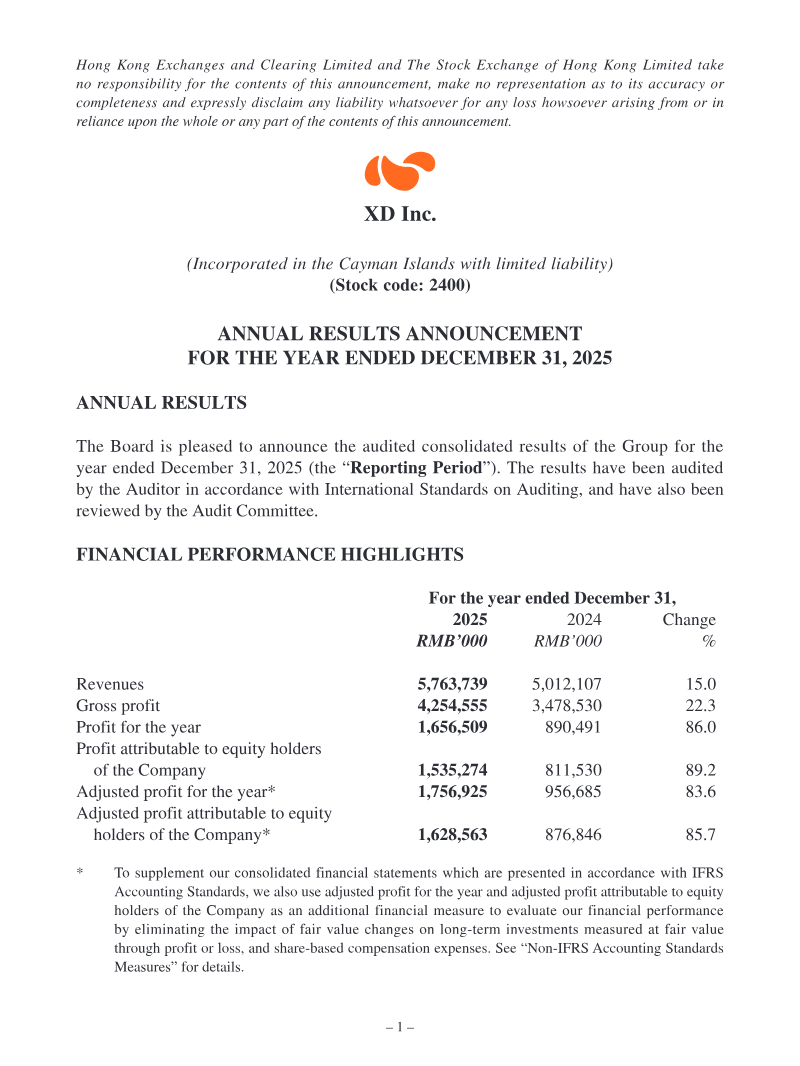
Hong Kong Exchanges and Clearing Limited and The Stock Exchange of Hong Kong Limited take no responsibility for the contents of this announcement, make no representation as to its accuracy or completeness and expressly disclaim any liability whatsoever for any loss howsoever arising from or in reliance upon the whole or any part of the contents of this announcement. XD Inc. 心动有限公司 (Incorporated in the Cayman Islands with limited liability) (Stock code: 2400) ANNUAL RESULTS ANNOUNCEMENT FOR THE YEAR ENDED DECEMBER 31, 2025 ANNUAL RESULTS The Board is pleased to announce the audited consolidated results of the Group for the year ended December 31, 2025 (the “Reporting Period”). The results have been audited by the Auditor in accordance with International Standards on Auditing, and have also been reviewed by the Audit Committee. FINANCIAL PERFORMANCE HIGHLIGHTS For the year ended December 31, 2025 2024 Change RMB’000 RMB’000 % Revenues 5,763,739 5,012,107 15.0 Gross profit 4,254,555 3,478,530 22.3 Profit for the year 1,656,509 890,491 86.0 Profit attributable to equity holders of the Company 1,535,274 811,530 89.2 Adjusted profit for the year* 1,756,925 956,685 83.6 Adjusted profit attributable to equity holders of the Company* 1,628,563 876,846 85.7
.0 Gross profit 4,254,555 3,478,530 22.3 Profit for the year 1,656,509 890,491 86.0 Profit attributable to equity holders of the Company 1,535,274 811,530 89.2 Adjusted profit for the year* 1,756,925 956,685 83.6 Adjusted profit attributable to equity holders of the Company* 1,628,563 876,846 85.7 * To supplement our consolidated financial statements which are presented in accordance with IFRS Accounting Standards, we also use adjusted profit for the year and adjusted profit attributable to equity holders of the Company as an additional financial measure to evaluate our financial performance by eliminating the impact of fair value changes on long-term investments measured at fair value through profit or loss, and share-based compensation expenses. See “Non-IFRS Accounting Standards Measures” for details.
KEY OPERATING INFORMATION For the year ended December 31, 2025 2024 Change (in thousands) (in thousands) % Online Games Average MAUs(1) 11,347 14,247 -20.4 Average MPUs(2) 1,284 1,609 -20.2 TapTap Average App MAUs in TapTap PRC 44,974 44,046 2.1 Average App MAUs in TapTap International 4,325 5,032 -14.1 (1) Our average MAUs for online games are calculated by dividing the aggregate of the total MAUs of each online game for the respective period by the number of months of that period. (2) Our average MPUs for online games are calculated by dividing the aggregate of the total MPUs of each online game for the respective period by the number of months of that period.
MANAGEMENT DISCUSSION AND ANALYSIS BUSINESS REVIEW AND OUTLOOK In 2025, we achieved continued year-on-year growth in both revenue and profit. Meanwhile, by further integrating AI technology and acquiring the IP rights of Torchlight series games, we have laid a solid foundation for the long-term growth of our business. In our game segment, the strong performance of Ragnarok M: Classic (仙境傳說M:初 心服), Heartopia (心動小鎮), and Torchlight: Infinite (火炬之光:無限) drove a 10.5% year-on-year increase in our gaming revenue, both Heartopia (心動小鎮) and Torchlight: Infinite (火炬之光:無限) have the potential to become evergreen games. We plan to continuously invest in R&D and support them to nurture an increasingly broad player base. In our platform segment, improvements to advertising algorithms and enhancements in user engagement led to a 24.7% year-on-year growth in the revenue of TapTap. We launched the PC version of TapTap, creating synergies with the mobile app to provide more convenient services for both players and developers. Furthermore, in early 2026, we initiated the invitation test for TapTap Maker, with the vision of creating a zero-barrier AI game-creation agent for game enthusiasts. Below is an overview of our core products and services: Our Games As of December 31, 2025, our portfolio consisted of 22 online games and 45 premium games. Online Games
the invitation test for TapTap Maker, with the vision of creating a zero-barrier AI game-creation agent for game enthusiasts. Below is an overview of our core products and services: Our Games As of December 31, 2025, our portfolio consisted of 22 online games and 45 premium games. Online Games During 2025, the average MAUs of our online games decreased by 20.4% year-on-year, while the average MPUs decreased by 20.2% year-on-year. This decrease was primarily attributable to the declines in number of users of Heartopia (心動小鎮) and Sausage Man (香腸派對) as compared with 2024. For the year ended December 31, 2025, Heartopia (心動小鎮), GoGo Muffin (出發吧麥芬), Torchlight: Infinite (火炬之光:無限), Ragnarok M (仙境傳說M), and Etheria: Restart (伊瑟) were our top five games in terms of their revenue contribution. An overview of our major games at present is as follows: — Heartopia (心動小鎮): This self-developed life simulation game was launched in July 2024 in Chinese Mainland and was enthusiastically received by players, topping the App Store’s game download rankings multiple times. In 2025, while the number of users for the game experienced a moderation compared to its initial launch period, we strategically expanded the development team, enhanced our production capacity, and
released several well-received content updates, enabling the game to achieve sustained success. In January 2026, we successfully launched the game in multiple countries and regions globally. — GoGo Muffin (出發吧麥芬): This self-developed idle role-playing game was launched in Hong Kong, Macau and Taiwan in January 2024, and subsequently launched in Chinese Mainland and various overseas markets. In 2025, the user base and revenue of this game experienced significant year-on-year declines compared to 2024. — Torchlight: Infinite (火炬之光:無限): This self-developed loot-based ARPG was launched in overseas markets outside China in October 2022 and launched in domestic market in Chinese Mainland in May 2023. Through several successful seasonal updates, the game has gained continuous recognition among players, and expanded the player community. At the end of 2025, we acquired the IP rights of Torchlight series games and related intangible assets. In the future, we hope the game will continue to attract more gamers through more attractive seasonal updates.
Giant Network’s 2025 annual report demonstrates a robust year‑over‑year performance, with total revenue escalating 72.7 % to ¥5.05 billion and net profit attributable to shareholders rising 23.1 % to ¥1.76 billion. Operating cash flow surged by 188.6 %, underscoring strong liquidity generation. The company’s dual‑core strategy—leveraging the MMORPG IP “征途” and the casual title “超自然行动组”—drives growth, supported by AI‑enabled development and cross‑platform expansion. Despite these gains, recent non‑recurring losses have yet to turn positive, creating some uncertainty about long‑term profitability. Regulatory developments in China have accelerated a focus on original IP and digital‑culture products. Government policies encourage embedding traditional culture into game design, boosting AI and cloud R&D, and expanding overseas digital content. Giant Network aligns with these directives through a research‑and‑operations model, heavy IP investment, and compliance tightening under new child‑online‑protection rules. Financially, operating profit rose 54 % to ¥829 million, while net profit increased 93 % to ¥947 million, largely due to higher investment income and lower tax expense. R&D spending more than doubled, reflecting intensified product development. Other comprehensive income swung from a positive ¥219 million to a negative ¥220 million, driven by fair‑value changes and credit impairment losses. The group maintained a conservative asset‑liability ratio, rising from 12.76 % to 18.67 %, and retained over 80 % voting control through founder‑controlled entities. Key findings highlight that core gaming revenue remains strong, investment income is mixed, and non‑recurring items significantly impact overall profitability. The report covers China exclusively, focusing on the 2025 fiscal year and encompassing gaming operations, IP development, regulatory compliance, and financial risk management.
Archosaur Games, a Hong Kong‑listed mobile‑game developer incorporated in the Cayman Islands and majority owned by Tencent and Perfect World, reported a 14.3 % revenue rise to RMB 1,304.4 million in FY 2025, driven by the launches of Dragon Raja: Cassell Gate and Immortal Skywalker in China. Gross profit climbed 11.8 % to RMB 923.7 million, but the margin slipped to 70.8 % because of higher IP‑holder commissions on licensed titles. Operating loss narrowed sharply to RMB 91.1 million from a ¥341.4 million loss in 2024, largely due to a 19 % cut in selling and marketing expenses; R&D spend remained flat. Net loss improved to RMB 36.7 million, an 87.2 % reduction versus the prior year, with an adjusted net loss of RMB 31.9 million after share‑based compensation add‑back. Cash flow and liquidity strengthened: operating cash usage fell 71.9 %, net current assets rose to RMB 1.48 bn and cash to RMB 1.09 bn, although gearing increased to 24.6 %. The group maintained a robust capital strategy with no external debt, Level‑3 fair‑value investments of RMB 2.24 bn, and a low credit‑risk profile for trade receivables. Governance structures met listing requirements; the board comprised two executives, two non‑executives and three independent directors, with audit, nomination, remuneration and risk committees each staffed by three members. Share‑based incentive plans remained within regulatory caps, granting 4.9 million RSUs and 4.1 million options in 2025. Geographically, Archosaur operates seven wholly‑owned overseas entities across Singapore, UAE, China, Japan, Korea and the U.S., while its Chinese subsidiaries are controlled through a complex contractual framework that navigates foreign‑investment restrictions. The company’s financial reporting follows IFRS and HKCO, with ongoing transition to IFRS 18 for revenue recognition. Overall, Archosaur Games achieved significant profitability improvement and strengthened liquidity while maintaining compliance with governance and regulatory standards across its global operations.
Tencent Holdings demonstrated robust financial growth during the first half of 2019, characterized by a 21 percent year-on-year revenue increase to RMB 88.8 billion in the second quarter alone. Total revenue for the six-month period reached RMB 174.29 billion, with profit attributable to equity holders rising to RMB 51.35 billion. This performance was underpinned by strong momentum in smartphone gaming, digital content, and the newly established FinTech and Business Services segment, which generated RMB 44.68 billion in revenue. While the company faced headwinds in PC gaming and media advertising, these were offset by strategic investments in cloud services and a diversified digital ecosystem. The company maintained a stable financial position as of June 30, 2019, reporting total assets of RMB 816.86 billion and cash and cash equivalents of RMB 122.84 billion. Operational efficiency remained high, with net cash flows from operating activities reaching RMB 53.80 billion. To optimize its capital structure, Tencent expanded its Global Medium Term Note Programme to USD 20 billion and issued USD 6 billion in senior notes in April 2019. The firm also successfully integrated IFRS 16 accounting standards and maintained a healthy debt-to-adjusted EBITDA ratio of 1.54, ensuring compliance with all financial covenants. Beyond core operations, Tencent continued to leverage a substantial investment portfolio valued at RMB 417.05 billion, reflecting its commitment to long-term platform growth and strategic partnerships. The organization expanded its workforce to 56,310 employees, supported by active share-based compensation programs designed to retain talent. Governance remained a priority, with the company adhering to the Corporate Governance Code while navigating a complex landscape of international investments and enterprise-facing service expansion. These results underscore a transition toward a more diversified, service-oriented business model that prioritizes sustainable ecosystem development over traditional revenue streams.
Tencent Holdings’ 2011 financial year was marked by a sharp expansion of its core internet platform, with consolidated revenues rising 45 % to RMB 28.5 billion and operating profit increasing 24.6 % to RMB 12.3 billion. The growth was driven primarily by internet value‑added services (IVAS) and mobile telecommunications services, which together accounted for 80 % of sales. Online gaming revenue surged 66 %, propelled by flagship titles such as *Cross Fire* and *League of Legends*, while social networking platforms—QQ.com, Qzone, Pengyou and Tencent Microblog—expanded user bases to 373 million registered users and 68 million daily active users. Total assets doubled from RMB 35.8 billion to RMB 56.8 billion, largely due to a jump in current assets and non‑current investments, including significant equity stakes in eLong, Kingsoft and other associates. Capital expenditures more than doubled to RMB 4.16 billion, reflecting investment in infrastructure and acquisitions such as Riot Games and Gamegoo, which generated goodwill of RMB 3.8 billion. Net profit attributable to equity holders rose 26.7 % to RMB 10.2 billion, with earnings per share reaching RMB 5.61 basic. Governance remained robust: the board met quarterly, retained a majority of non‑executive directors and three independent members, and maintained COSO‑based internal controls with no material deficiencies. Share‑based compensation expanded markedly—over 7 million options exercised and a share award pool of nearly 16 million shares outstanding—while dividend policy remained conservative with a final dividend of HKD 0.75 per share. Geographically, operations were concentrated in China through subsidiaries such as Tencent Computer and Tencent Technology, with the group’s legal domicile in the Cayman Islands and listing on Hong Kong. The period covered 2011, with a focus on internet services, mobile telecommunications, online gaming and advertising within the Chinese market.