Shiying Studio
Company
3 documents in the library are about Shiying Studio, from writers such as DiGRA. Each has a summary and key insights with the page they come from.
Connections
Each row is a game or company named alongside Shiying Studio, each column a document, oldest first. A mark means that document names it. Select a row to see those documents.
Documents about Shiying Studio
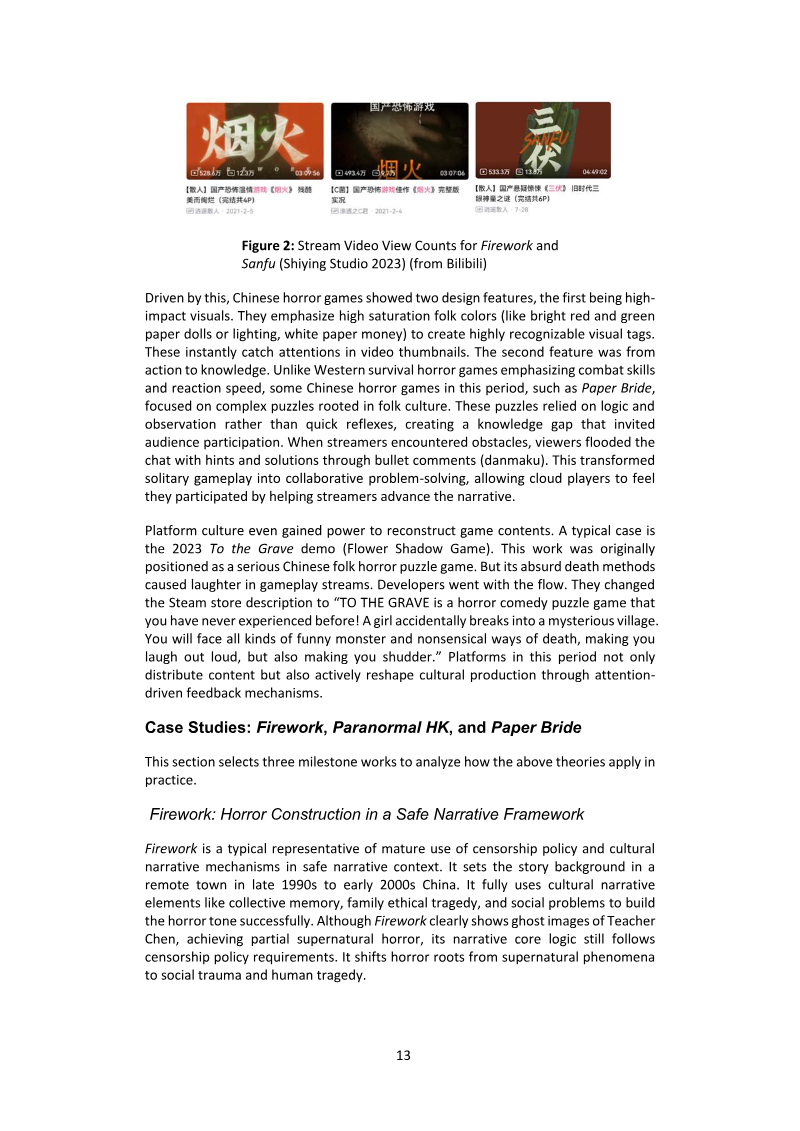
From Restricted to Shared: The Intersectional Pleasure Mechanisms in Chinese Horror Games (2001-2024)
This study examines the evolution of Chinese horror games from 2001 to 2024, arguing that three interacting forces, policy regulation, platform distribution, and cultural narrative, jointly shaped the genre's development.
- The study argues that policy restrictions acted as creative drivers rather than mere obstacles, pushing Chinese horror developers from visual horror toward psychological storytelling built on withheld imagery and decoded meaning.
- The authors coin "restricted pleasure" (tension from withheld explicit imagery) and "strategic pleasure" (satisfaction from decoding concealed meanings) as the core player experiences this design approach produces.
- The period 2001–2024 is divided into three phases: the Dawn period (2001–2016) of underground production and commercial marginalization, the Transition period (2017–2023) of platform-driven change, and the Expansion period (2024 onward) marked by dissatisfaction with formulaic folk-symbol horror.
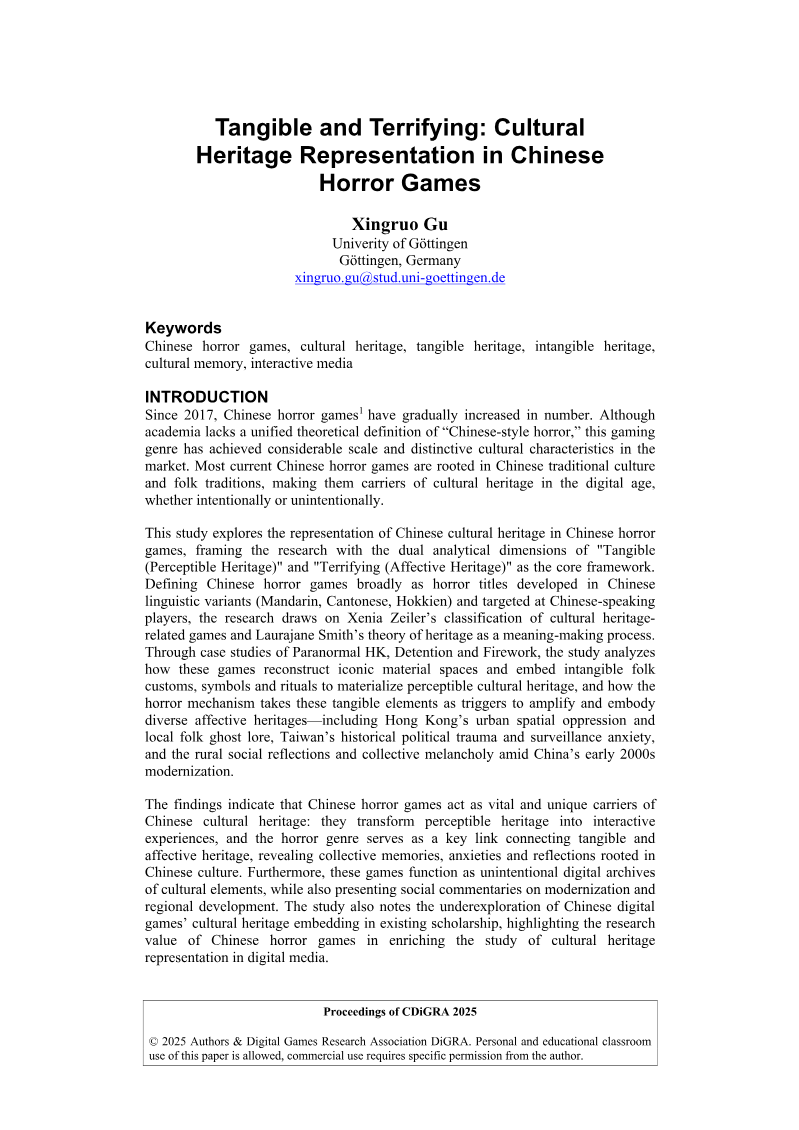
Tangible and Terrifying: Cultural Heritage Representation in Chinese Horror Games
This study examines how Chinese horror games represent cultural heritage, organizing its analysis around two dimensions: "Tangible (Perceptible Heritage)" and "Terrifying (Affective Heritage)."
- Chinese horror games act as significant, if largely unintentional, carriers of Chinese cultural heritage, with the horror genre serving as the key link between tangible (perceptible) heritage and affective heritage.
- The study organizes its analysis around two dimensions: 'Tangible (Perceptible Heritage)', where games reconstruct recognizable material spaces and embed folk customs, symbols, and rituals, and 'Terrifying (Affective Heritage)', where horror mechanics use these elements as triggers to amplify emotional responses.
- Three case studies, Paranormal HK, Detention, and Firework, anchor the analysis of how these games reconstruct real-world spaces and cultural elements.
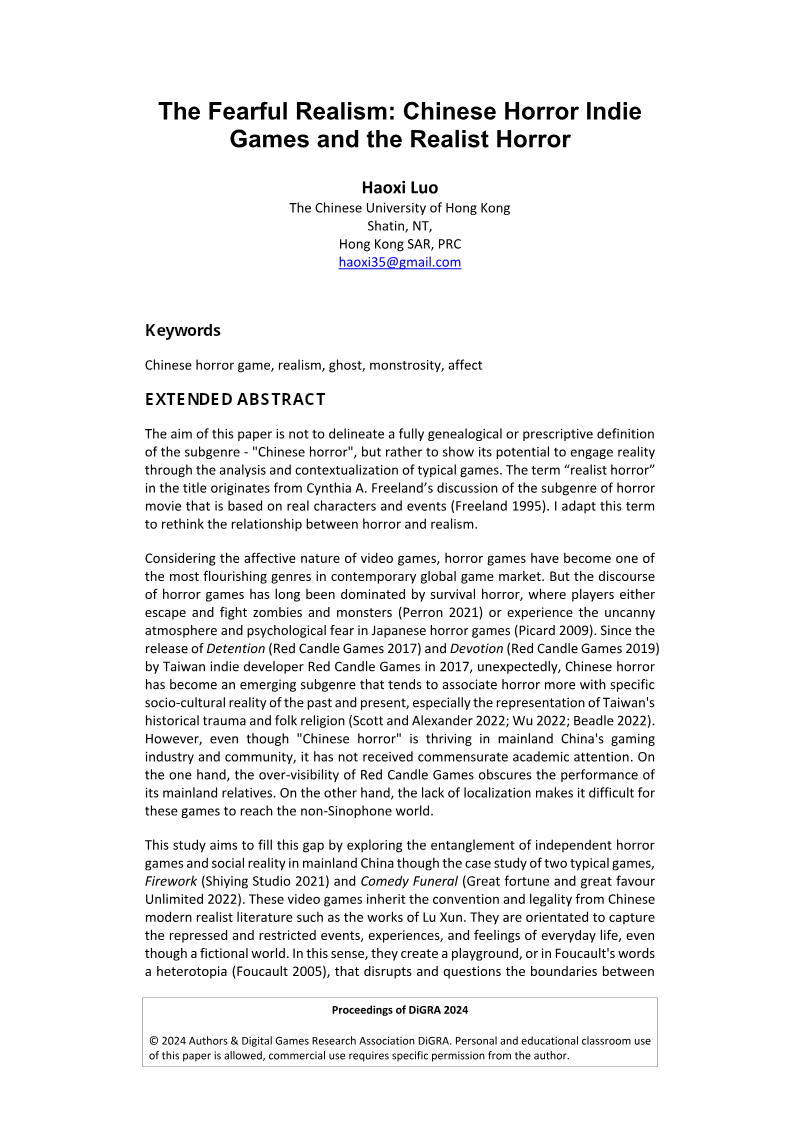
The Fearful Realism: Chinese Horror Indie Games and the Realist Horror
This paper examines Chinese horror indie games as a distinct subgenre that engages directly with social reality, proposing the term "fearful realism" to describe its aesthetic approach.
- The paper proposes "fearful realism" as a term for Chinese horror indie games that use supernatural elements to surface repressed histories and everyday injustices, drawing on Cynthia Freeland's concept of realist horror.
- The analysis centers on two mainland Chinese indie titles: Firework (Shiying Studio, 2021), in which a police officer reinvestigates a mountain village massacre, and Comedy Funeral (Great Fortune and Great Favour Unlimited, 2022), in which a child explores a grandmother's memories of trafficking and forced marriage.
- These games share a gameplay structure of diminished action, minimal combat and escape, simple untimed puzzles, and "archival adventure," in which players reconstruct stories from fragmentary memorabilia.